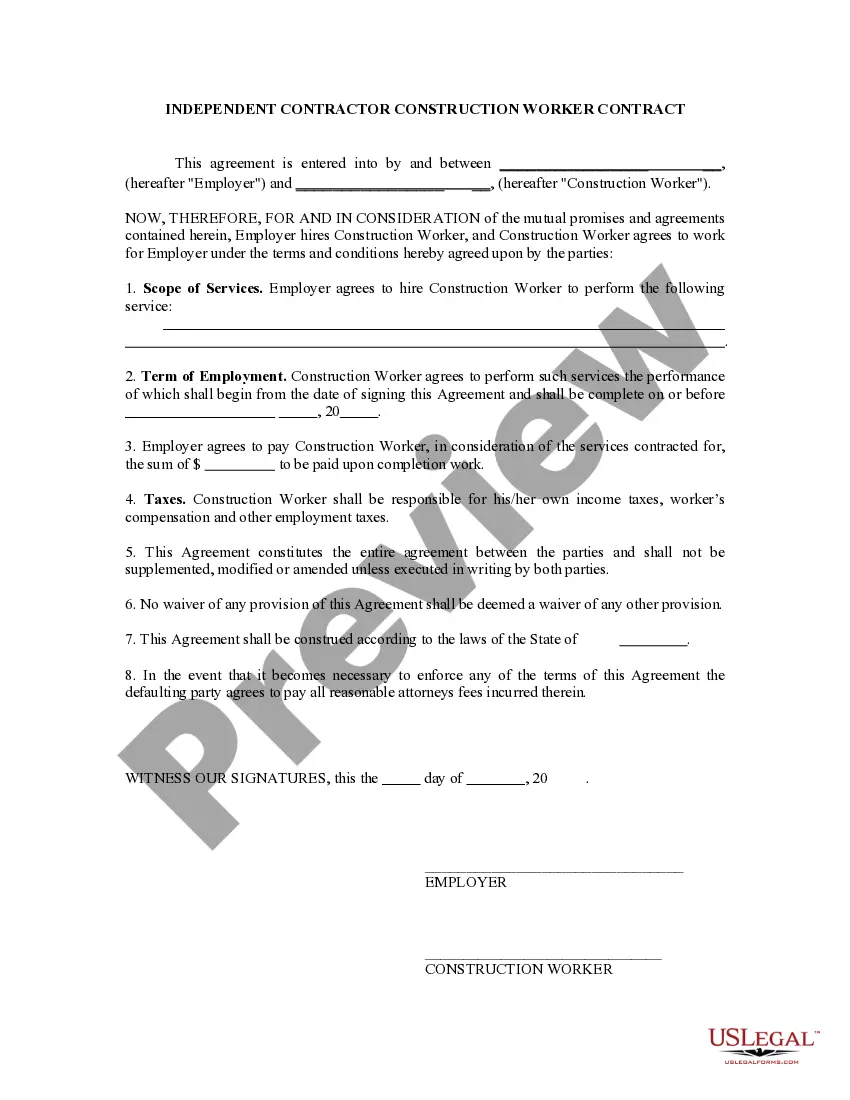
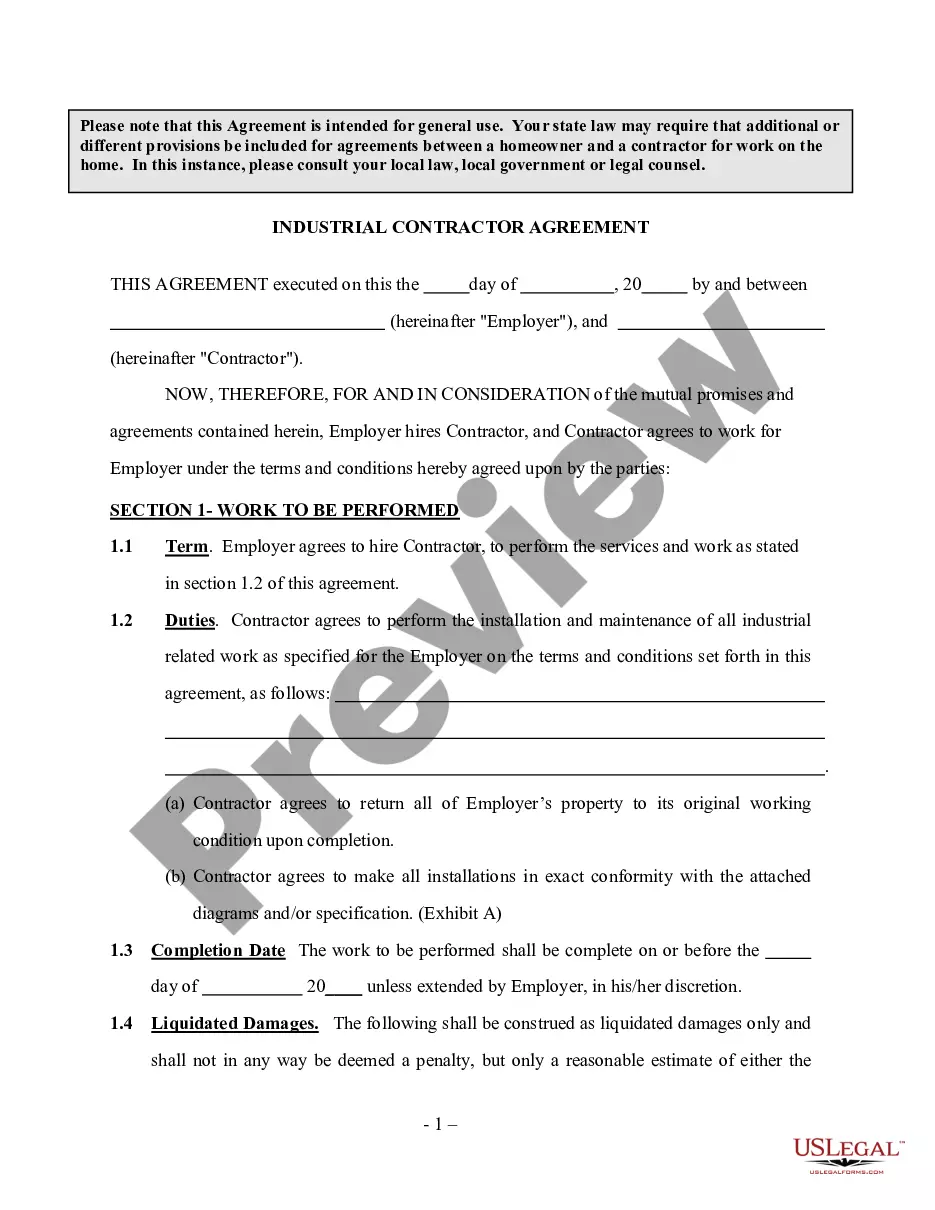
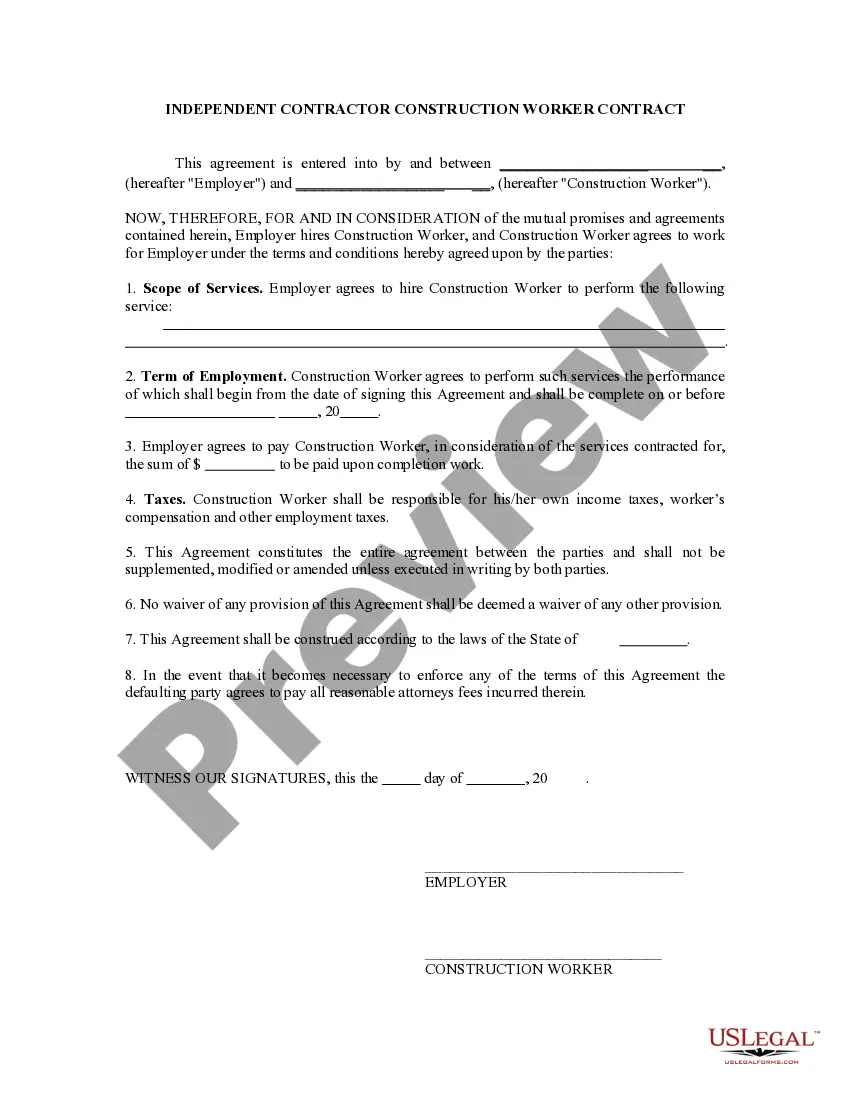
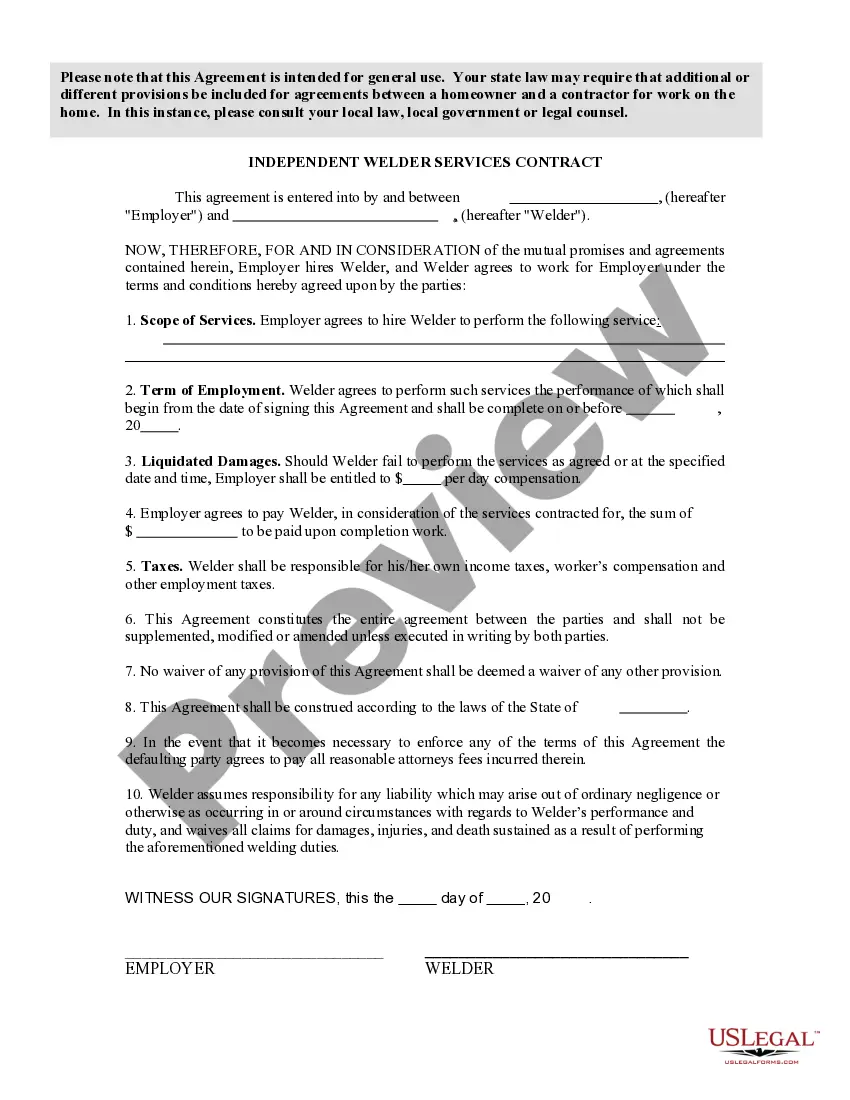
Employer hires a construction worker as an independent contractor to provide various construction help as specified in the Agreement.
Washington Self-Employed Independent Contractor Construction Worker Contract
State:
Multi-State
Control #:
US-INDC-178
Format:
Word;
Rich Text
Instant download
Description
Get your form ready online
Our built-in tools help you complete, sign, share, and store your documents in one place.
Built-in online Word editor
Make edits, fill in missing information, and update formatting in US Legal Forms—just like you would in MS Word.
Export easily
Download a copy, print it, send it by email, or mail it via USPS—whatever works best for your next step.
E-sign your document
Sign and collect signatures with our SignNow integration. Send to multiple recipients, set reminders, and more. Go Premium to unlock E-Sign.
Notarize online 24/7
If this form requires notarization, complete it online through a secure video call—no need to meet a notary in person or wait for an appointment.
Store your document securely
We protect your documents and personal data by following strict security and privacy standards.
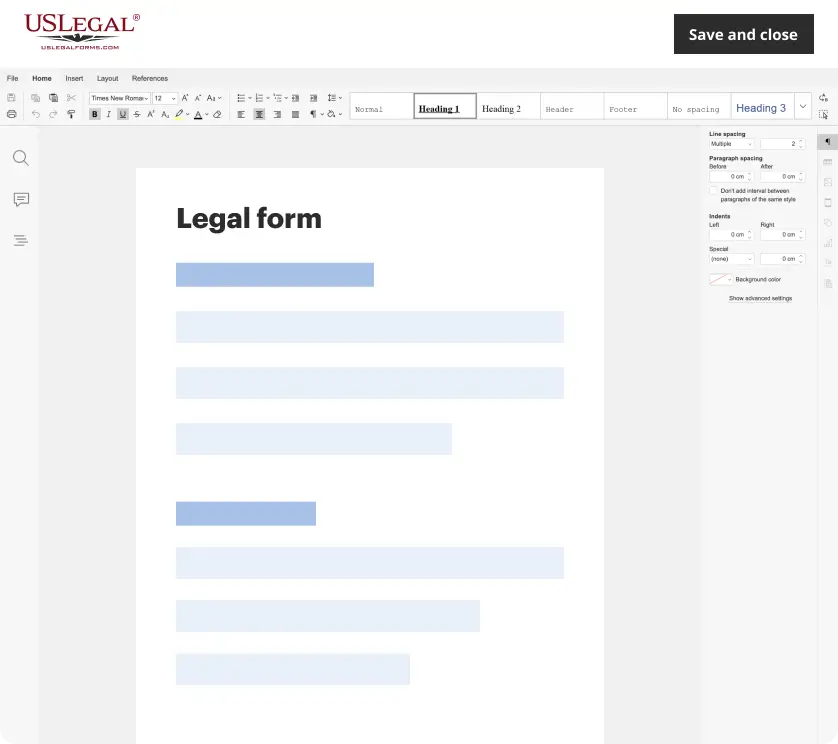
Make edits, fill in missing information, and update formatting in US Legal Forms—just like you would in MS Word.
Download a copy, print it, send it by email, or mail it via USPS—whatever works best for your next step.
Sign and collect signatures with our SignNow integration. Send to multiple recipients, set reminders, and more. Go Premium to unlock E-Sign.

If this form requires notarization, complete it online through a secure video call—no need to meet a notary in person or wait for an appointment.
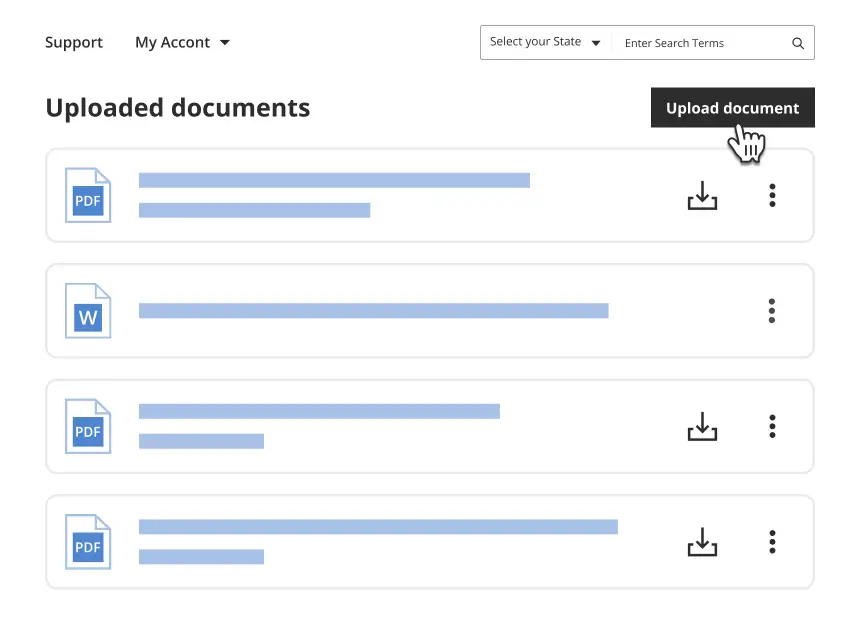
We protect your documents and personal data by following strict security and privacy standards.
Looking for another form?
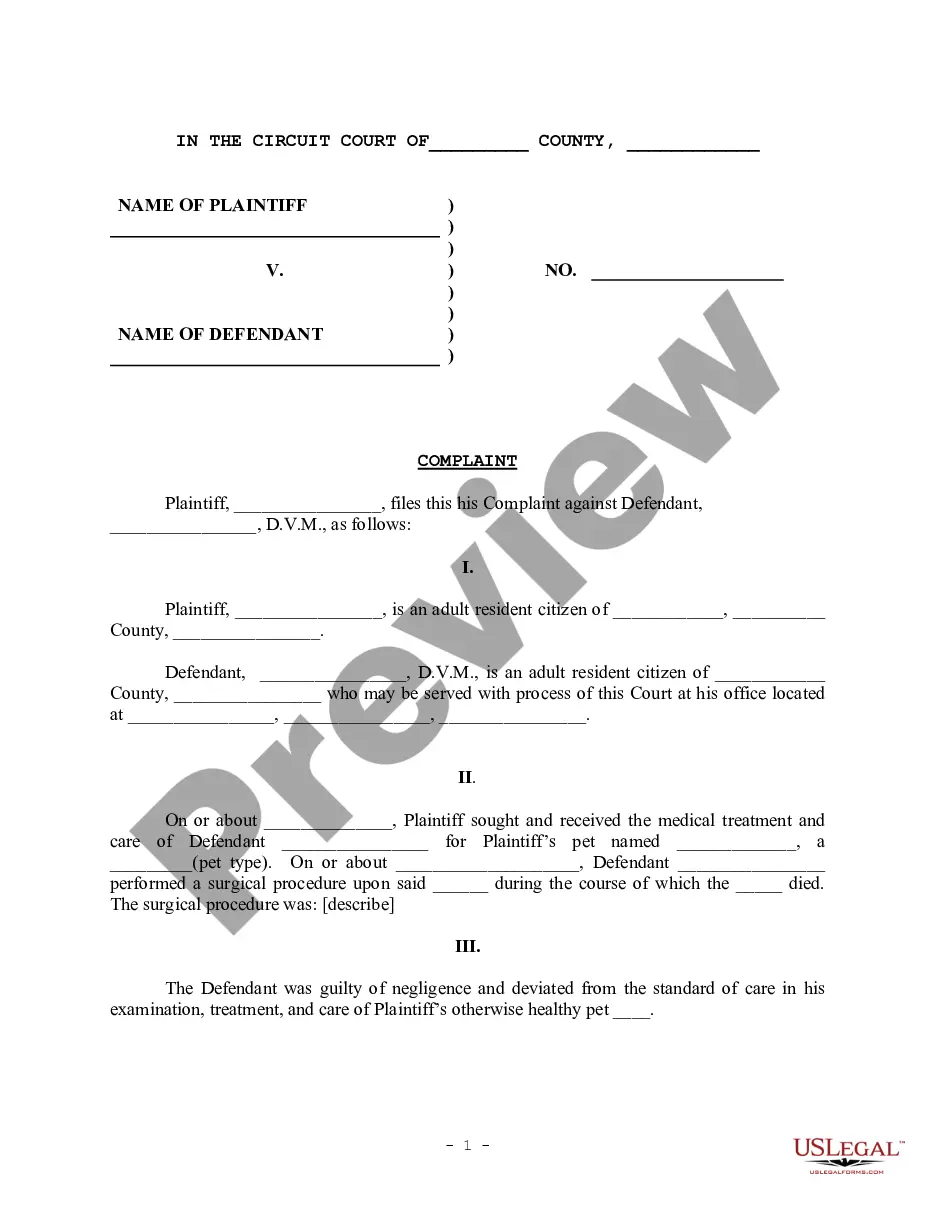





How to fill out Self-Employed Independent Contractor Construction Worker Contract?
US Legal Forms - one of the largest collections of authentic documents in the United States - offers a variety of valid document templates that you can download or print. By using the website, you can access thousands of forms for business and personal purposes, organized by categories, states, or keywords. You can obtain the latest versions of documents such as the Washington Self-Employed Independent Contractor Construction Worker Contract within minutes.
If you already have a monthly membership, Log In and access the Washington Self-Employed Independent Contractor Construction Worker Contract from your US Legal Forms library. The Download button will appear on each document you view. You can access all previously saved documents in the My documents section of your account.
If you are using US Legal Forms for the first time, here are simple instructions to help you get started: Ensure you have selected the correct form for your city/region. Click the Preview button to review the document’s content. Check the document summary to confirm you have selected the right form. If the form does not meet your needs, use the Search box at the top of the screen to find one that does.
Access the Washington Self-Employed Independent Contractor Construction Worker Contract with US Legal Forms, the most extensive collection of authentic document templates. Utilize thousands of professional and state-specific templates that meet your business or personal needs and requirements.
- If you are satisfied with the document, confirm your choice by clicking the Purchase now button.
- Then, select your preferred pricing plan and provide your details to register for the account.
- Process the transaction. Use your credit card or PayPal account to complete the transaction.
- Choose the format and download the document to your device.
- Make modifications. Fill out, edit, and print and sign the saved Washington Self-Employed Independent Contractor Construction Worker Contract.
- Every template you added to your account does not have an expiration date and is yours indefinitely. Therefore, if you wish to obtain or print another copy, simply go to the My documents section and click on the document you need.
Form popularity
FAQ
To fill out an independent contractor form, make sure to start with accurate personal information, including your name and contact details. Specify the nature of your work and the project timeline. Don't forget to include payment terms and any preferences regarding invoicing. For assistance, you can use platforms like US Legal Forms, which offer templates tailored for a Washington Self-Employed Independent Contractor Construction Worker Contract.
Writing an independent contractor agreement begins with outlining the parties involved, including their legal names and addresses. Next, detail the work to be completed, payment schedules, and terms for termination. Clearly define responsibilities, deliverables, and timelines to prevent misunderstandings. Utilizing resources like the US Legal Forms platform can streamline this process, specifically for crafting a Washington Self-Employed Independent Contractor Construction Worker Contract.
An independent contractor typically needs to fill out a W-9 form for tax purposes, providing their Tax Identification Number to the hiring company. This form facilitates correct tax reporting and income disclosure. If you're working under a specific agreement, that contract may also outline any additional forms needed based on the nature of the work. In a Washington Self-Employed Independent Contractor Construction Worker Contract, ensuring proper documentation helps avoid tax complications.
To fill out an independent contractor agreement, start by providing your basic information, including your name, address, and the details of the hiring party. Clearly outline the project details, including the scope of work, payment terms, and deadlines. Additionally, both parties should sign and date the contract to make it legally binding. This process ensures clarity and protection for both parties in a Washington Self-Employed Independent Contractor Construction Worker Contract.
To prove your employment as an independent contractor, you can use various documents. Common proof includes your Washington Self-Employed Independent Contractor Construction Worker Contract, invoices showing payment, and bank statements reflecting your earnings. Additionally, if clients provide letters of engagement or 1099 forms, these can strengthen your employment verification. Consider using platforms like uslegalforms to easily create and manage your contracts and related documents.
Yes, independent contractors file their taxes as self-employed individuals. When you work under a Washington Self-Employed Independent Contractor Construction Worker Contract, you report your earnings on a Schedule C along with your personal tax return. This process allows you to deduct business expenses, which can reduce your taxable income. Understanding your filing responsibilities is key to financial success as an independent contractor.
Typically, you do not issue a 1099 to a construction company if it operates as a corporation or LLC, as these entities are considered separate from their owners. Instead, you should confirm the company's status before deciding on tax reporting. Consulting with a professional can help you navigate these aspects, along with your Washington Self-Employed Independent Contractor Construction Worker Contract.
In Washington, independent contractors generally do not need workers' compensation insurance, but there are exceptions. If they employ others or work in industries where it’s required, they must have coverage. Clarifying these requirements upfront in a Washington Self-Employed Independent Contractor Construction Worker Contract can prevent misunderstandings.
Yes, if you operate as an independent contractor in Washington, you typically need a business license. This ensures compliance with state regulations and enhances your professional credibility. Using the Washington Self-Employed Independent Contractor Construction Worker Contract also helps maintain legal compliance.
Yes, you can 1099 a construction worker if they meet the criteria for being an independent contractor. Typically, this means they work independently and are not classified as employees. Always use a Washington Self-Employed Independent Contractor Construction Worker Contract to define their role clearly.