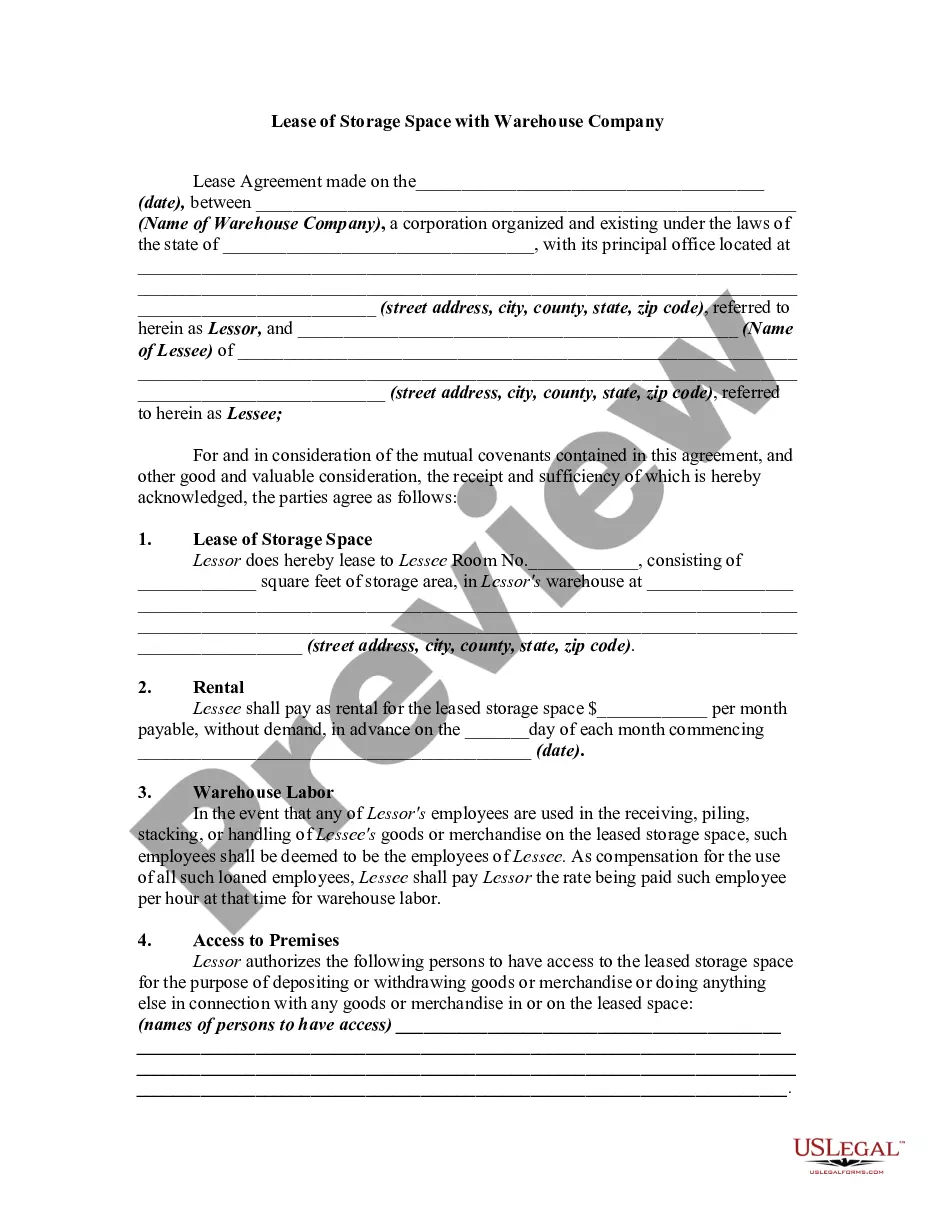
Washington Monthly Cash Flow Plan
Description


Get your form ready online
Our built-in tools help you complete, sign, share, and store your documents in one place.
Make edits, fill in missing information, and update formatting in US Legal Forms—just like you would in MS Word.
Download a copy, print it, send it by email, or mail it via USPS—whatever works best for your next step.
Sign and collect signatures with our SignNow integration. Send to multiple recipients, set reminders, and more. Go Premium to unlock E-Sign.
If this form requires notarization, complete it online through a secure video call—no need to meet a notary in person or wait for an appointment.
We protect your documents and personal data by following strict security and privacy standards.

Make edits, fill in missing information, and update formatting in US Legal Forms—just like you would in MS Word.

Download a copy, print it, send it by email, or mail it via USPS—whatever works best for your next step.

Sign and collect signatures with our SignNow integration. Send to multiple recipients, set reminders, and more. Go Premium to unlock E-Sign.

If this form requires notarization, complete it online through a secure video call—no need to meet a notary in person or wait for an appointment.

We protect your documents and personal data by following strict security and privacy standards.
Looking for another form?






How to fill out Monthly Cash Flow Plan?
You might spend time online searching for the legal document template that complies with the state and federal requirements you need.
US Legal Forms provides a vast selection of legal forms that are reviewed by experts.
You can download or print the Washington Monthly Cash Flow Plan from this service.
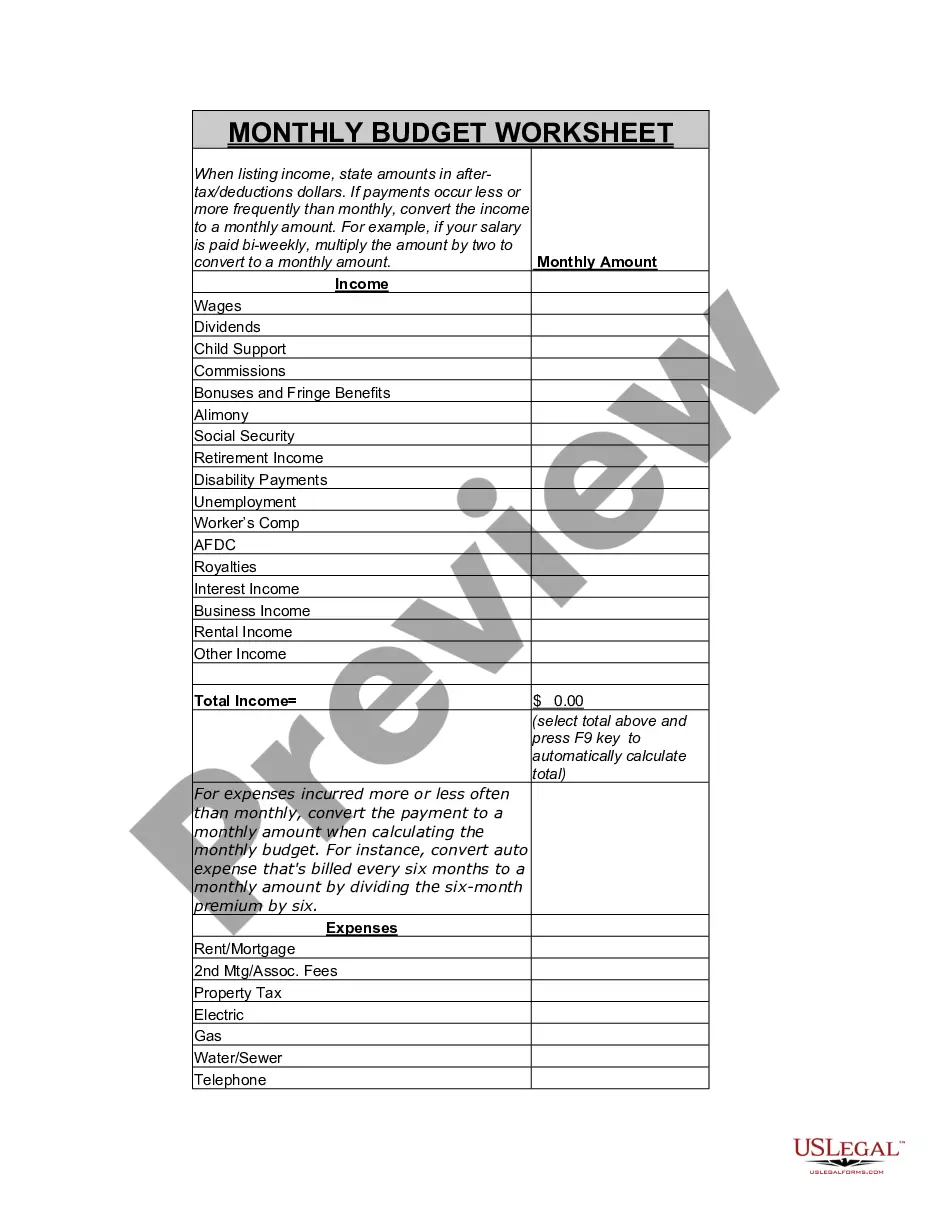
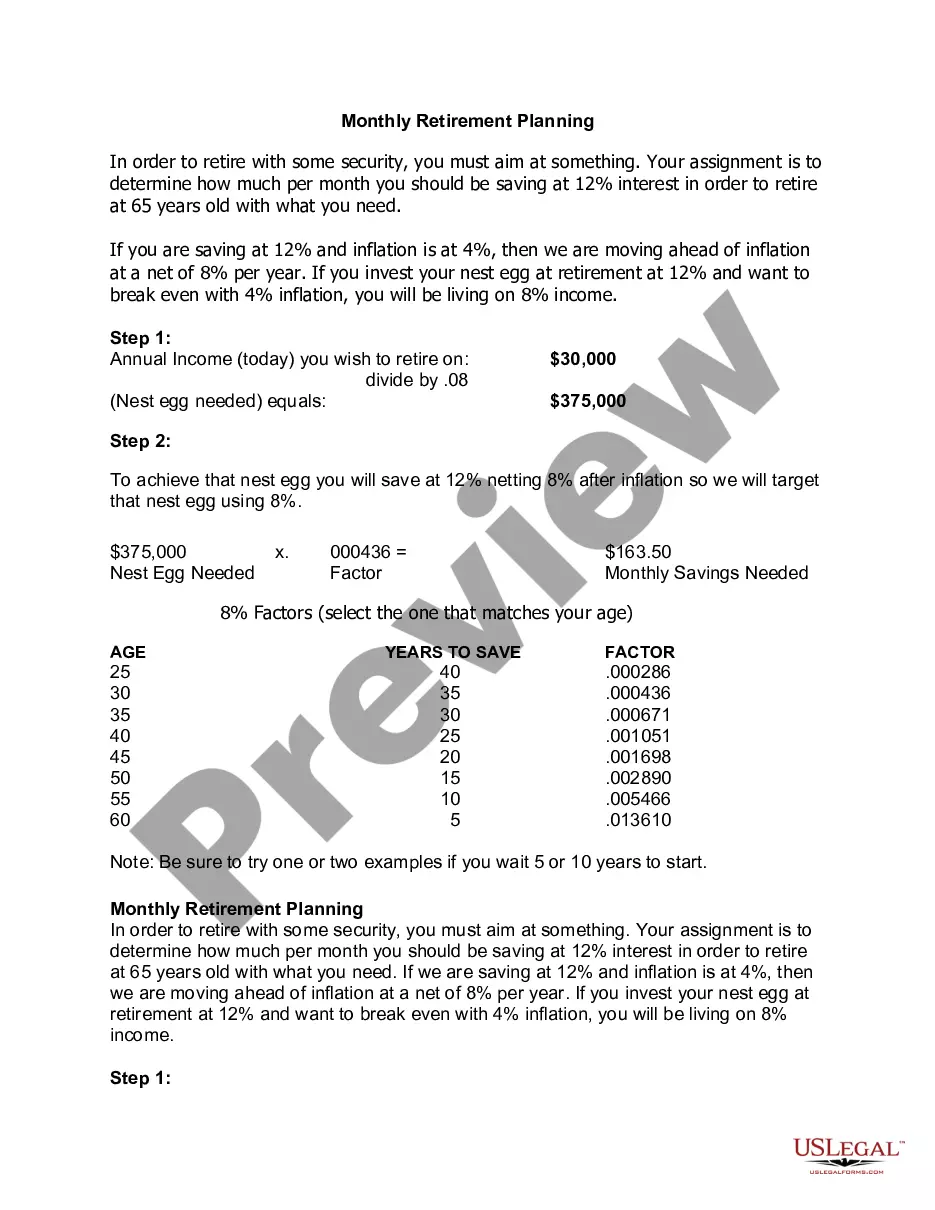
If applicable, make use of the Preview option to look through the document template as well.
- If you possess a US Legal Forms account, you can Log In and click on the Obtain option.
- After that, you can complete, modify, print, or sign the Washington Monthly Cash Flow Plan.
- Every legal document template you obtain is yours forever.
- To get an additional copy of the acquired form, navigate to the My documents tab and click on the respective option.
- If you are using the US Legal Forms website for the first time, follow the simple instructions below.
- First, ensure that you have chosen the correct document template for the area/region of your preference.
- Review the form details to confirm you have selected the appropriate form.
Form popularity
FAQ
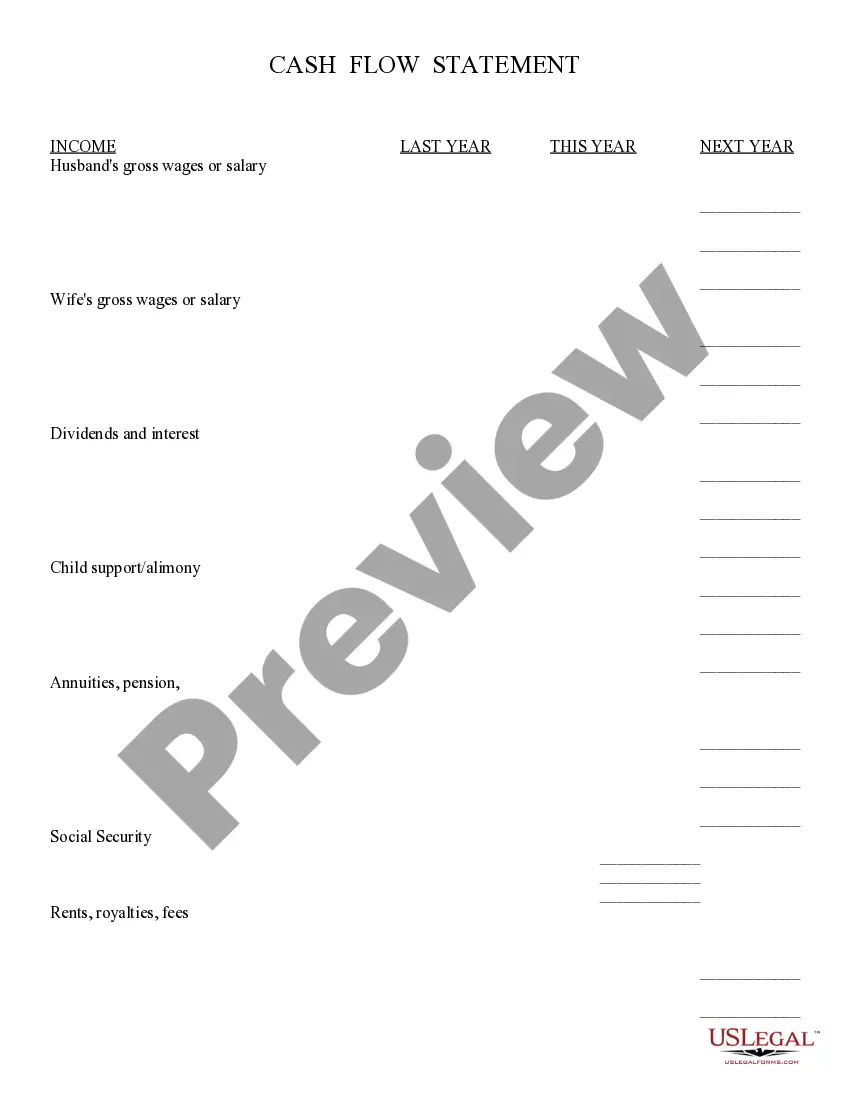
The primary aim of the monthly cash flow report is to present an overview of the financial activity experienced throughout the month. Organizations rely on monthly cash flow statements to closely monitor cash inflows and outflows. Typical users of the cash flow report are CFOs, controllers, and accountants.
Monthly Cash Flow reports are considered essential month-end financial statements and are often used by CFOs and Analysts to review the cash inflows and outflows of the business. Key functionality in this type of report is parameter driven so the figures are presented automatically when the user runs the report.
Basically, any time actual hard cash entered or left the company for any reason, it gets summarized for the year in the statement of cash flow.
Do one month at a time.Enter Your Beginning Balance. For the first month, start your projection with the actual amount of cash your business will have in your bank account.Estimate Cash Coming In. Fill in all amounts you expect to take in during the month.Estimate Cash Going Out.Subtract Outlays From Income.
A cash flow projection estimates the money you expect to flow in and out of your business, including all of your income and expenses. Typically, most businesses' cash flow projections cover a 12-month period. However, your business can create a weekly, monthly, or semi-annual cash flow projection.
The cash flow statement should be prepared on a monthly basis during the first year, on a quarterly basis for the second year, and annually for the third year.
Below are some cash flow management strategies to consider:Pay bills strategically.Choose the right payroll cycle.Negotiate your payments with suppliers.Collect receivables quickly.Manage your credit policies carefully.Use a business credit card.Consider a line of credit.More items...
The cash flow from investing activities is derived by adding all the cash inflows from the sale or maturity of assets and subtracting all the cash outflows from the purchase or payment for new fixed assets or investments.
In some cases, accounting professionals recommend that you prepare a cash flow statement every month because, for many businesses, monthly billings are usual and operating expensesuch as rent and wagesare often paid monthly. In some circumstances, quarterly cash flow statements may work.
Monthly Cash Flow reports are considered essential month-end financial statements and are often used by CFOs and Analysts to review the cash inflows and outflows of the business.