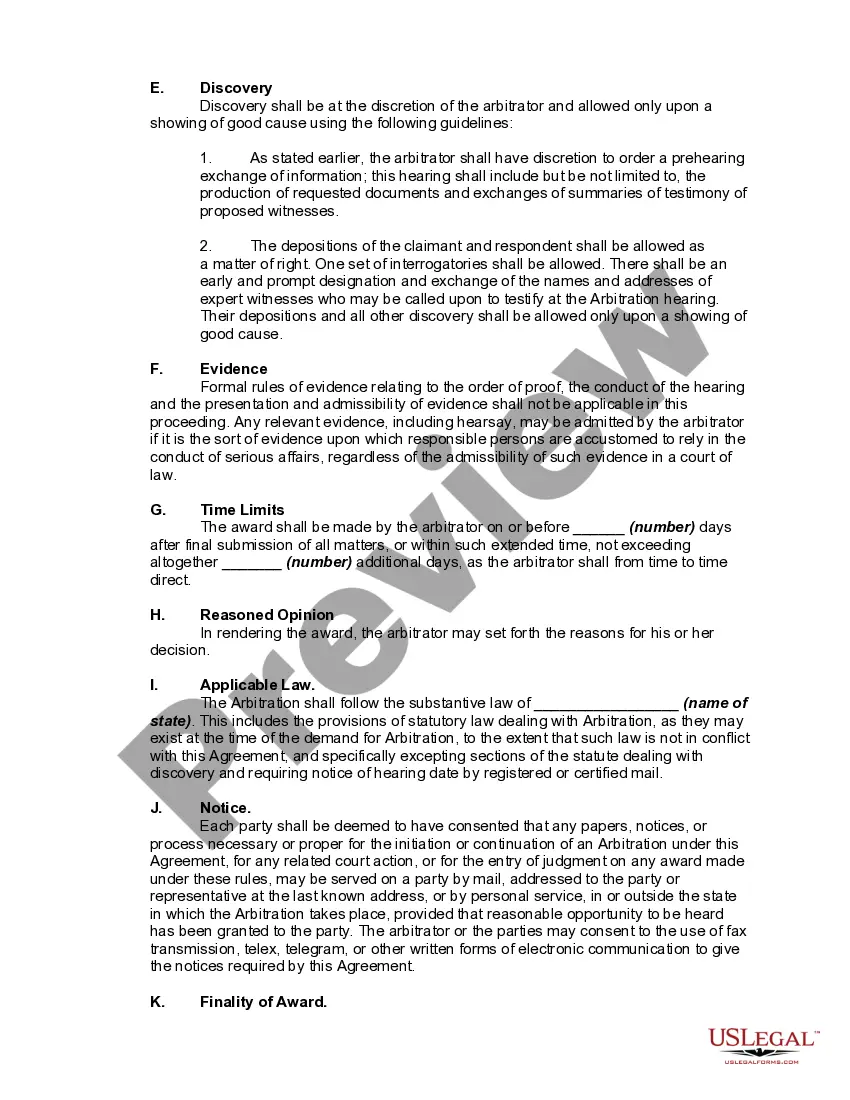
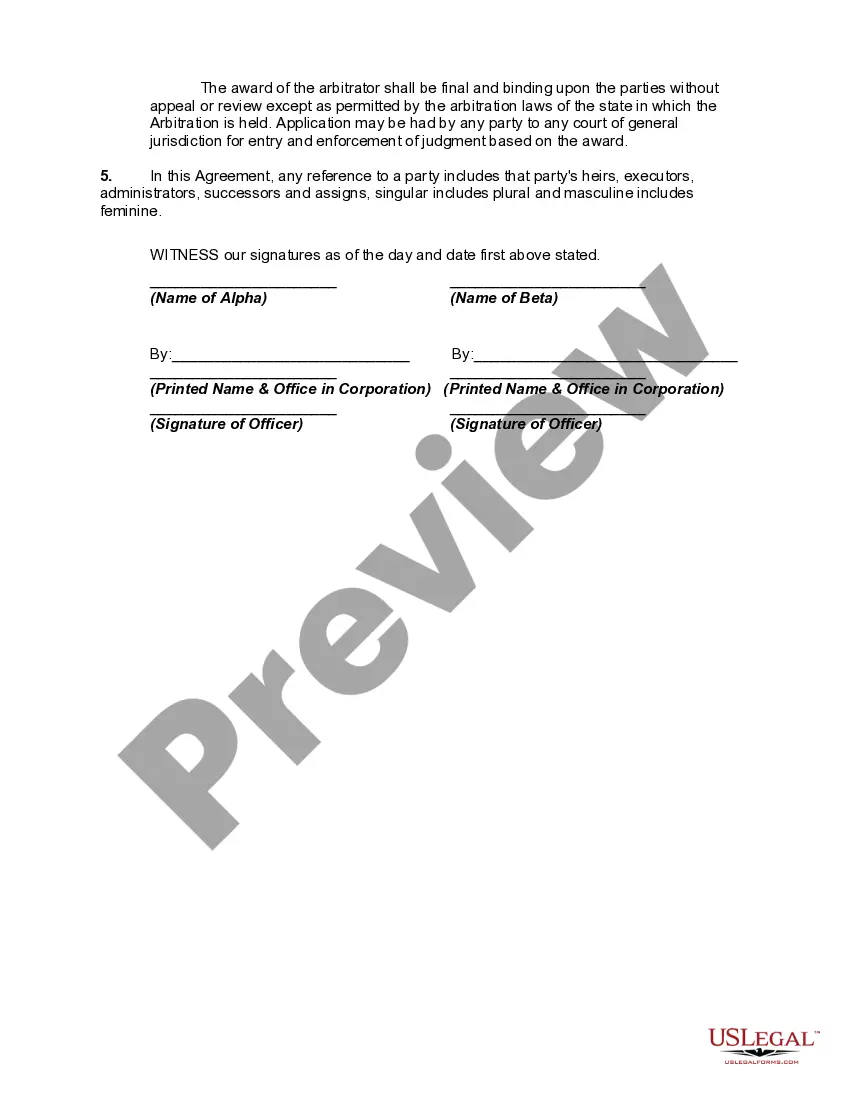
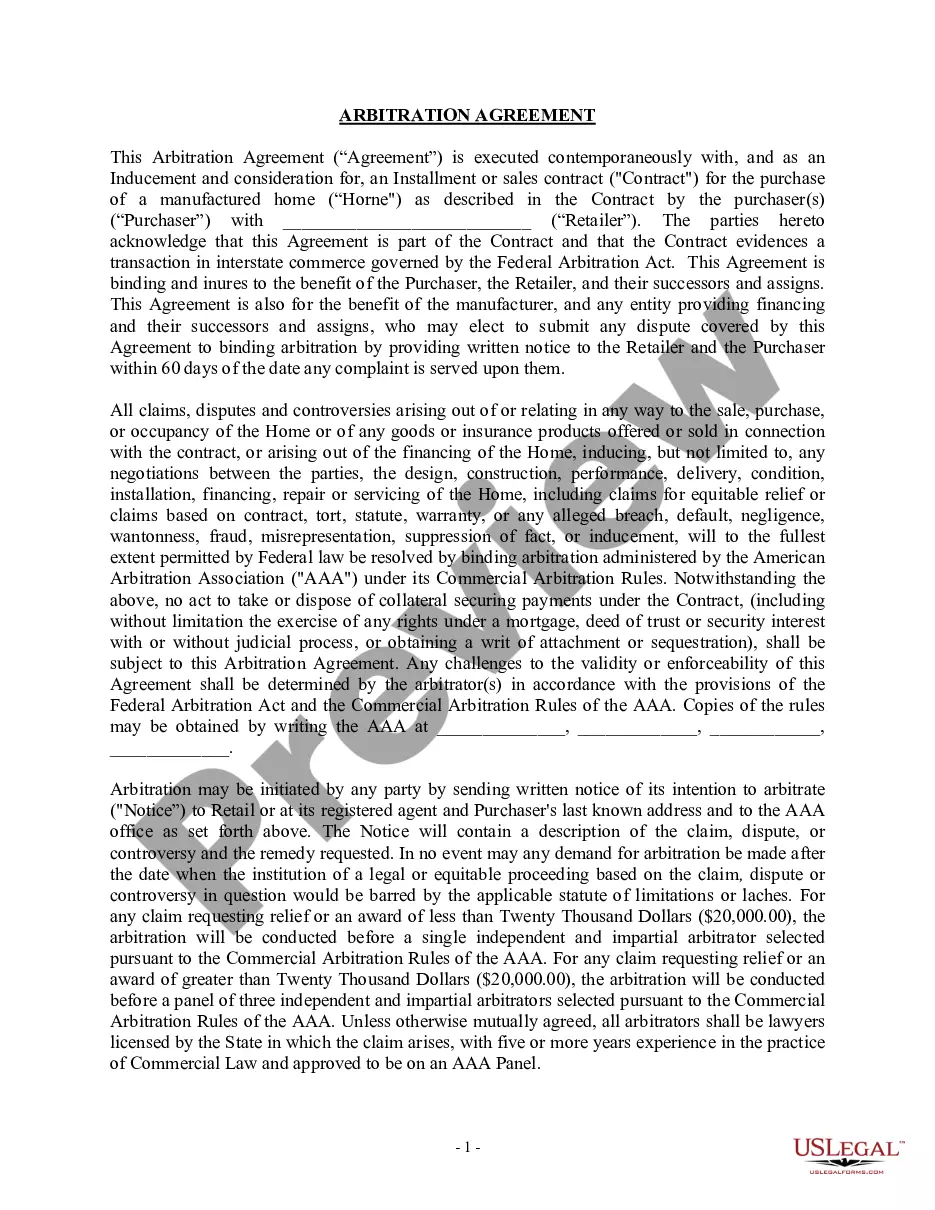
Arbitration is an alternative means of settling a dispute by impartial persons without proceeding to a court trial. It is sometimes preferred as a means of settling a matter in order to avoid the expense, delay, and acrimony of litigation. Discovery is with the discretion of the Arbitrator and there are simplified rules of evidence in arbitration.
Mediation is a non-adversarial method of alternative dispute resolution (ADR) in which a neutral third party helps resolve a dispute. The mediator does not have the power to render a decision on the matter or order an outcome. If a satisfactory resolution cannot be reached, the parties can pursue a lawsuit or arbitration.
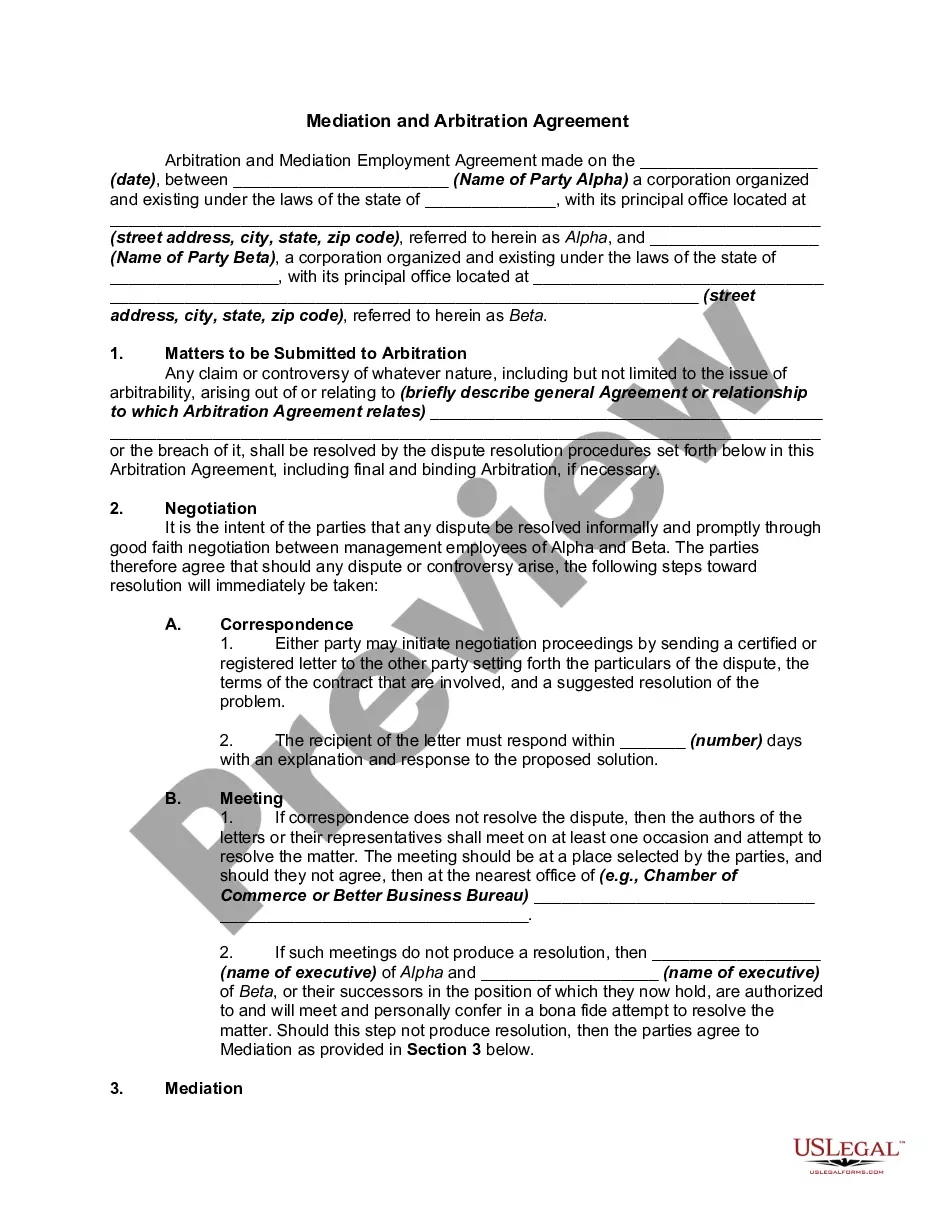
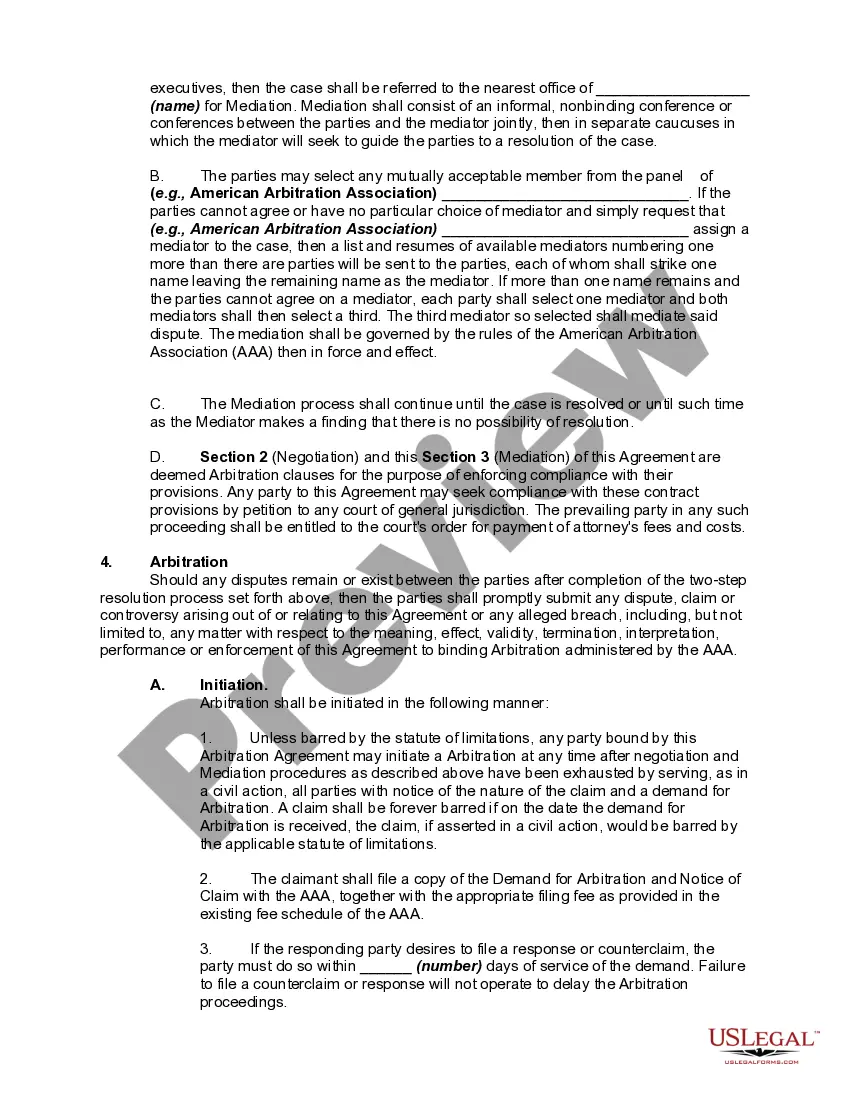
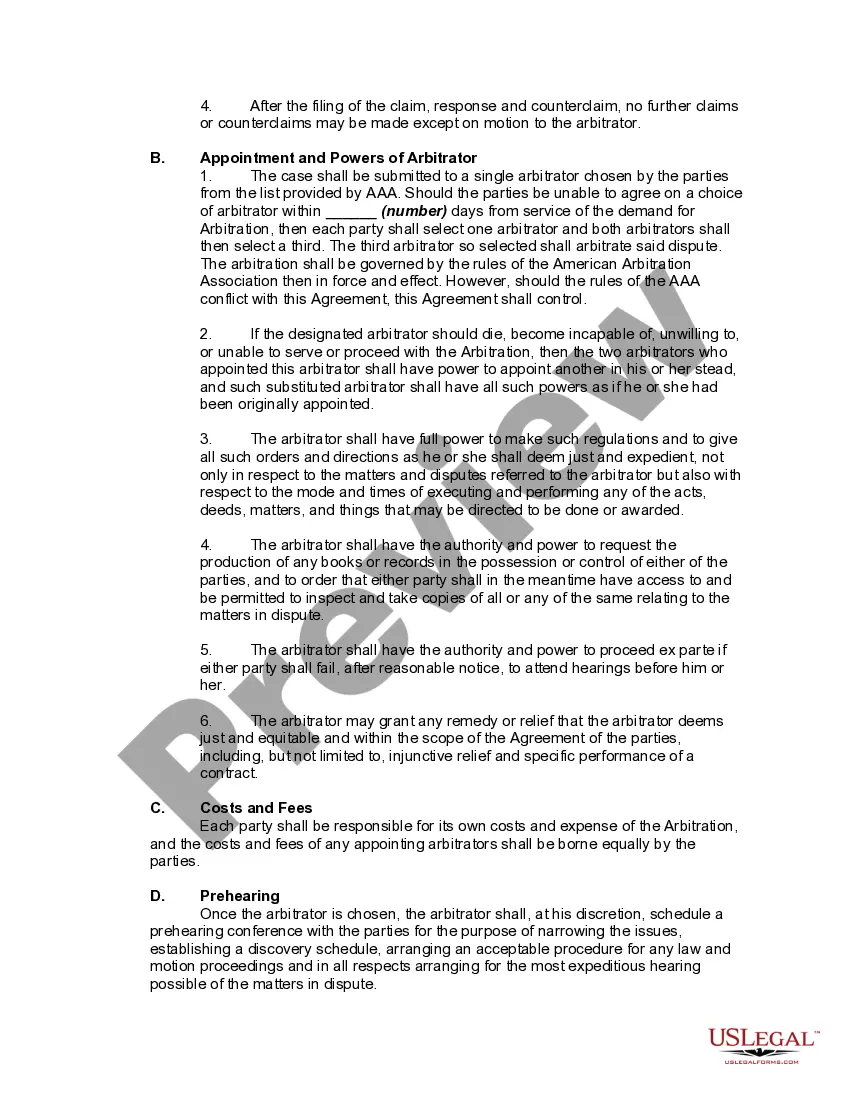
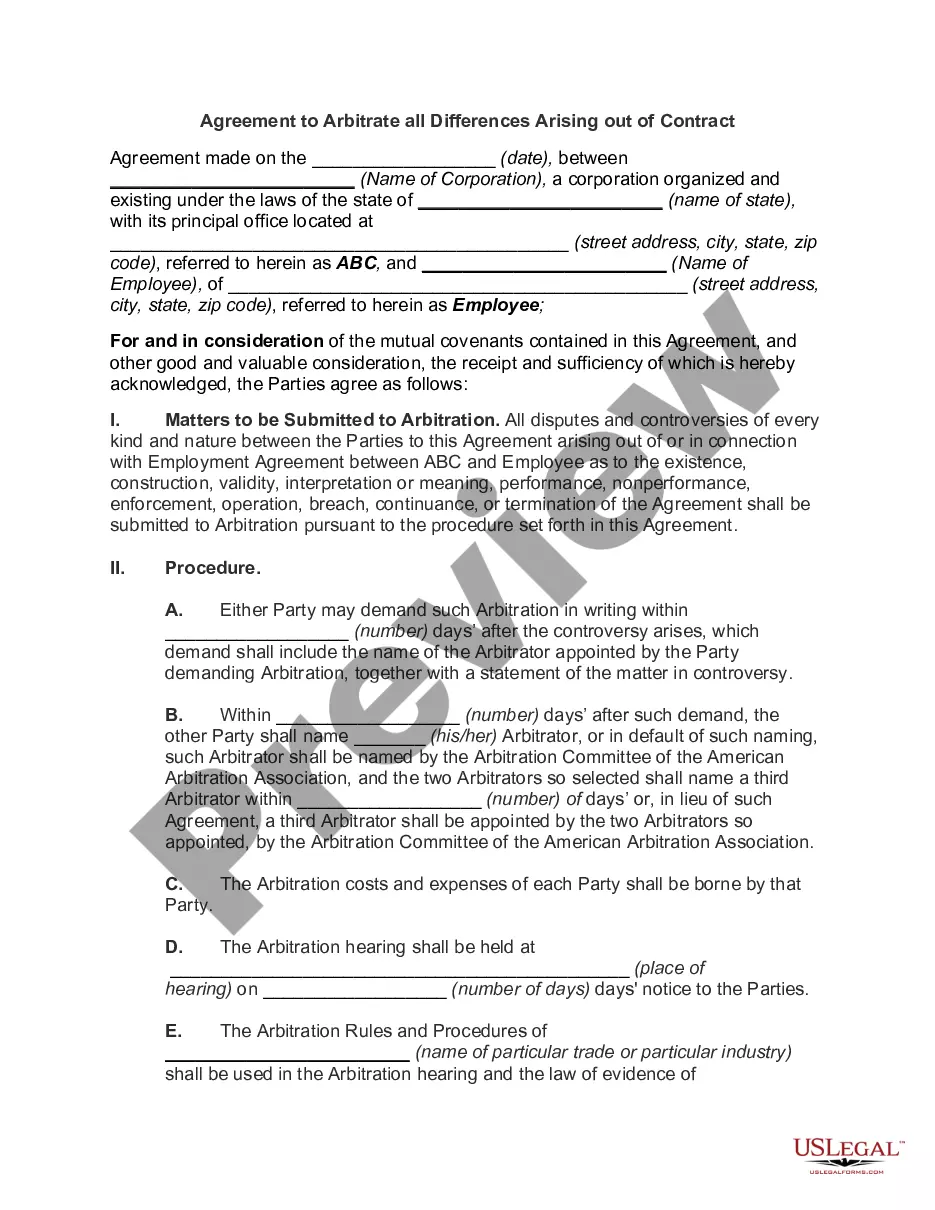
This form provides for negotiation, then mediation if the negotiation fails to resolve the issues. If both negotiation and mediation fail to resolve the issues, the parties arbitrate the dispute.
Washington Mediation and Arbitration Agreement
Category:
State:
Multi-State
Control #:
US-02980BG
Format:
Word;
Rich Text
Instant download
Description
Free preview



How to fill out Mediation And Arbitration Agreement?
You can devote time online looking for the appropriate legal document format that meets the federal and state requirements you have. US Legal Forms provides thousands of legal templates that are reviewed by experts.
You are able to download or print the Washington Mediation and Arbitration Agreement from our platform.
If you already possess a US Legal Forms account, you can Log In and then click the Obtain button. Following that, you can complete, edit, print, or sign the Washington Mediation and Arbitration Agreement. Each legal document template you acquire is yours permanently. To obtain another copy of any purchased document, navigate to the My documents section and click the appropriate button.
Make alterations to your document if necessary. You can complete, edit, sign, and print the Washington Mediation and Arbitration Agreement. Acquire and print thousands of template documents using the US Legal Forms website, which offers the largest selection of legal forms. Utilize professional and state-specific templates to address your business or individual requirements.
- If you are visiting the US Legal Forms website for the first time, follow the simple instructions below.
- First, make sure that you have selected the correct document template for the area/city of your choice. Review the document description to confirm you have chosen the right form. If available, use the Review button to check the document template as well.
- If you wish to obtain another version of the form, use the Search field to find the template that fits your needs and requirements.
- Once you have identified the template you require, click on Buy now to proceed.
- Choose the pricing plan you want, enter your details, and create your account on US Legal Forms.
- Complete the payment. You can use your Visa, Mastercard, or PayPal account to purchase the legal document.
- Select the format of the document and download it to your device.
Form popularity
FAQ
The mediation arbitration combination is an innovative approach that merges mediation and arbitration into a single dispute resolution process. Initially, parties attempt to resolve their differences through mediation, fostering collaborative negotiations. If mediation does not yield a resolution, the matter then transitions to arbitration, where a definitive ruling is made. This dual approach, supported by a Washington Mediation and Arbitration Agreement, can enhance effectiveness and satisfaction for all parties involved.
A mediation and arbitration agreement is a legal document that outlines the processes for resolving disputes through mediation and arbitration. It specifies the rules, procedures, and obligations of the parties involved, ensuring everyone is on the same page. This agreement offers both clarity and an efficient path to resolution, helping you avoid the lengthy litigation process. By using a Washington Mediation and Arbitration Agreement, you can set clear expectations for both mediation and arbitration stages.
Both mediation and arbitration offer alternative dispute resolution methods that can save time and reduce costs compared to traditional litigation. They both involve a neutral party, whether it's a mediator or an arbitrator, to help parties navigate their disputes. Importantly, both methods prioritize confidentiality, allowing you to resolve issues without public scrutiny. Incorporating a Washington Mediation and Arbitration Agreement can ensure clarity and structure in these processes.
The combination of mediation and arbitration, often referred to as 'med-arb,' integrates the benefits of both processes. Initially, parties engage in mediation to seek a mutually acceptable resolution, and if they fail to reach an agreement, they proceed to arbitration, where a binding decision is made. This approach allows for flexibility and fosters a collaborative atmosphere while also providing closure if needed. A Washington Mediation and Arbitration Agreement can effectively outline the terms for this combined process.
In Washington, mediation is a structured process where a neutral third party helps disputing parties reach a voluntary agreement. The mediator facilitates communication, encourages understanding, and guides the conversation. This process empowers you to explore options and reach a resolution tailored to your needs without resorting to court. Utilizing a Washington Mediation and Arbitration Agreement can further streamline this process.
A strong arbitration clause in a Washington Mediation and Arbitration Agreement clearly states that any disputes arising from the agreement will be resolved through arbitration. It should specify details such as the arbitration provider, location, and procedural rules, thus eliminating ambiguity. For instance, stating, 'In the event of a dispute, all parties agree to submit the matter to the American Arbitration Association in Seattle, Washington,' exemplifies a well-crafted clause.
Yes, arbitration agreements, including the Washington Mediation and Arbitration Agreement, are generally enforceable in Washington state. The courts uphold these agreements as long as they meet certain legal standards, such as mutual consent and clarity of terms. Thus, having a well-structured arbitration agreement can provide both parties with a reliable framework for resolving disputes without resorting to litigation.
Drafting a Washington Mediation and Arbitration Agreement requires clarity and precision. Start by identifying the parties involved, then outline the specific disputes that will be subject to arbitration. It's critical to include details about the arbitration process, including rules, timeline, and how arbitrators will be chosen. This thoughtful approach ensures that both parties understand and agree to the terms, reducing the risk of future conflicts.
The process for arbitration typically includes five essential steps. First, parties file a request for arbitration, which outlines the dispute. Next, they select an arbitrator or a panel. Following this, both parties exchange information and evidence. Then, the arbitration hearing takes place, where both sides present their case. Finally, the arbitrator issues a written decision, resolving the dispute in accordance with the Washington Mediation and Arbitration Agreement.
For a Washington Mediation and Arbitration Agreement to be valid, it must demonstrate mutual consent between the parties, usually through signatures. Additionally, the terms of the agreement should be clear and not ambiguous, covering essential aspects like the arbitration process and dispute resolution. Both parties must also enter the agreement voluntarily, without any coercion or duress.