Washington Notice of Intent to Vacate at End of Specified Lease Term from Tenant to Landlord for Residential Property
What this document covers
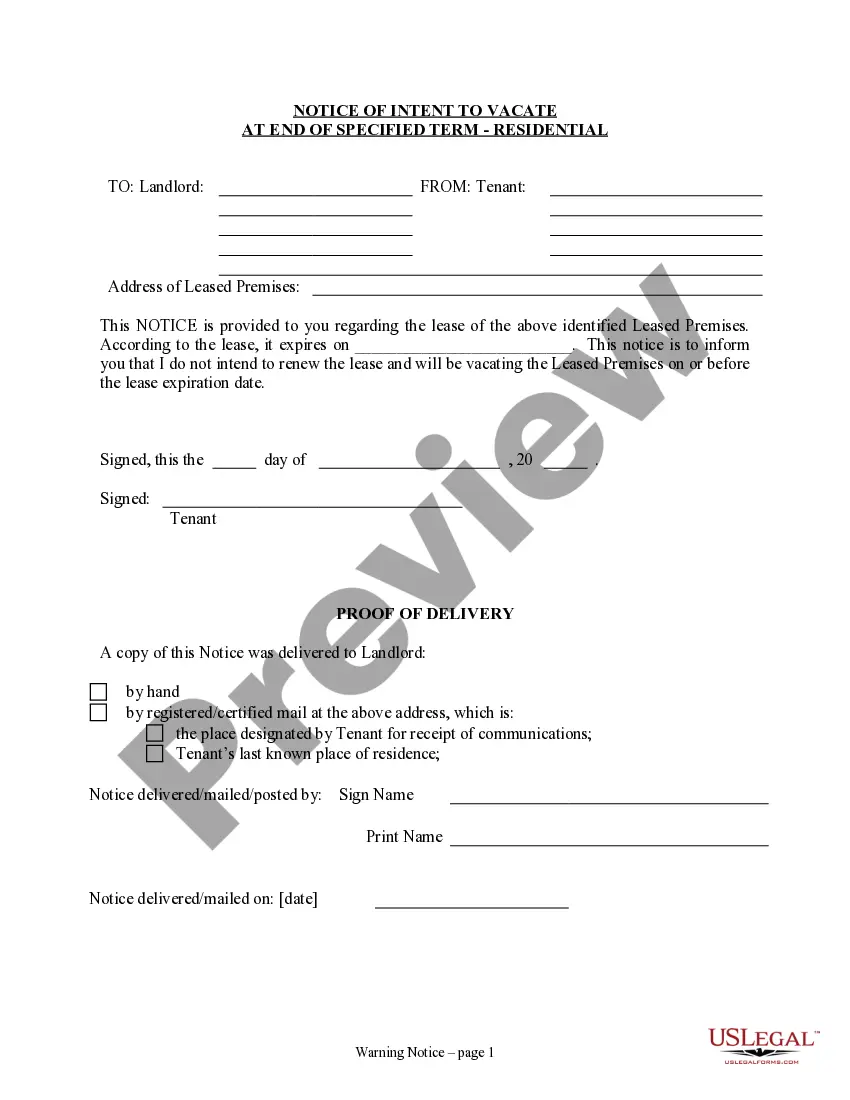
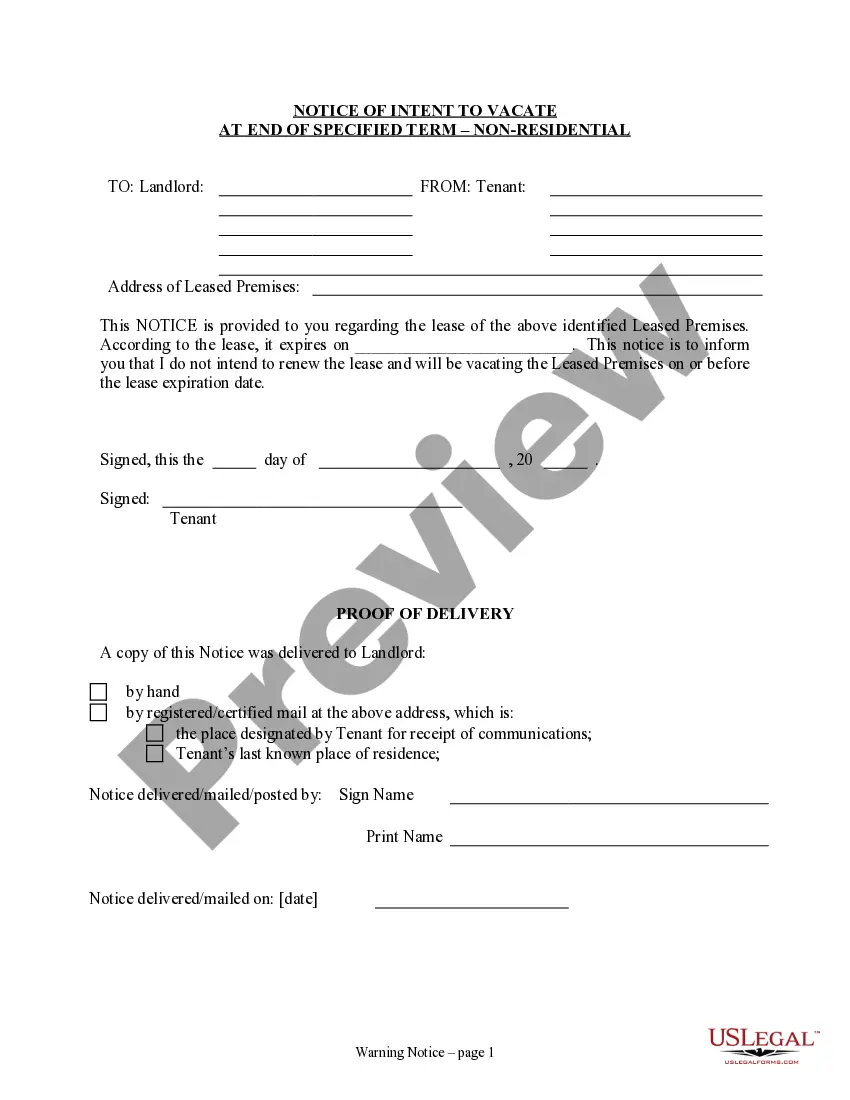
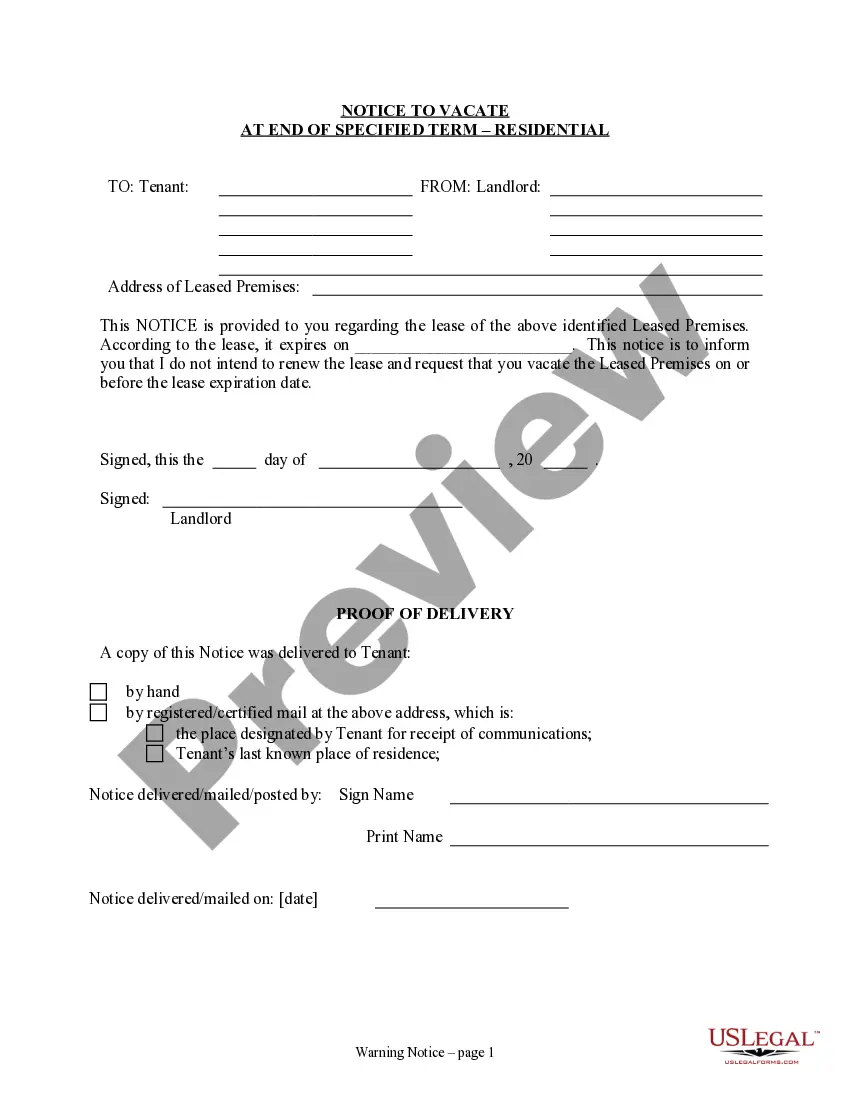
The Notice of Intent to Vacate at End of Specified Lease Term from Tenant to Landlord for Residential Property is a legal document used by tenants who wish to notify their landlord of their intention to leave a rented property at the end of a specified lease term. This form is particularly useful for lease agreements that have a defined expiration date, differentiating it from lease termination notices that might require more detailed explanations or conditions. By using this form, tenants can clearly communicate their plans without needing to explain why they will not be renewing their lease.
Main sections of this form
- Identification of parties: Names of the tenant and landlord are included.
- Description of the leased property: The address of the rental unit is specified.
- Lease expiration date: Clearly outlines when the current lease ends.
- Statement of intent: The tenant declares their intention to vacate the property.
- Signature section: Requires the tenant's signature and date of the notice.
- Proof of delivery section: Details how the notice was delivered to the landlord.
Common use cases
This form should be used when a tenant is nearing the end of a lease agreement with a specific expiration date and does not wish to renew the lease. Typical scenarios may include moving due to job changes, purchasing a new home, or simply choosing to seek other rental options. It is essential to provide this notice in a timely manner to ensure a smooth transition and avoid potential misunderstandings with the landlord.
Who should use this form
- Residential tenants planning to vacate once their specified lease term ends.
- Tenants who have confirmed their decision not to renew the lease.
- Individuals seeking a formal method to notify landlords about their intention to vacate.
How to complete this form
- Identify the parties: Enter the names of the tenant and landlord.
- Specify the property: Fill in the address of the leased premises.
- Enter the lease expiration date: Clearly state when the current lease term ends.
- State intent to vacate: Indicate that you will be vacating the property by the lease expiration date.
- Sign and date the notice: Ensure you include your signature and the date of completion.
- Deliver the notice: Use the proof of delivery section to note how you provided this notice to the landlord.
Notarization guidance
Notarization is not commonly needed for this form. However, certain documents or local rules may make it necessary. Our notarization service, powered by Notarize, allows you to finalize it securely online anytime, day or night.
Get your form ready online
Our built-in tools help you complete, sign, share, and store your documents in one place.
Make edits, fill in missing information, and update formatting in US Legal Forms—just like you would in MS Word.
Download a copy, print it, send it by email, or mail it via USPS—whatever works best for your next step.
Sign and collect signatures with our SignNow integration. Send to multiple recipients, set reminders, and more. Go Premium to unlock E-Sign.
If this form requires notarization, complete it online through a secure video call—no need to meet a notary in person or wait for an appointment.
We protect your documents and personal data by following strict security and privacy standards.
Make edits, fill in missing information, and update formatting in US Legal Forms—just like you would in MS Word.
Download a copy, print it, send it by email, or mail it via USPS—whatever works best for your next step.
Sign and collect signatures with our SignNow integration. Send to multiple recipients, set reminders, and more. Go Premium to unlock E-Sign.

If this form requires notarization, complete it online through a secure video call—no need to meet a notary in person or wait for an appointment.
We protect your documents and personal data by following strict security and privacy standards.
Common mistakes to avoid
- Failing to deliver the notice in a timely manner according to lease terms.
- Not providing complete information about the property or parties involved.
- Omitting the signature or date from the notice.
- Not retaining a copy of the notice for personal records.
Benefits of using this form online
- Convenience: Easily download and complete the form from anywhere.
- Editability: Fill out the form at your own pace and make necessary adjustments.
- Reliability: Access templates prepared by licensed attorneys to ensure legal compliance.
Legal use & context
- This form serves as a legally binding notification to the landlord regarding the tenant's intent to vacate.
- Failure to use this form or notice might lead to misunderstandings or disputes regarding the lease end date.
- Using an official form helps protect the tenant's rights and establishes clear communication with the landlord.
Quick recap
- The form is essential for notifying a landlord about intent to vacate at the end of a defined lease term.
- It provides clear documentation that can be referenced if any disputes arise.
- Completing the form correctly helps ensure a smooth move-out process.
Looking for another form?
Form popularity
FAQ
Explain the Situation Tell your tenant in straightforward terms what the problem is, and explain that they cannot stay on the property any longer. Describe the Consequences Calmly explain that they will be evicted with necessary court orders if they remain on the property.
A holdover tenant is a tenant who stays in the rental unit after the lease expires. If the tenant continues to pay rent, the tenancy essentially becomes a month-to-month tenancy. A holdover tenant is legally allowed to stay in the rental unit as long as the landlord takes no action to remove them.
The date you're submitting your notice. The date you're moving. Information on your current home the address and the landlord's name. A statement declaring that you intend to leave the home. A straightforward statement that you're providing this letter, 30 days out, per your lease agreement.
1 month's notice if your tenancy runs from month to month. 4 weeks' notice if your tenancy runs from week to week. If you live with your landlord. You don't have to give a set amount of notice (unless your tenancy agreement says otherwise).
Weekly tenancyThe tenant or landlord must give one week of notice.
A landlord can simply give you a written notice to move, allowing you 30 days (60 days if you've lived in the rental a year or more) as required by California law and specifying the date on which your tenancy will end.
A termination notice has to give the tenant 14 clear days before the tenant has to leave the residential premises. The day the notice is served on the tenant and the day the tenant moves out do not count as part of the 14 days.
At-will tenancy is subject to the will of both the tenant and the landlord (hence the name). In other words, the tenant can choose to leave and stop paying rent at any time, and the landlord can choose to stop accepting rent and ask the tenant to leave at any time.
If you are a month-to-month tenant, you must give notice to your landlord in writing at least 20 days before the last day of the month that you want to move out. For example, if you wanted to move out by July 31, you must give notice no later than July 11.