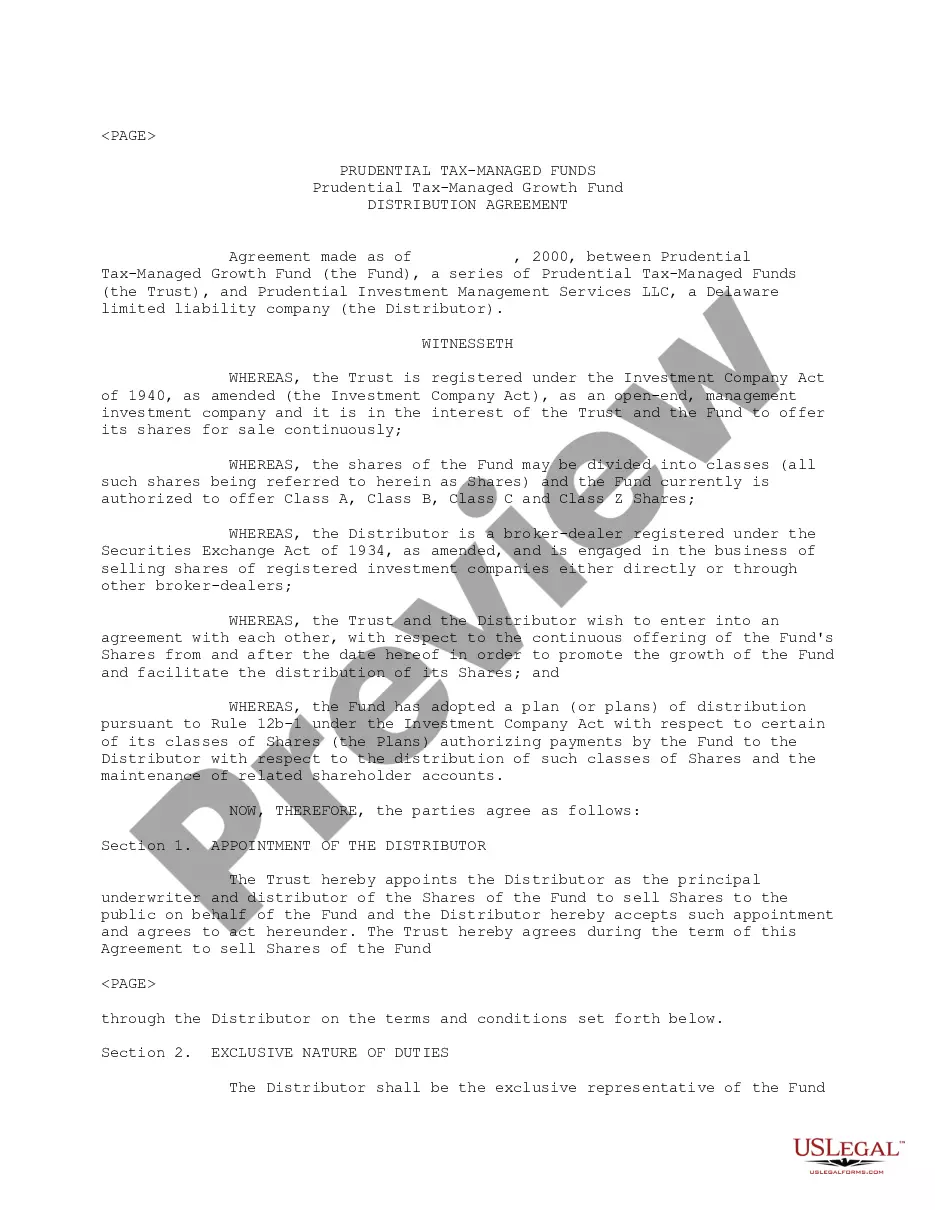
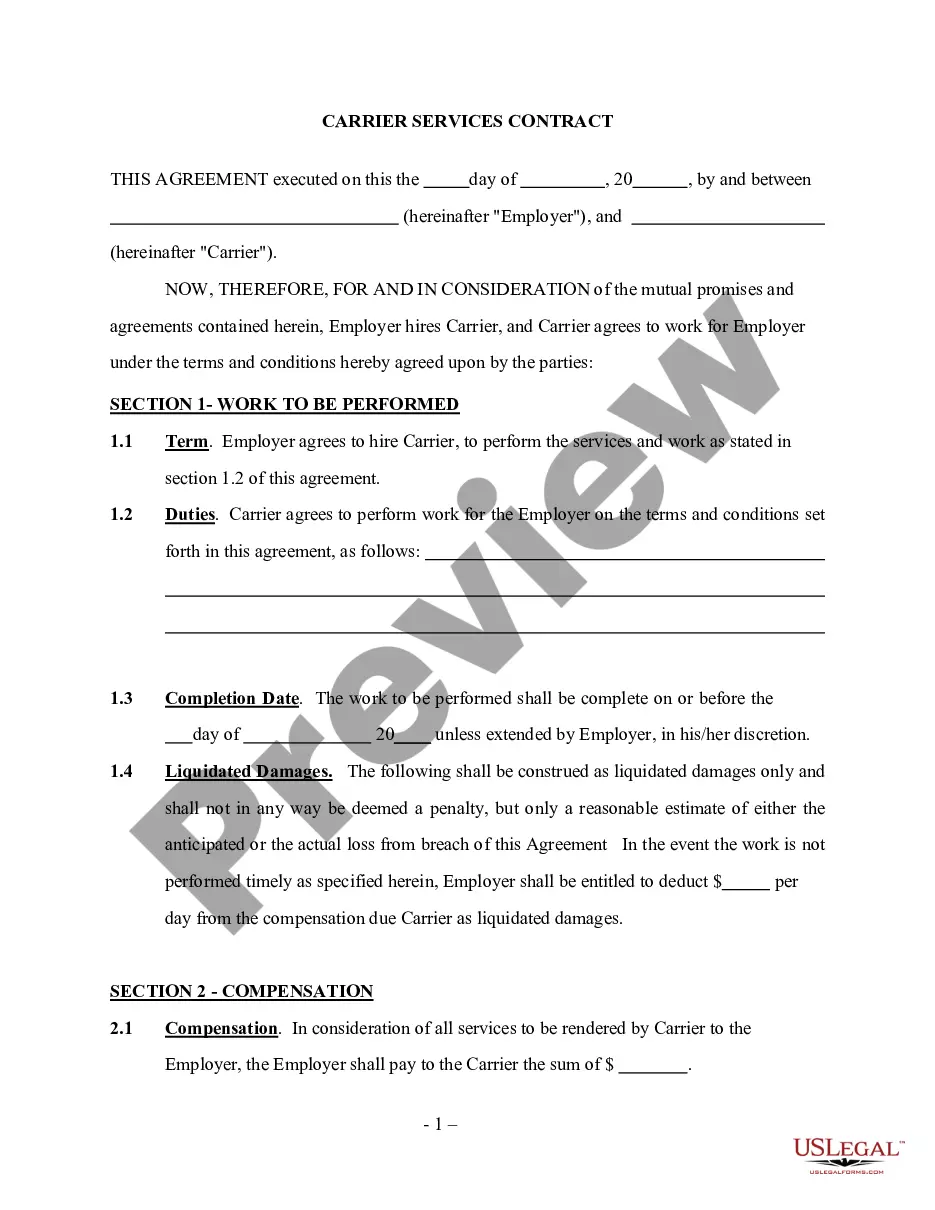
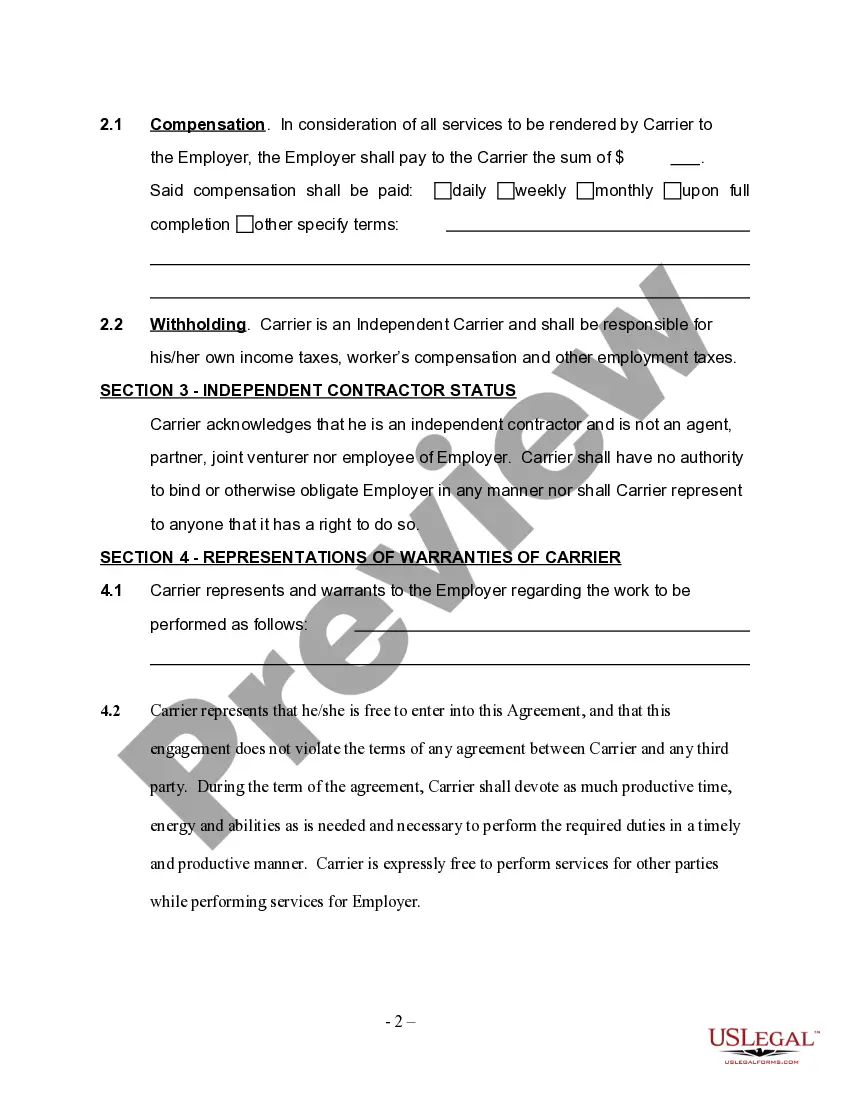
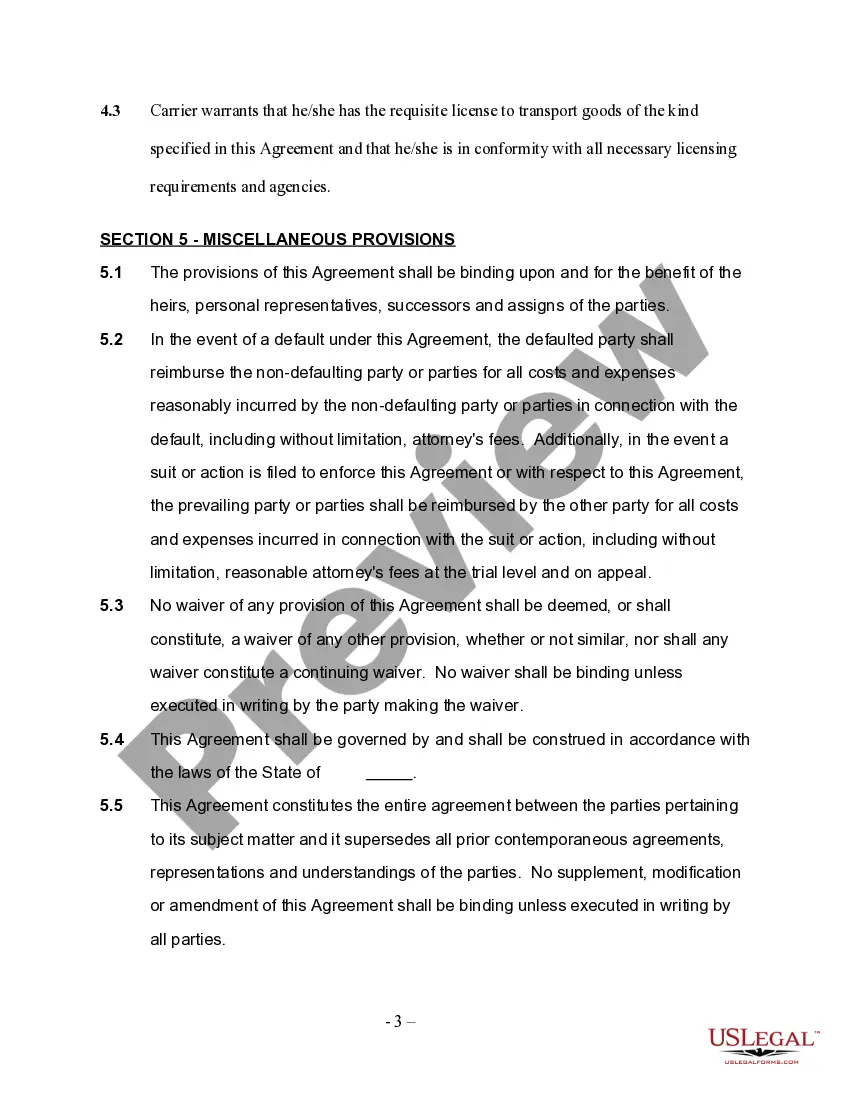
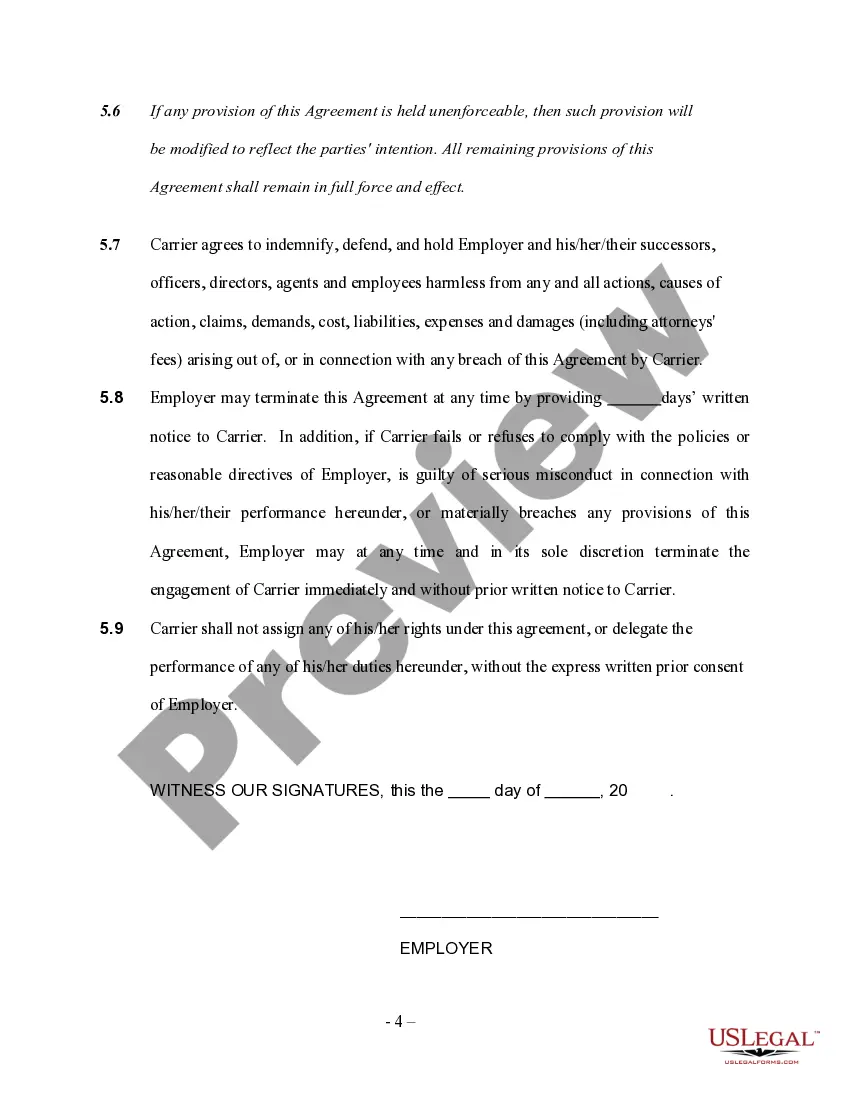
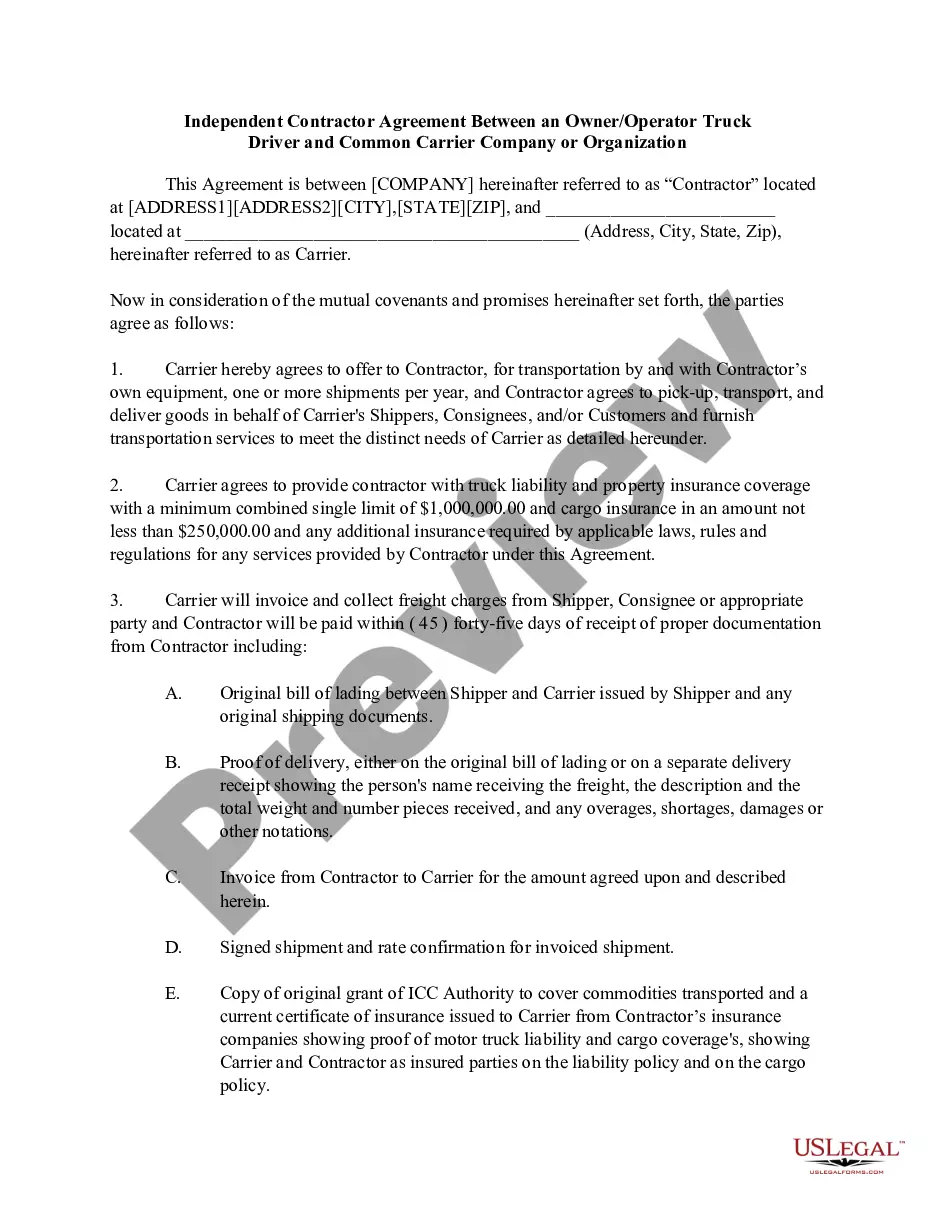
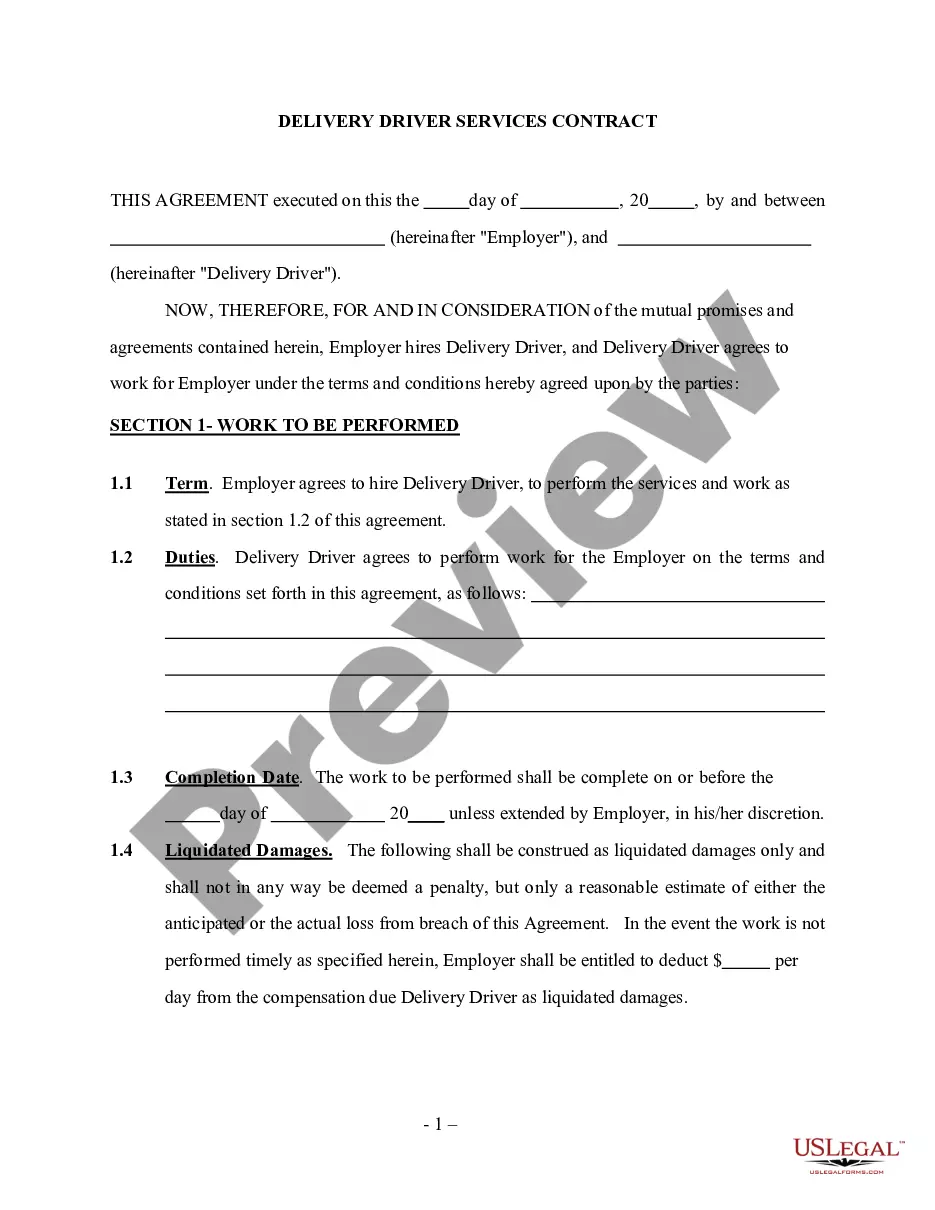
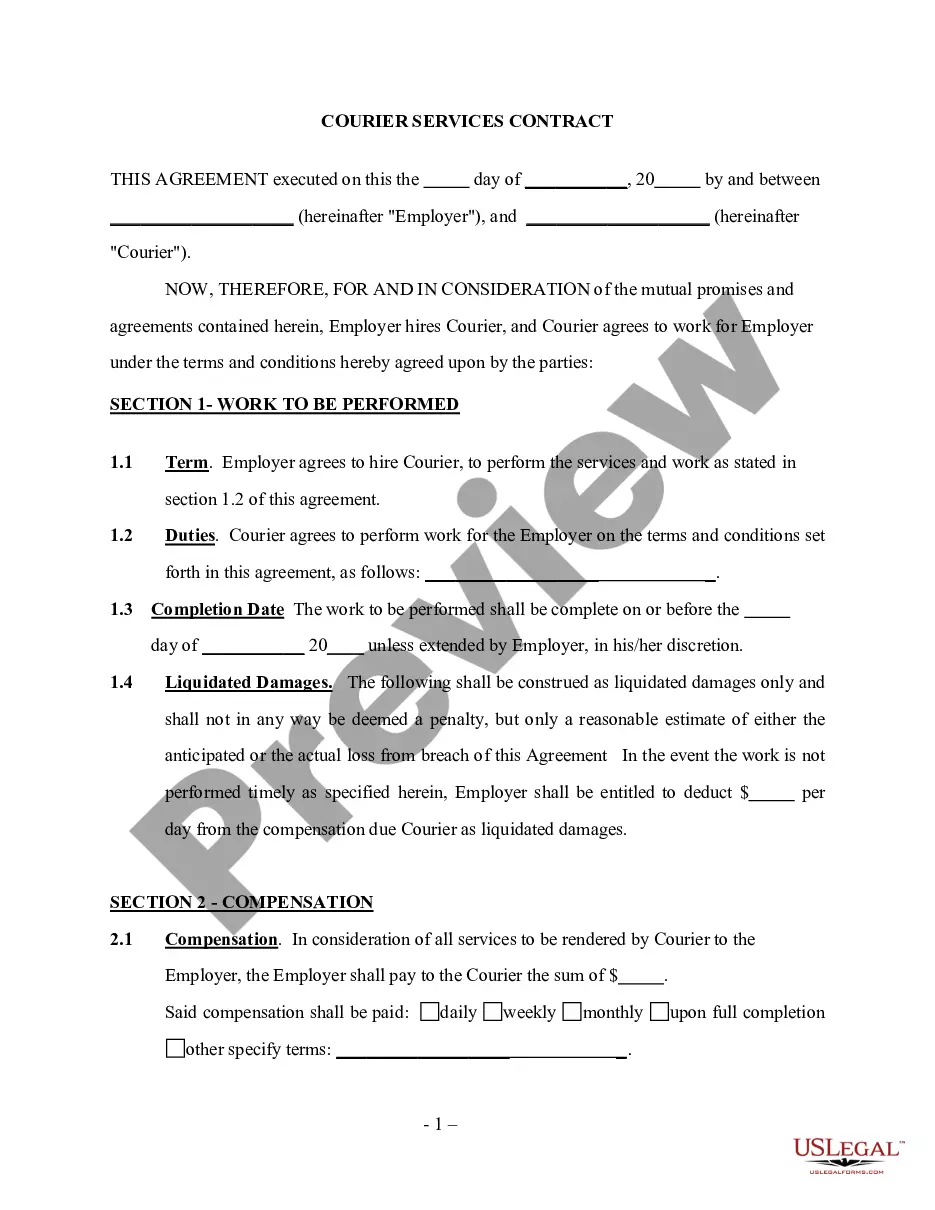
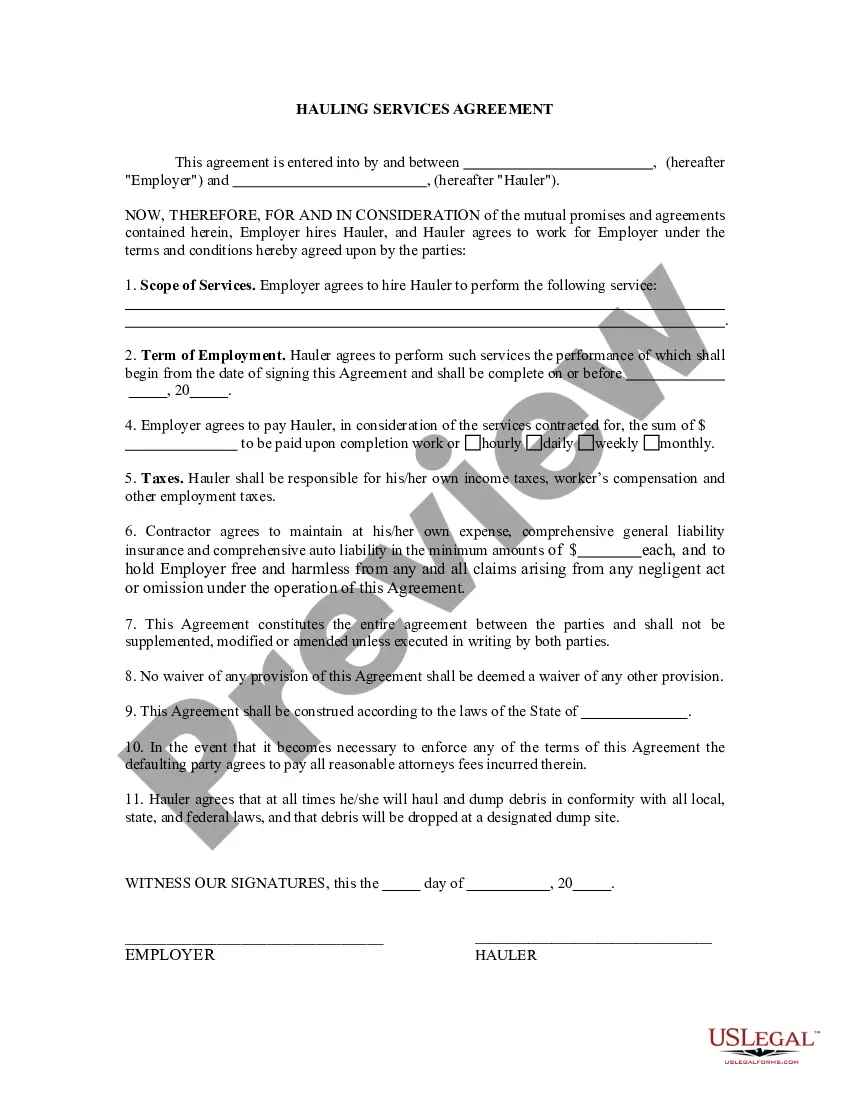
This is an agreement between an Employer trucking or transporting company and a trucker who is hired as an indepedent contractor.
Vermont Carrier Services Contract - Self-Employed Independent Contractor
State:
Multi-State
Control #:
US-INDC-04
Format:
Word;
Rich Text
Instant download
Description
Free preview


Get your form ready online
Our built-in tools help you complete, sign, share, and store your documents in one place.
Built-in online Word editor
Make edits, fill in missing information, and update formatting in US Legal Forms—just like you would in MS Word.
Export easily
Download a copy, print it, send it by email, or mail it via USPS—whatever works best for your next step.
E-sign your document
Sign and collect signatures with our SignNow integration. Send to multiple recipients, set reminders, and more. Go Premium to unlock E-Sign.
Notarize online 24/7
If this form requires notarization, complete it online through a secure video call—no need to meet a notary in person or wait for an appointment.
Store your document securely
We protect your documents and personal data by following strict security and privacy standards.

Make edits, fill in missing information, and update formatting in US Legal Forms—just like you would in MS Word.

Download a copy, print it, send it by email, or mail it via USPS—whatever works best for your next step.

Sign and collect signatures with our SignNow integration. Send to multiple recipients, set reminders, and more. Go Premium to unlock E-Sign.

If this form requires notarization, complete it online through a secure video call—no need to meet a notary in person or wait for an appointment.

We protect your documents and personal data by following strict security and privacy standards.
Looking for another form?

How to fill out Carrier Services Contract - Self-Employed Independent Contractor?
It is feasible to spend hours online searching for the valid document template that meets the federal and state requirements you need.
US Legal Forms offers thousands of legal documents that are assessed by professionals.
You can download or print the Vermont Carrier Services Contract - Self-Employed Independent Contractor from this platform.
To obtain an additional version of the form, use the Search field to find the template that fits your needs.
- If you already have a US Legal Forms account, you may Log In and click the Download button.
- After this, you can complete, modify, print, or sign the Vermont Carrier Services Contract - Self-Employed Independent Contractor.
- Each legal document template you obtain is your property permanently.
- To get an additional copy of any purchased form, go to the My documents section and click the respective button.
- If you are using the US Legal Forms site for the first time, follow the simple instructions below.
- First, ensure that you have selected the correct document template for the county/region of your choice. Check the form details to confirm you have chosen the right document.
- If available, utilize the Review button to browse through the document template as well.
Form popularity
FAQ
To fill out an independent contractor agreement, start with the parties' information, including their names and addresses. Specify the work to be performed, payment details, and the duration of the contract. When using the Vermont Carrier Services Contract - Self-Employed Independent Contractor template from USLegalForms, make sure to customize the fields to reflect the specifics of your arrangement, ensuring a clear understanding between all parties.
When writing an independent contractor agreement, clearly outline the roles, responsibilities, and expectations of both parties involved. Include payment rates, deadlines, and any specific conditions that apply to the Vermont Carrier Services Contract - Self-Employed Independent Contractor. It’s essential to ensure the agreement protects both the contractor and the client, so consider using templates from platforms like USLegalForms for guidance.
To fill out an independent contractor form accurately, start by gathering your personal information, including your name, address, and Social Security number. Next, provide the details of the work, including the scope, payment terms, and deadlines. If you are using the Vermont Carrier Services Contract - Self-Employed Independent Contractor, ensure that you are completing all required fields to avoid any issues in your business transactions.
To perform services as an independent contractor in the US, you should ensure compliance with local, state, and federal regulations. This often involves obtaining necessary licenses, permits, or registrations depending on your industry. Platforms like uslegalforms can guide you through the process of securing a Vermont Carrier Services Contract - Self-Employed Independent Contractor and help you navigate the legal requirements.
Certainly, being self-employed and having a contract often go hand in hand. Many self-employed individuals establish formal agreements with clients to outline expectations and deliverables. Engaging in a Vermont Carrier Services Contract - Self-Employed Independent Contractor is an excellent way to formalize such arrangements and ensure clarity for both parties.
Yes, independent contractors are a subset of self-employed individuals. They manage their business and client relationships while typically operating under a contract that specifies the nature of services provided. Understanding this relationship is vital, especially when engaging in a Vermont Carrier Services Contract - Self-Employed Independent Contractor.
The primary difference lies in the control over work. Employees work under the direct control of an employer, following set schedules and guidelines, while independent contractors retain autonomy over how to complete their tasks. This distinction is significant when establishing work agreements like a Vermont Carrier Services Contract - Self-Employed Independent Contractor.
Yes, individuals who receive Form 1099 for their services are generally classified as self-employed. This classification means they are not entitled to the same benefits as traditional employees, such as health insurance or retirement plans. It's crucial to be aware of these implications when engaging in a Vermont Carrier Services Contract - Self-Employed Independent Contractor.
Self-employed individuals encompass a variety of roles, including freelancers, sole proprietors, and independent contractors. Conversely, independent contractors typically work under a specific agreement or contract to provide defined services, often with specific guidelines. Understanding this distinction is essential when negotiating terms in a Vermont Carrier Services Contract - Self-Employed Independent Contractor.
Both terms describe individuals who work independently rather than as employees. While 'self-employed' is a broader term encompassing various forms of work, 'independent contractor' refers specifically to those contracted for services. It's often beneficial to choose the term that aligns with your specific legal and financial circumstances, especially when dealing with a Vermont Carrier Services Contract - Self-Employed Independent Contractor.