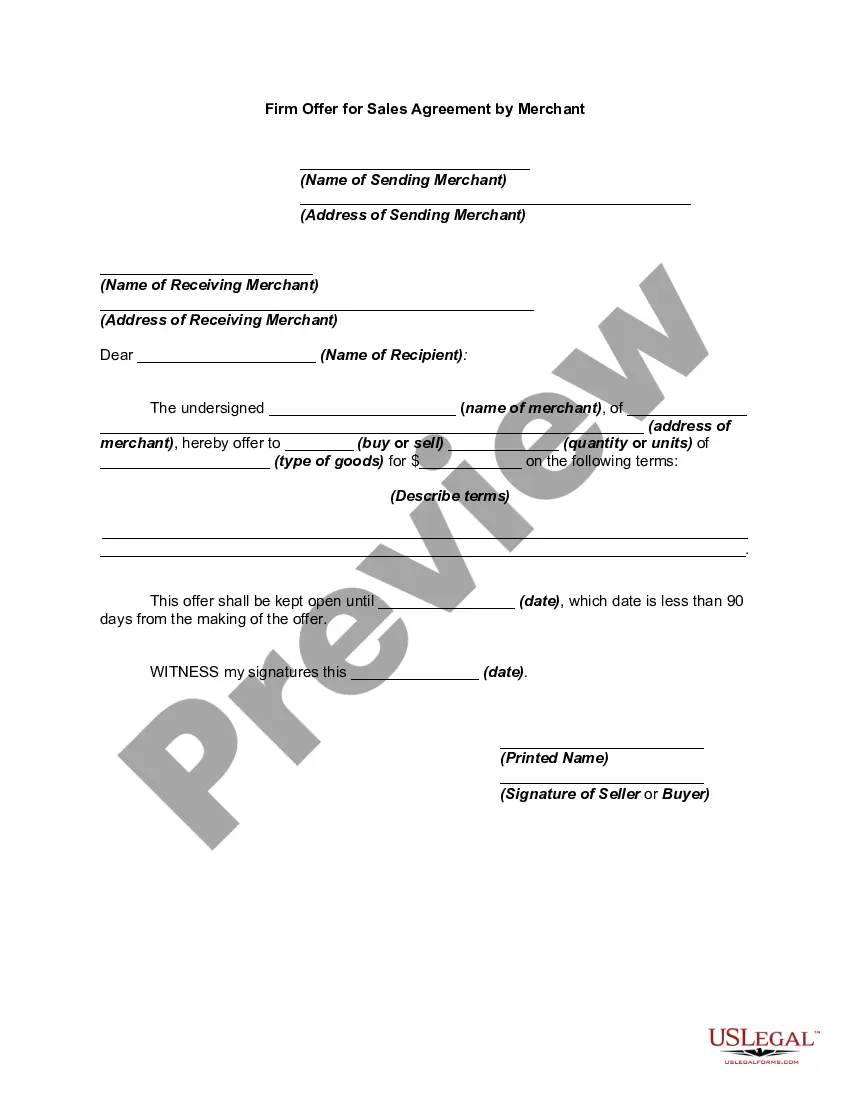
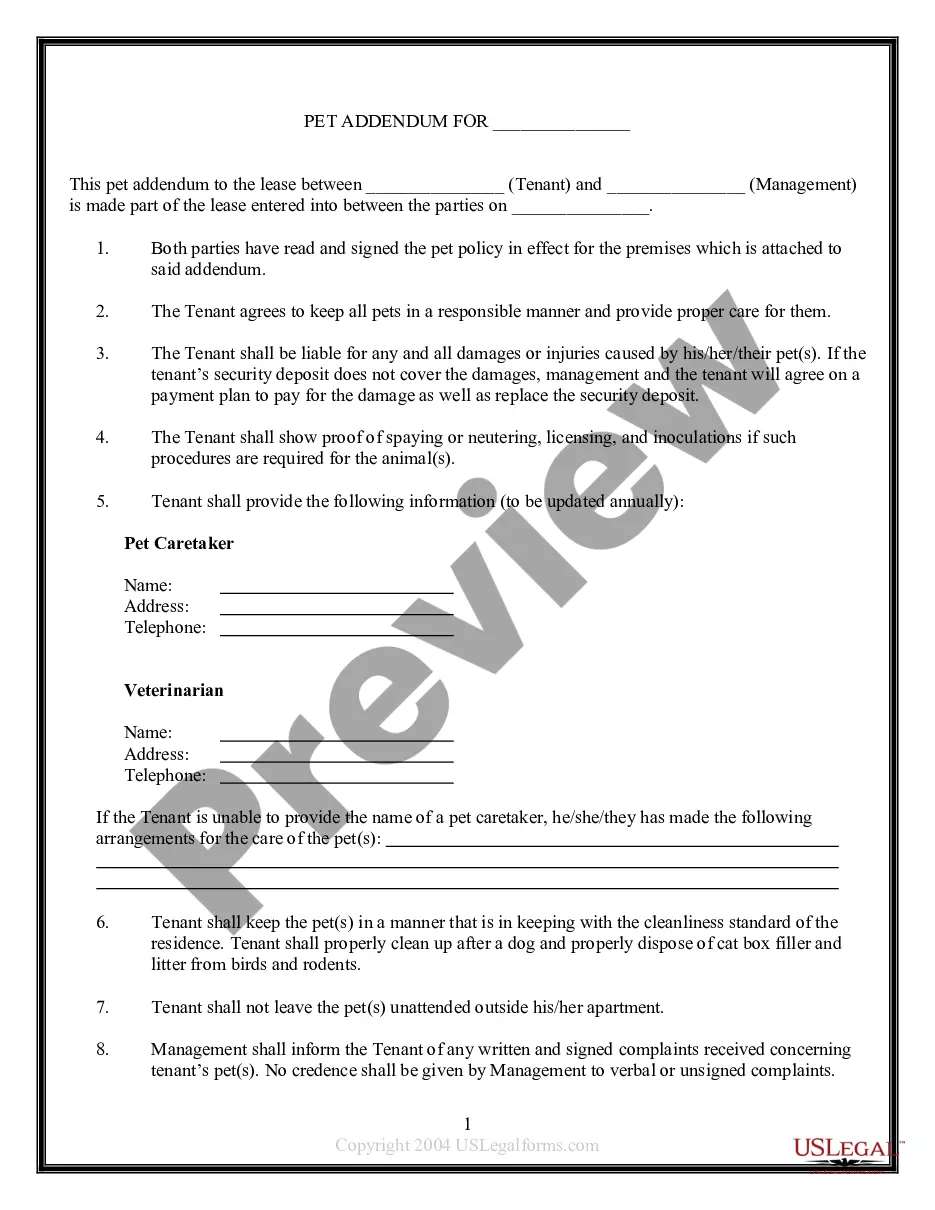
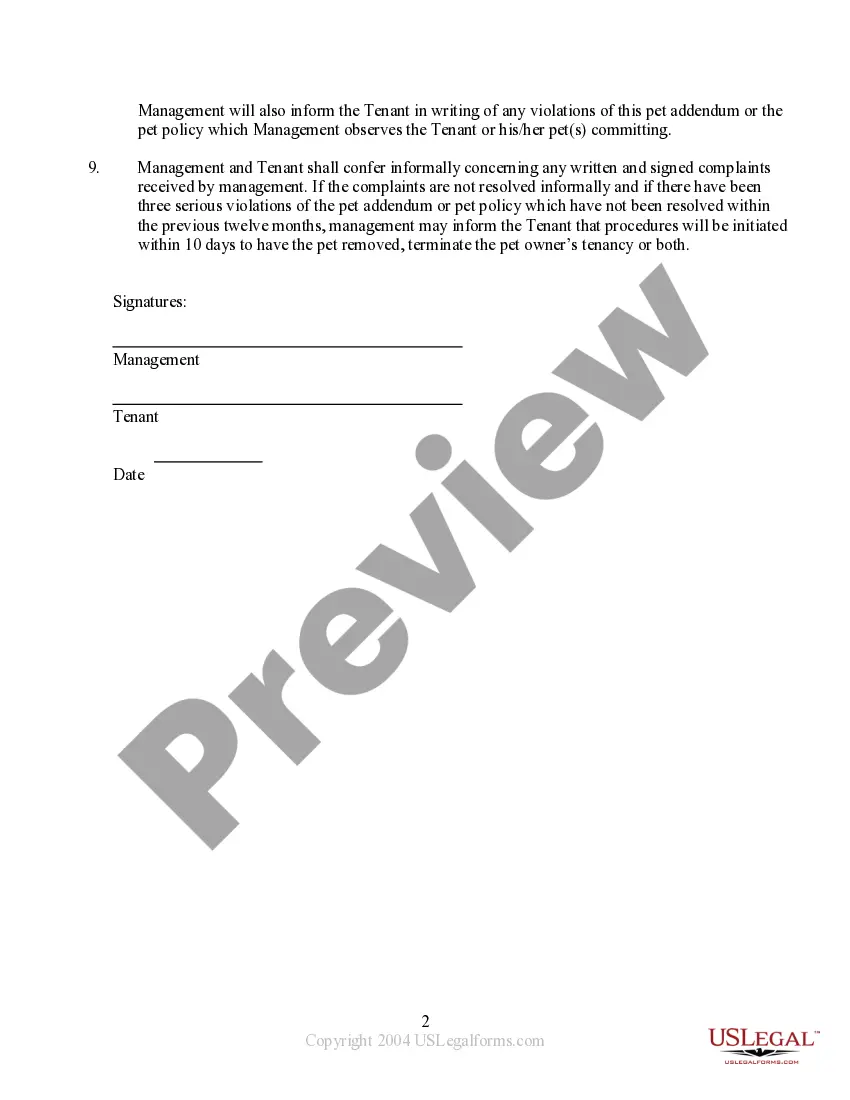
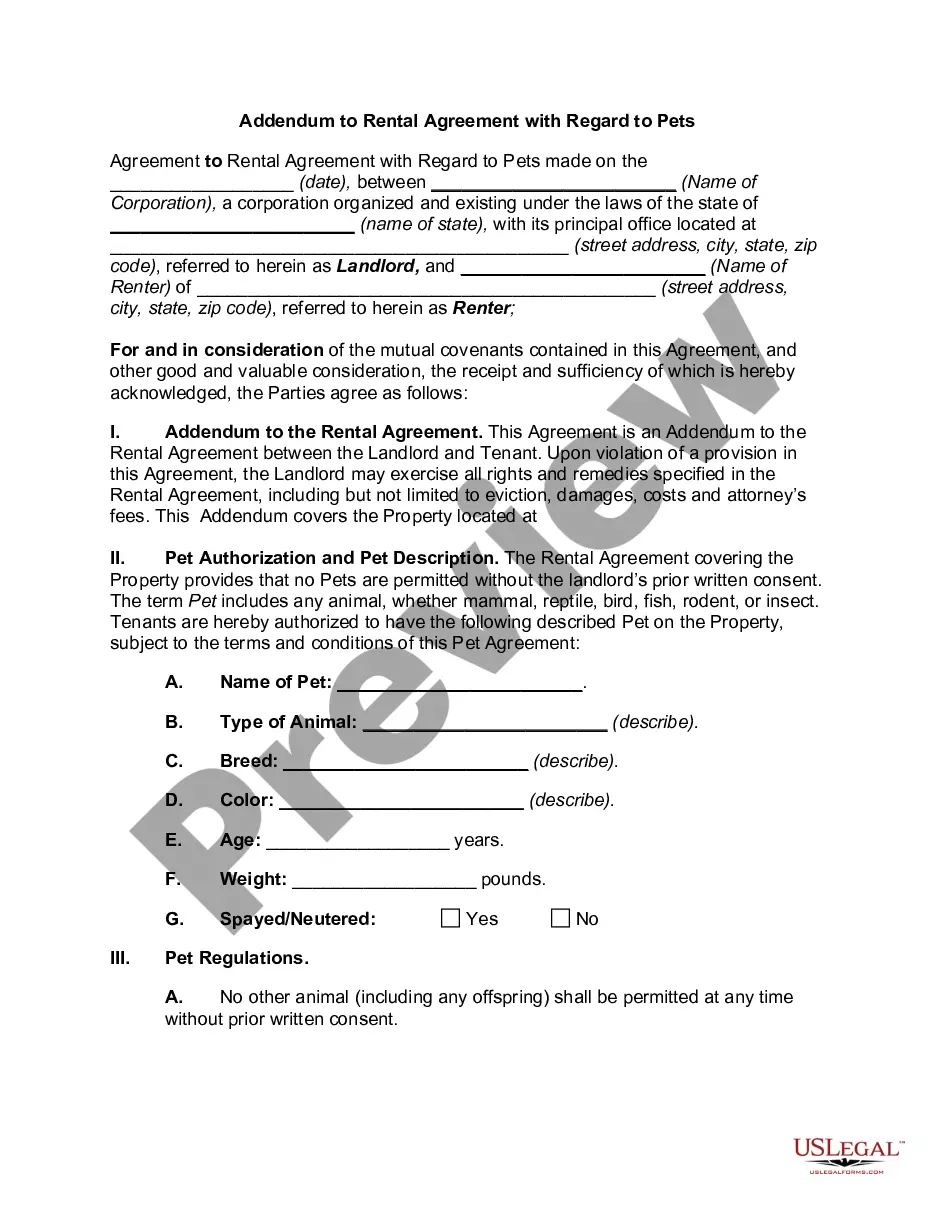
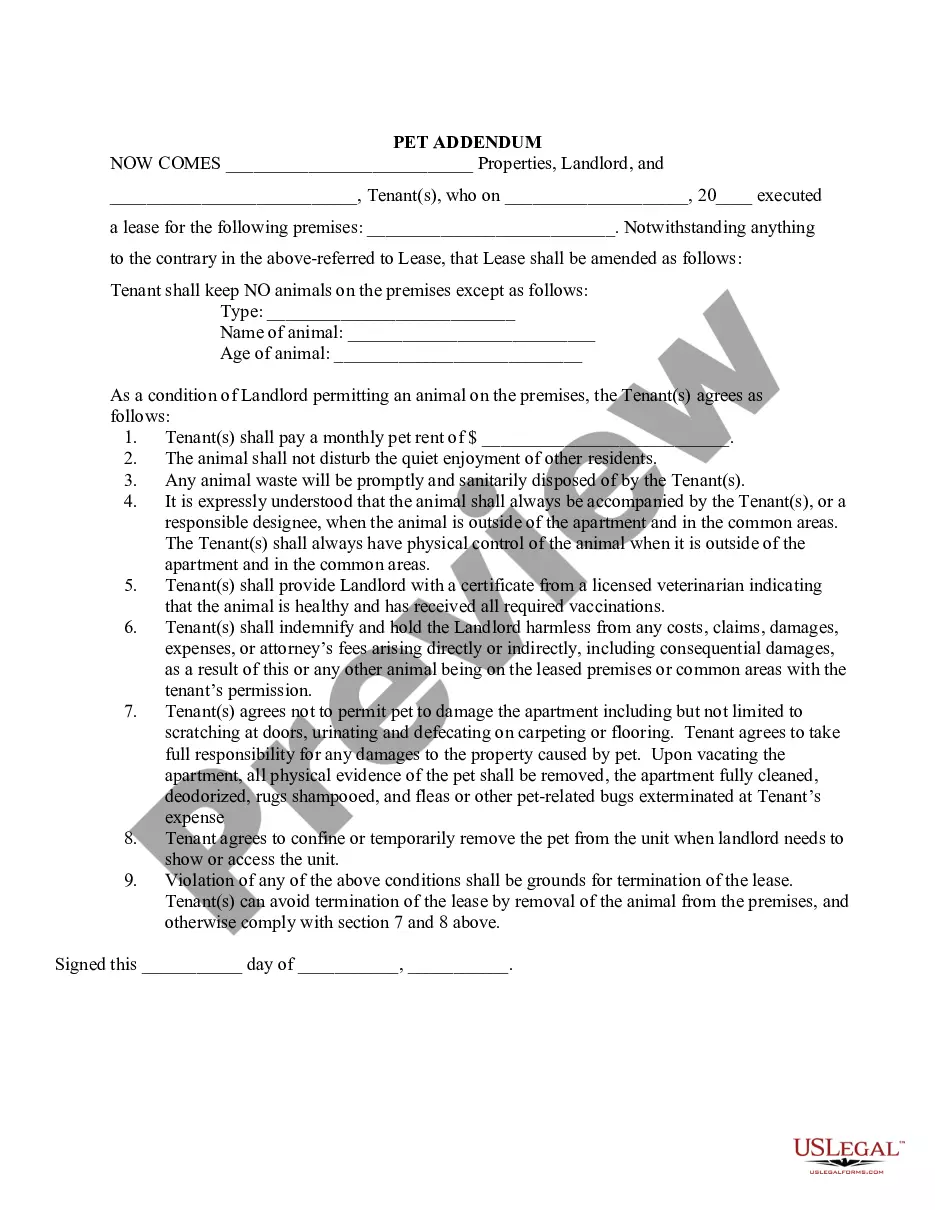
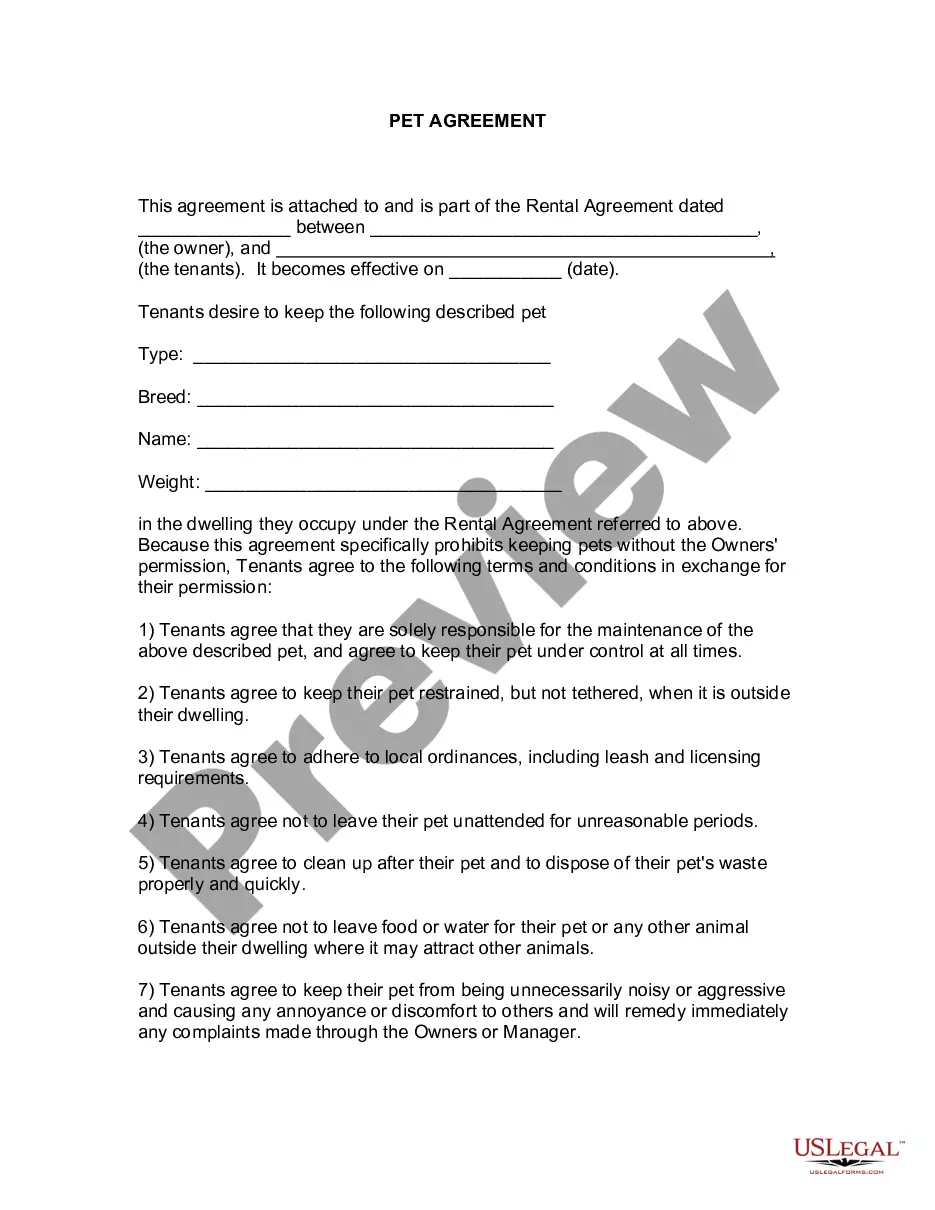
Apartment lease addendum concerning the keeping of pets in the complex units.
Vermont Addendum To Apartment Lease regarding Pets
State:
Multi-State
Control #:
US-902LT
Format:
Word;
Rich Text
Instant download
Description
Free preview
Get your form ready online
Our built-in tools help you complete, sign, share, and store your documents in one place.
Built-in online Word editor
Make edits, fill in missing information, and update formatting in US Legal Forms—just like you would in MS Word.
Export easily
Download a copy, print it, send it by email, or mail it via USPS—whatever works best for your next step.
E-sign your document
Sign and collect signatures with our SignNow integration. Send to multiple recipients, set reminders, and more. Go Premium to unlock E-Sign.
Notarize online 24/7
If this form requires notarization, complete it online through a secure video call—no need to meet a notary in person or wait for an appointment.
Store your document securely
We protect your documents and personal data by following strict security and privacy standards.

Make edits, fill in missing information, and update formatting in US Legal Forms—just like you would in MS Word.

Download a copy, print it, send it by email, or mail it via USPS—whatever works best for your next step.

Sign and collect signatures with our SignNow integration. Send to multiple recipients, set reminders, and more. Go Premium to unlock E-Sign.

If this form requires notarization, complete it online through a secure video call—no need to meet a notary in person or wait for an appointment.

We protect your documents and personal data by following strict security and privacy standards.
Looking for another form?




How to fill out Addendum To Apartment Lease Regarding Pets?
Selecting the appropriate legitimate document template can be a challenge. Clearly, there is a wide range of online templates available, but how can you find the official form you require? Utilize the US Legal Forms website. This platform offers thousands of templates, including the Vermont Addendum To Apartment Lease concerning Pets, which you can use for business and personal purposes. All of the forms are validated by experts and comply with state and federal regulations.
If you are currently logged in, access your account and click on the Download button to retrieve the Vermont Addendum To Apartment Lease concerning Pets. Use your account to view the legal documents you have previously acquired. Navigate to the My documents tab in your account and obtain another copy of the document you need.
If you are a new user of US Legal Forms, here are some easy steps for you to follow: First, ensure you have selected the correct document for your region/county. You can review the form using the Preview button and read the form details to confirm it is suitable for you. If the document does not align with your needs, use the Search field to find the right one. Once you are confident the form is appropriate, click the Buy now button to obtain it. Choose the pricing plan you require and input the necessary information. Create your account and complete the purchase using your PayPal account or credit card. Select the file format and download the legitimate document template to your device. Complete, edit, print, and sign the acquired Vermont Addendum To Apartment Lease concerning Pets.
US Legal Forms boasts the largest collection of legal documents where you will find various file templates. Take advantage of this service to download professionally-crafted documents that adhere to state requirements.
- Utilize the US Legal Forms website for access to numerous document templates.
- Ensure you are logged in to download your needed forms.
- Review your previous purchases under the 'My documents' tab.
- Follow easy instructions for new users to select the correct form.
- Use the preview feature to verify document suitability.
- Complete your purchase securely through PayPal or card.
Form popularity
FAQ
Renters in Vermont have rights that include safe and habitable living conditions, privacy, and the ability to negotiate lease terms. For example, if you wish to keep a pet, the Vermont Addendum To Apartment Lease regarding Pets can be a tool to assert this right, as long as it aligns with local regulations. Knowing your rights empowers you to advocate for yourself effectively. Familiarize yourself with state laws or consult resources from uslegalforms for guidance.
Alongside the proposed bill, the Ministry of Housing updated their standard tenancy agreement so that landlords cannot issue a 'blanket ban' on pets. Allowing pets is now the default position on the government's recommended model tenancy agreement.
A landlord would need a good reason to refuse. For instance, if a home is too small for a pet to be feasible. The government's new model tenancy agreement is its recommended contract for landlords. But there is no obligation to use it and most landlords don't.
Landlords can no longer issue a blanket ban on tenants having pets. Instead, under the government issued model tenancy agreement, the default position on rental property and pets is that a landlord will rent to tenants with pets.
A provision in a tenancy agreement prohibiting the presence of animals in or about the residential complex is void. This means that any tenancy agreement provided to you that prohibits animals in your living space, is void. In other words, a landlord cannot refuse your pets in Ontario. This law is current as of 2021.
The Tenant hereby undertakes and agrees to remedy and pay for any damage caused to The Property and/or contents of The Property which shall have been caused by The Pet residing in The Property. For the avoidance of doubt any such damage shall not be deemed to be fair wear and tear.
With a Lease Addendum, a landlord and tenant can add new or update existing lease terms without having to terminate their original agreement and create a new one. A Lease Addendum is also known as a: Tenancy addendum. Lease amendment.
A pet addendum is used by the landlord to give the tenant written permission to have one or more pets on the property. The pet addendum usually requires the tenant to take responsibility for the behavior of their pet, to avoid excessive noise, and to pay for any damages caused by their pet.
Do landlords have to accept pets? 'The short answer is yes unless they have a very good reason not to,' says Vince Courtney, group lettings director at Andrews Property Group. 'Renting with pets has often been an emotive topic and it can cause tensions between landlords and tenants.
The Model Tenancy Agreement wording says pets are allowed by default if a tenant makes a written request to keep one. Landlords can still stop tenants from keeping pets but must offer a reasonable excuse for refusal in writing within 28 days of the tenant's request.