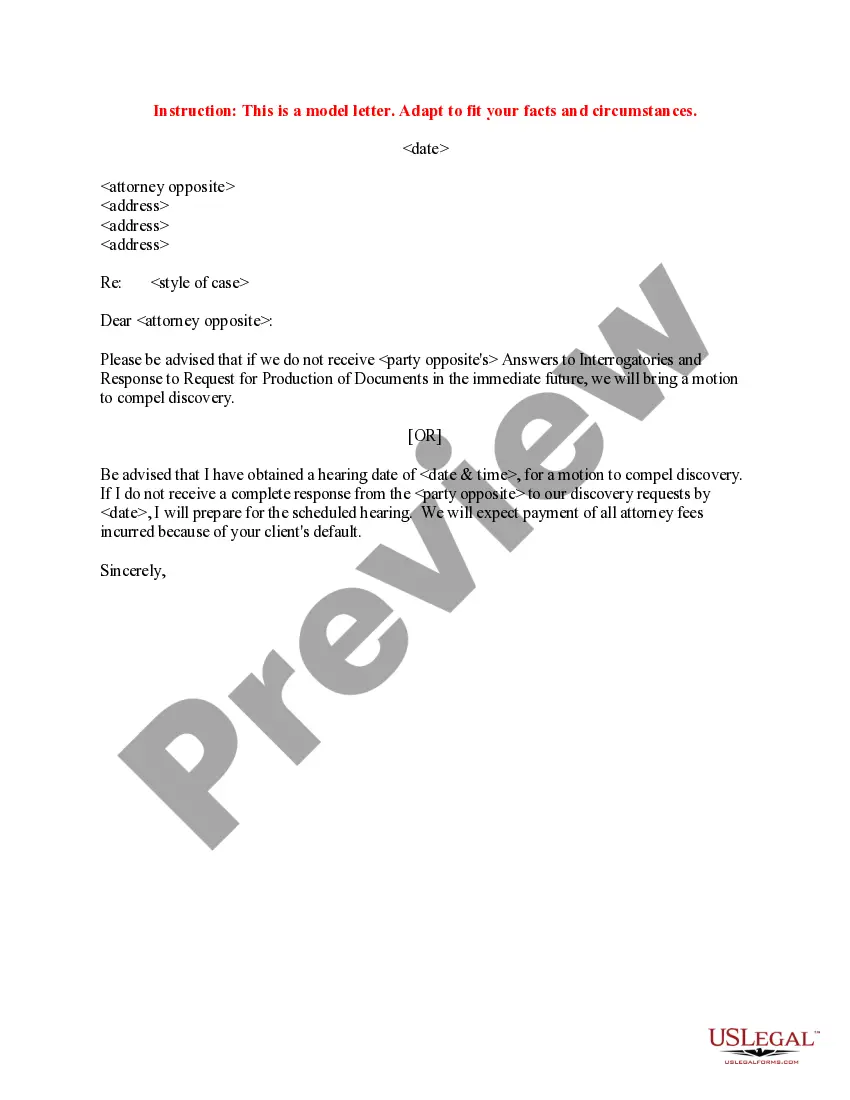
Vermont Discovery - Sample Letter to Attorney Opposite regarding His Client's overdue Interrogatories
Description




How to fill out Discovery - Sample Letter To Attorney Opposite Regarding His Client's Overdue Interrogatories?
US Legal Forms - one of several biggest libraries of legitimate types in the USA - delivers a variety of legitimate papers themes you are able to down load or print out. Utilizing the website, you can get 1000s of types for organization and specific uses, categorized by types, claims, or keywords and phrases.You will find the most recent types of types such as the Vermont Discovery - Sample Letter to Attorney Opposite regarding His Client's overdue Interrogatories in seconds.
If you currently have a membership, log in and down load Vermont Discovery - Sample Letter to Attorney Opposite regarding His Client's overdue Interrogatories through the US Legal Forms catalogue. The Acquire switch will appear on every develop you look at. You have access to all in the past delivered electronically types within the My Forms tab of your accounts.
In order to use US Legal Forms initially, here are simple instructions to help you started out:
- Make sure you have chosen the correct develop to your town/state. Click the Preview switch to examine the form`s information. Read the develop explanation to ensure that you have selected the correct develop.
- If the develop does not fit your specifications, utilize the Research field at the top of the display screen to get the one which does.
- In case you are happy with the form, validate your decision by simply clicking the Purchase now switch. Then, choose the pricing prepare you prefer and give your references to sign up to have an accounts.
- Procedure the transaction. Utilize your credit card or PayPal accounts to accomplish the transaction.
- Select the format and down load the form on your own system.
- Make changes. Fill out, edit and print out and indicator the delivered electronically Vermont Discovery - Sample Letter to Attorney Opposite regarding His Client's overdue Interrogatories.
Every single design you put into your account lacks an expiry date which is your own eternally. So, if you want to down load or print out another backup, just check out the My Forms area and click on on the develop you want.
Get access to the Vermont Discovery - Sample Letter to Attorney Opposite regarding His Client's overdue Interrogatories with US Legal Forms, the most extensive catalogue of legitimate papers themes. Use 1000s of specialist and status-distinct themes that meet up with your small business or specific requirements and specifications.
Form popularity
FAQ
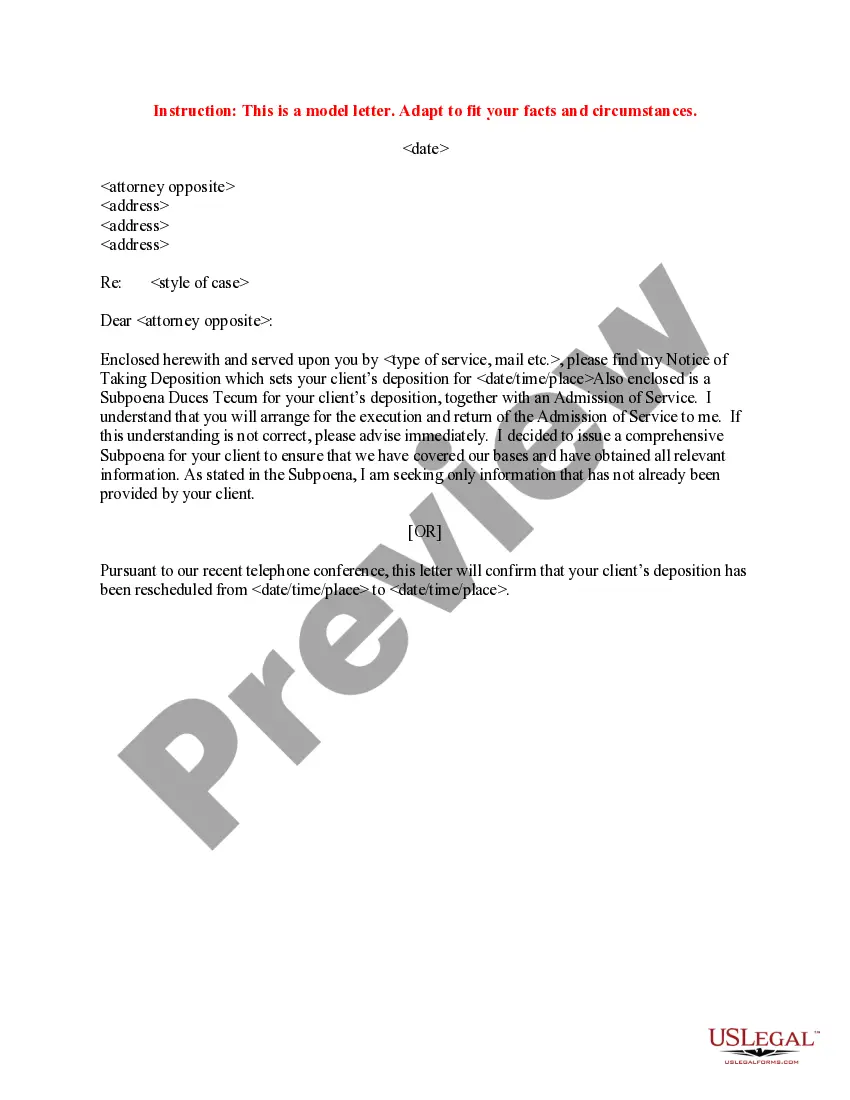
Dear [Opposing Counsel Name], I am writing to follow up on our recent communication regarding [case name]. I have not yet received a response from you regarding [list the specific issue or question]. Please let me know your thoughts as soon as possible so that we can continue to move forward with the case.
If the other person did not respond or didn't provide complete responses, try to work it out with them directly first. If that does not work, you can request a court order that requires them to respond or respond with more information.
As the party resisting discovery by objecting to an interrogatory, you have the burden to explain why your objections are proper. To satisfy this burden, you should state your objection with specificity. This means giving specific facts, statutes, or judicial precedent supporting your position.
You can object to an interrogatory if the information sought is known by the requesting party or available to both parties equally. For example, you should raise this objection if the answers are publicly available or in a third-party's custody or control.
Some of the valid grounds for objecting to interrogatories are: Irrelevant questions or questions outside the scope of permissible discovery. The information sought for is privileged (protected under the attorney client privilege doctrine or the like)
If you do not answer the questions by the deadline, which is usually about a month, the other side could ask the judge to order you to respond to the interrogatories. If you miss the second deadline, the judge could impose a fine against you or strike your pleadings.
Answer only the question that is asked, and avoid the temptation to over-explain your answer. If the question contains several parts, you may break your answer into parts as well. It is also possible that you might object to the question.
If you are unable to answer an interrogatory because it is too vague, ambiguous, or somehow objectionable, you can state an objection and the reason for your objection. You must then answer to the extent the interrogatory is not objectionable.