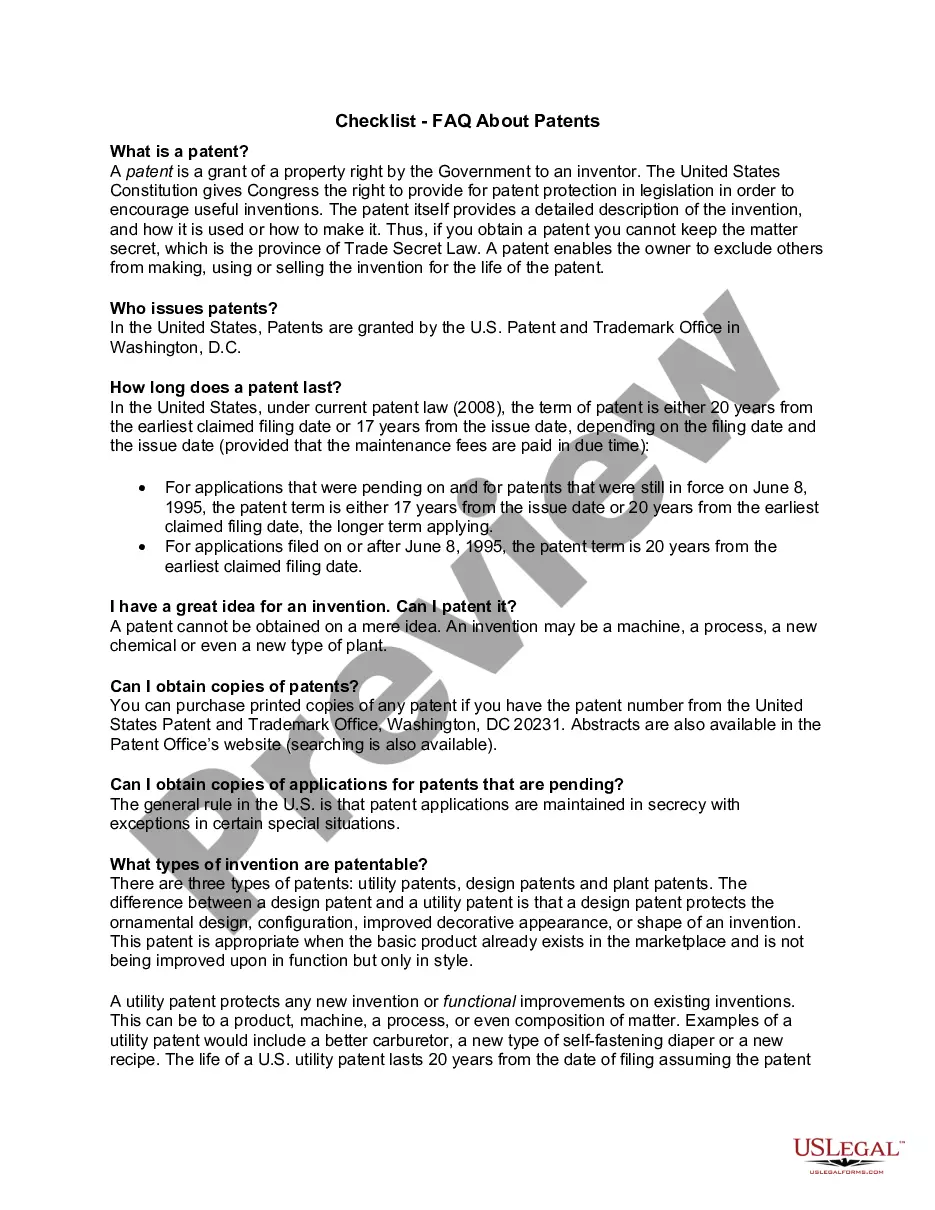
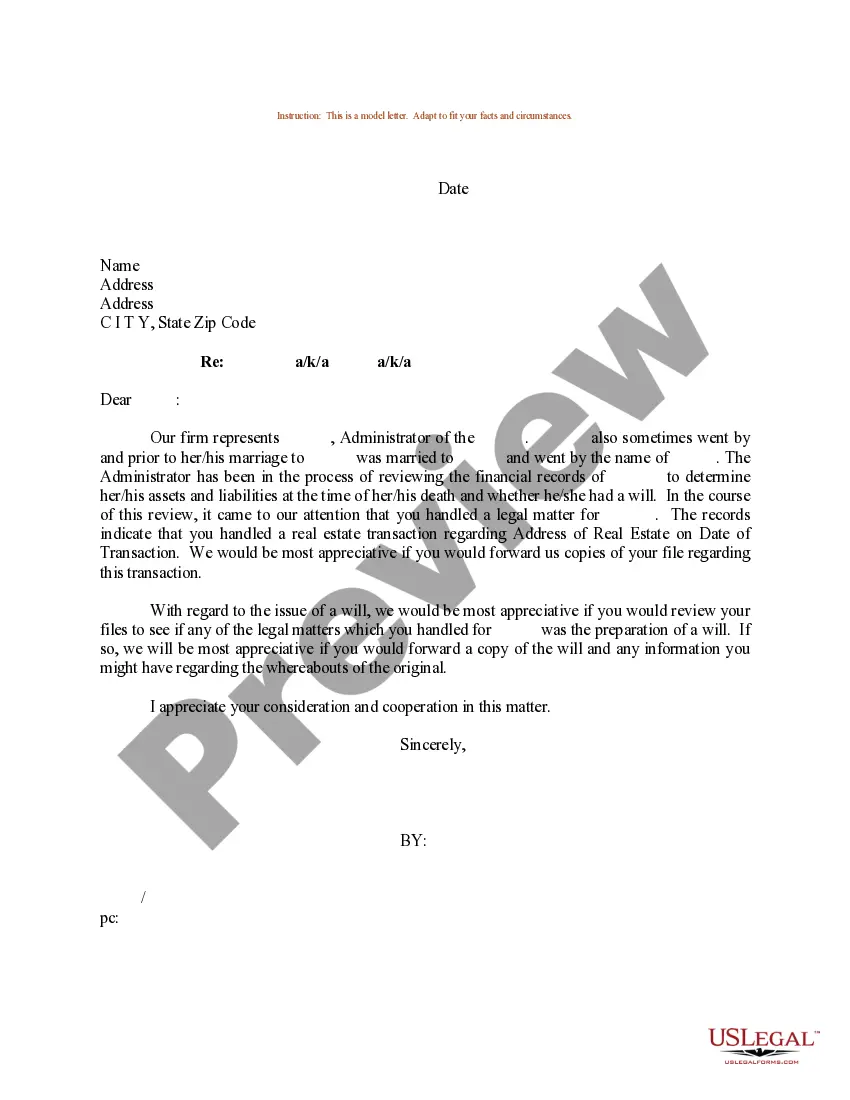
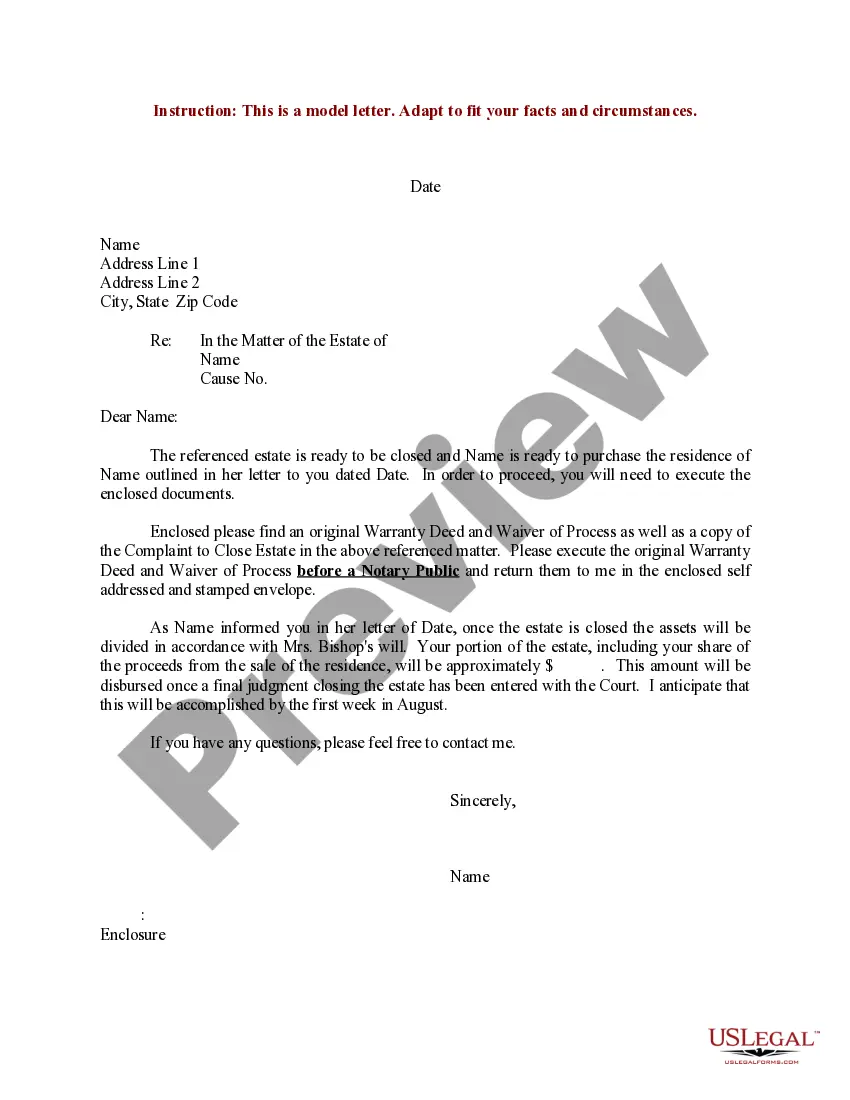
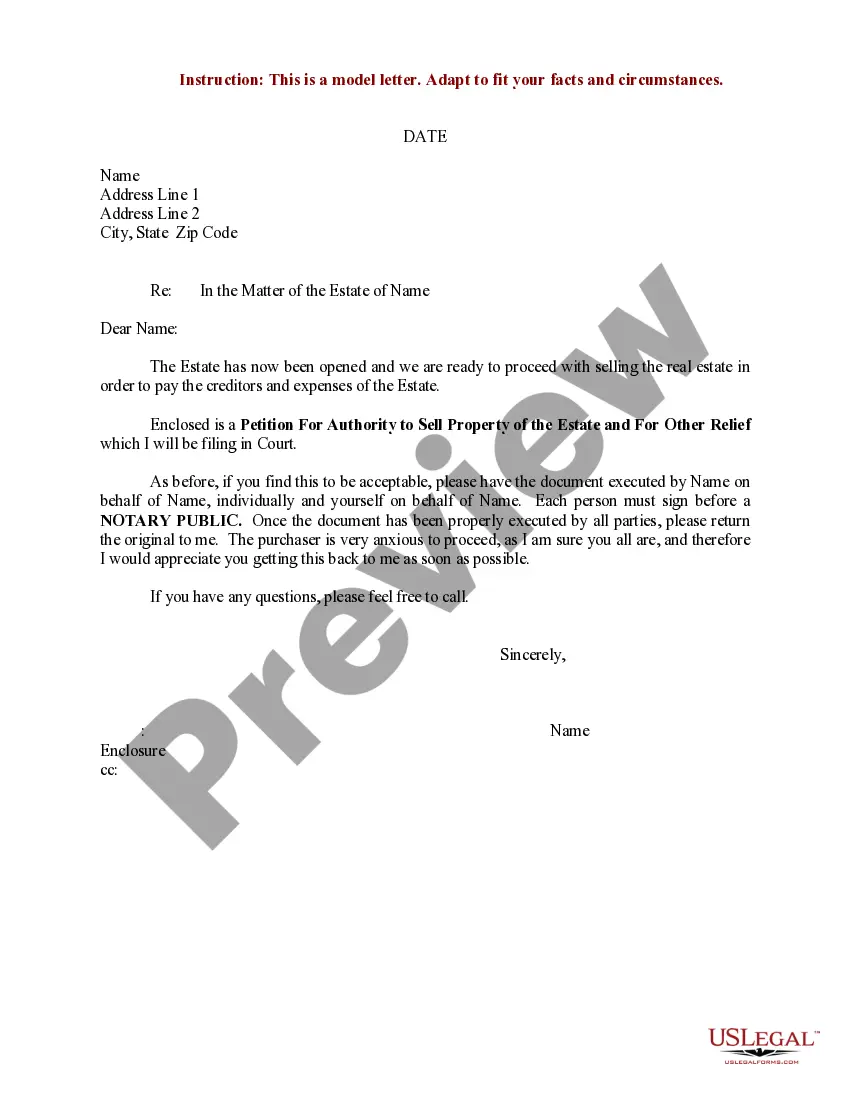
Vermont Sample Letter for Decedent's Real Estate Transaction
Description

Get your form ready online
Our built-in tools help you complete, sign, share, and store your documents in one place.
Make edits, fill in missing information, and update formatting in US Legal Forms—just like you would in MS Word.
Download a copy, print it, send it by email, or mail it via USPS—whatever works best for your next step.
Sign and collect signatures with our SignNow integration. Send to multiple recipients, set reminders, and more. Go Premium to unlock E-Sign.
If this form requires notarization, complete it online through a secure video call—no need to meet a notary in person or wait for an appointment.
We protect your documents and personal data by following strict security and privacy standards.

Make edits, fill in missing information, and update formatting in US Legal Forms—just like you would in MS Word.

Download a copy, print it, send it by email, or mail it via USPS—whatever works best for your next step.

Sign and collect signatures with our SignNow integration. Send to multiple recipients, set reminders, and more. Go Premium to unlock E-Sign.

If this form requires notarization, complete it online through a secure video call—no need to meet a notary in person or wait for an appointment.

We protect your documents and personal data by following strict security and privacy standards.
Looking for another form?

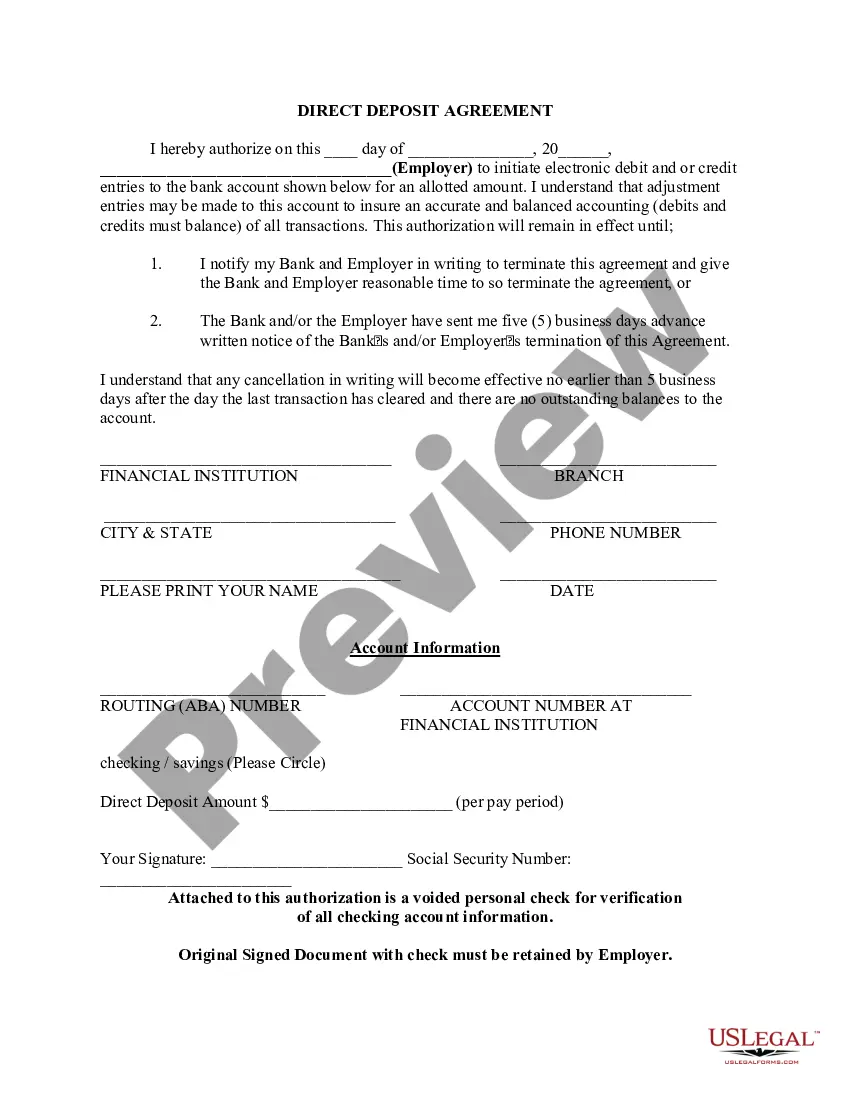
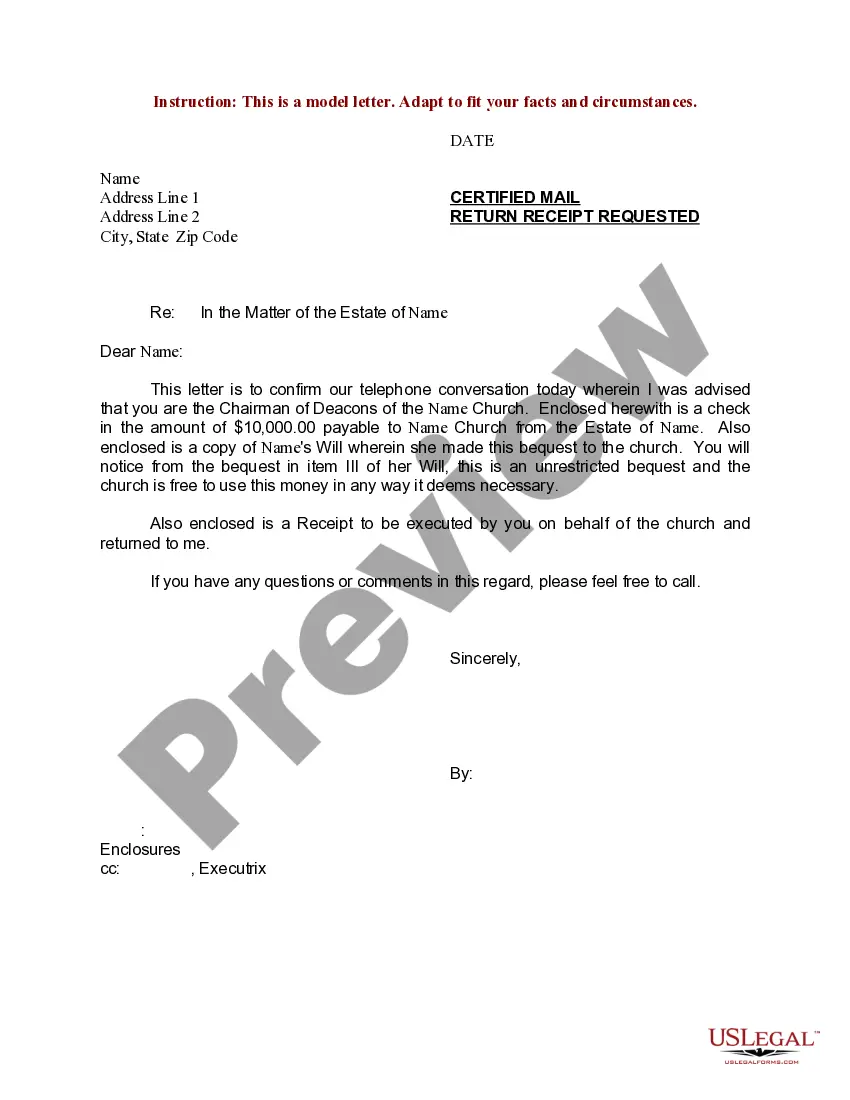


How to fill out Sample Letter For Decedent's Real Estate Transaction?
Discovering the right authorized file design could be a have difficulties. Of course, there are plenty of layouts available online, but how will you obtain the authorized form you want? Use the US Legal Forms site. The support delivers thousands of layouts, including the Vermont Sample Letter for Decedent's Real Estate Transaction, that can be used for organization and personal requirements. All of the kinds are checked out by professionals and meet up with federal and state needs.
If you are currently authorized, log in to your accounts and click on the Down load switch to get the Vermont Sample Letter for Decedent's Real Estate Transaction. Make use of accounts to check from the authorized kinds you have purchased earlier. Go to the My Forms tab of your own accounts and acquire one more duplicate of your file you want.
If you are a new customer of US Legal Forms, listed here are simple guidelines that you should follow:
- Initially, make sure you have chosen the correct form for your personal area/state. You can examine the form while using Review switch and read the form information to make sure this is basically the right one for you.
- In case the form is not going to meet up with your preferences, use the Seach field to obtain the right form.
- When you are certain that the form would work, click on the Get now switch to get the form.
- Opt for the pricing prepare you need and enter in the needed info. Build your accounts and buy your order utilizing your PayPal accounts or credit card.
- Pick the data file formatting and download the authorized file design to your system.
- Complete, change and print and sign the obtained Vermont Sample Letter for Decedent's Real Estate Transaction.
US Legal Forms may be the most significant local library of authorized kinds for which you can see a variety of file layouts. Use the company to download expertly-created paperwork that follow status needs.
Form popularity
FAQ
While most estates need to undergo the probate process, the best way to avoid probate in Vermont is by creating a living trust before dying. Assets will then transfer to your beneficiaries without the need to go to court.
Formal Probate If the person who died owned real estate or if the estate is worth more than $45,000.
Understanding Transfer on Death This applies to assets such as bank accounts, brokerage accounts, and securities. However, Vermont law does not currently allow real estate to be transferred via TOD deeds.
Vermont has no inheritance tax, but it does have an estate tax, in addition to the federal estate tax. The estate tax in Vermont affects the estates of state residents, as well as the estates of nonresidents who own tangible personal property, real estate, or income-generating property in the Green Mountain State.
In Vermont, executor fees are not explicitly defined by statute. Instead, the law allows for "reasonable" compensation, which is determined based on several factors like the complexity of the estate and the amount of work required by the executor.
Property That May Avoid Probate Property held in a trust3 Jointly held property (but not common property) Death benefits from insurance policies (unless payable to the estate)4 Property given away before you die. Assets in a pay-on-death account. Retirement accounts with a named beneficiary.
Small Claims Fees Fee typeAmountAffidavit procedure for small estates pursuant to Vermont Rule of Probate Procedure 80.3(h)$50.00Filing fee for estate $10,000 or less$50.00Filing fee for estate $10,001 to $50,000$110.00Filing fee for estate $50,001 to $150,000$265.0034 more rows
As stated in Section 103 of Title 14 of Chapter 3 of Vermont probate laws, the individual with custody of the will has to file with a court within 30 days of learning about the death. You do not need to file a petition to open probate at the same time as filing, but you can complete both simultaneously.