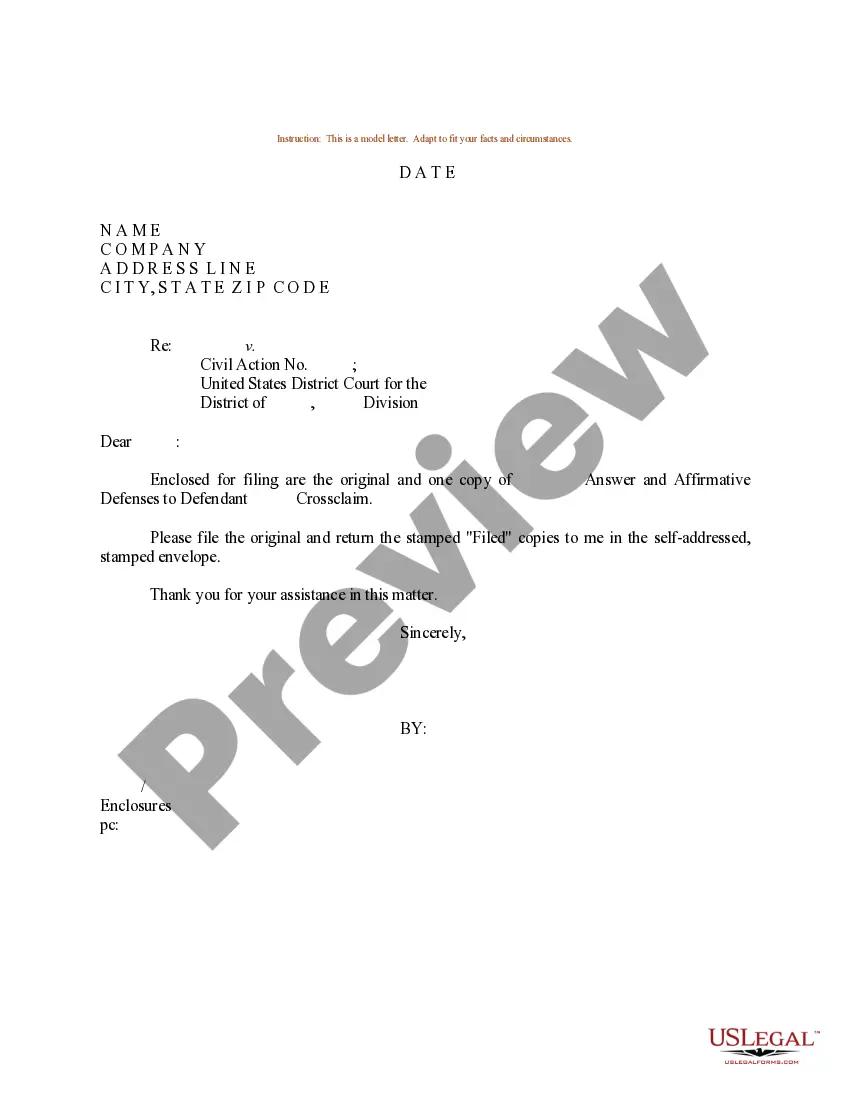
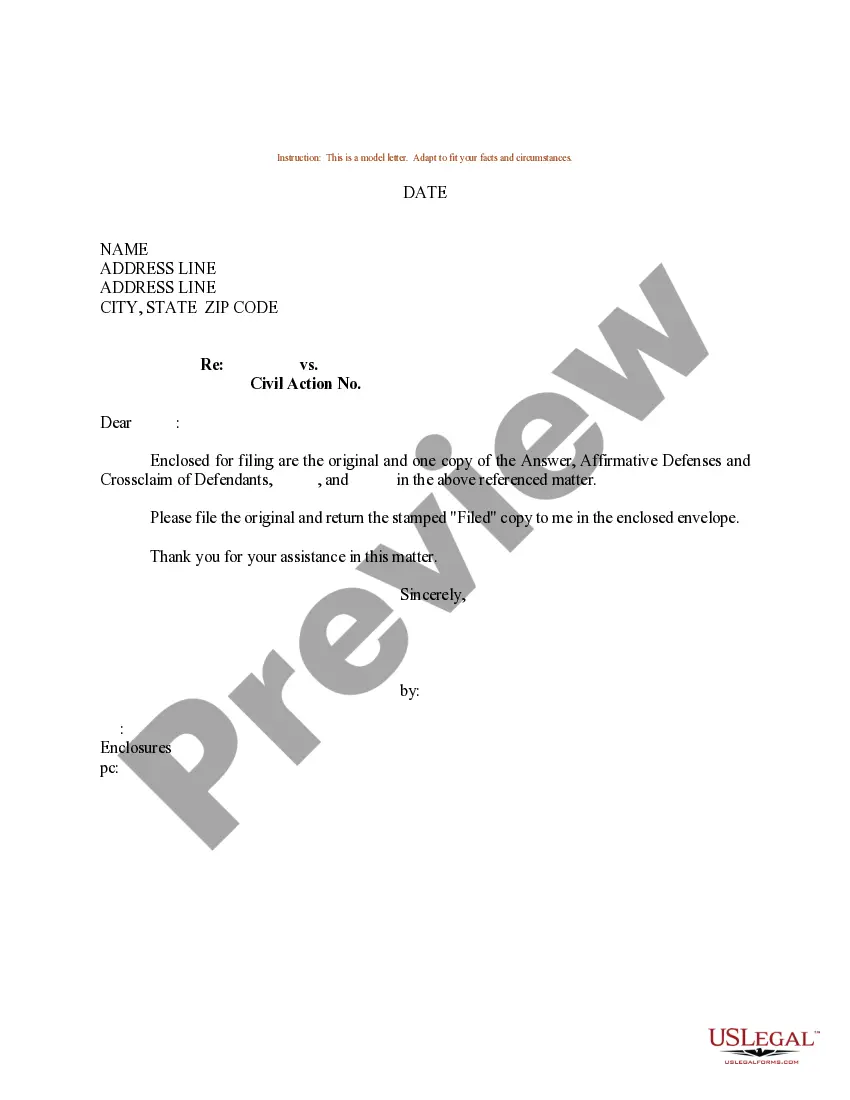
Vermont Sample Letter for Answer and Affirmative Defenses to Defendant's Crossclaim
Description
Get your form ready online
Our built-in tools help you complete, sign, share, and store your documents in one place.
Make edits, fill in missing information, and update formatting in US Legal Forms—just like you would in MS Word.
Download a copy, print it, send it by email, or mail it via USPS—whatever works best for your next step.
Sign and collect signatures with our SignNow integration. Send to multiple recipients, set reminders, and more. Go Premium to unlock E-Sign.
If this form requires notarization, complete it online through a secure video call—no need to meet a notary in person or wait for an appointment.
We protect your documents and personal data by following strict security and privacy standards.

Make edits, fill in missing information, and update formatting in US Legal Forms—just like you would in MS Word.

Download a copy, print it, send it by email, or mail it via USPS—whatever works best for your next step.

Sign and collect signatures with our SignNow integration. Send to multiple recipients, set reminders, and more. Go Premium to unlock E-Sign.

If this form requires notarization, complete it online through a secure video call—no need to meet a notary in person or wait for an appointment.

We protect your documents and personal data by following strict security and privacy standards.
Looking for another form?

How to fill out Sample Letter For Answer And Affirmative Defenses To Defendant's Crossclaim?
You can invest time on the Internet trying to find the lawful record design which fits the federal and state needs you will need. US Legal Forms gives 1000s of lawful varieties that are evaluated by experts. It is possible to acquire or produce the Vermont Sample Letter for Answer and Affirmative Defenses to Defendant's Crossclaim from the services.
If you already have a US Legal Forms profile, you may log in and click on the Acquire button. Following that, you may full, modify, produce, or signal the Vermont Sample Letter for Answer and Affirmative Defenses to Defendant's Crossclaim. Each lawful record design you get is your own eternally. To get an additional duplicate of the bought form, proceed to the My Forms tab and click on the related button.
If you are using the US Legal Forms web site initially, adhere to the simple instructions listed below:
- Initial, ensure that you have selected the proper record design for your county/metropolis that you pick. Read the form description to make sure you have picked the right form. If readily available, take advantage of the Review button to appear through the record design also.
- If you would like get an additional edition of the form, take advantage of the Search field to discover the design that meets your needs and needs.
- Upon having identified the design you want, click Acquire now to carry on.
- Find the costs plan you want, key in your qualifications, and register for your account on US Legal Forms.
- Comprehensive the deal. You should use your charge card or PayPal profile to pay for the lawful form.
- Find the structure of the record and acquire it to your system.
- Make modifications to your record if needed. You can full, modify and signal and produce Vermont Sample Letter for Answer and Affirmative Defenses to Defendant's Crossclaim.
Acquire and produce 1000s of record templates making use of the US Legal Forms web site, that offers the largest variety of lawful varieties. Use specialist and express-particular templates to deal with your small business or personal requires.
Form popularity
FAQ
In the vast majority of cases, the defendant/respondent bears the burden of proof regarding the claimed affirmative defense.
When arguing an affirmative defense, a defendant must meet the ?preponderance of the evidence? burden of proof ? a much lower standard. Subsequently, the burden of proof shifts back to the prosecution who must disprove the affirmative defense raised beyond a reasonable doubt.
A crossclaim seeks affirmative relief against a co-party in the lawsuit such as a co- defendant. Crossclaims are generally permissive in that they may be brought in the same suit if they arise out of the same transaction or occurrence, but some state courts allow cross claims to be brought in a sep- arate suit.
Affirmative defense?Examples On [Date], after making the contract and the alleged breach, and before this action was commenced, defendant paid to the plaintiff the sum of [specify amount], which was accepted by the plaintiff in full satisfaction and discharge of the damages claimed in the petition.
In a criminal case, the prosecution has the burden of proof as to each element of the crime charged, and the criminal defendant has the burden of proof on any affirmative defenses (e.g., insanity, necessity, or self-defense).
The criminal burden of proof for the prosecution is beyond a reasonable doubt. The criminal burden of proof for the defense is generally preponderance of evidence. States vary on whether they require the criminal defendant to meet both the burden of production and persuasion or just the burden of production.
Self-defense, entrapment, insanity, necessity, and respondeat superior are some examples of affirmative defenses. Under the Federal Rules of Civil Procedure Rule 56, any party may make a motion for summary judgment on an affirmative defense.
29 In other words, a defendant has the burden of proving an affirmative defense, just as a plaintiff has the burden of proving a cause of action.