Vermont Quitclaim Deed from Individual to Individual
What this document covers
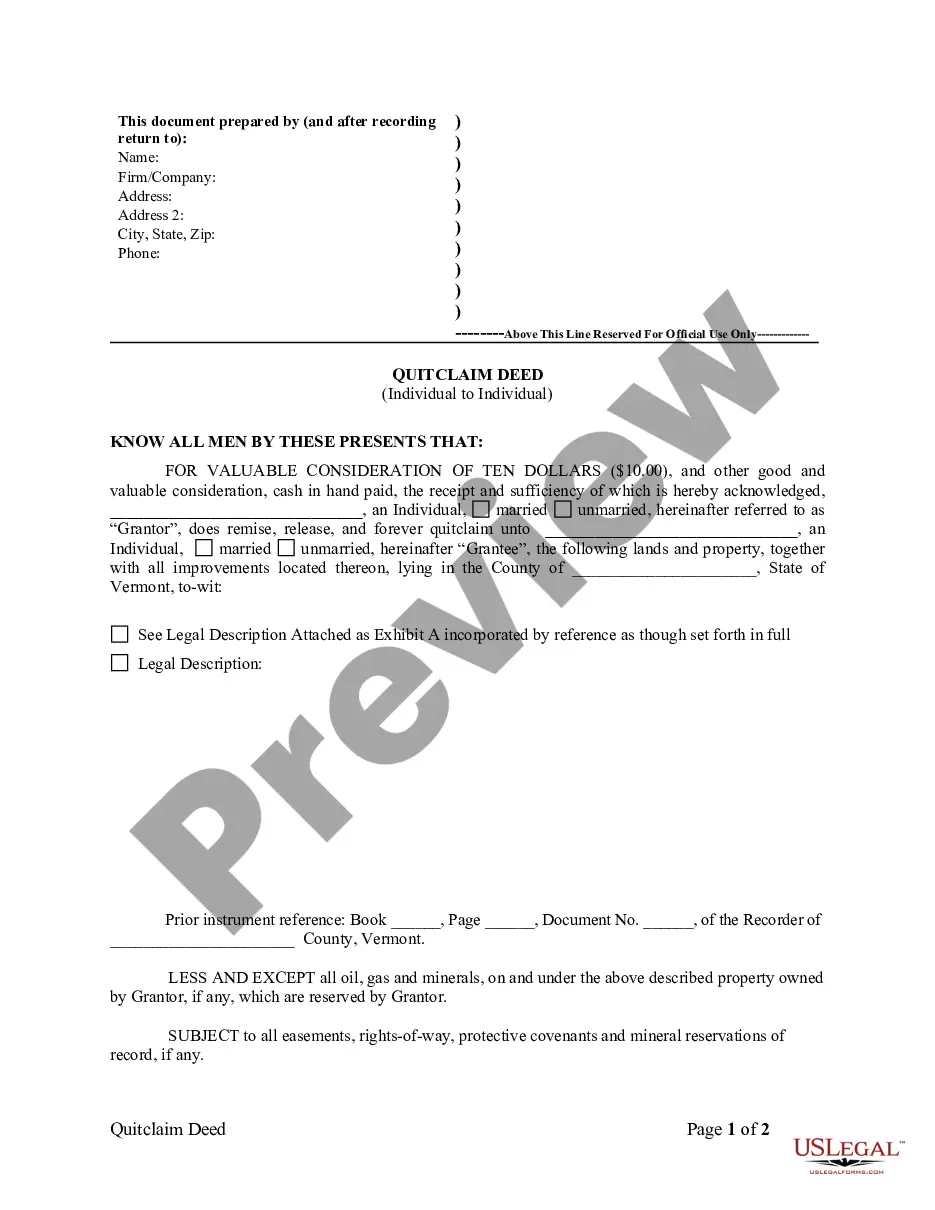
The Quitclaim Deed from Individual to Individual is a legal document that allows one individual (the Grantor) to transfer their interest in a property to another individual (the Grantee). Unlike a warranty deed, this form does not guarantee that the title is clear; it simply conveys what the Grantor may own. This form is typically used in situations where the parties know each other, such as family members or friends, or when the Grantor cannot provide a warranty of title.
Form components explained
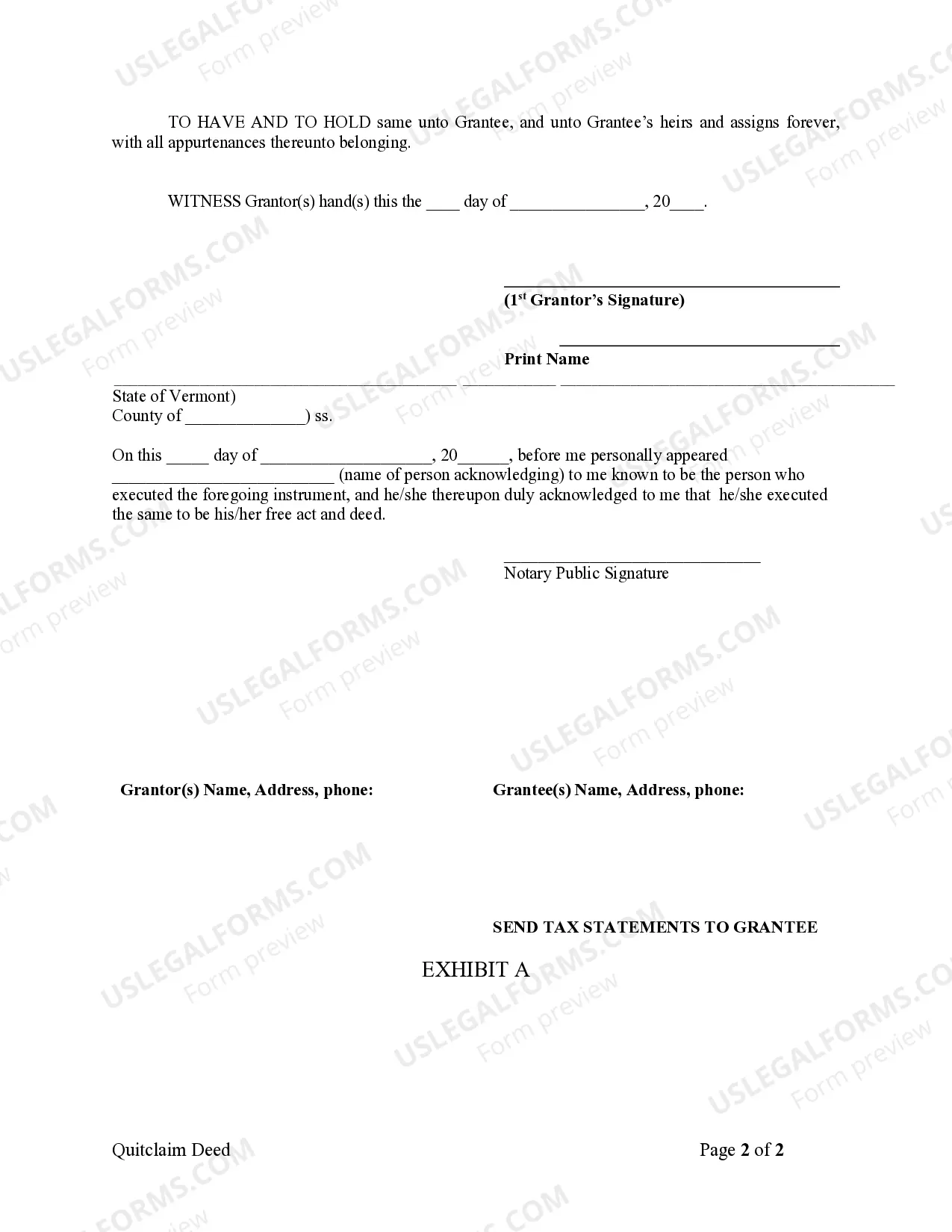
- Identification of the Grantor and Grantee
- Description of the property being transferred
- Reservation of oil, gas, and mineral rights by the Grantor
- Easements and covenants that may affect the property
- Date of execution and signatures of the parties involved




Situations where this form applies
This form is commonly used when an individual wants to transfer their ownership interest in real estate to another individual. It is particularly useful in informal transactions, such as gifting property to a family member or facilitating a property transfer between friends. Additionally, it can be applied in situations where the Grantor wants to drop off their claim to the property without the complexities involved in traditional sales.
Intended users of this form
- Anyone transferring real property to another individual
- Individuals who do not require a warranty or guarantee of the title
- Family members or friends engaging in property transfers or gifts
- Property owners seeking to simplify the transfer process
How to prepare this document
- Identify the parties involved: the Grantor (individual transferring the property) and the Grantee (individual receiving the property).
- Clearly describe the property being transferred, including any specific boundaries or descriptions.
- Note any reservations, easements, or rights that the Grantor is retaining, such as mineral rights.
- Fill in the date of execution where indicated.
- Obtain the Grantorâs signature to finalize the transfer.
Does this form need to be notarized?
This form does not typically require notarization unless specified by local law. However, it's a good practice to have the document notarized to enhance its legal validity and to provide an official record of the signatures.
Get your form ready online
Our built-in tools help you complete, sign, share, and store your documents in one place.
Make edits, fill in missing information, and update formatting in US Legal Forms—just like you would in MS Word.
Download a copy, print it, send it by email, or mail it via USPS—whatever works best for your next step.
Sign and collect signatures with our SignNow integration. Send to multiple recipients, set reminders, and more. Go Premium to unlock E-Sign.
If this form requires notarization, complete it online through a secure video call—no need to meet a notary in person or wait for an appointment.
We protect your documents and personal data by following strict security and privacy standards.

Make edits, fill in missing information, and update formatting in US Legal Forms—just like you would in MS Word.

Download a copy, print it, send it by email, or mail it via USPS—whatever works best for your next step.

Sign and collect signatures with our SignNow integration. Send to multiple recipients, set reminders, and more. Go Premium to unlock E-Sign.

If this form requires notarization, complete it online through a secure video call—no need to meet a notary in person or wait for an appointment.

We protect your documents and personal data by following strict security and privacy standards.
Typical mistakes to avoid
- Failing to include a complete property description can lead to legal complications.
- Not retaining notes on reservations or rights may affect the future use of the property.
- Forgetting to date or sign the document can render it invalid.
Why use this form online
- Convenience of downloading the form immediately without going to a legal office.
- Editability allows users to customize the document according to their specific needs.
- Access to forms created by licensed attorneys increases reliability and legal compliance.
Legal use & context
- This form is legally recognized for transferring property interest but does not guarantee that the title is free from defects or claims.
- It is advised to disclose any known issues related to the property before executing this deed.
- Depending on the state, additional paperwork may be needed for a complete transfer of title.
Quick recap
- A Quitclaim Deed from Individual to Individual transfers property interest without title guarantees.
- It is suitable for informal property transfers, such as between family or friends.
- Ensuring all details are accurately filled out can prevent future disputes.
Looking for another form?

Form popularity
FAQ
If you own your own home, you are free to gift or sell an interest in the real property to someone else.You'll need to transfer an interest by writing up another deed with the person's name on it. In California, you can use either a grant deed, a quitclaim deed or an interspousal deed, depending on your circumstances.
But you might be wondering if an owner can transfer a deed to another person without a real estate lawyer. The answer is yes. Parties to a transaction are always free to prepare their own deeds.A quitclaim deed, for example, is far simpler than a warranty deed.
A quitclaim deed transfers the owner's entire interest in the property to the person receiving the property but it only transfers what he actually owns, so if two people jointly own the property and one of them quitclaims his interest to his brother, he can only transfer his half of the ownership.
The drawback, quite simply, is that quitclaim deeds offer the grantee/recipient no protection or guarantees whatsoever about the property or their ownership of it. Maybe the grantor did not own the property at all, or maybe they only had partial ownership.
A person who signs a quitclaim deed to transfer property they do not own results in no title at all being transferred since there is no actual ownership interest. The quitclaim deed only transfers the type of title you own.
Quitclaim deeds are most often used to transfer property between family members. Examples include when an owner gets married and wants to add a spouse's name to the title or deed, or when the owners get divorced and one spouse's name is removed from the title or deed.
Yes, you can use a Quitclaim Deed to transfer a gift of property to someone. You must still include consideration when filing your Quitclaim Deed with the County Recorder's Office to show that title has been transferred, so you would use $10.00 as the consideration for the property.
Quitclaim deeds are most often used to transfer property between family members.Examples include when an owner gets married and wants to add a spouse's name to the title or deed, or when the owners divorce and one spouse's name is removed from the title or deed.
Once you sign a quitclaim deed and it has been filed and recorded with the County Clerks Office, the title has been officially transferred and cannot be easily reversed. In order to reverse this type of transfer, it would require your spouse to cooperate and assist in adding your name back to the title.