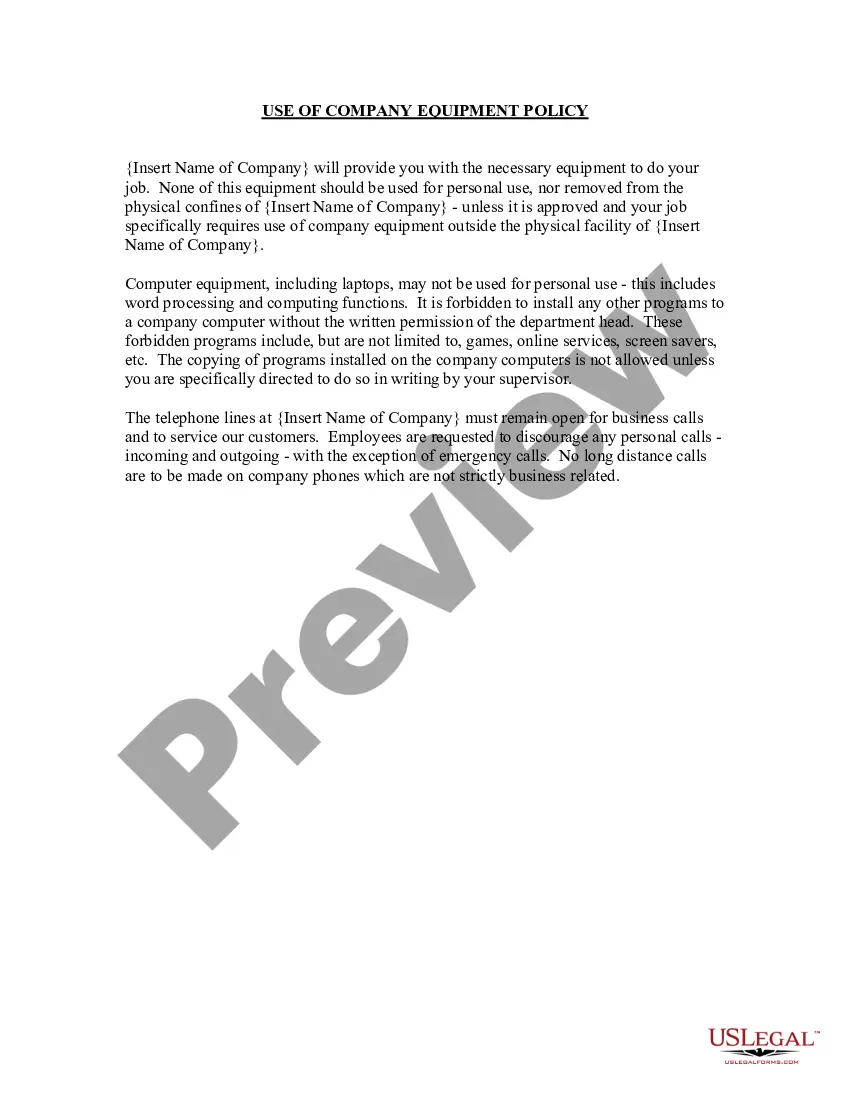
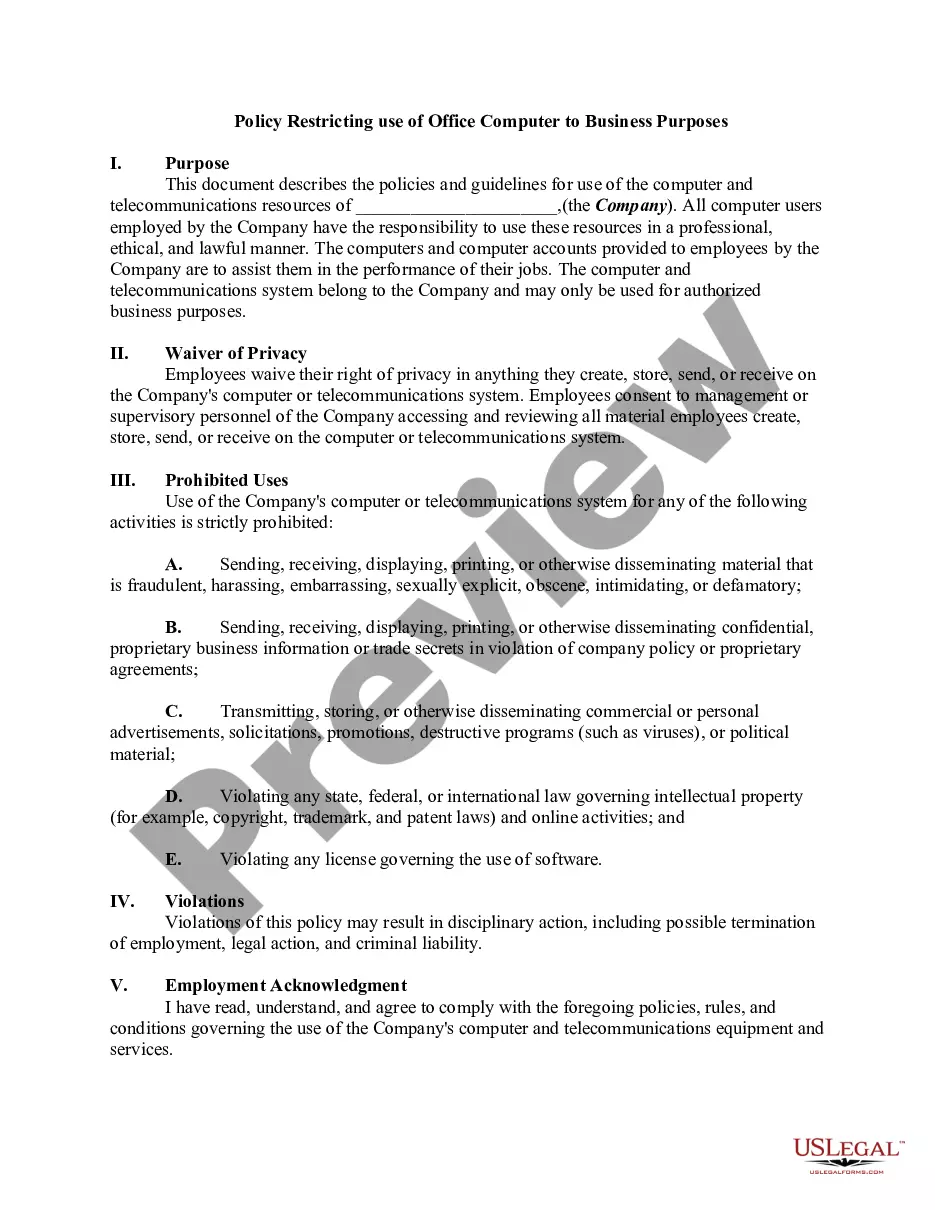
Virginia Use of Company Equipment
Description

Get your form ready online
Our built-in tools help you complete, sign, share, and store your documents in one place.
Make edits, fill in missing information, and update formatting in US Legal Forms—just like you would in MS Word.
Download a copy, print it, send it by email, or mail it via USPS—whatever works best for your next step.
Sign and collect signatures with our SignNow integration. Send to multiple recipients, set reminders, and more. Go Premium to unlock E-Sign.
If this form requires notarization, complete it online through a secure video call—no need to meet a notary in person or wait for an appointment.
We protect your documents and personal data by following strict security and privacy standards.

Make edits, fill in missing information, and update formatting in US Legal Forms—just like you would in MS Word.

Download a copy, print it, send it by email, or mail it via USPS—whatever works best for your next step.

Sign and collect signatures with our SignNow integration. Send to multiple recipients, set reminders, and more. Go Premium to unlock E-Sign.

If this form requires notarization, complete it online through a secure video call—no need to meet a notary in person or wait for an appointment.

We protect your documents and personal data by following strict security and privacy standards.
Looking for another form?
How to fill out Use Of Company Equipment?
It is feasible to allocate time online attempting to locate the legal document format that meets the state and federal requirements you need.
US Legal Forms provides thousands of legal templates that have been reviewed by professionals.
You can easily download or print the Virginia Use of Company Equipment from their service.
In order to obtain another version of the document, use the Search field to locate the format that suits your requirements and preferences.
- If you have a US Legal Forms account, you can Log In and click on the Acquire button.
- After that, you can fill out, modify, print, or sign the Virginia Use of Company Equipment.
- Every legal document format you obtain is yours indefinitely.
- To get an additional copy of the purchased form, visit the My documents tab and click on the relevant button.
- If you are using the US Legal Forms website for the first time, follow the straightforward instructions below.
- Firstly, ensure that you have selected the correct document format for your county/town of choice.
- Review the document outline to confirm you have chosen the appropriate form.
Form popularity
FAQ
Virginia Code 58.1-602 outlines the rules governing the assessment of tangible personal property for taxation purposes. This code is essential for businesses to understand as it affects how equipment and machinery are evaluated for tax purposes. Familiarity with Virginia Use of Company Equipment in light of this code can help ensure accurate tax reporting and compliance.
Section 58.1-3507 in Virginia pertains to the assessment and taxation of personal property, including company equipment. This section helps clarify how different types of property are classified and taxed. Being well-informed about these sections can aid businesses in compliance with tax laws related to Virginia Use of Company Equipment.
Virginia is a personal property tax state where owners of vehicles and leased vehicles are subject to an annual tax based on the value of the vehicle on January 1.
Virginia is a personal property tax state where owners of vehicles and leased vehicles are subject to an annual tax based on the value of the vehicle on January 1.
Tangible personal property, as defined by state code, is all personal property not otherwise classified as intangible personal property, merchants' capital, or as short-term rental property (Code of Virginia, §58.1-3500).
The current percentage of personal property tax relief is 27% and is provided only on the first $20,000 of a vehicle's value. For an estimate of the tax on your vehicle, contact the office of the Commissioner of the Revenue.
The Code of Virginia requires all business owners, including home based businesses, to annually report business tangible personal property for taxation.
The Personal Property Taxpayers Division assesses all vehicles including cars, trucks, trailers, motorcycles, motor homes, aircraft, and watercraft. Mobile homes on temporary foundations are also assessed as personal property. Personal Property is taxable in the locality where it is normally garaged, docked, or parked.
Tangible personal property, as defined by state code, is all personal property not otherwise classified as intangible personal property, merchants' capital, or as short-term rental property (Code of Virginia, §58.1-3500).
Tangible personal property (TPP) comprises property that can be moved or touched, and commonly includes items such as business equipment, furniture, and automobiles. This is contrasted with intangible personal property, which includes stocks, bonds, and intellectual property like copyrights and patents.