Virginia Instructional Design ADDIE
Description
Get your form ready online
Our built-in tools help you complete, sign, share, and store your documents in one place.
Make edits, fill in missing information, and update formatting in US Legal Forms—just like you would in MS Word.
Download a copy, print it, send it by email, or mail it via USPS—whatever works best for your next step.
Sign and collect signatures with our SignNow integration. Send to multiple recipients, set reminders, and more. Go Premium to unlock E-Sign.
If this form requires notarization, complete it online through a secure video call—no need to meet a notary in person or wait for an appointment.
We protect your documents and personal data by following strict security and privacy standards.

Make edits, fill in missing information, and update formatting in US Legal Forms—just like you would in MS Word.

Download a copy, print it, send it by email, or mail it via USPS—whatever works best for your next step.

Sign and collect signatures with our SignNow integration. Send to multiple recipients, set reminders, and more. Go Premium to unlock E-Sign.

If this form requires notarization, complete it online through a secure video call—no need to meet a notary in person or wait for an appointment.

We protect your documents and personal data by following strict security and privacy standards.
Looking for another form?







How to fill out Instructional Design ADDIE?
You might spend hours online searching for the legal document template that satisfies the federal and state requirements you require.
US Legal Forms provides a vast array of legal forms assessed by professionals.
It is easy to download or print the Virginia Instructional Design ADDIE from my services.
If available, utilize the Preview option to view the document template as well.
- If you already possess a US Legal Forms account, you can Log In and select the Obtain option.
- After that, you can complete, alter, print, or sign the Virginia Instructional Design ADDIE.
- Every legal document template you obtain is yours forever.
- To acquire another copy of any purchased form, navigate to the My documents tab and click the relevant option.
- If you are using the US Legal Forms website for the first time, follow the straightforward instructions listed below.
- First, ensure that you have chosen the appropriate document template for the area/city of your choice.
- Review the form outline to confirm you have selected the right form.
Form popularity
FAQ
The five steps of the ADDIE training process are Analysis, Design, Development, Implementation, and Evaluation. In Virginia Instructional Design ADDIE, each step plays a critical role in creating effective learning experiences. You analyze needs, design the curriculum, develop training materials, implement the program, and evaluate the outcomes. This systematic approach enhances learning impact.
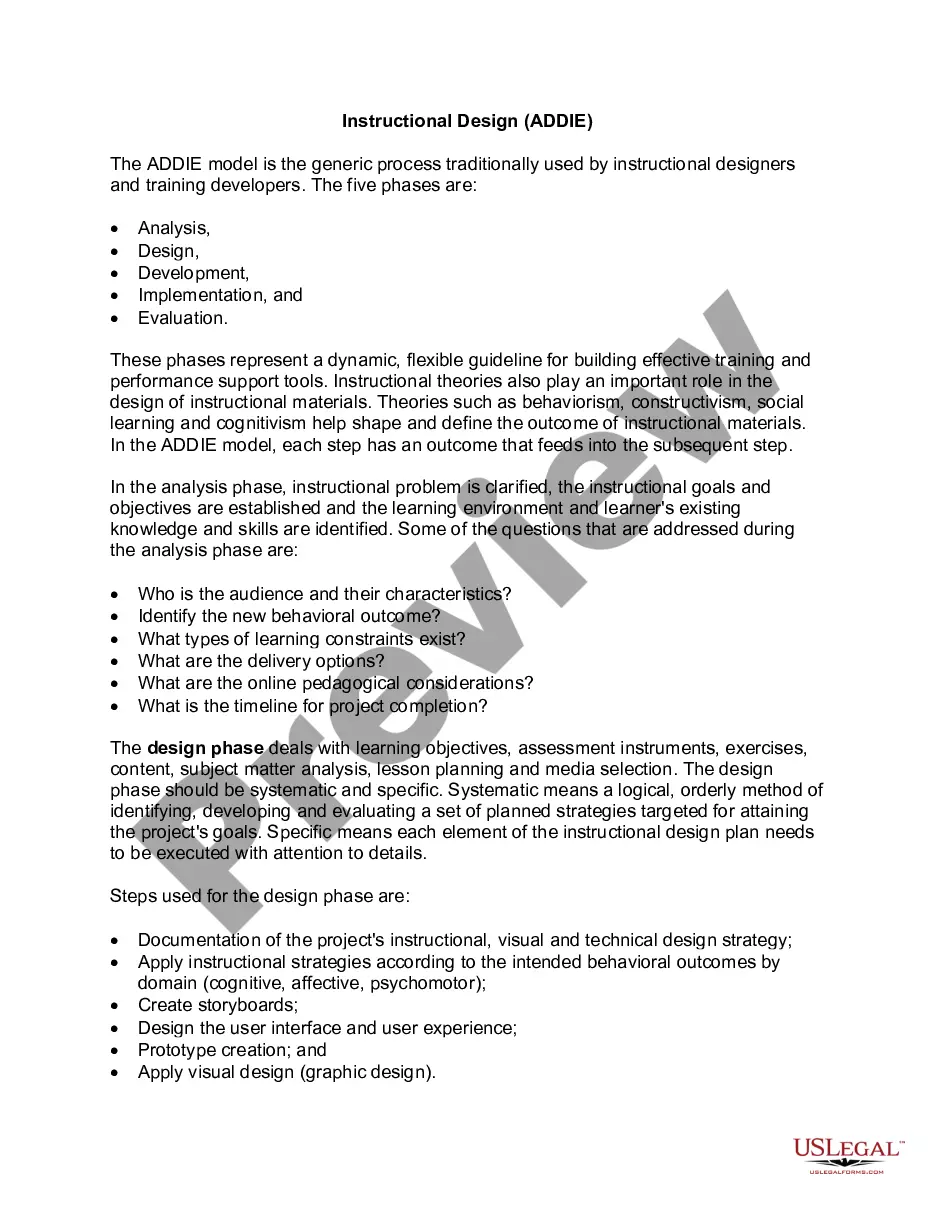
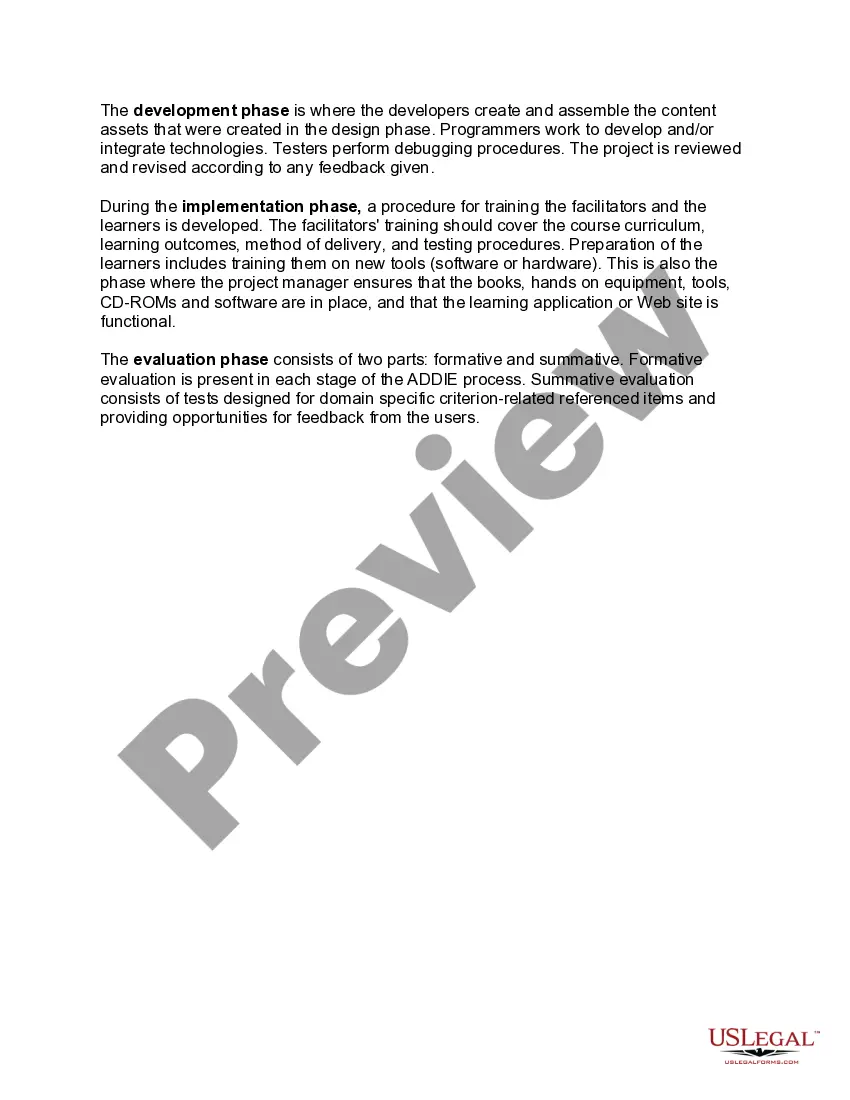
The ADDIE model is the generic process traditionally used by instructional designers and training developers. The five phasesAnalysis, Design, Development, Implementation, and Evaluationrepresent a dynamic, flexible guideline for building effective training and performance support tools.
In this post we'll explore the five stages of the ADDIE model of instructional designanalysis, design, development, implementation, and evaluationand how this process can help or hurt your learning evaluation methods.
Addie is an acronym for the five stages of a development process: Analysis, Design, Development, Implementation, and Evaluation. The ADDIE model relies on each stage being done in the given order but with a focus on reflection and iteration.
The phases of the ADDIE model include: (1) Analysis, (2) Design, (3) Development, (4) Implementation, and (5) Evaluation.
Stages of the Training Process. Effective training begins well before a trainer delivers an individual training session and continues after that training session is complete. Training can be viewed as a process comprised of five related stages or activities: assessment, motivation, design, delivery, and evaluation.
ADDIE is a learning model used by instructional designers and training developers to create effective learning experiences. What does the acronym ADDIE stand for? The term, ADDIE, is an acronym for a five-step process: Analysis, Design, Development, Implementation, and Evaluation.
ADDIE is an acronym for Analyze, Design, Development, Implementation, and Evaluation. We will now go through each of these phases and highlight their key points.
The ADDIE model was created by Florida State University for the military in the 1970s. The name of the model is an acronym for the 5 stages of design: Analysis, Design, Development, Implementation, and Evaluation and was meant as a guideline to create effective training and instructional materials.
In this post we'll explore the five stages of the ADDIE model of instructional designanalysis, design, development, implementation, and evaluationand how this process can help or hurt your learning evaluation methods.