A party wall is a wall located on or at the division line between adjoining premises and used by adjoining landowners in the construction or maintenance of improvements on their respective properties. Generally, each owner of adjoining lands on which a party wall stands owns the part of the wall that stands on the owner's land and has an easement on the other part. Party wall interests are dependent on the terms of an agreement between the adjoining landowners. Unless the party wall agreement provides otherwise, the duration of the adjoining owners interests in the wall ordinarily continue as long as the wall stands. Party wall easements are terminated on the accidental destruction of the wall and, under some circumstances, on substantial changes in conditions of the neighborhood. The terms of the party wall agreement can provide for termination under other circumstances.
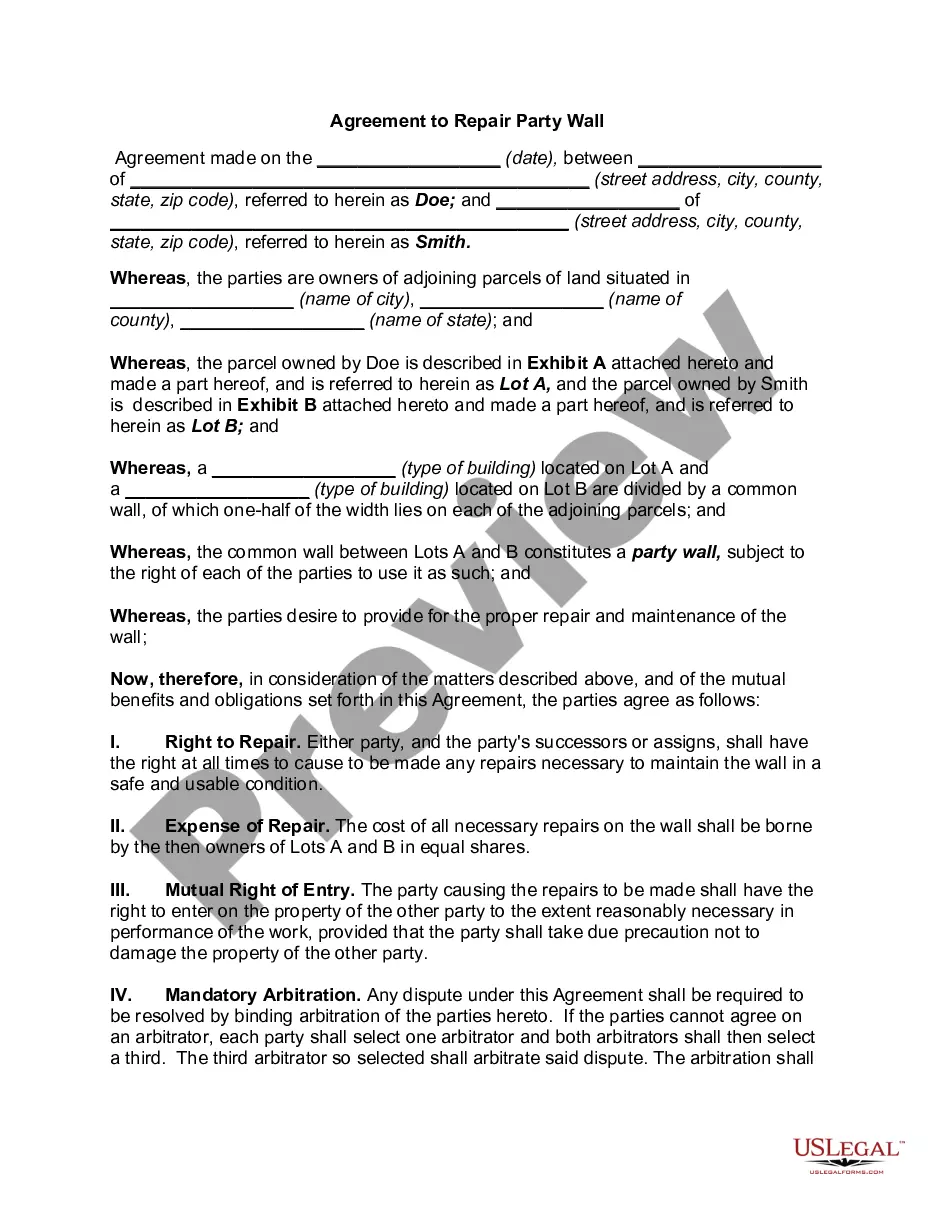
Since a party wall easement is an interest in land, it may be created by express deed drawn and executed with the same formalities as any other deed to real estate, or by a deed provision granting or reserving party wall interests. A contract, or provision in a contract, may also operate to create party wall interests. The following form is a general form establishing a party wall.
Virginia Party Wall Agreement
165 downloads
Description
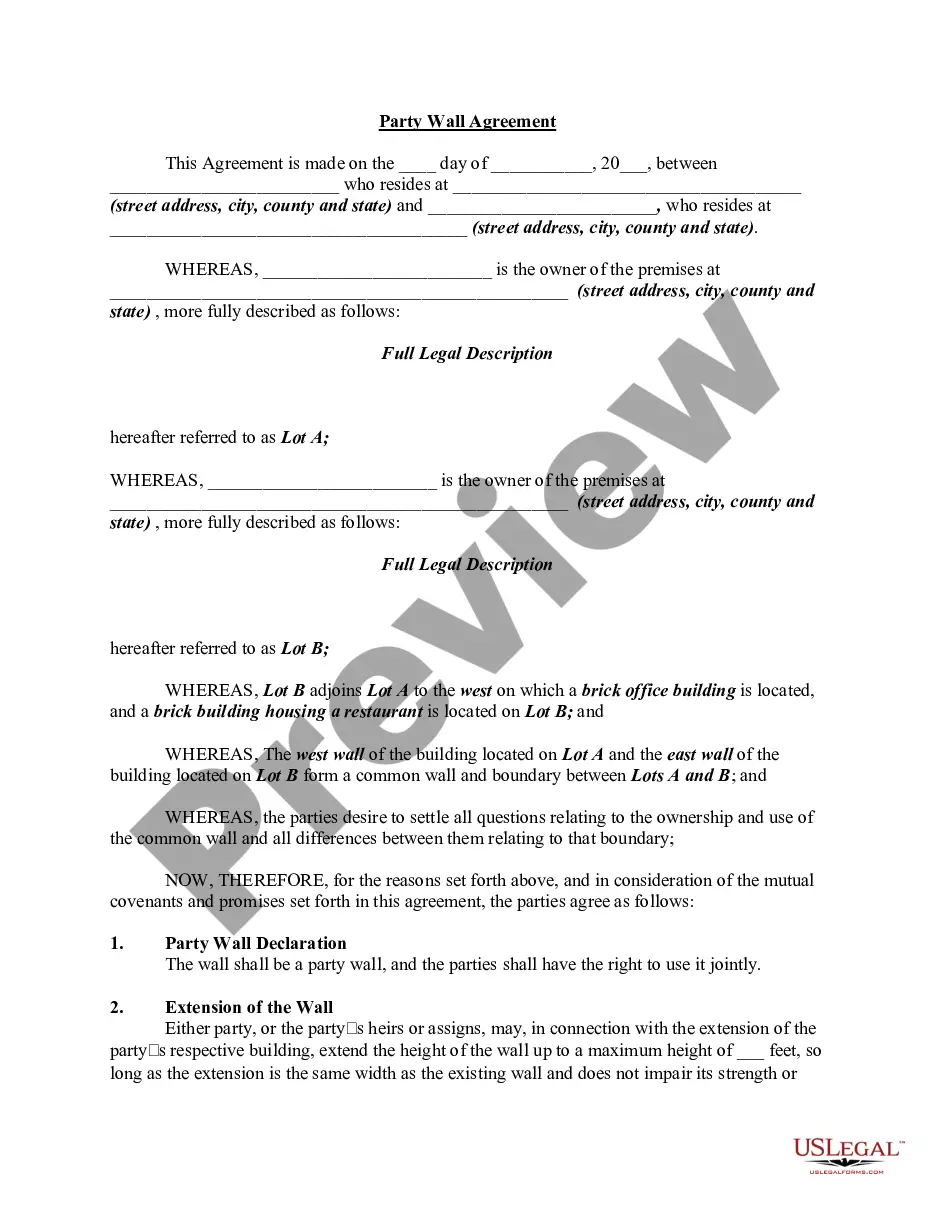
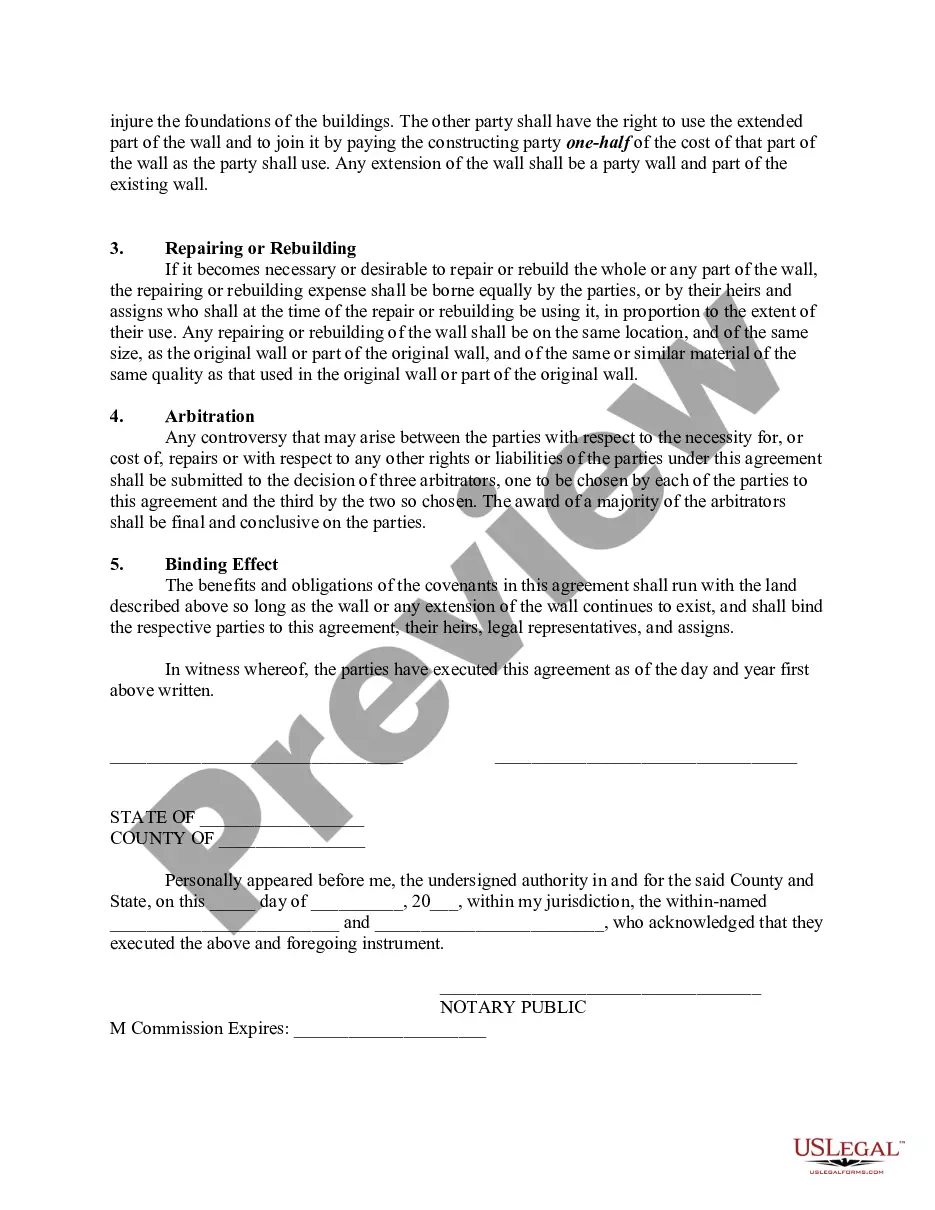
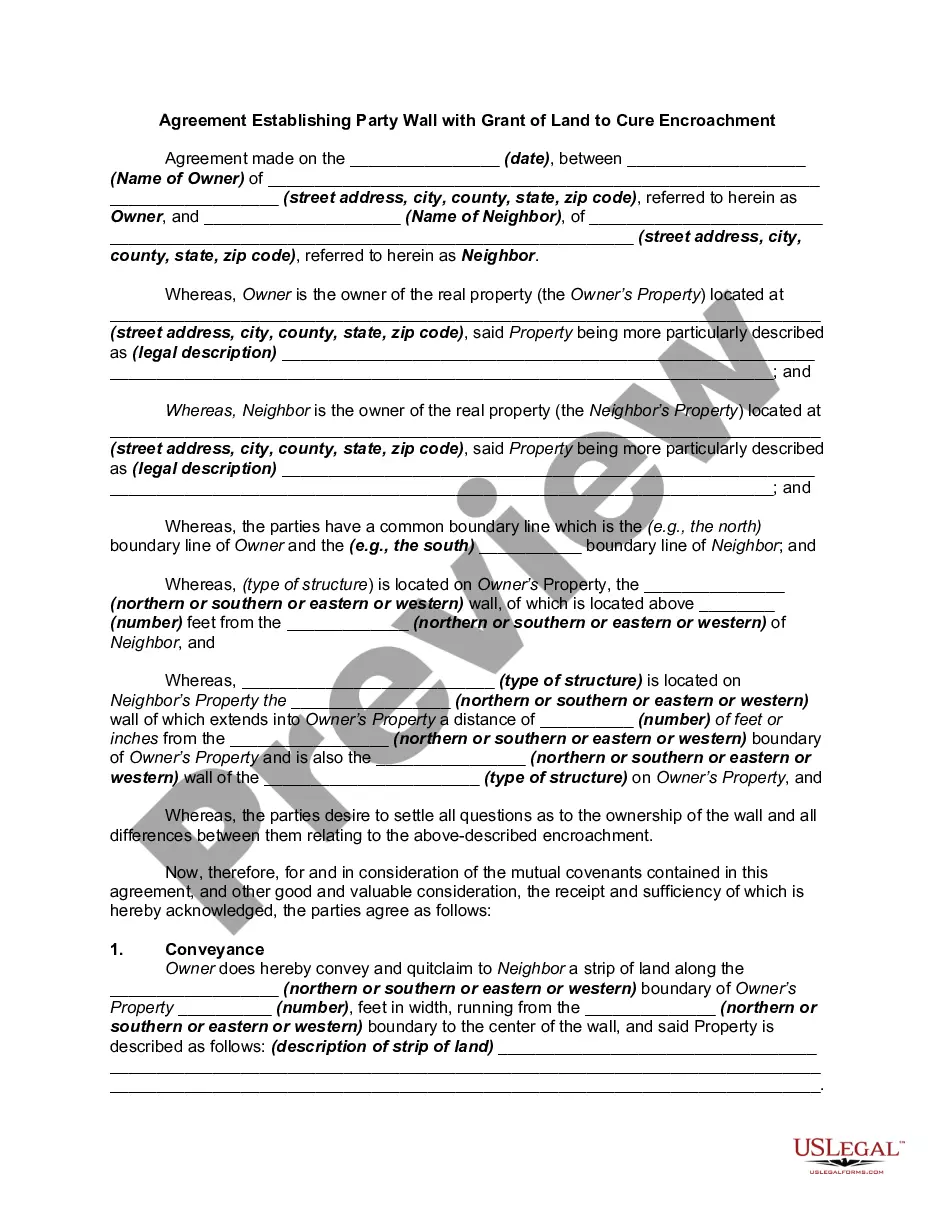
Free preview
Get your form ready online
Our built-in tools help you complete, sign, share, and store your documents in one place.
Built-in online Word editor
Make edits, fill in missing information, and update formatting in US Legal Forms—just like you would in MS Word.
Export easily
Download a copy, print it, send it by email, or mail it via USPS—whatever works best for your next step.
E-sign your document
Sign and collect signatures with our SignNow integration. Send to multiple recipients, set reminders, and more. Go Premium to unlock E-Sign.
Notarize online 24/7
If this form requires notarization, complete it online through a secure video call—no need to meet a notary in person or wait for an appointment.
Store your document securely
We protect your documents and personal data by following strict security and privacy standards.

Make edits, fill in missing information, and update formatting in US Legal Forms—just like you would in MS Word.

Download a copy, print it, send it by email, or mail it via USPS—whatever works best for your next step.

Sign and collect signatures with our SignNow integration. Send to multiple recipients, set reminders, and more. Go Premium to unlock E-Sign.

If this form requires notarization, complete it online through a secure video call—no need to meet a notary in person or wait for an appointment.

We protect your documents and personal data by following strict security and privacy standards.
Looking for another form?


How to fill out Party Wall Agreement?
Have you ever been in a situation where you require documents for either business or personal purposes almost every day? There are numerous legitimate document templates accessible online, but finding versions you can rely on is challenging.
US Legal Forms offers thousands of template documents, similar to the Virginia Party Wall Agreement, designed to meet federal and state regulations.
If you are already familiar with the US Legal Forms website and have an account, simply Log In. After that, you can download the Virginia Party Wall Agreement template.
- Find the document you need and ensure it is for your respective city/county.
- Use the Preview button to review the form.
- Read the description to confirm you have chosen the correct document.
- If the document is not what you’re looking for, utilize the Search field to find a form that meets your requirements.
- Once you've found the right document, click Acquire now.
- Select the subscription plan you desire, fill in the required details to create your account, and purchase the order using your PayPal or credit card.
- Choose a convenient format and download your copy.
Form popularity
FAQ
Yes, you can create your own Virginia Party Wall Agreement, but it is crucial to include all necessary provisions to protect both parties. Ensure that your agreement addresses construction details, responsibilities, and dispute resolution methods. To simplify this process and ensure legality, consider using resources from US Legal Forms for reliable templates.
To write a party wall notice in Virginia, start by providing your details and the details of the adjacent property owner. Clearly outline your intended work and include the date you plan to start. US Legal Forms offers templates that ensure your notice meets legal standards, making it easier for you to communicate effectively.
Filling a party wall can vary depending on local laws and specific agreements in your Virginia Party Wall Agreement. Generally, you may need consent from the adjacent property owner before making any alterations. It is crucial to have everything documented to avoid disputes, so utilizing a platform like US Legal Forms can be very helpful.
Yes, you can serve a party wall notice yourself in Virginia, but caution is advisable. A properly drafted notice is essential to comply with legal requirements, and it should include all pertinent information about the project. If you feel unsure about the process, consider using services from US Legal Forms for guidance and accuracy.
Writing a Virginia Party Wall Agreement involves several key steps. First, clearly define the property boundaries and the specific rights and responsibilities of each party. Include details about any planned construction or alterations, and how disputes will be resolved. You can use templates provided by platforms like US Legal Forms to ensure you cover all necessary legal aspects.
To serve a Virginia Party Wall Agreement, you must deliver the document to the adjoining property owner properly. This can be done by hand delivery or through registered mail to ensure you have proof of receipt. Including specific details about the proposed work and deadlines in the notice can facilitate a clear response from the other party. If needed, uslegalforms offers templates and guidance to streamline this process effectively.
Typically, the property owners who share a boundary must arrange a Virginia Party Wall Agreement. This process often involves one party initiating the discussions and drafting the agreement. It is common for an attorney or a surveyor to assist in creating the document to ensure compliance with local laws. Ultimately, open communication between both parties leads to a successful agreement.
The distance from a boundary where you can build without a Virginia Party Wall Agreement largely depends on local regulations. As a general guideline, structures may need to be built at least a foot away from the boundary line to avoid necessitating an agreement. However, specific local laws can vary, so it's vital to check with your local authority. Consulting uslegalforms can provide the necessary documents tailored to your local requirements.
Ignoring a Virginia Party Wall Agreement can lead to significant legal and financial repercussions. If your construction affects a shared wall or boundary, proceeding without an agreement may result in disputes or even legal action from your neighbors. It is crucial to recognize that this agreement protects everyone involved by clearly outlining expectations and responsibilities. Engaging with uslegalforms can help ensure you have a valid agreement in place.
The 3 meter rule for a party wall refers to restrictions on construction activities within three meters of a neighboring property’s boundary. If your work falls within this distance and affects a shared wall, a Virginia Party Wall Agreement is likely necessary. This rule aims to protect neighboring properties from potential structural damage during construction. It is advisable to consult with legal expertise to interpret this rule correctly.