Virginia Protecting Minors from Identity Theft Package
What is this form package?
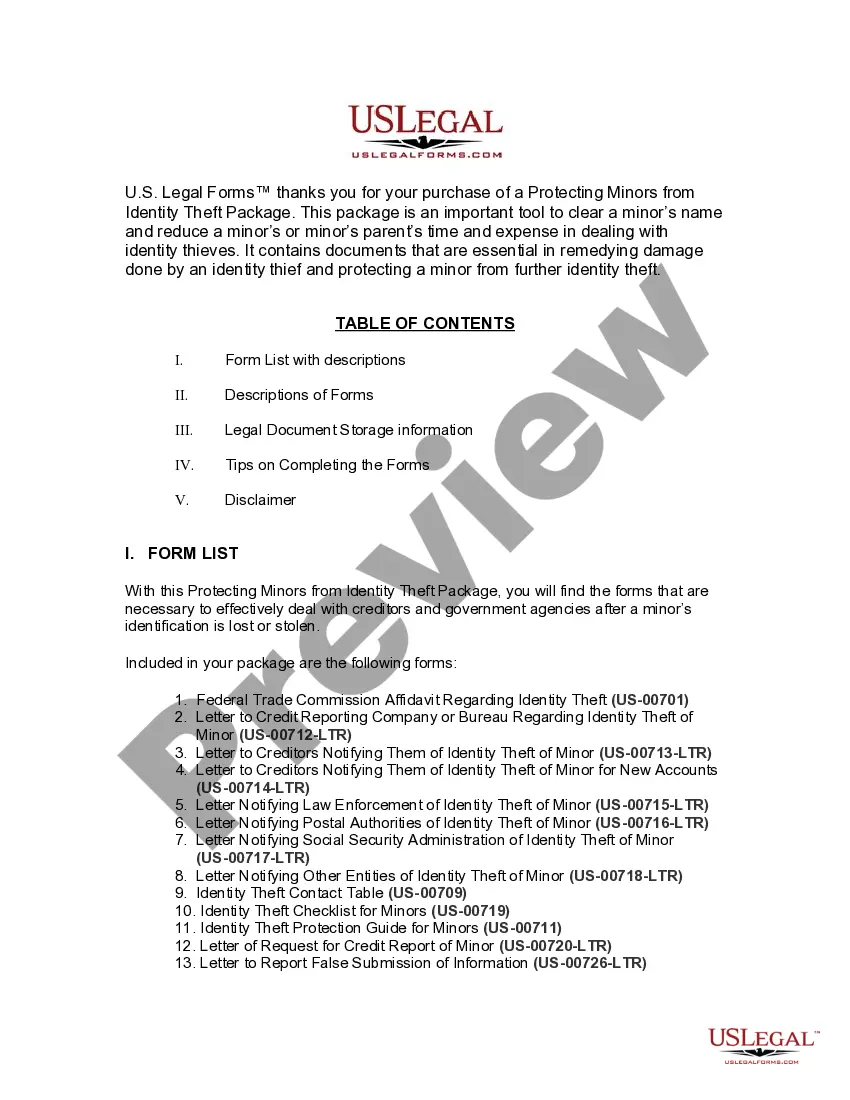
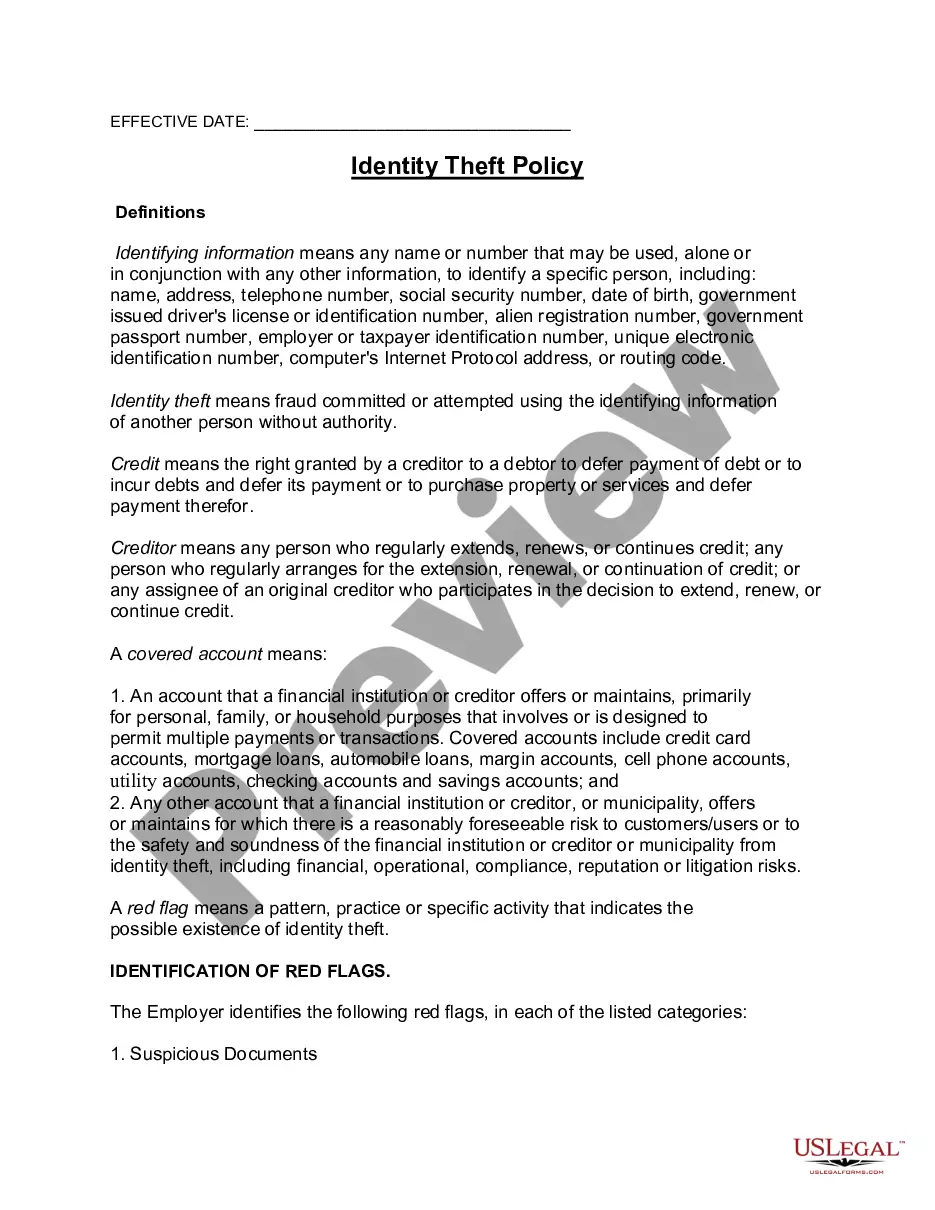
The Virginia Protecting Minors from Identity Theft Package is a comprehensive set of legal forms designed to help minors and their parents address identity theft issues. This package streamlines communication with creditors and government agencies after a minor's identification is lost or stolen. Unlike generic identity theft forms, this package is specifically tailored for minors, ensuring that all necessary steps are covered to protect their credit and financial well-being.
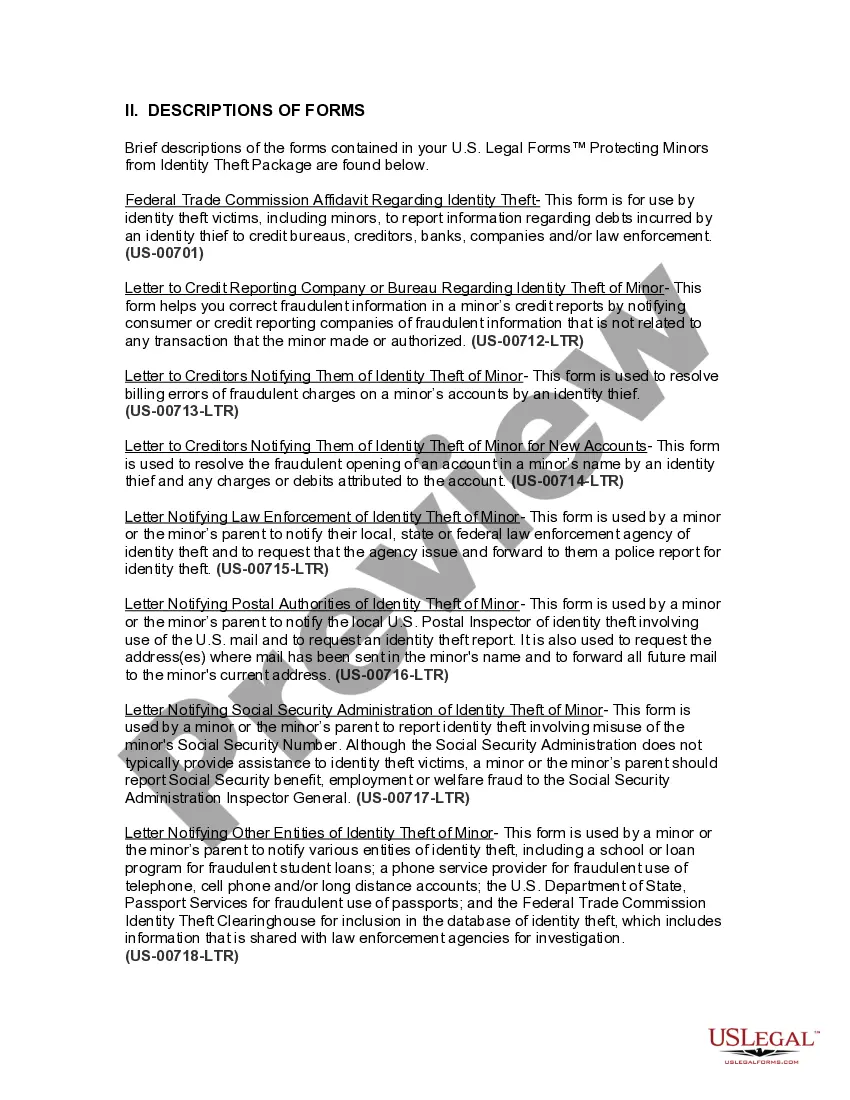
Forms provided in this package
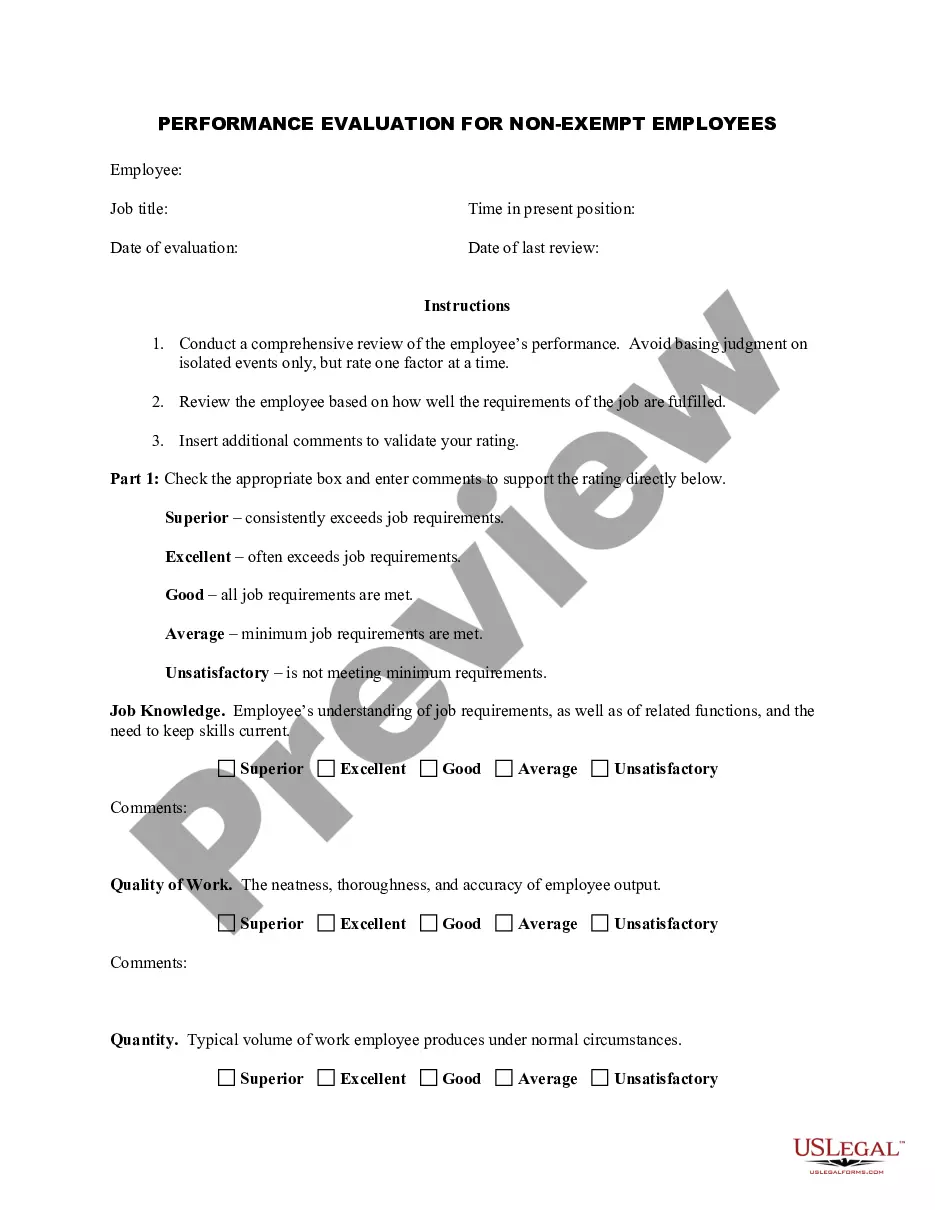
- Federal Trade Commission Affidavit regarding Identity Theft
- Identity Theft Contact Table
- Guide for Protecting Minors from Identity Theft
- Letter to Credit Reporting Company or Bureau Regarding Identity Theft of Minor
- Letter to Creditors Notifying Them of Identity Theft of Minor
- Letter to Creditors Notifying Them of Identity Theft of Minor for New Accounts
- Letter Notifying Law Enforcement of Identity Theft of Minor
- Letter Notifying Postal Authorities of Identity Theft of Minor
- Letter Notifying Social Security Administration of Identity Theft of Minor
- Letter to Other Entities Notifying Them of Identity Theft of Minor
- Identity Theft Checklist for Minors
- Sample Letter for Request for Credit Report of a Minor
- Sample Letter to Report False Submission of Minor's Information
Situations where these forms applies
This form package is needed in various scenarios, including:
- When a minor's identification has been lost or stolen.
- If fraudulent accounts have been opened in the minor's name.
- When a minor's personal information has been misused for financial gain.
- To notify law enforcement or government agencies about identity theft incidents involving a minor.
- To correct fraudulent information reported on a minor's credit report.
Who can use this document
- Parents or guardians of minors affected by identity theft.
- Minors who have experienced identity theft issues.
- Individuals looking to protect the credit and financial stability of minors.
How to prepare this document
- Review the forms included in the package to understand their purpose.
- Fill out each form carefully, entering all necessary information about the minor.
- Collect supporting documents that may be required for each notification or report.
- Send the completed forms to the relevant creditors, agencies, or authorities as instructed.
- Keep a copy of all correspondence and forms for your records.
Notarization requirements for forms in this package
Forms in this package typically do not require notarization unless required by local law. It is advisable to check specific requirements for certain forms you submit to ensure compliance.
Get your form ready online
Our built-in tools help you complete, sign, share, and store your documents in one place.
Make edits, fill in missing information, and update formatting in US Legal Forms—just like you would in MS Word.
Download a copy, print it, send it by email, or mail it via USPS—whatever works best for your next step.
Sign and collect signatures with our SignNow integration. Send to multiple recipients, set reminders, and more. Go Premium to unlock E-Sign.
If this form requires notarization, complete it online through a secure video call—no need to meet a notary in person or wait for an appointment.
We protect your documents and personal data by following strict security and privacy standards.

Make edits, fill in missing information, and update formatting in US Legal Forms—just like you would in MS Word.

Download a copy, print it, send it by email, or mail it via USPS—whatever works best for your next step.

Sign and collect signatures with our SignNow integration. Send to multiple recipients, set reminders, and more. Go Premium to unlock E-Sign.

If this form requires notarization, complete it online through a secure video call—no need to meet a notary in person or wait for an appointment.

We protect your documents and personal data by following strict security and privacy standards.
Common mistakes
- Failing to notify all relevant agencies about the identity theft.
- Leaving out critical details when filling out the forms.
- Not keeping copies of forms and correspondence for future reference.
- Assuming that one notification suffices; multiple notifications may be necessary.
Why use this package online
- Convenience of downloading and completing forms at your own pace.
- Editability allows for easy corrections and updates.
- Access to legal forms drafted by licensed attorneys, ensuring reliability and compliance with Virginia law.
Looking for another form?



Form popularity
FAQ
Can I put a block or a pin number on my son's social security number to prevent his dad from claiming him on his taxes? He doesn't support him anymore. No, you cannot stop someone from claiming a dependent.
Highlights: Check your child's credit reports. Consider a free security freeze. Consider a credit monitoring product. Keep your child's documents in a safe place. Don't share your child's personal information unless it's absolutely necessary.
No, you cannot stop someone from claiming a dependent.
First, you need to check with the Social Security Administration once a year to make sure no one is using your child's SSN. Secondly, you need to check your child's credit report (free Equifax -1-800-525-6285; Experian-1-888-397-3742; TransUnion-1-800-680-7289.)
What is child identity theft? Adults are not the only targets of identity theft. In fact, children under the age of 18 can also become victims. Child identity theft happens when someone uses a minor child's personal information, such as name and Social Security number, usually to obtain credit or employment.
Highlights: Check your child's credit reports. Consider a free security freeze. Consider a credit monitoring product. Keep your child's documents in a safe place. Don't share your child's personal information unless it's absolutely necessary.
To see if your Social Security number is being used by someone else for employment purposes, review your Social Security Statement at www.socialsecurity.gov/myaccount to look for suspicious activity. Finally, you'll want to use additional scrutiny by regularly checking your bank and credit card accounts online.
If you believe someone is using your Social Security number to work, get your tax refund, or other abuses involving taxes, contact the IRS online or call 1-800-908-4490. You can order free credit reports annually from the three major credit bureaus (Equifax, Experian and TransUnion).
Create an FTC Identity Theft Report. place a one-year fraud alert on your credit report. place a seven-year extended fraud alert on your credit report. get free copies of your credit report. get fraudulent information removed (or "blocked") from your credit report.