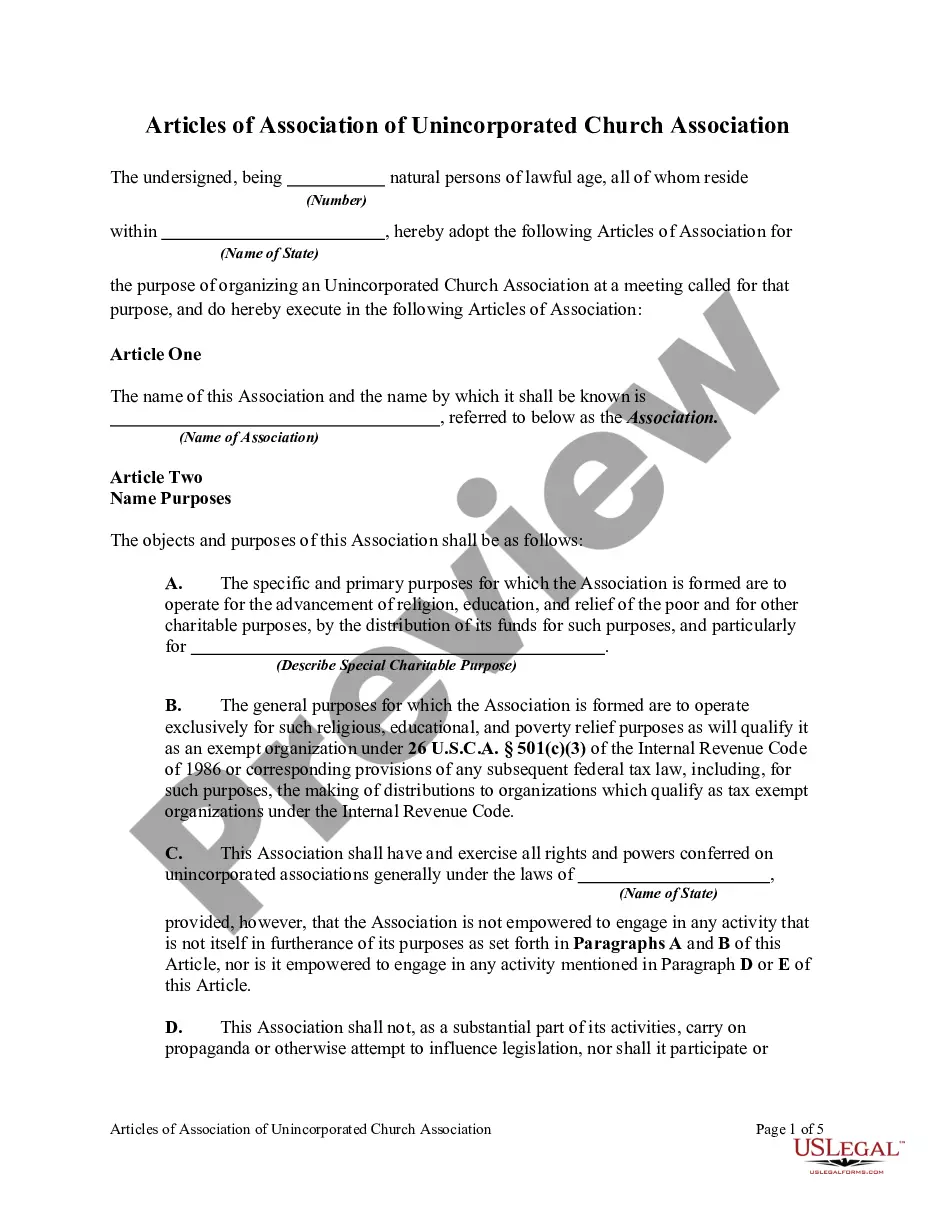
Virginia Notice to Mechanic Lien Agent and Owner/Agent - Corporation
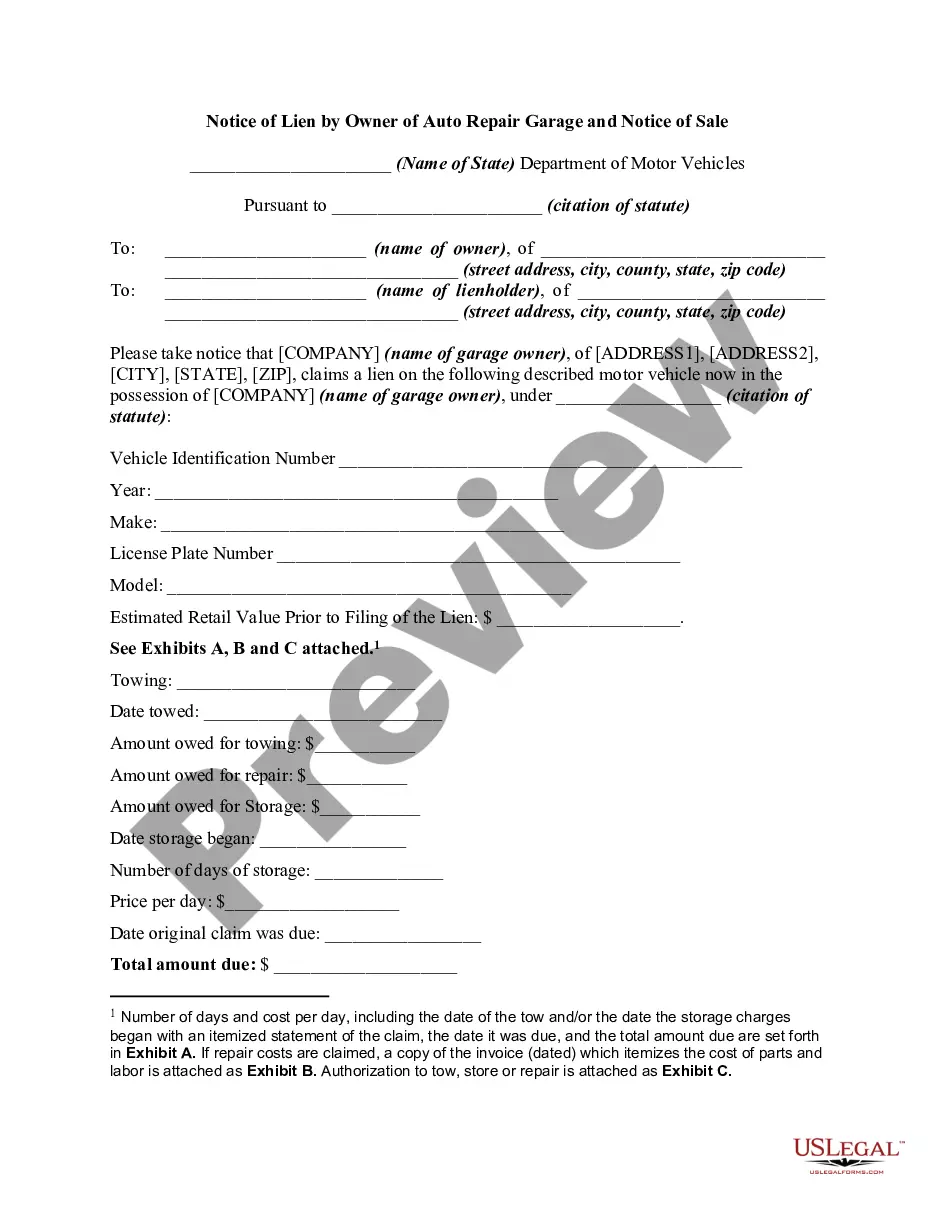
About this form
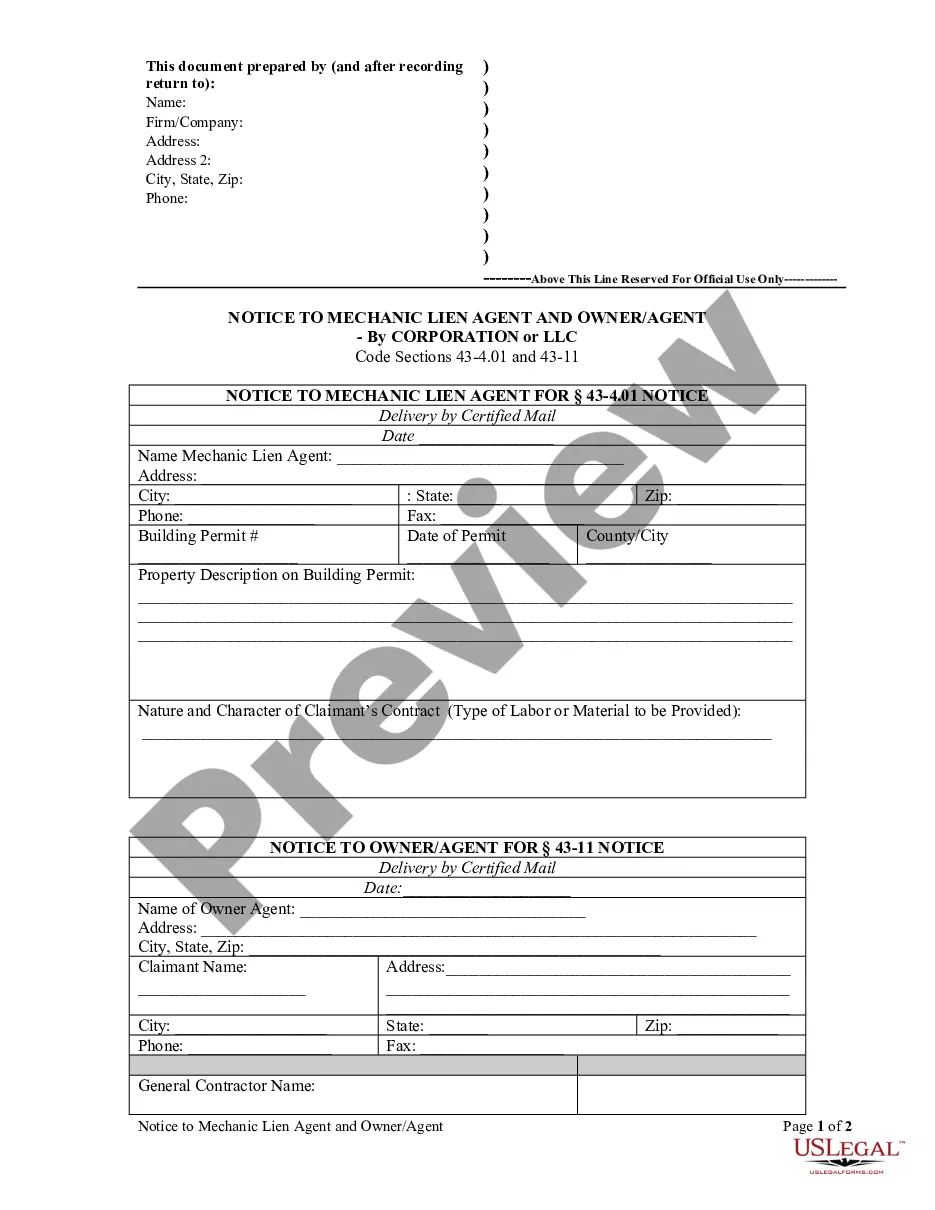
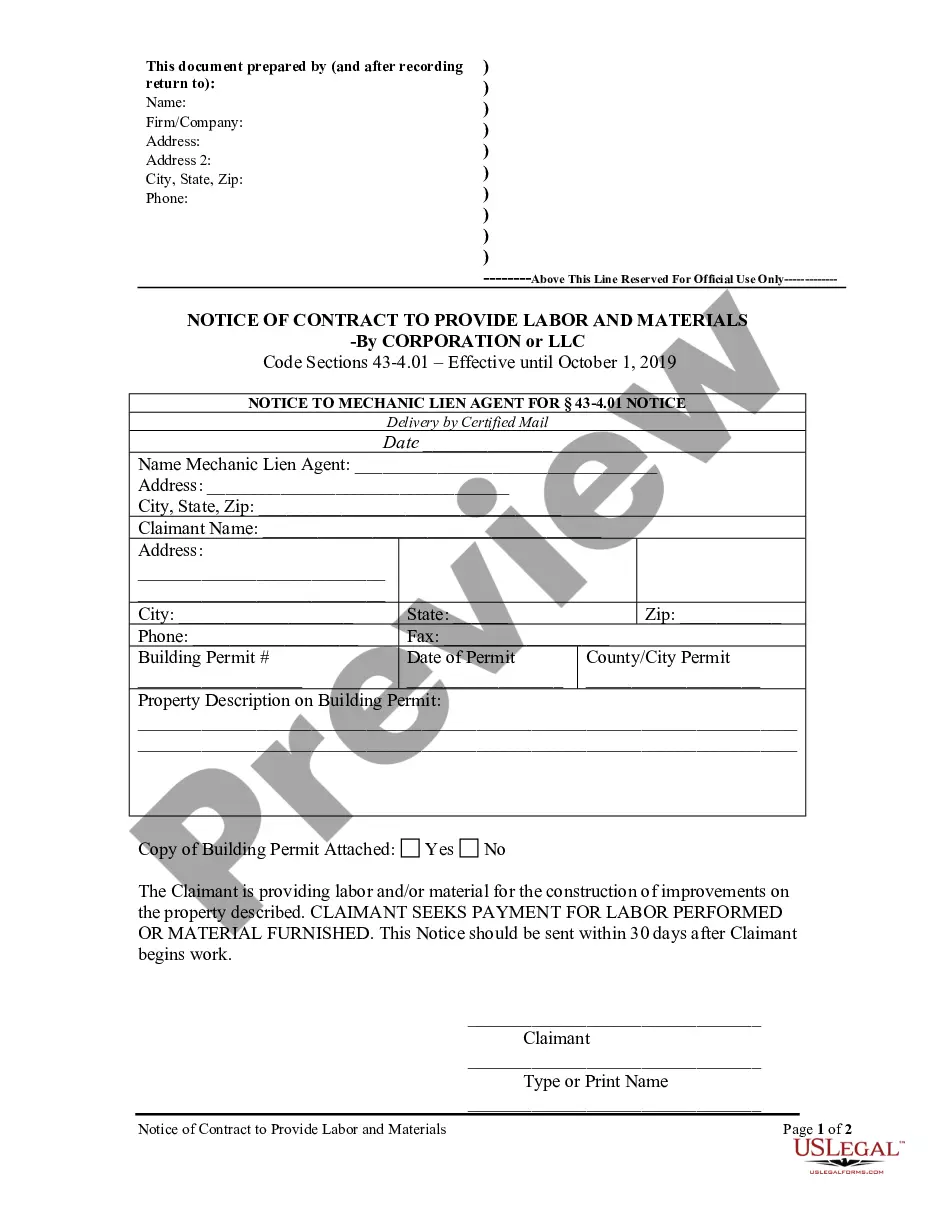
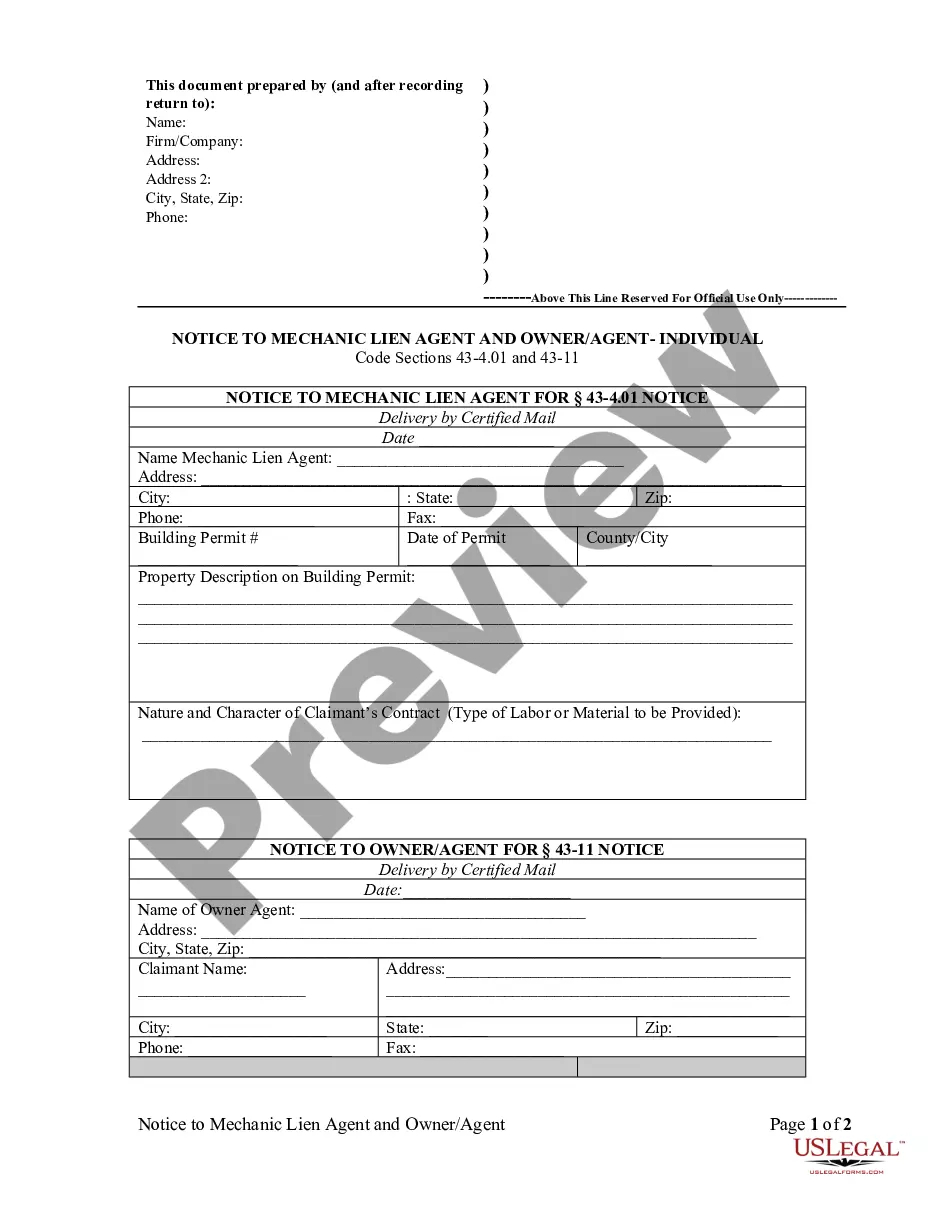
The Notice to Mechanic Lien Agent and Owner/Agent - Corporation is a legal document used by subcontractors or suppliers to notify property owners and general contractors about claims for payment related to labor or materials provided for construction projects. This form serves to inform the owner and the general contractor about the subcontractorâs contract details and estimated amounts, establishing a basis for claims. It is an essential step to protect the claimantâs rights under applicable lien laws.
Form components explained
- Claimant's contact information including address and phone number.
- Property details such as building permit number and description.
- Nature of work or materials provided by the claimant.
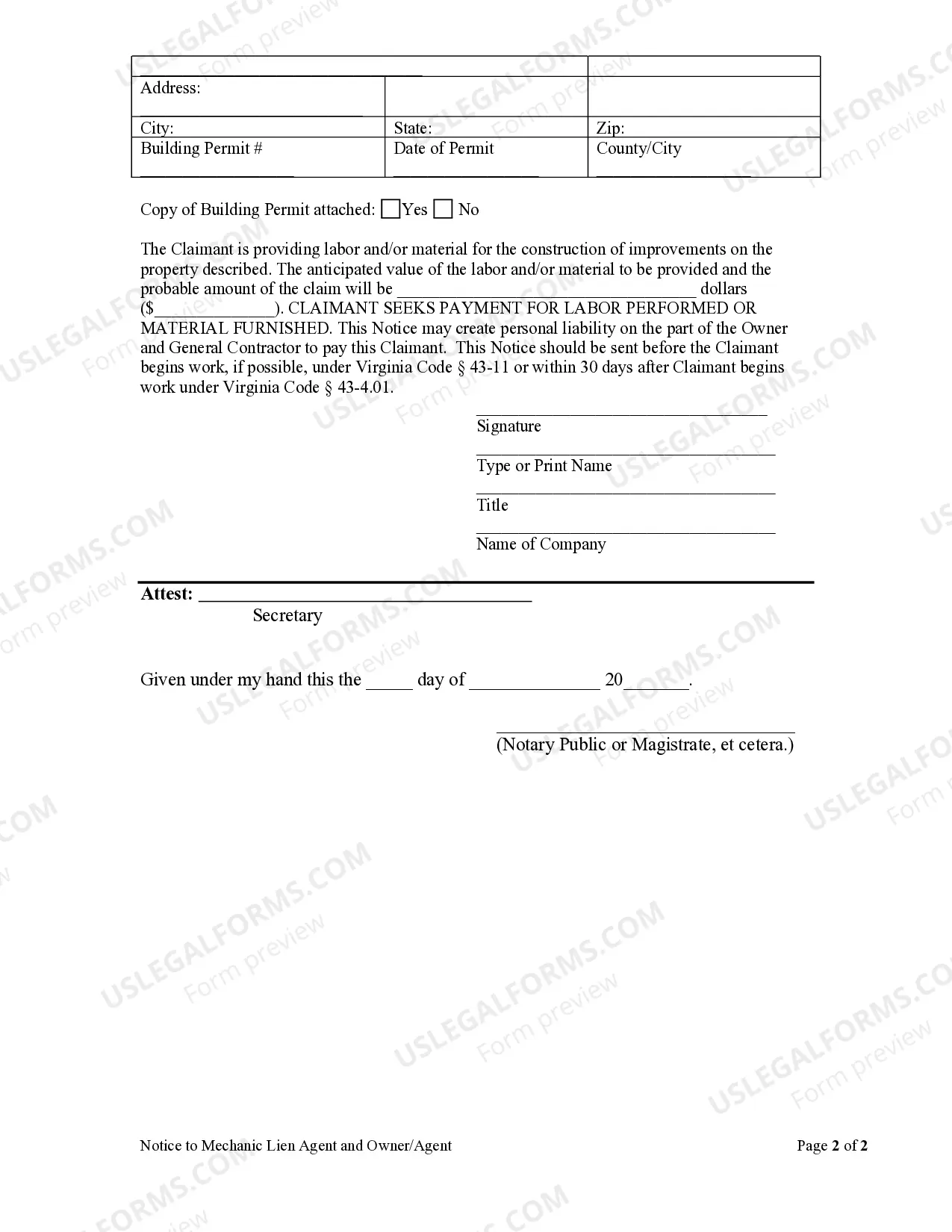
- Amount due for the labor or materials.
- Signature and title of the claimant or an authorized representative.
- Notary verification, if required.
When to use this document
This form should be used when subcontractors or suppliers need to notify property owners and general contractors about a claim for payment due to labor or materials supplied during a construction project. It is particularly important to send this notice before beginning work if possible, or within thirty days of commencing work, to protect the claimantâs right to payment and potential lien rights.
Who this form is for
This form is intended for:
- Subcontractors providing labor or materials for a construction project.
- Suppliers of materials involved in building improvements.
- Corporations acting as claimants in construction-related contracts.
How to prepare this document
- Identify the parties involved, including the claimant, owner, and general contractor.
- Provide the property details including the building permit number and description.
- Specify the nature of the work performed or materials provided.
- Quantify the anticipated value of the labor or materials to be claimed.
- Sign the form and include the title and designation of the claimant or representative.
- If required, ensure the form is notarized to validate the information provided.
Is notarization required?
This form does not typically require notarization unless specified by local law. However, having a notary certify the document can enhance its legal standing and is recommended for formal submission.
Get your form ready online
Our built-in tools help you complete, sign, share, and store your documents in one place.
Make edits, fill in missing information, and update formatting in US Legal Forms—just like you would in MS Word.
Download a copy, print it, send it by email, or mail it via USPS—whatever works best for your next step.
Sign and collect signatures with our SignNow integration. Send to multiple recipients, set reminders, and more. Go Premium to unlock E-Sign.
If this form requires notarization, complete it online through a secure video call—no need to meet a notary in person or wait for an appointment.
We protect your documents and personal data by following strict security and privacy standards.

Make edits, fill in missing information, and update formatting in US Legal Forms—just like you would in MS Word.

Download a copy, print it, send it by email, or mail it via USPS—whatever works best for your next step.

Sign and collect signatures with our SignNow integration. Send to multiple recipients, set reminders, and more. Go Premium to unlock E-Sign.

If this form requires notarization, complete it online through a secure video call—no need to meet a notary in person or wait for an appointment.

We protect your documents and personal data by following strict security and privacy standards.
Typical mistakes to avoid
- Failing to notify the owner or general contractor before beginning work.
- Incomplete or incorrect property description.
- Neglecting to include all necessary signatures.
- Not providing an accurate claim amount, which can lead to disputes.
Why use this form online
- Immediate access to the necessary legal documents, saving time.
- Editability, allowing customization to meet specific needs.
- Reliability through professionally drafted templates by licensed attorneys.
Legal use & context
- This form provides a necessary legal notice that protects the rights of subcontractors and suppliers.
- Failure to properly submit this notice can lead to difficulty in enforcing payment claims later.
Key takeaways
- The notice is crucial for protecting the rights of subcontractors and suppliers in Virginia.
- Timely delivery of the notice can establish personal liability for payment.
- Correct completion of the form is essential to ensure enforceability.
Looking for another form?

Form popularity
FAQ
Posting a Bond Asselta says to expect to pay 110 percent of the lien amount. Submit the bond to the court. The lien will then transfer to the bond and clear the property's title. Wait for the contractor claimant to foreclose on the lien in the allotted period to dispute the lien in court.
If a license is required for the work performed, an unlicensed contractor NOT ONLY cannot file a valid mechanics lien, but s/he also cannot file suit to recover, either. In California, unlicensed contractors are not entitled to be paid period for anything, and will be thrown out of court if they sue to get paid.
Someone who is owed money is generally not able to just put a lien on property without first securing a judgment. Securing a judgment requires the creditor to sue the debtor. This may be through circuit court in many jurisdictions. If under a certain dollar amount, this suit may be through the small claims court.
When a carpenter, plumber, roofer, or electrician works on a house, he or she can put a labor lien on the property if they are not paid. To file the lien, you must visit the Recorder of Deeds office in the county where the property is located.
The people who can file mechanic's liens are identified by state law. A subcontractor or supplier to a subcontractor may not be able to file a lien. Also, unlicensed contractors are often barred from filing a mechanic's lien.
Who can file a Virginia mechanics' lien Claim? All persons providing labor or materials worth $50 or more for the construction, repair, or improvement or removal of any permanent building or structure next to real estate or railroad is entitled to file a Virginia mechanics' lien .
To attach the lien, the creditor records the judgment on the county recorder's lien docket in any Virginia county where the debtor owns property now or may own property in the future.
With the judgment in hand, a judgment creditor can place a judgment lien on your real estate and occasionally on personal property depending on the state in which you live.
2. States where the lien law doesn't require a written contract. In these states, contractors and suppliers are generally allowed to file a lien even if they don't have a written contract.These states typically permit parties with verbal, oral, or even implied contracts to claim lien rights.