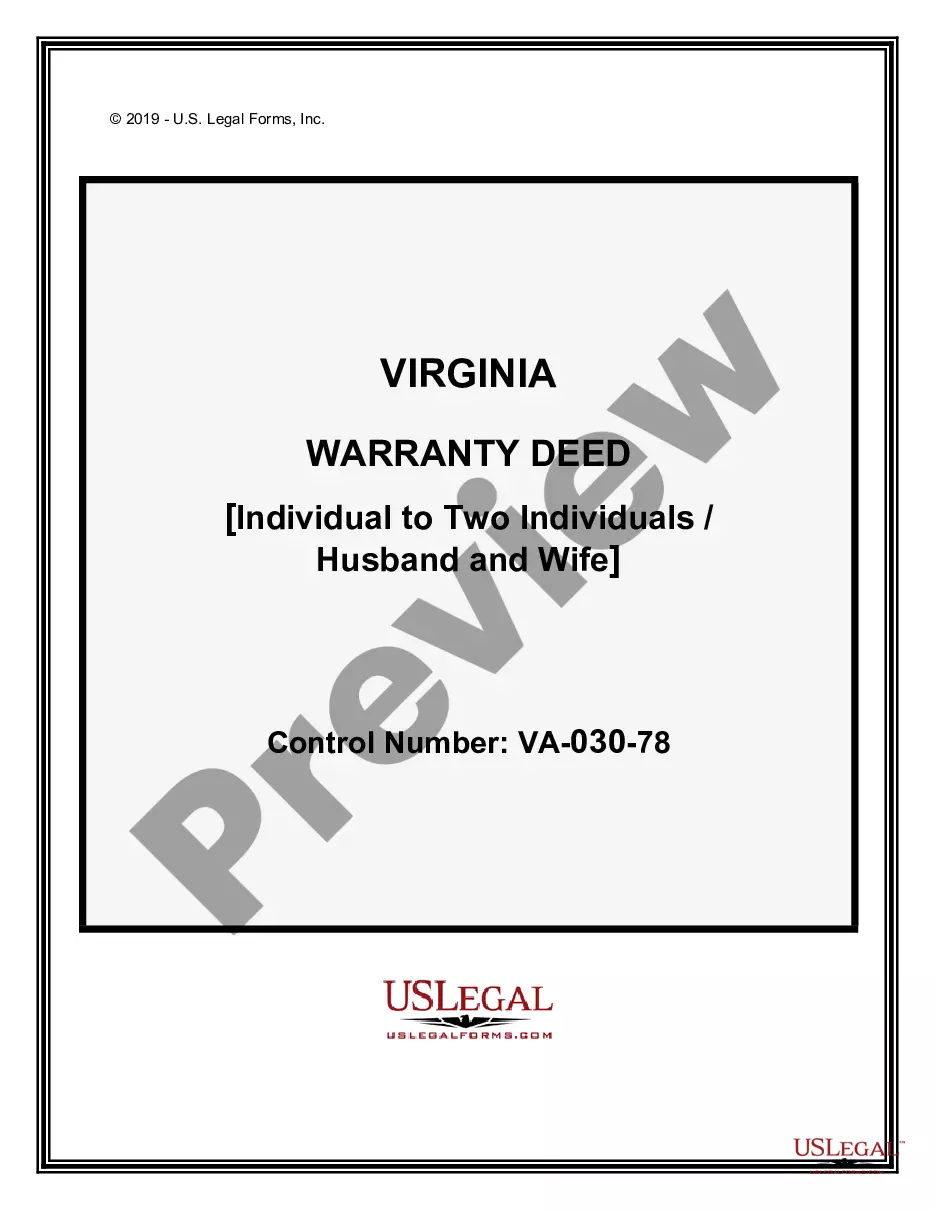
Virginia Warranty Deed from an Individual to Two Individuals or Husband and Wife
Overview of this form
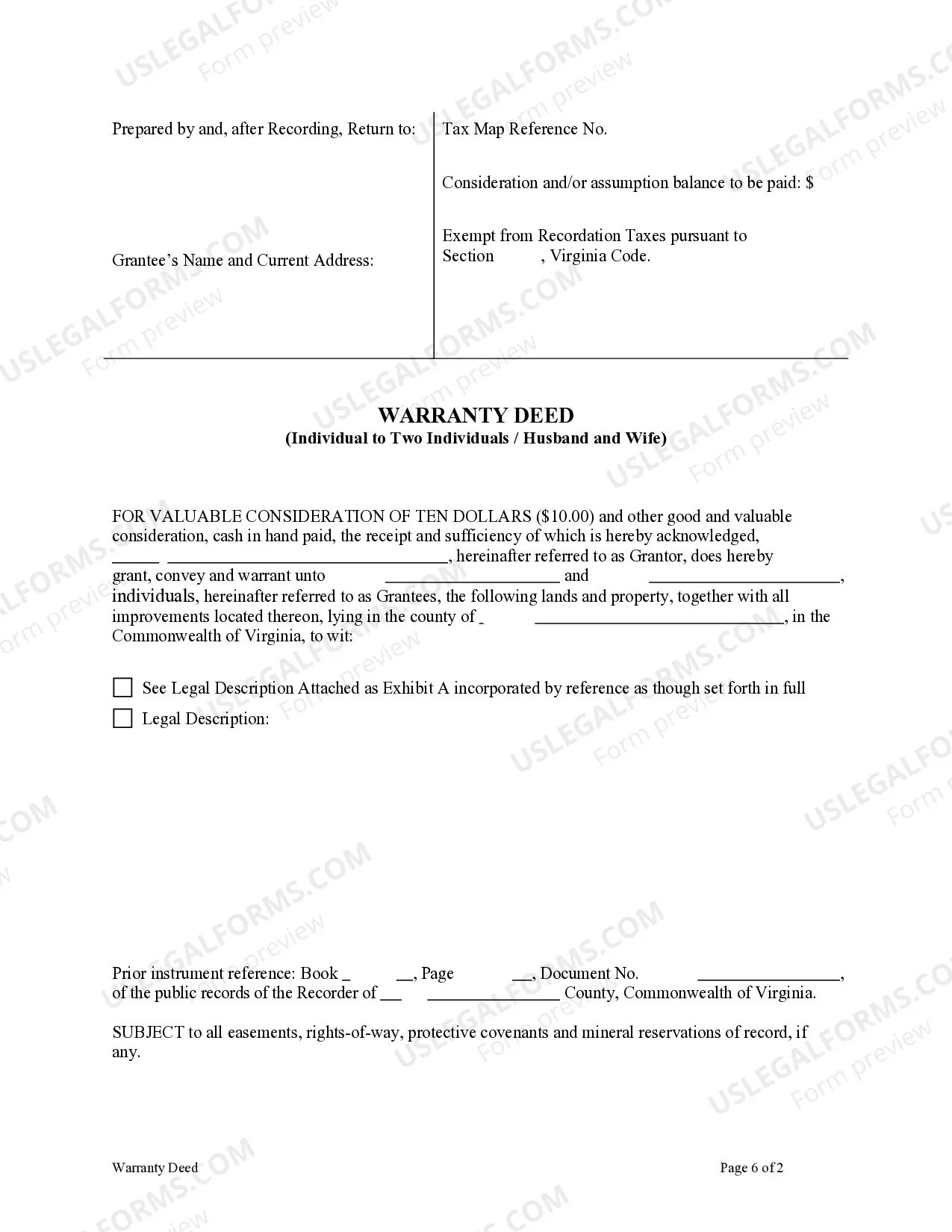
This form is a Warranty Deed from an Individual to Two Individuals or Husband and Wife. It allows an individual (the Grantor) to convey property to two individuals or a couple (the Grantees). The Warranty Deed ensures that the Grantees receive the property with certain guarantees regarding ownership and title, distinguishing it from other types of deeds that may not offer these assurances, such as quitclaim deeds.
Key components of this form
- Identification of the Grantor (the individual transferring the property).
- Details about the Grantees (the two individuals or couple receiving the property).
- Description of the property being conveyed, including its legal boundaries.
- Terms of ownership (tenants in common, joint tenants with the right of survivorship, or tenants by the entirety).
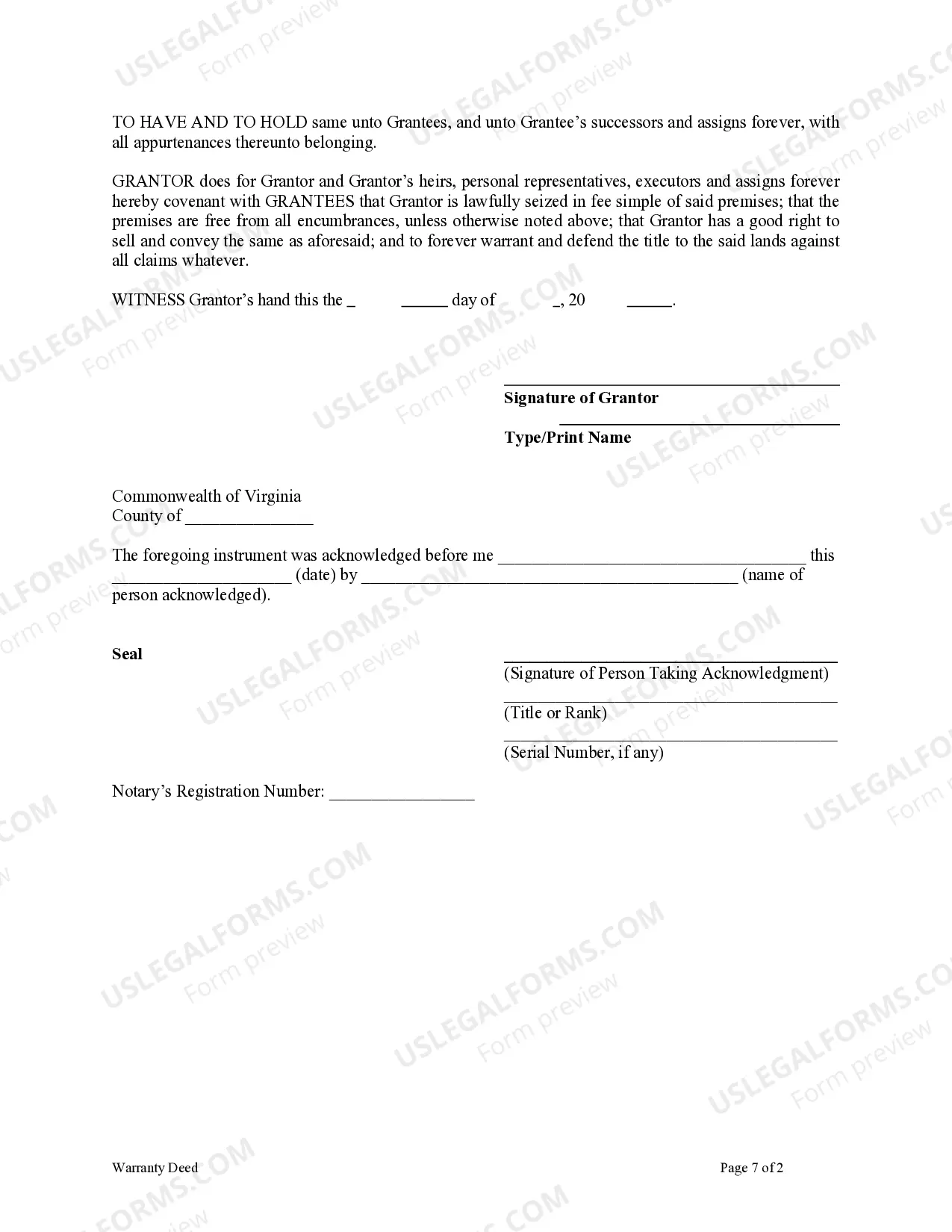
- Signatures of involved parties along with a notary public acknowledgment.


Common use cases
This Warranty Deed should be used when an individual wants to transfer property ownership to two individuals or a married couple, particularly when a guarantee of title is necessary. It is also ideal for situations involving joint ownership and rights of survivorship, ensuring that the surviving owner retains ownership in the event of one owner's death.
Who should use this form
- Property owners looking to transfer real estate to two other individuals or a married couple.
- Individuals who want to ensure rights of survivorship in a marriage or partnership.
- Buyers and sellers in real estate transactions needing a warranty of title.
Completing this form step by step
- Identify the Grantor and Grantees and include their legal names.
- Provide a detailed description of the property being conveyed.
- Choose the type of ownership (tenants in common, joint tenants, or tenants by the entirety).
- Fill in the date of the transaction and have all parties sign the deed.
- Obtain notarization of the document to validate the transfer.
Is notarization required?
This form must be notarized to be legally valid. US Legal Forms provides secure online notarization powered by Notarize, allowing you to complete the process through a verified video call.
Get your form ready online
Our built-in tools help you complete, sign, share, and store your documents in one place.
Make edits, fill in missing information, and update formatting in US Legal Forms—just like you would in MS Word.
Download a copy, print it, send it by email, or mail it via USPS—whatever works best for your next step.
Sign and collect signatures with our SignNow integration. Send to multiple recipients, set reminders, and more. Go Premium to unlock E-Sign.
If this form requires notarization, complete it online through a secure video call—no need to meet a notary in person or wait for an appointment.
We protect your documents and personal data by following strict security and privacy standards.

Make edits, fill in missing information, and update formatting in US Legal Forms—just like you would in MS Word.

Download a copy, print it, send it by email, or mail it via USPS—whatever works best for your next step.

Sign and collect signatures with our SignNow integration. Send to multiple recipients, set reminders, and more. Go Premium to unlock E-Sign.

If this form requires notarization, complete it online through a secure video call—no need to meet a notary in person or wait for an appointment.

We protect your documents and personal data by following strict security and privacy standards.
Common mistakes
- Failing to include a complete property description, leading to legal disputes.
- Omitting the signature of one or more parties involved in the transaction.
- Not notarizing the document, which may render it invalid in some jurisdictions.
- Choosing the wrong type of ownership, which can affect inheritance and property rights.
Advantages of online completion
- Convenience of completing the form from anywhere at any time.
- Editability allows you to make changes before finalizing the deed.
- Reliability of professionally drafted templates ensures compliance with legal standards.
Summary of main points
- This Warranty Deed facilitates property transfer with guaranteed ownership.
- It is suitable for married couples or two individuals sharing property ownership.
- Completing the form correctly and obtaining notarization is vital for legal validation.
Looking for another form?
Form popularity
FAQ
All deeds must be prepared by the owner of the property or by an attorney licensed to practice in Virginia. The requirements are listed below in the code section. Click here to read about e-Recording. § 17.1-223.
If you live in a common-law state, you can keep your spouse's name off the title the document that says who owns the property.You can put your spouse on the title without putting them on the mortgage; this would mean that they share ownership of the home but aren't legally responsible for making mortgage payments.
A warranty deed is a document often used in real estate that provides the greatest amount of protection to the purchaser of the property. The deed pledges or warrants that the owner owns the property free and clear of any outstanding liens, mortgages, or other encumbrances.
When it comes to reasons why you shouldn't add your new spouse to the Deed, the answer is simple divorce and equitable distribution. If you choose not to put your spouse on the Deed and the two of you divorce, the entire value of the home is not subject to equitable distribution.
Locate the most recent deed to the property. Create the new deed. Sign and notarize the new deed. Record the deed in the land records of the clerk's office of the circuit court in the jurisdiction where the property is located.
You will need to have the quitclaim deed notarized with the signatures of you and your spouse. Once this is done, the quitclaim deed replaces your former deed and the property officially is in both of your names. You must record the deed at your county office.
The Virginia general warranty deed is a form that warrants property conveyed from a Seller (the Grantor) to a Buyer (the Grantee).Afterwards, the deed may be filed with the Circuit Court in the jurisdiction of where the property is located.
To add a co-owner, the bank would have to create a new home loan agreement, which must be registered after paying the due stamp duty and registration charges. The bank would also insist on making the co-owner a co-borrower in the home loan applicable.
How do I add someone or remove someone from my deed? To make changes to ownership of property, a new deed will need to be prepared and recorded in the Clerk's Office where the property is located. The Commonwealth of Virginia does not provide any forms for deed transfers.