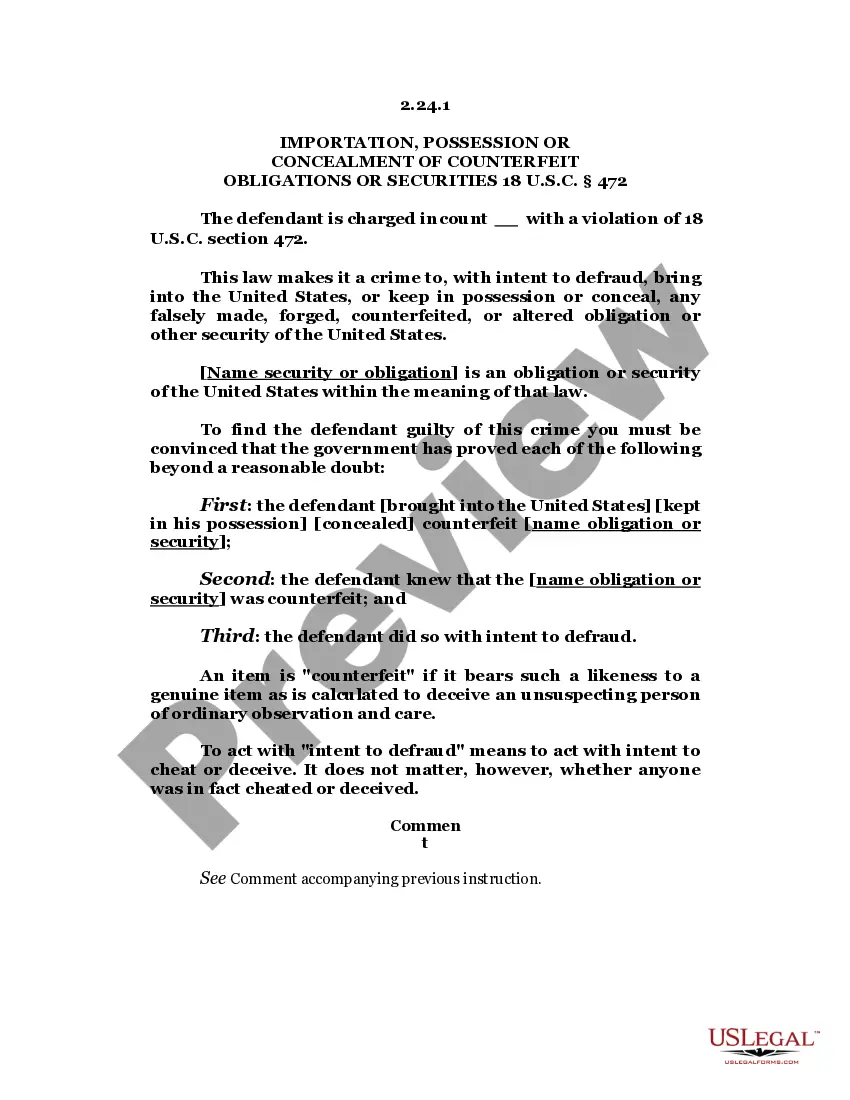
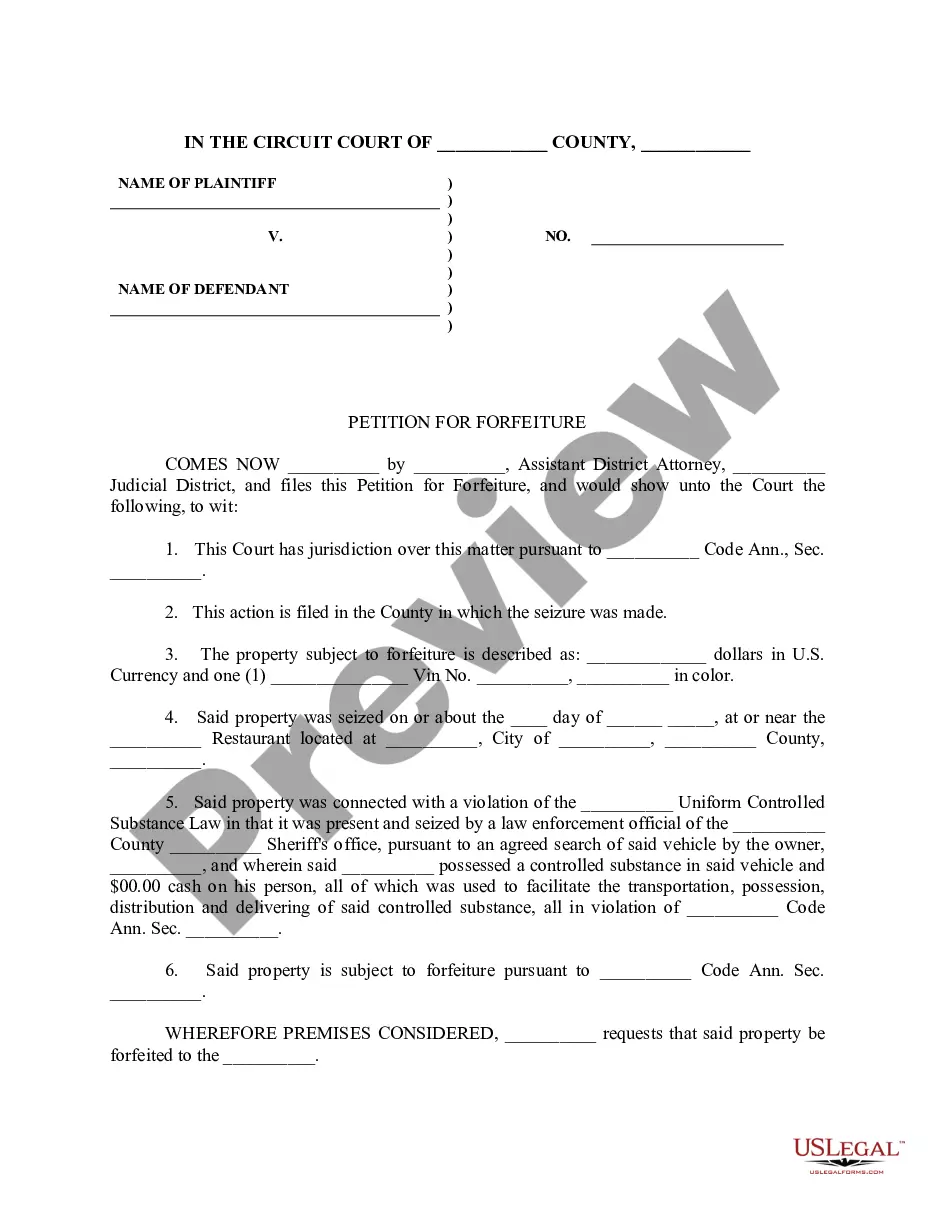
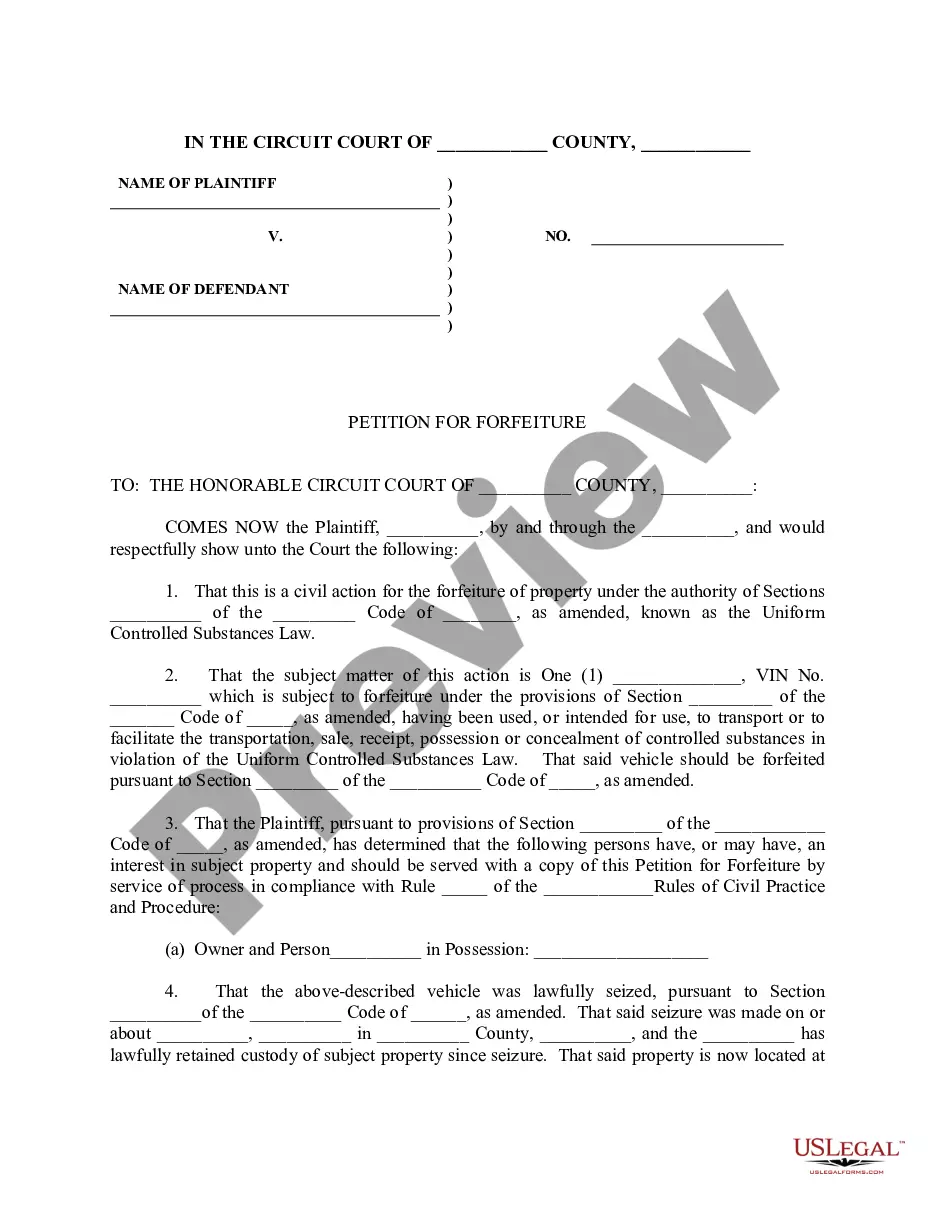
Utah Petition for Forfeiture
Description

Get your form ready online
Our built-in tools help you complete, sign, share, and store your documents in one place.
Make edits, fill in missing information, and update formatting in US Legal Forms—just like you would in MS Word.
Download a copy, print it, send it by email, or mail it via USPS—whatever works best for your next step.
Sign and collect signatures with our SignNow integration. Send to multiple recipients, set reminders, and more. Go Premium to unlock E-Sign.
If this form requires notarization, complete it online through a secure video call—no need to meet a notary in person or wait for an appointment.
We protect your documents and personal data by following strict security and privacy standards.

Make edits, fill in missing information, and update formatting in US Legal Forms—just like you would in MS Word.

Download a copy, print it, send it by email, or mail it via USPS—whatever works best for your next step.

Sign and collect signatures with our SignNow integration. Send to multiple recipients, set reminders, and more. Go Premium to unlock E-Sign.

If this form requires notarization, complete it online through a secure video call—no need to meet a notary in person or wait for an appointment.

We protect your documents and personal data by following strict security and privacy standards.
Looking for another form?

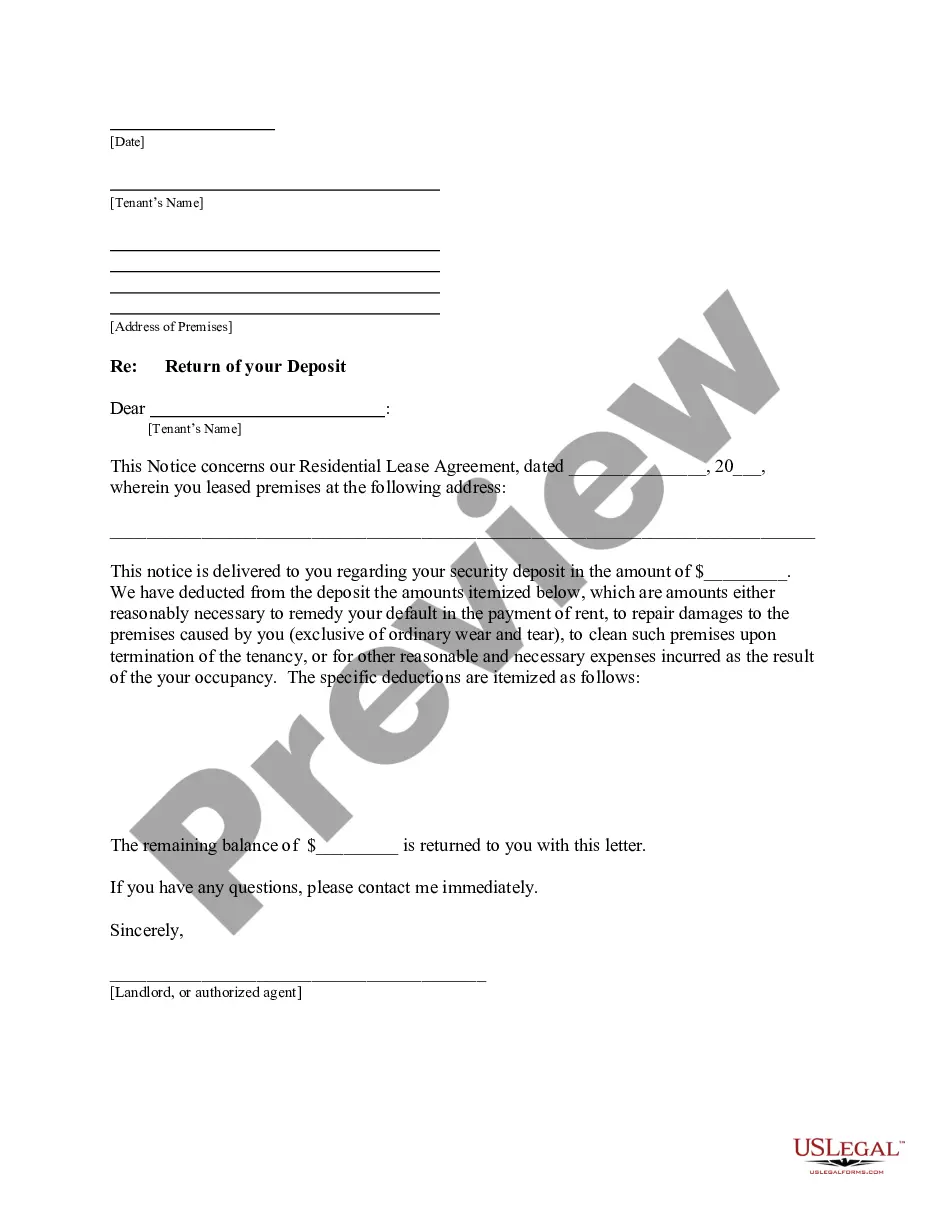


How to fill out Petition For Forfeiture?
If you wish to completely, download, or print authentic document templates, utilize US Legal Forms, the largest collection of authentic forms, which can be accessed online.
Take advantage of the site's straightforward and user-friendly search to locate the documents you need.
A range of templates for business and personal purposes are organized by categories and states, or keywords. Use US Legal Forms to find the Utah Petition for Forfeiture in just a few clicks.
Every legal document format you obtain is yours permanently. You will have access to every form you downloaded with your account. Click the My documents section and select a form to print or download again.
Stay proactive and download, and print the Utah Petition for Forfeiture with US Legal Forms. There are countless professional and state-specific forms you can utilize for your business or personal needs.
- When you are currently a US Legal Forms member, Log In to your account and click the Download button to retrieve the Utah Petition for Forfeiture.
- You can also access forms you previously downloaded in the My documents section of your account.
- If you are using US Legal Forms for the first time, follow the instructions below.
- Step 1. Ensure you have chosen the form for the correct city/state.
- Step 2. Use the Preview option to review the form’s content. Don’t forget to read the description.
- Step 3. If you are not satisfied with the form, use the Search field at the top of the screen to find other types of the legal form format.
- Step 4. Once you have located the form you need, select the Buy now button. Choose the pricing plan you prefer and enter your information to sign up for the account.
- Step 5. Complete the transaction. You can use your credit card or PayPal account to finalize the purchase.
- Step 6. Select the format of the legal form and download it to your device.
- Step 7. Complete, modify, and print or sign the Utah Petition for Forfeiture.
Form popularity
FAQ
Under Federal law, there are three (3) types of forfeiture: criminal forfeiture, civil judicial forfeiture, and administrative forfeiture.
The seizure of a bank account, for example, takes place when you lose the right to use the money in your account. Forfeiture occurs when your rights to the seized property are permanently lost through a court order or judgment. Forfeiture occurs after seizure, and seizure does not always end in forfeiture.
For example, if your car was used to sell drugs or if your cash is the proceeds of drug activity, the police may seize your property and hold it. However, you are still the owner of your property and you may request a judge to order that your property be returned to you.
A general example of forfeiture is a failure to make payment under a contract for the sale of immovable property. The advance for purchase of property is likely to be forfeited under the contract.
A criminal case involving the seized property. If a criminal case is filed, the agency will hold your property until all criminal proceedings and related cases are final. As part of the criminal case, the prosecution could ask that you lose your right to the property. This is called forfeiture.
Forfeiture is broadly defined as the loss of property for failing to obey the law, and that property is generally lost to the state. A person may have a vested interest in property to be forfeit in two ways: In personum jurisdiction and in rem jurisdiction.
A bail forfeiture is treated as though you entered a guilty plea, and is considered to be a conviction. This conviction becomes part of your criminal record, and may show up on a background check or criminal history report.
Criminal forfeiture operates as punishment for a crime. It, therefore, requires a conviction, following which the state takes the assets in question from the criminal. Civil forfeiture rests on the idea (a legal fiction) that the property itself, not the owner, has violated the law.