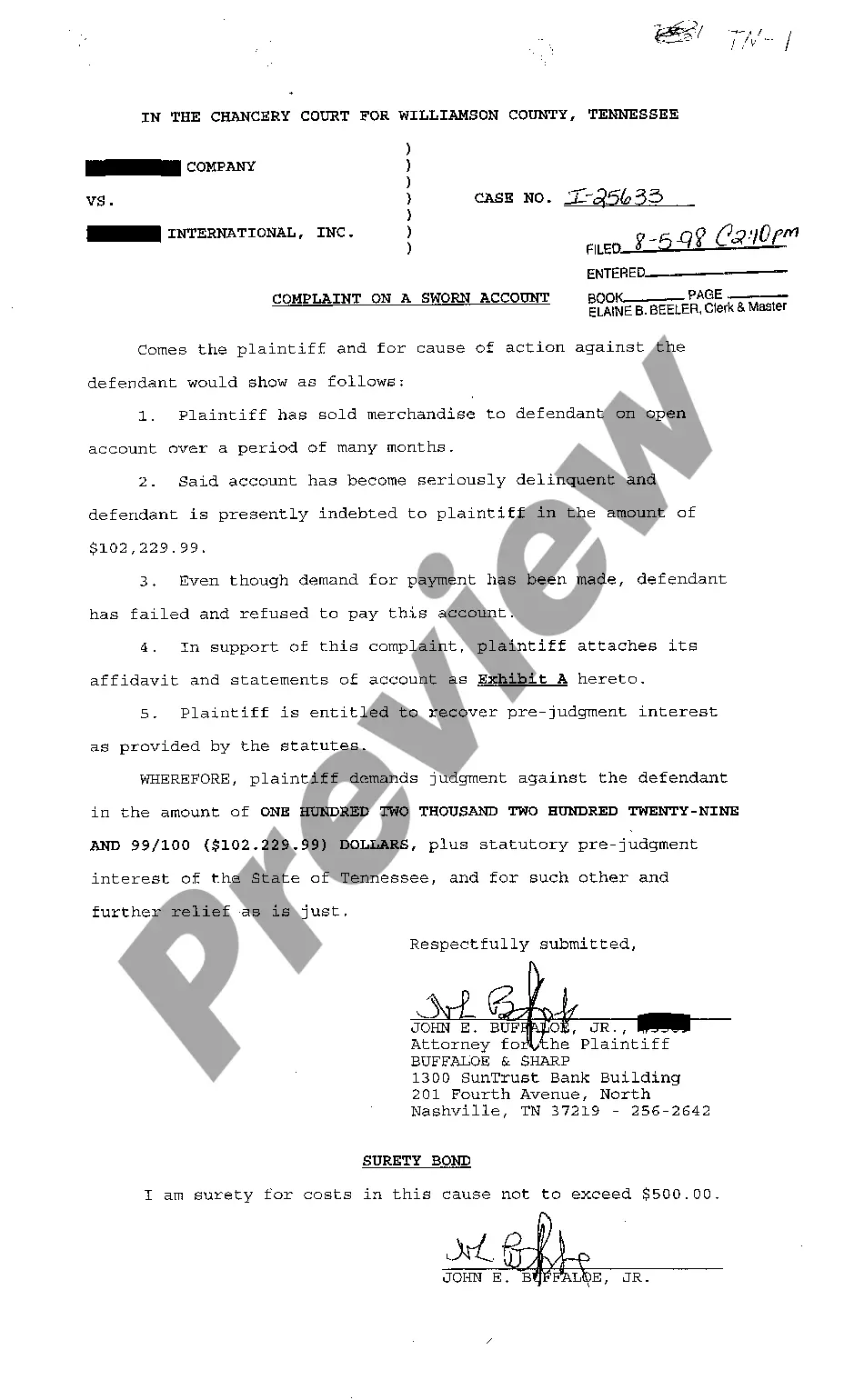
Utah Acceptance of Service, Appearance, Consent and Waiver
About this form
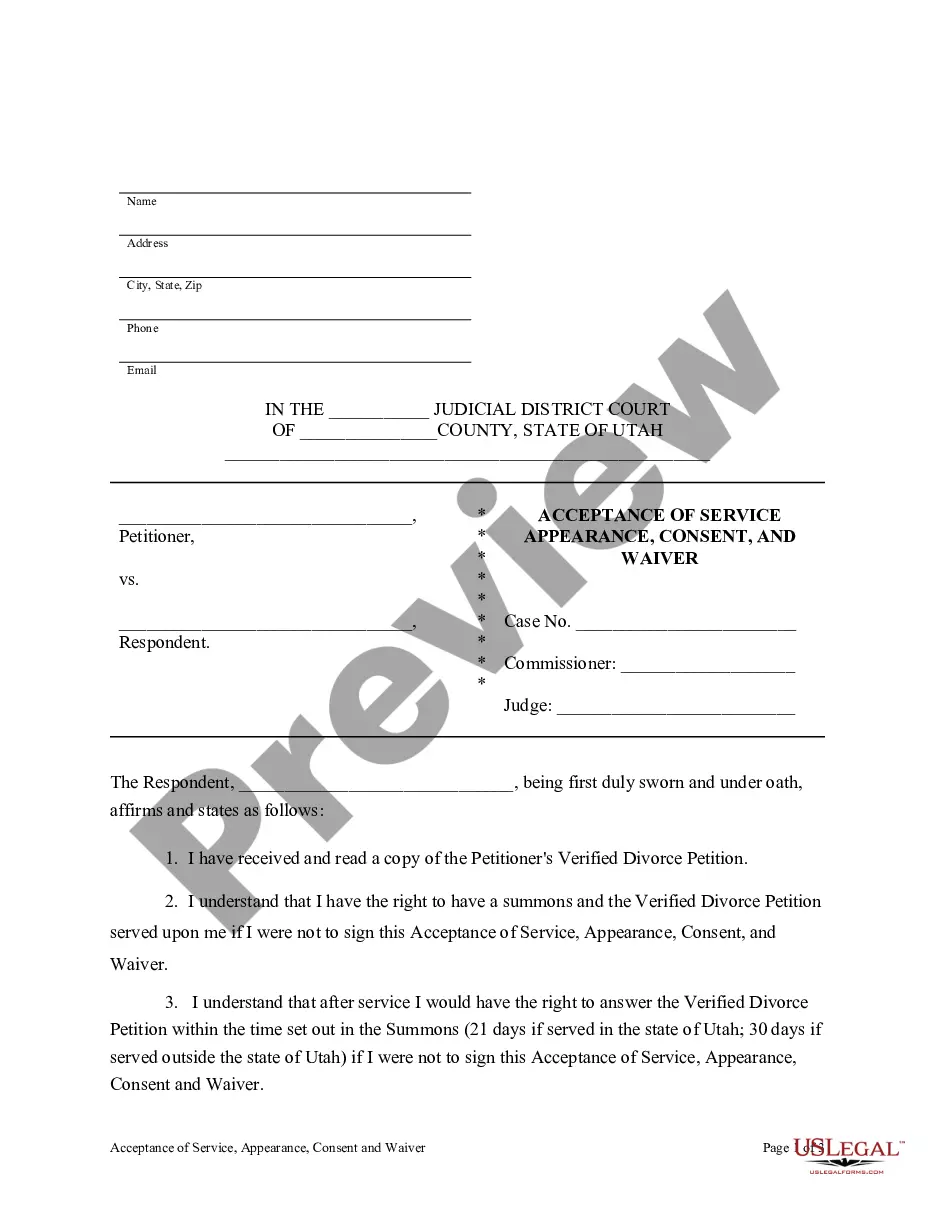
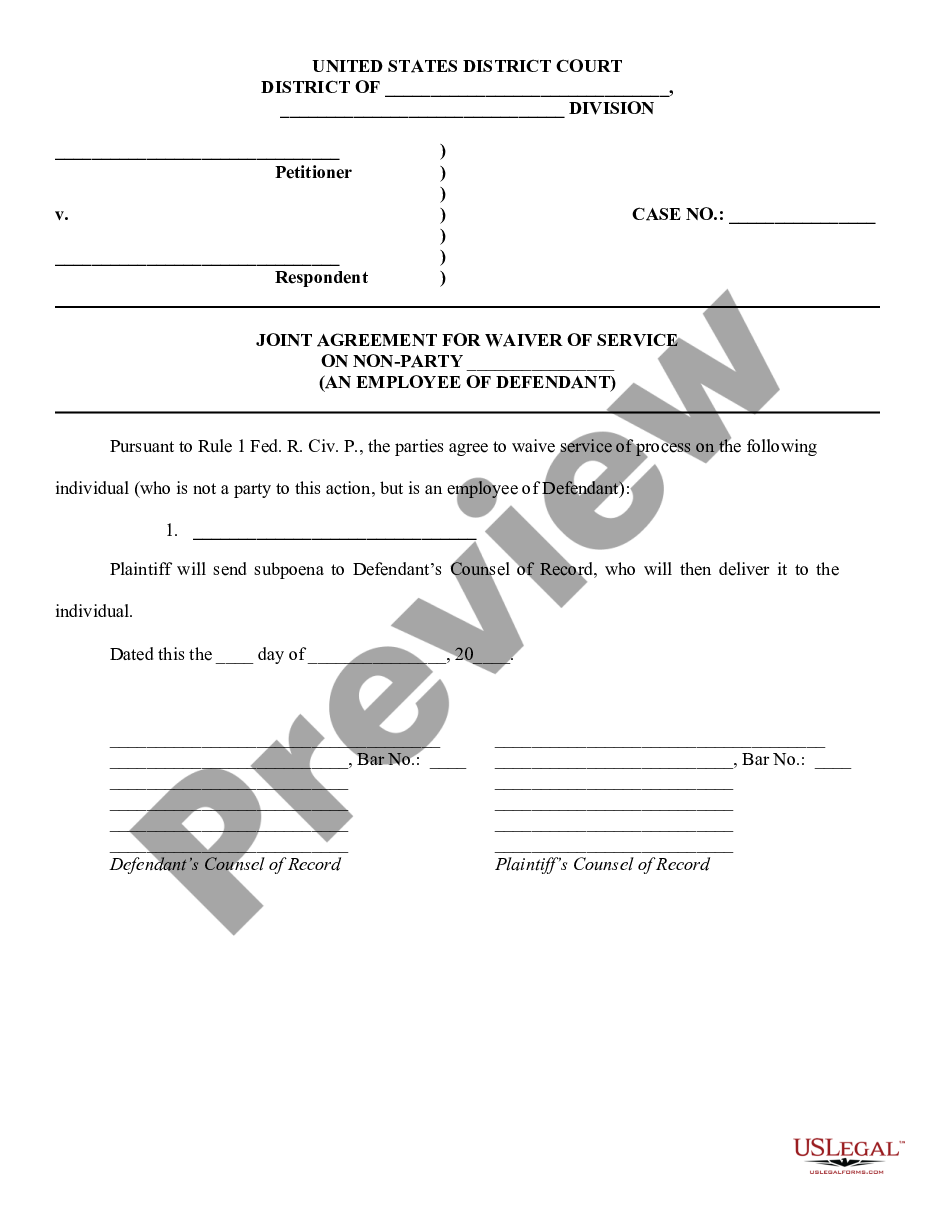
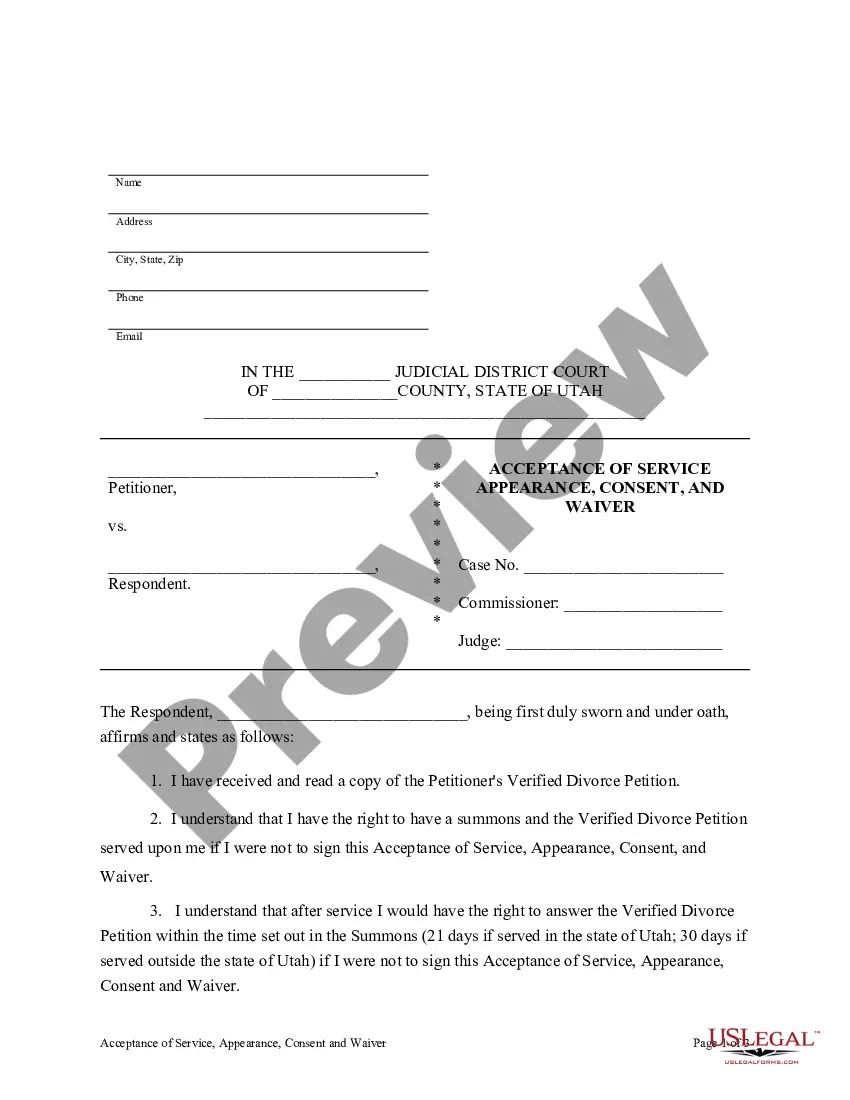
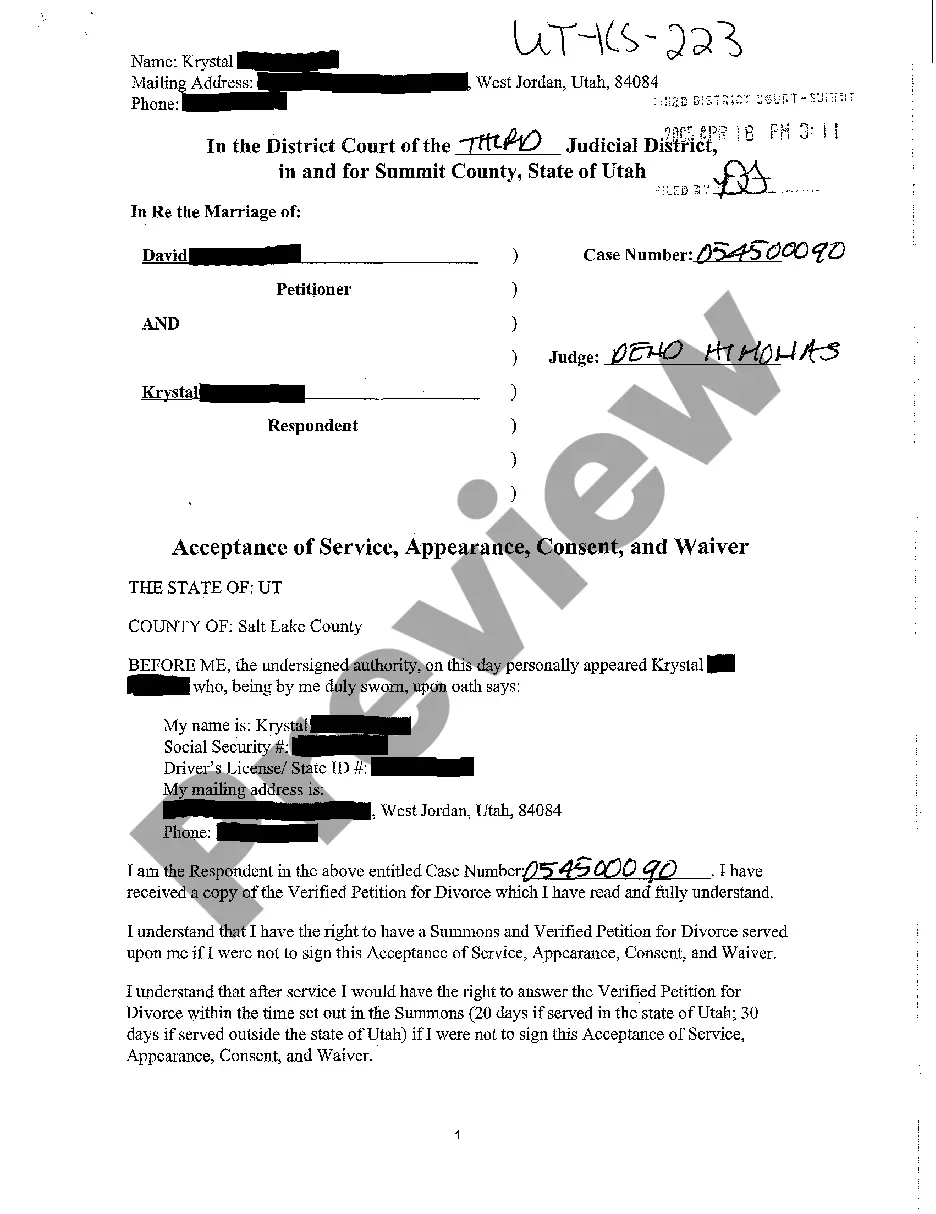
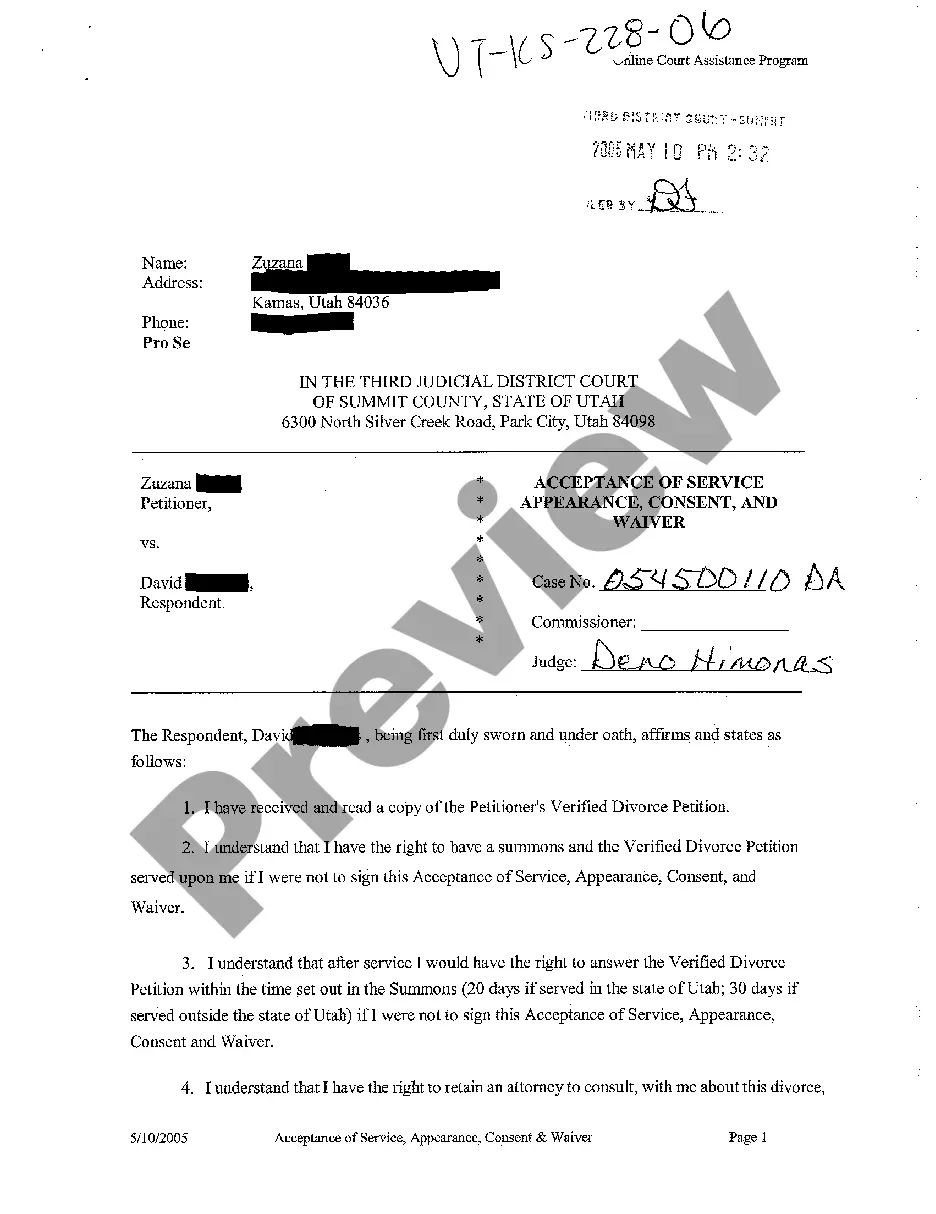
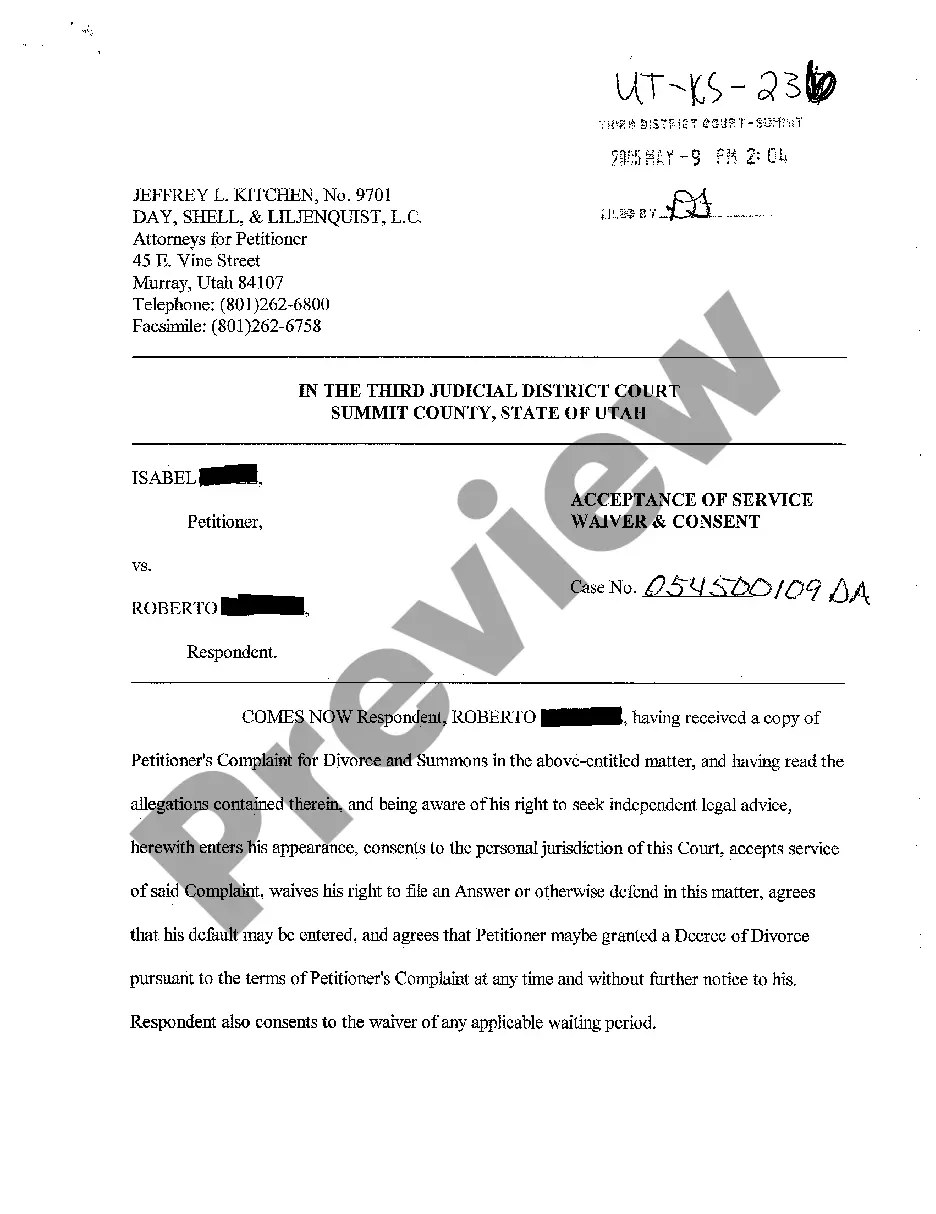
The Acceptance of Service, Appearance, Consent and Waiver is a legal document utilized by a respondent in a divorce proceeding. This form allows the respondent to acknowledge receipt of the divorce petition, enter their appearance in the court proceedings, consent to a judgment of divorce, and waive their right to further notice regarding court filings. Unlike other forms, this one consolidates several acknowledgments into a single document, simplifying the process for respondents.
Key parts of this document
- Identification of the judicial district court and the parties involved.
- A statement confirming receipt and acknowledgment of the divorce petition.
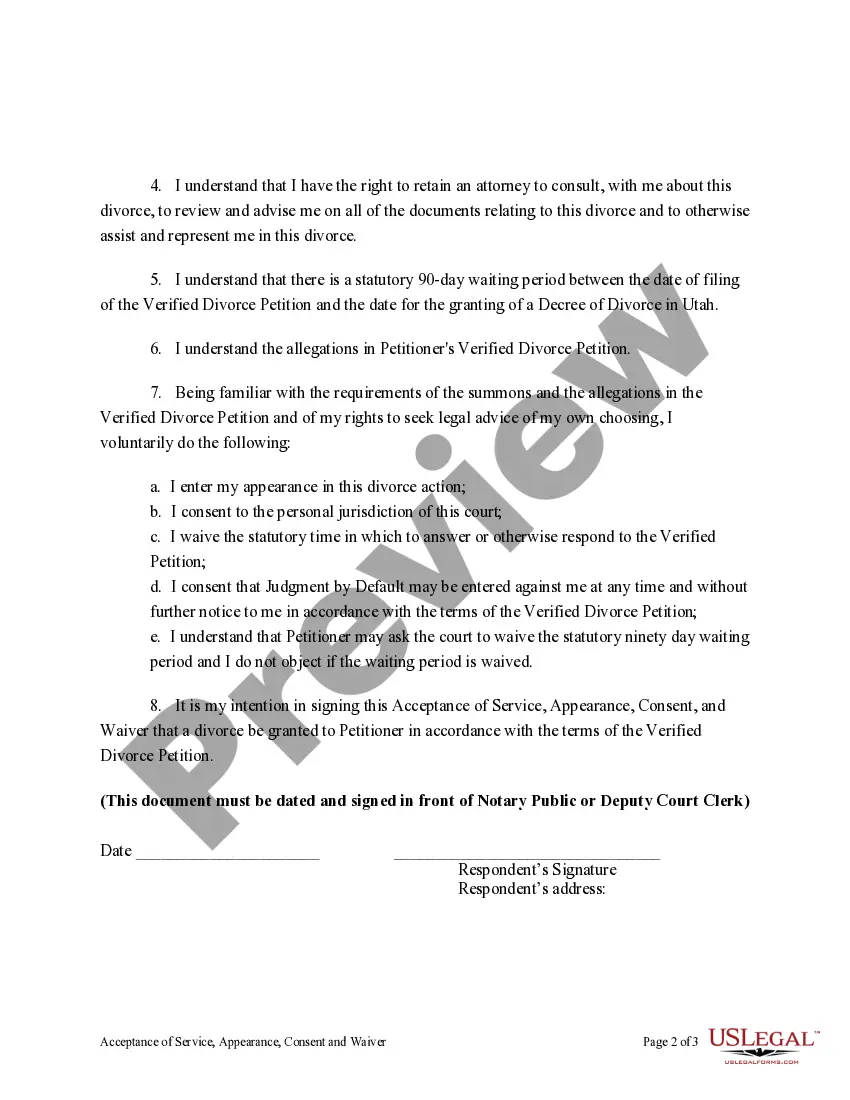
- Consent to the personal jurisdiction of the court.
- Waiver of the statutory time to respond to the divorce petition.
- Voluntary agreement to allow default judgment without further notice.
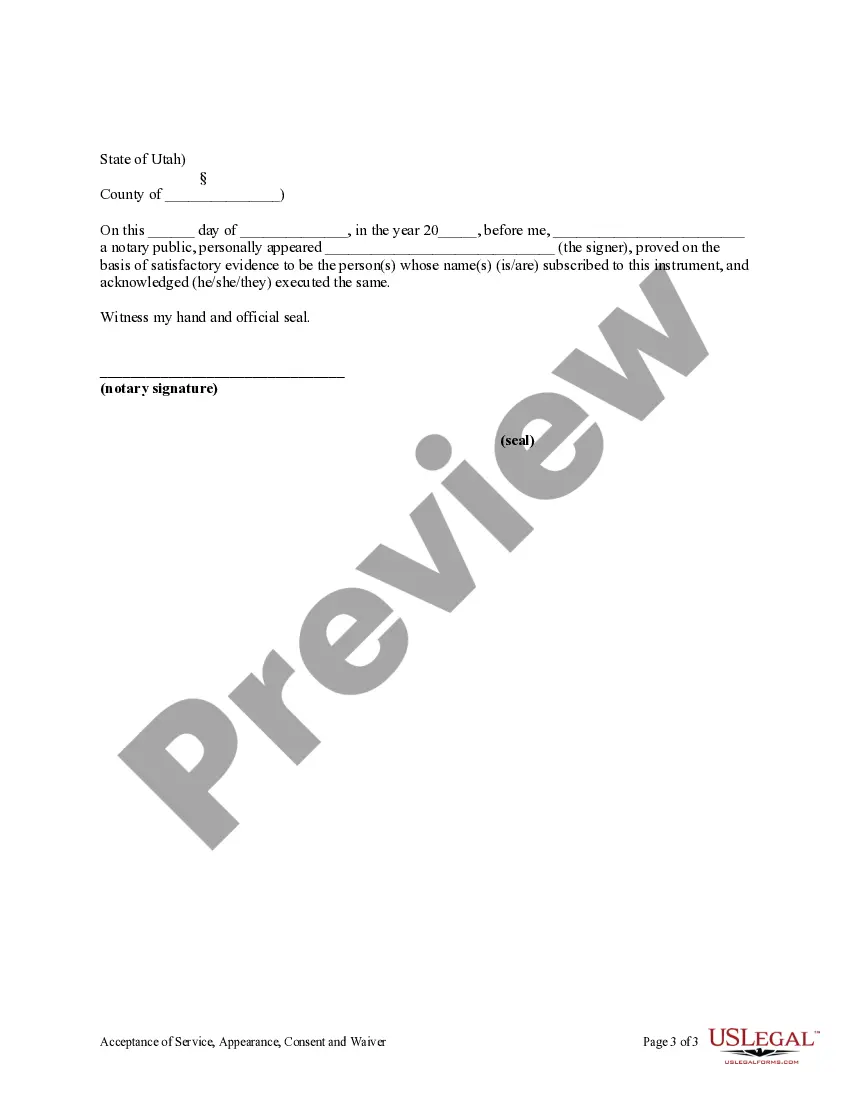
- Signature section for the respondent, to be notarized.
When this form is needed
This form is used when a respondent is aware of a divorce petition filed against them and wishes to accept the petition and streamline the divorce process. It is particularly applicable in cases where both parties agree on the divorce terms or when the respondent chooses not to contest the divorce proceedings.
Who this form is for
- Individuals who are named as respondents in a divorce petition.
- Individuals who agree to the terms of the divorce without requiring additional hearings.
- Respondents who want to avoid further legal complications or notifications.
How to complete this form
- Fill in the name, address, city, state, and ZIP code for both parties.
- Enter the case number, commissioner, and judge's name as specified in the courtâs documentation.
- Sign the form in the presence of a Notary Public or Deputy Court Clerk.
- Review the acknowledgment clauses and ensure your understanding of the implications before signing.
- Keep a copy of the completed form for your records.
Is notarization required?
Yes, this form must be notarized to be legally valid. It is essential to have your signature witnessed by a Notary Public or a Deputy Court Clerk, which ensures that the document meets legal standards and is recognized by the court.
Get your form ready online
Our built-in tools help you complete, sign, share, and store your documents in one place.
Make edits, fill in missing information, and update formatting in US Legal Forms—just like you would in MS Word.
Download a copy, print it, send it by email, or mail it via USPS—whatever works best for your next step.
Sign and collect signatures with our SignNow integration. Send to multiple recipients, set reminders, and more. Go Premium to unlock E-Sign.
If this form requires notarization, complete it online through a secure video call—no need to meet a notary in person or wait for an appointment.
We protect your documents and personal data by following strict security and privacy standards.

Make edits, fill in missing information, and update formatting in US Legal Forms—just like you would in MS Word.

Download a copy, print it, send it by email, or mail it via USPS—whatever works best for your next step.

Sign and collect signatures with our SignNow integration. Send to multiple recipients, set reminders, and more. Go Premium to unlock E-Sign.

If this form requires notarization, complete it online through a secure video call—no need to meet a notary in person or wait for an appointment.

We protect your documents and personal data by following strict security and privacy standards.
Typical mistakes to avoid
- Failing to sign the document in front of a notary, rendering it invalid.
- Not thoroughly reading the terms outlined in the Acceptance of Service.
- Leaving out necessary personal information, such as the case number or addresses.
- Not understanding the implications of waiving the right to further notice.
Benefits of completing this form online
- Convenience of downloading and filling the form at your own pace.
- Accessibility to legal resources drafted by licensed attorneys.
- The ability to easily edit the form to gather all necessary information before submission.
Key takeaways
- The Acceptance of Service simplifies the divorce process by consolidating multiple acknowledgments into one document.
- It is crucial to understand all elements of the form before signing.
- Notarization is required for this form to be considered valid in Utah divorce proceedings.
- The form helps respondents to formally accept the divorce petition while waiving certain rights.
Looking for another form?
Form popularity
FAQ
What Can a Judge Do if I Avoid Being Served? If they are avoiding a process server, a judge may allow the papers to be left at their home or business with any competent person over the age of 18. A judge may also allow the summons to be mailed to their home or business address via certified mail.
Step 1: Complete a Training Program. You need to follow state and federal laws to become a process server. Step 2: Gain Certification. You may also need to gain a certification or pass a licensure exam to become a process server. Step 3: Gain Experience.
With people in the United States relying heavily on cell phones and text message technology, text messages offer a unique method for serving process. Text messages would be useful for serving a defendant when the defendant cannot be located.In addition, unlike e-mail, text messages do not require In- ternet access.
N. the delivery of copies of legal documents such as summons, complaint, subpena, order to show cause (order to appear and argue against a proposed order), writs, notice to quit the premises, and certain other documents, usually by personal delivery to the defendant or other person to whom the documents are directed.
Tell the server to: Give the papers to a responsible adult where the Defendant lives, or to someone in charge where the Defendant works. Say, These are court papers. Then, mail (first-class) a copy of the papers to the Defendant at the same address where s/he left the papers.
Serve documents, which means giving a copy of your court documents to the other parties in the case. File proof of service to show the court that you served the documents.
Can Someone Refuse to Be Served Papers? No, in California a person cannot refuse to accept service. If we can identify a person on whom legal service can be made either personally or by sub-service and they refuse to accept the documents, we can absolutely still serve them.
Personal ServiceDocuments can be served by a sheriff, a constable, a U.S. Marshal, or by any person 18 or older who is: not a party in the case or an attorney for a party in the case, not been convicted of a felony violation of a sex offense listed in Utah Code section 77-41-102(16), or.
In the majority of states, you can serve papers by sending them to the defendant via certified mail with a return receipt requested. In some states, service by certified (or registered) mail is one among several ways you may serve papers.