Foreign Corrupt Practices Act - Corporate Policy
What is this form?
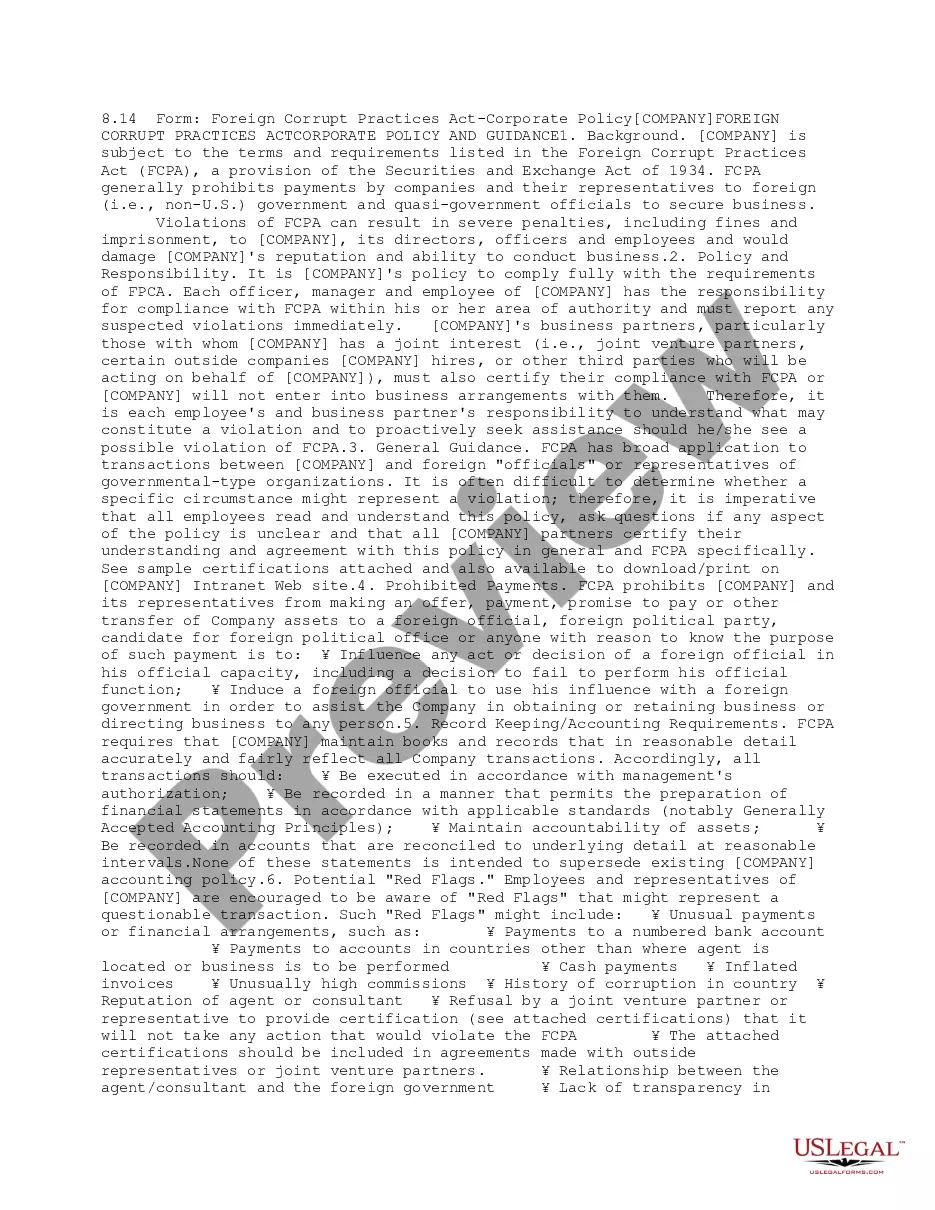
The Foreign Corrupt Practices Act - Corporate Policy is a document that outlines a corporation's commitment to adhere to the regulations set by the Foreign Corrupt Practices Act (FCPA). This act, part of the Securities and Exchange Act of 1934, prohibits companies from bribing foreign officials to gain business advantages. This policy serves as a framework for ensuring ethical business practices and protecting both the company and its employees from legal penalties and reputational harm.
Key parts of this document
- Background and purpose of the FCPA and its implications for the company.
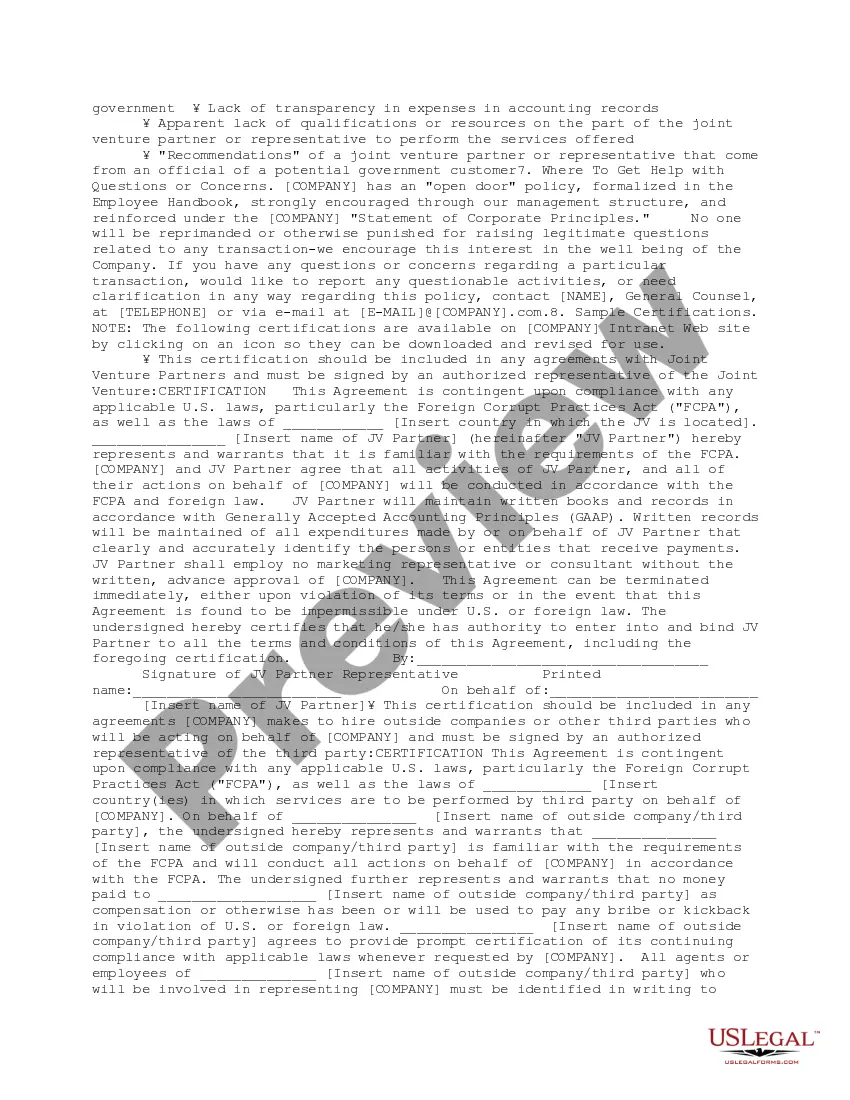
- Detailed corporate policy on compliance responsibilities for all employees and business partners.
- Guidance on recognizing and reporting potential violations.
- Clear definitions of prohibited payments and related actions.
- Record-keeping and accounting requirements necessary for compliance.
- Identification of common red flags indicating questionable transactions.
- Contact information for reporting concerns and seeking clarification.
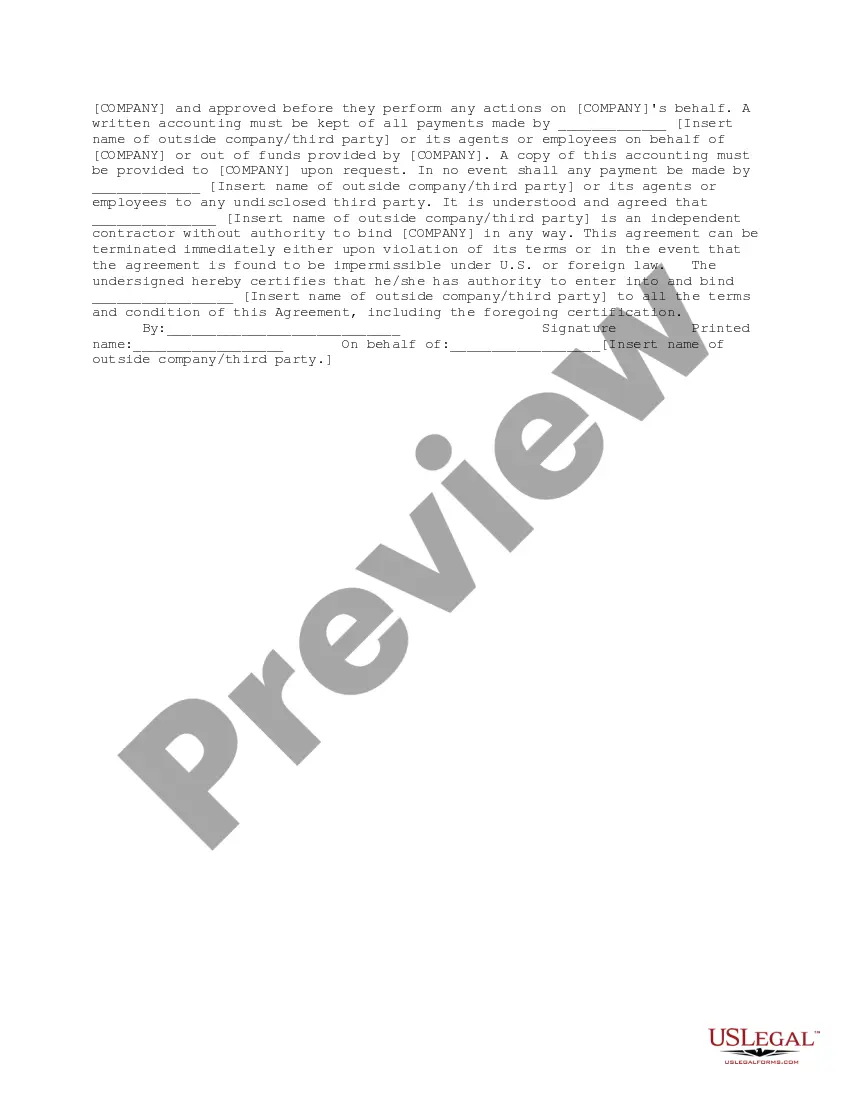
- Sample certifications for business partners and third-party contracts.

Common use cases
This corporate policy should be used when establishing a compliance framework for international business operations. It is essential for companies engaging with foreign markets, hiring international partners, or any business that may involve government officials abroad. This policy helps prevent violations of the FCPA and ensures all employees understand their compliance obligations.
Who should use this form
- Corporation executives and managers responsible for compliance.
- Employees engaging with foreign officials or conducting international business.
- Business partners or joint venture entities interacting with the company.
- Compliance officers overseeing adherence to legal requirements.
Completing this form step by step
- Review the policy thoroughly to ensure understanding of all components.
- Identify all employees, managers, and business partners who must comply.
- Ensure the incorporation of this policy into training for relevant personnel.
- Facilitate the completion of sample certifications by partners.
- Set up reporting mechanisms for any potential violations.
Does this form need to be notarized?
In most cases, this form does not require notarization. However, some jurisdictions or signing circumstances might. US Legal Forms offers online notarization powered by Notarize, accessible 24/7 for a quick, remote process.
Get your form ready online
Our built-in tools help you complete, sign, share, and store your documents in one place.
Make edits, fill in missing information, and update formatting in US Legal Forms—just like you would in MS Word.
Download a copy, print it, send it by email, or mail it via USPS—whatever works best for your next step.
Sign and collect signatures with our SignNow integration. Send to multiple recipients, set reminders, and more. Go Premium to unlock E-Sign.
If this form requires notarization, complete it online through a secure video call—no need to meet a notary in person or wait for an appointment.
We protect your documents and personal data by following strict security and privacy standards.

Make edits, fill in missing information, and update formatting in US Legal Forms—just like you would in MS Word.

Download a copy, print it, send it by email, or mail it via USPS—whatever works best for your next step.

Sign and collect signatures with our SignNow integration. Send to multiple recipients, set reminders, and more. Go Premium to unlock E-Sign.

If this form requires notarization, complete it online through a secure video call—no need to meet a notary in person or wait for an appointment.

We protect your documents and personal data by following strict security and privacy standards.
Mistakes to watch out for
- Failing to communicate the policy effectively to all employees.
- Not regularly updating the policy to reflect changes in law or business practices.
- Ignoring the importance of training sessions on compliance and reporting.
- Overlooking the necessity of certifications from business partners.
Why complete this form online
- Convenient access to the policy for download and printing.
- Editability to customize the form according to specific corporate needs.
- Reliable templates drafted by licensed attorneys to ensure legal soundness.
- Quick integration of current legal standards into corporate practices.
Legal use & context
- This policy complies with the FCPA, ensuring adherence to U.S. law.
- It helps mitigate the risk of legal penalties and reputational damage.
- The policy serves as a legal safeguard for the company and its employees.
Summary of main points
- The Foreign Corrupt Practices Act - Corporate Policy is essential for ethical international business conduct.
- All employees and business partners share responsibility for FCPA compliance.
- Prohibited payments and record-keeping requirements are critical elements of this policy.
Looking for another form?
Form popularity
FAQ
The Foreign Corrupt Practices Act (FCPA), enacted in 1977, generally prohibits the payment of bribes to foreign officials to assist in obtaining or retaining business.
Who Is Covered by the FCPA? The FCPA applies to two broad categories of persons: those with formal ties to the United States and those who take action in furtherance of a violation while in the United States. U.S. "issuers" and "domestic concerns" must obey the FCPA, even when acting outside the country.
Who Is Covered by the FCPA? The FCPA applies to two broad categories of persons: those with formal ties to the United States and those who take action in furtherance of a violation while in the United States. U.S. "issuers" and "domestic concerns" must obey the FCPA, even when acting outside the country.
In drafted and implemented appropriately, an FCPA compliance program will: serve as an invaluable tool against corruption, promote ethical conduct within the company, reduce the societal costs of corruption, and foster business expansion domestically and globally.
Ascertain and Formally Determine Your Level of FCPA Risk. Create and Maintain an FCPA Compliance Policy. Create an FCPA-Based Compliance Team. Ascertain the Anti-Corruption/Bribery Legislations in Other Countries. Implement and Maintain an Adequate Set of Internal Audit Controls.
The FCPA has two primary provisions: (1) an anti-bribery provision which makes it unlawful for a U.S. company or citizen, and certain foreign issuers of securities, to make a corrupt payment to a foreign official for the purpose of obtaining or retaining business and (2) an accounting provision which requires companies
The FCPA is enforcement against all US based companies, wherever they operate across the globe; against all US citizens anywhere in the world; against all foreign subsidiaries of US companies across the globe; against any foreign company which has a US subsidiary or which does business in the US; against any company
Who Is Covered by the FCPA? The FCPA applies to two broad categories of persons: those with formal ties to the United States and those who take action in furtherance of a violation while in the United States. U.S. "issuers" and "domestic concerns" must obey the FCPA, even when acting outside the country.