Reservation of A Call on, Or Preferential Right to Purchase Production by Lessor
What this document covers
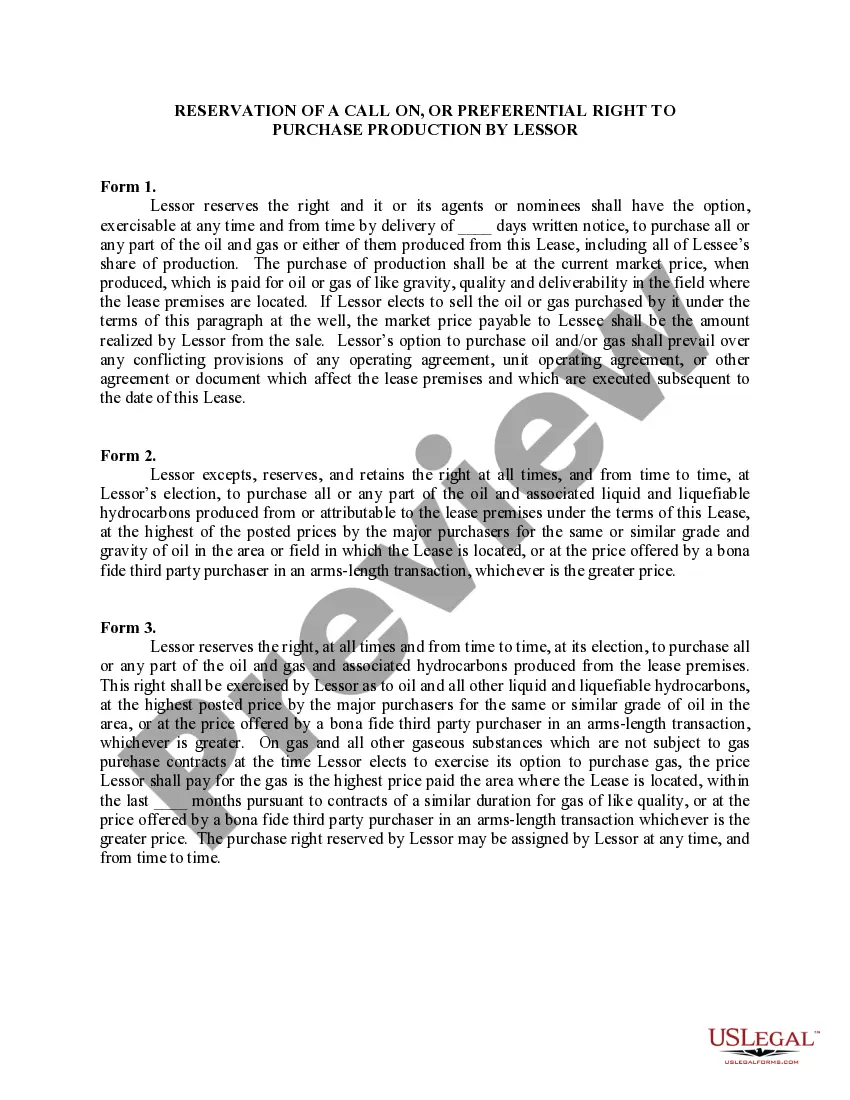
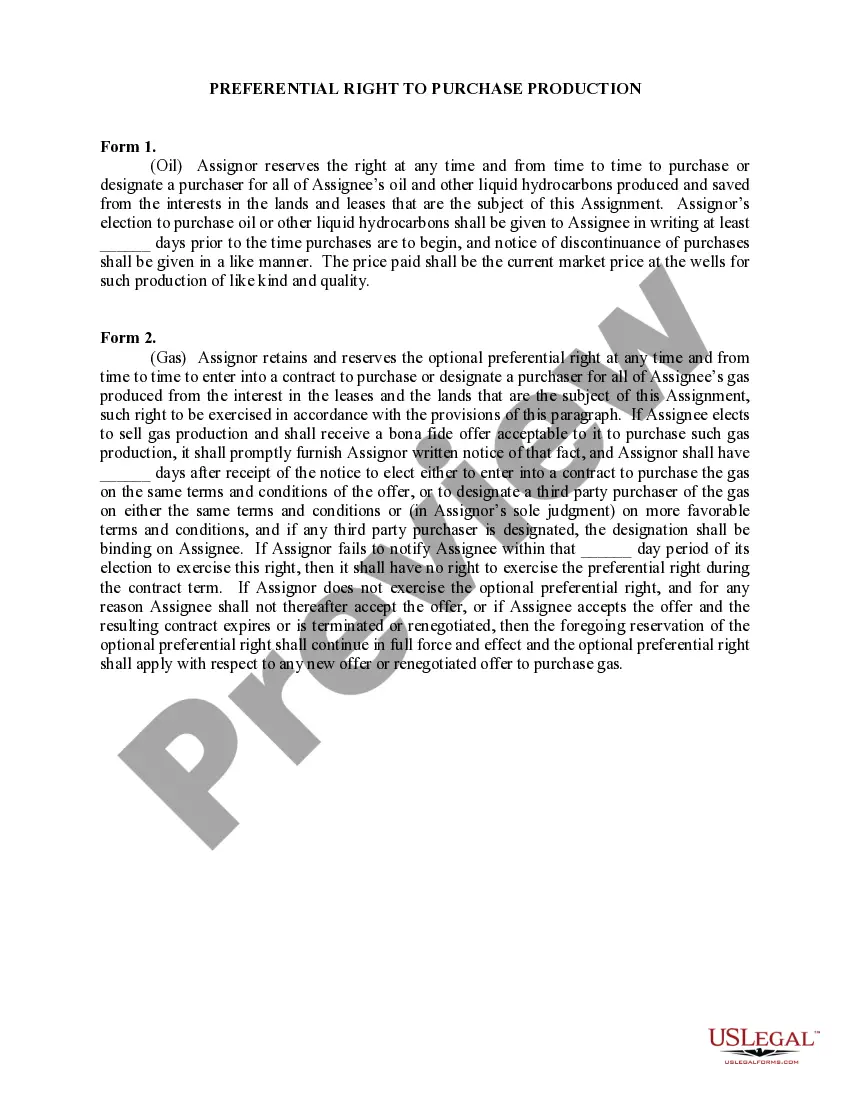
The Reservation of a Call on, or Preferential Right to Purchase Production by Lessor form is a lease rider that allows the lessor to reserve the right to purchase oil and gas produced from leased premises. This form includes specific provisions that modify the standard oil and gas lease to address the lessor's concerns and rights, providing an option to purchase production at market prices or highest posted prices offered by major purchasers. This customization distinguishes it from standard lease agreements by offering tailored rights of purchase to the lessor.
Main sections of this form
- Reservation of the right to purchase all or part of oil and gas produced from the lease.
- Options for purchase based on current market price or higher posted prices by major purchasers.
- Notice requirement for exercising the purchase right.
- Provision for assigning purchase rights to another party.
- Conditions regarding pricing based on transactions for similar hydrocarbon products.
When this form is needed
This form should be used when entering into an oil and gas lease where the lessor wishes to retain the option to purchase production at predetermined prices. It is particularly useful in scenarios where the lessor has specific concerns about market fluctuations and wants to ensure they can purchase production on favorable terms, thereby maintaining control over the resources extracted from their land.
Who should use this form
- Landowners (lessors) involved in oil and gas leases.
- Individuals seeking to negotiate specific rights within a lease agreement.
- Legal representatives of landowners looking for tailored lease terms.
- Any party wanting to secure preferential rights in oil and gas transactions.
Instructions for completing this form
- Identify the parties involved in the lease agreement.
- Specify the duration for providing written notice of exercising the purchase right.
- Fill in the terms for purchasing production, including pricing structures.
- Include any additional provisions or limitations that address specific concerns.
- Ensure all parties sign the document to validate the agreement.
Notarization requirements for this form
Notarization is not commonly needed for this form. However, certain documents or local rules may make it necessary. Our notarization service, powered by Notarize, allows you to finalize it securely online anytime, day or night.
Get your form ready online
Our built-in tools help you complete, sign, share, and store your documents in one place.
Make edits, fill in missing information, and update formatting in US Legal Forms—just like you would in MS Word.
Download a copy, print it, send it by email, or mail it via USPS—whatever works best for your next step.
Sign and collect signatures with our SignNow integration. Send to multiple recipients, set reminders, and more. Go Premium to unlock E-Sign.
If this form requires notarization, complete it online through a secure video call—no need to meet a notary in person or wait for an appointment.
We protect your documents and personal data by following strict security and privacy standards.

Make edits, fill in missing information, and update formatting in US Legal Forms—just like you would in MS Word.

Download a copy, print it, send it by email, or mail it via USPS—whatever works best for your next step.

Sign and collect signatures with our SignNow integration. Send to multiple recipients, set reminders, and more. Go Premium to unlock E-Sign.

If this form requires notarization, complete it online through a secure video call—no need to meet a notary in person or wait for an appointment.

We protect your documents and personal data by following strict security and privacy standards.
Common mistakes
- Failing to provide clear pricing terms for purchases.
- Not specifying the notice period for exercising the purchase right.
- Overlooking the need for all parties' signatures.
- Neglecting local law variations that may affect lease agreements.
Why complete this form online
- Convenient access to professionally drafted legal forms.
- Editable templates that allow for customization to fit specific needs.
- Instant downloads, ensuring you can act quickly in securing your rights.
- Reliability of forms created by licensed attorneys.
Looking for another form?
Form popularity
FAQ
An ITM call may be less risky than an OTM call, but it also costs more. If you only want to stake a small amount of capital on your call trade idea, the OTM call may be the best, pardon the pun, option.
When you're forecasting a quick, drastic rise in the underlying stock, it might make more sense to buy out-of-the-money options. Conversely, if you anticipate a relatively modest rise over a longer time frame, you may prefer to trade in-the-money options.
Investors often buy calls when they are bullish on a stock or other security because it affords them leverage. Call options help reduce the maximum loss an investment may incur, unlike stocks, where the entire value of the investment may be lost if the stock price drops to zero.
Call Right means the right (but not the obligation) of the holder thereof to purchase all, but not less than all, of the outstanding Certificates on any Call Date at a price equal to the Call Price, all in accordance with Section 7 hereof.
Call options are financial contracts that give the option buyer the right, but not the obligation, to buy a stock, bond, commodity or other asset or instrument at a specified price within a specific time period. The stock, bond, or commodity is called the underlying asset.
Option Right means the right to purchase Common Shares upon exercise of an option granted pursuant to Section 4 of this Plan.Option Right means the right to purchase Common Stock upon exercise of an option granted pursuant to Section 4 or Section 9 of this Plan.
For example, if a stock price was sitting at $50 per share and you wanted to buy a call option on it for a $45 strike price at a $5.50 premium (which, for 100 shares, would cost you $550) you could also sell a call option at a $55 strike price for a $3.50 premium (or $350), thereby reducing the risk of your investment
A call option is a contract between a buyer and a seller to purchase a certain stock at a certain price up until a defined expiration date. The buyer of a call has the right, not the obligation, to exercise the call and purchase the stocks.
Call options are in the money when the stock price is above the strike price at expiration. The call owner can exercise the option, putting up cash to buy the stock at the strike price. Or the owner can simply sell the option at its fair market value to another buyer.