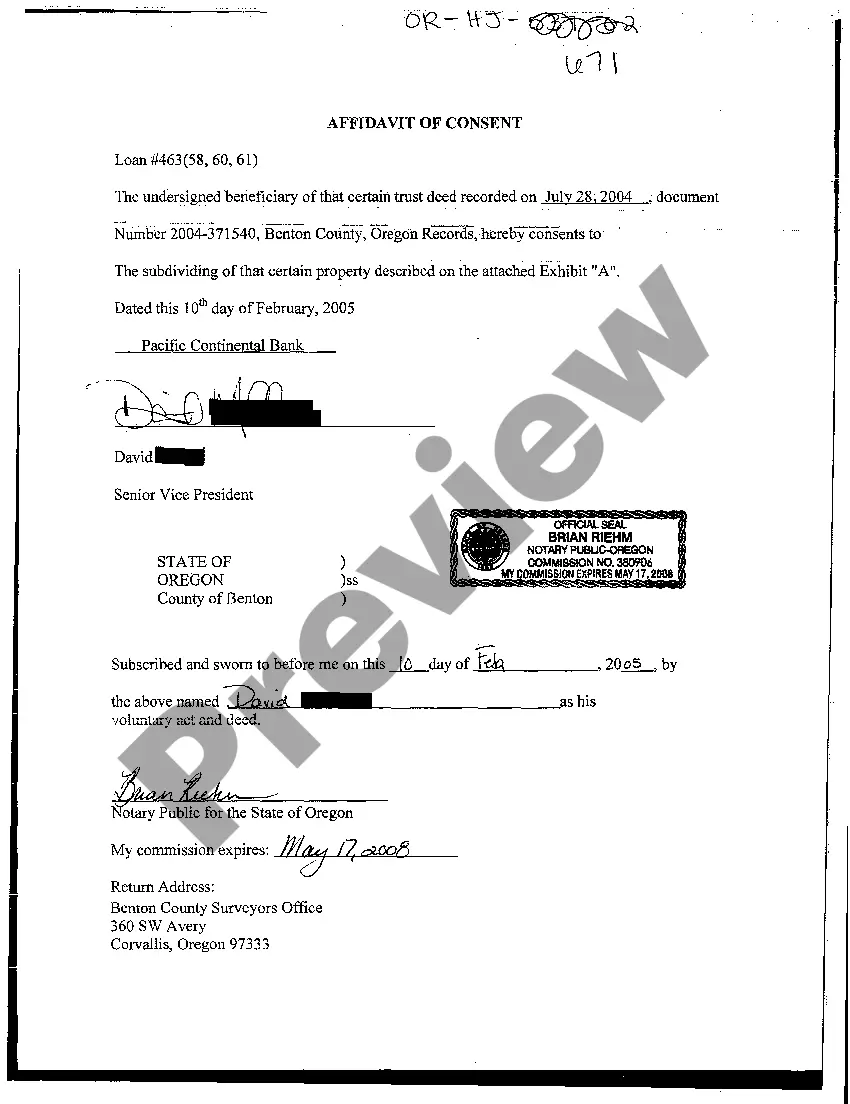
Amendment to Unit Designation to include Additional Lands and Leases in A Unit
Understanding this form
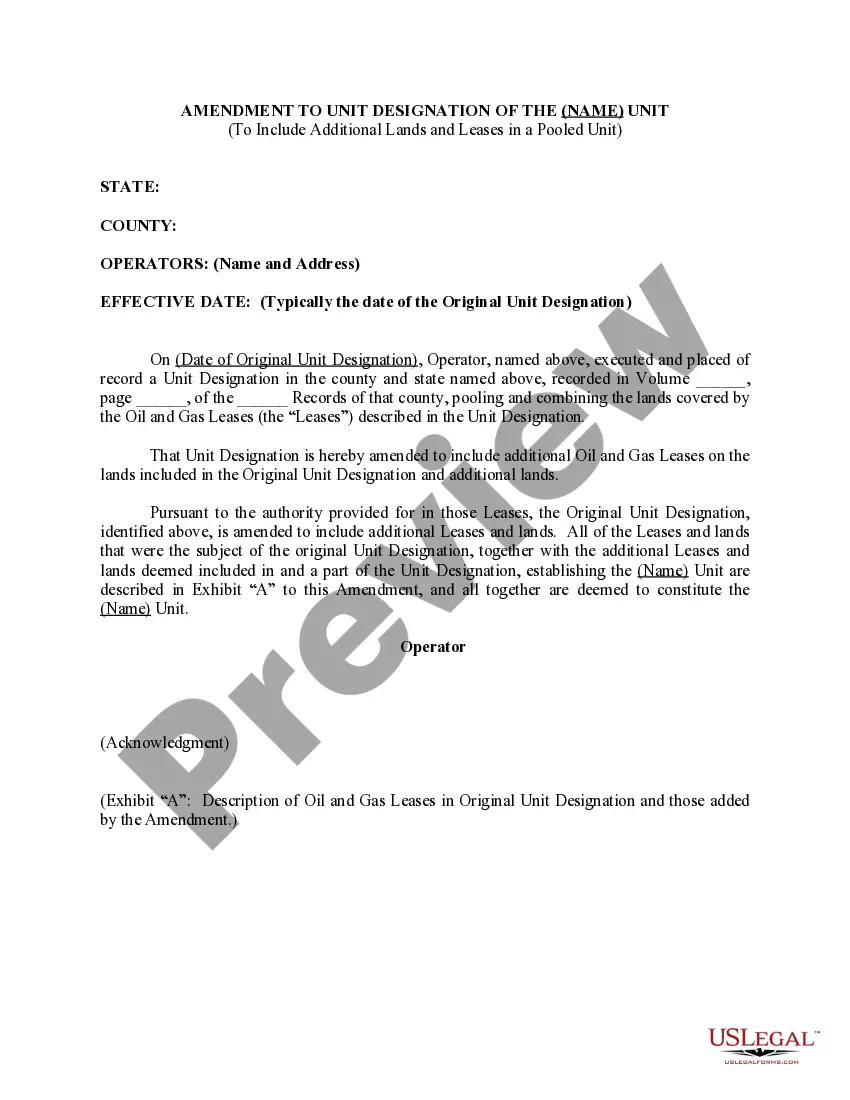
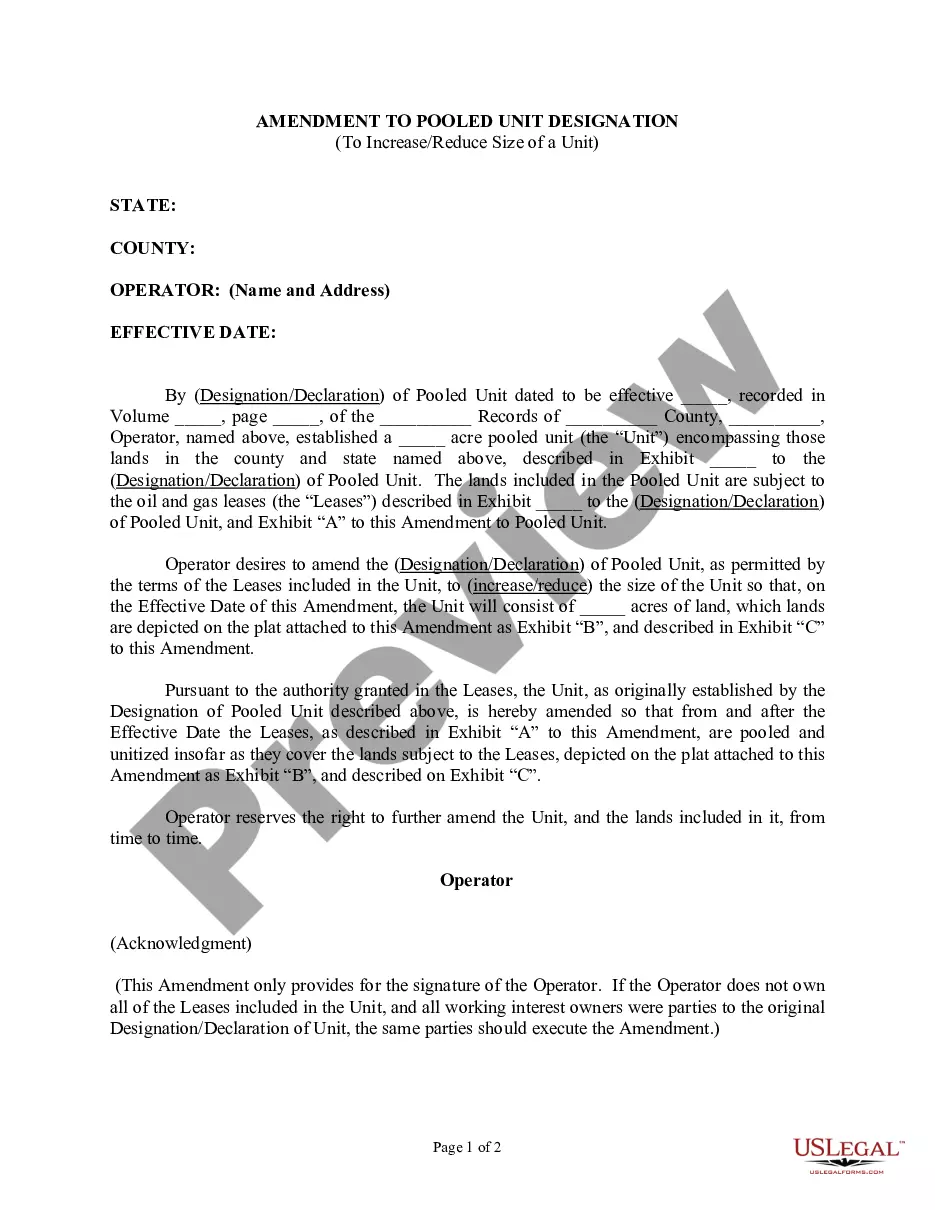
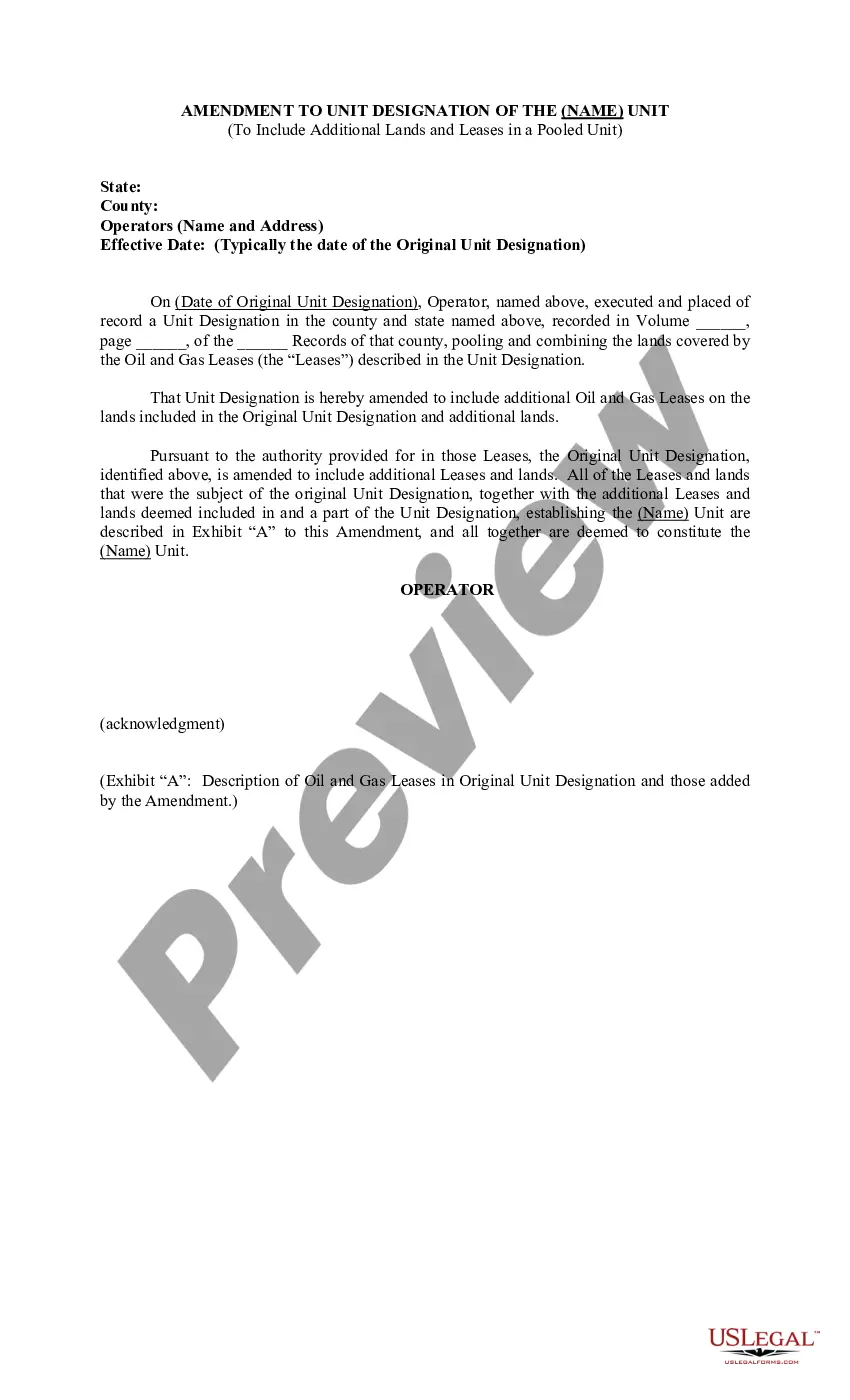
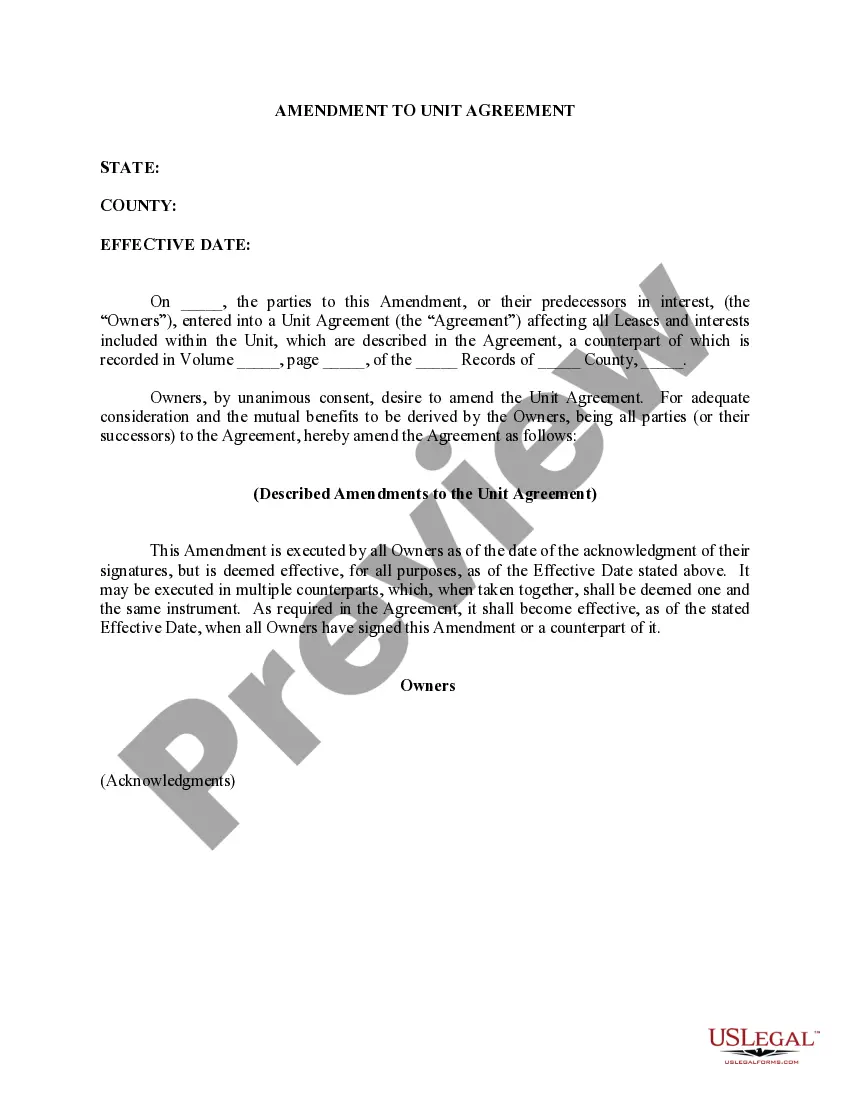
The Amendment to Unit Designation to Include Additional Lands and Leases in a Unit is a legal document designed to update an existing unit designation. This form allows property operators to amend the original designation, incorporating additional oil and gas leases and lands into a pooled unit. Unlike standard leases, this amendment is specifically crafted to reflect changes in land use and lease agreements, ensuring all relevant parties are notified of the updates.
Form components explained
- Operator name and address details.
- Effective date, often correlating with the original unit designation date.
- Details of the original unit designation, including recording volume, page, and county records.
- A confirmation that the amendment includes additional oil and gas leases and lands.
- Description of all leases and lands, which is outlined in Exhibit A.
- Acknowledgment section for the operator's signature.
When this form is needed
This form should be used when an operator needs to amend an existing unit designation to encompass new lands or additional leases. It is essential in scenarios where development opportunities arise in previously unleased areas or when new leases become available that are adjacent to existing operations. This ensures comprehensive management of resources and adherence to legal requirements.
Who can use this document
- Operators of oil and gas properties seeking to expand their legal designation.
- Landowners looking to add additional lands to an existing pooled unit.
- Legal counsel representing operators in updating unit designations.
Steps to complete this form
- Identify the operators and provide their names and addresses.
- Specify the effective date of the amendment.
- Fill in the recording details of the original unit designation.
- Clearly outline the additional leases and lands in Exhibit A.
- Ensure the operator signs acknowledging the amendment.
Notarization requirements for this form
This form does not typically require notarization unless specified by local law. However, it is important to consult local regulations to verify if notarization is necessary for legal validity in specific jurisdictions.
Get your form ready online
Our built-in tools help you complete, sign, share, and store your documents in one place.
Make edits, fill in missing information, and update formatting in US Legal Forms—just like you would in MS Word.
Download a copy, print it, send it by email, or mail it via USPS—whatever works best for your next step.
Sign and collect signatures with our SignNow integration. Send to multiple recipients, set reminders, and more. Go Premium to unlock E-Sign.
If this form requires notarization, complete it online through a secure video call—no need to meet a notary in person or wait for an appointment.
We protect your documents and personal data by following strict security and privacy standards.

Make edits, fill in missing information, and update formatting in US Legal Forms—just like you would in MS Word.

Download a copy, print it, send it by email, or mail it via USPS—whatever works best for your next step.

Sign and collect signatures with our SignNow integration. Send to multiple recipients, set reminders, and more. Go Premium to unlock E-Sign.

If this form requires notarization, complete it online through a secure video call—no need to meet a notary in person or wait for an appointment.

We protect your documents and personal data by following strict security and privacy standards.
Common mistakes to avoid
- Failing to accurately describe new lands or leases in Exhibit A.
- Not including the correct recording details of the original designation.
- Leaving the effective date blank or incorrect.
- Omitting the operator's acknowledgment signature.
Benefits of completing this form online
- Convenient downloadable format for immediate use and filing.
- Editable fields to ensure accurate and personalized information.
- Reliability of forms drafted by licensed attorneys in compliance with legal standards.
- Access to support and guidance on completion, ensuring compliance with regional laws.
Summary of main points
- The form is essential for updating unit designations in the oil and gas industry.
- Completing the form accurately is crucial to avoid legal issues.
- Online access allows for convenient and timely updates to leasing agreements.
- Review local laws to determine any specific notarization requirements.
Looking for another form?

Form popularity
FAQ
16th amendment. Income tax (the more money you pay, the more tax you pay) 17th amendment. Direct Election of U.S. Senators. 18th amendment. Prohibition (Volstel) Act. 19th amendment. Women's suffrage (took 72 years to get)
Scholars consider the Fifth Amendment as capable of breaking down into the following five distinct constitutional rights: 1) right to indictment by the grand jury before any criminal charges for felonious crimes, 2) a prohibition on double jeopardy, 3) a right against forced self-incrimination, 4) a guarantee that all
Passed by Congress on July 2, 1909, and ratified February 3, 1913, the 16th amendment established Congress's right to impose a Federal income tax.
The Seventeenth Amendment (Amendment XVII) to the United States Constitution established the direct election of United States senators in each state. The amendment supersedes Article I, §3, Clauses 1 and 2 of the Constitution, under which senators were elected by state legislatures.
Following ratification by the state of Virginia, the first 10 amendments to the U.S. Constitution, known collectively as the Bill of Rights, become the law of the land.
Explanation: The 15th amendment expands the "Blessings of Liberty" to more of the United States' population by stipulating that the right of citizens of the United States to vote shall not be rejected or curtailed by the United States government at all level based on race, color, or their history of servitude.
What was a common characteristic about groups denied voting rights before the 15th, 19th and 26th amendments were ratified? state legislatures could decide whether women, African-Americans and young people could vote. The president could decide whether women, African-Americans and young people could vote.
Amendments 15, 19, 24, and 26 all deal with voting rights. Ratified in 1870, the 15th Amendment gave the right to vote to any male, regardless of race, color, or belief.Ratified in 1964, the 24th Amendment made poll taxes illegal. Poll taxes were taxes or fees charged to vote.
Here's one: In 1919, the U.S. adopted the 18th Amendment, launching Prohibition; in 1920 came the 19th Amendment and women's suffrage.