Disclaimer of All Rights Under Operating Agreement by Successor to Party to Agreement
What is this form?
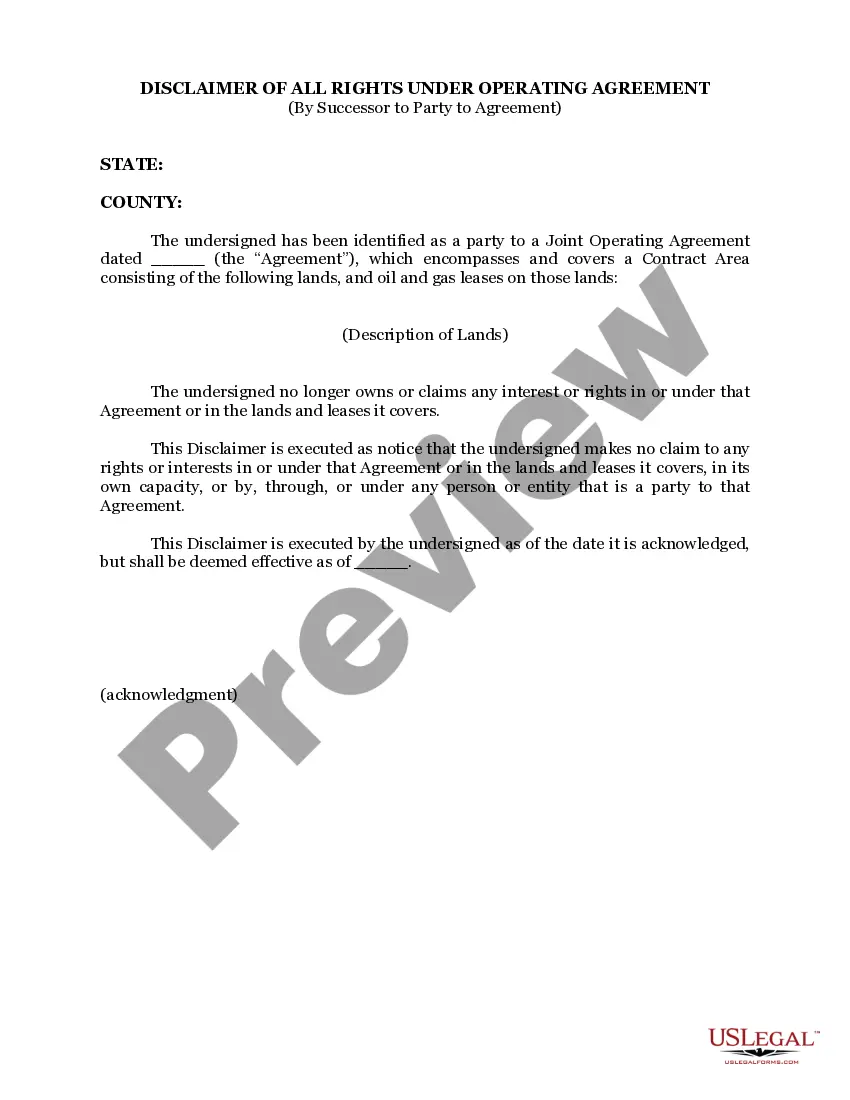
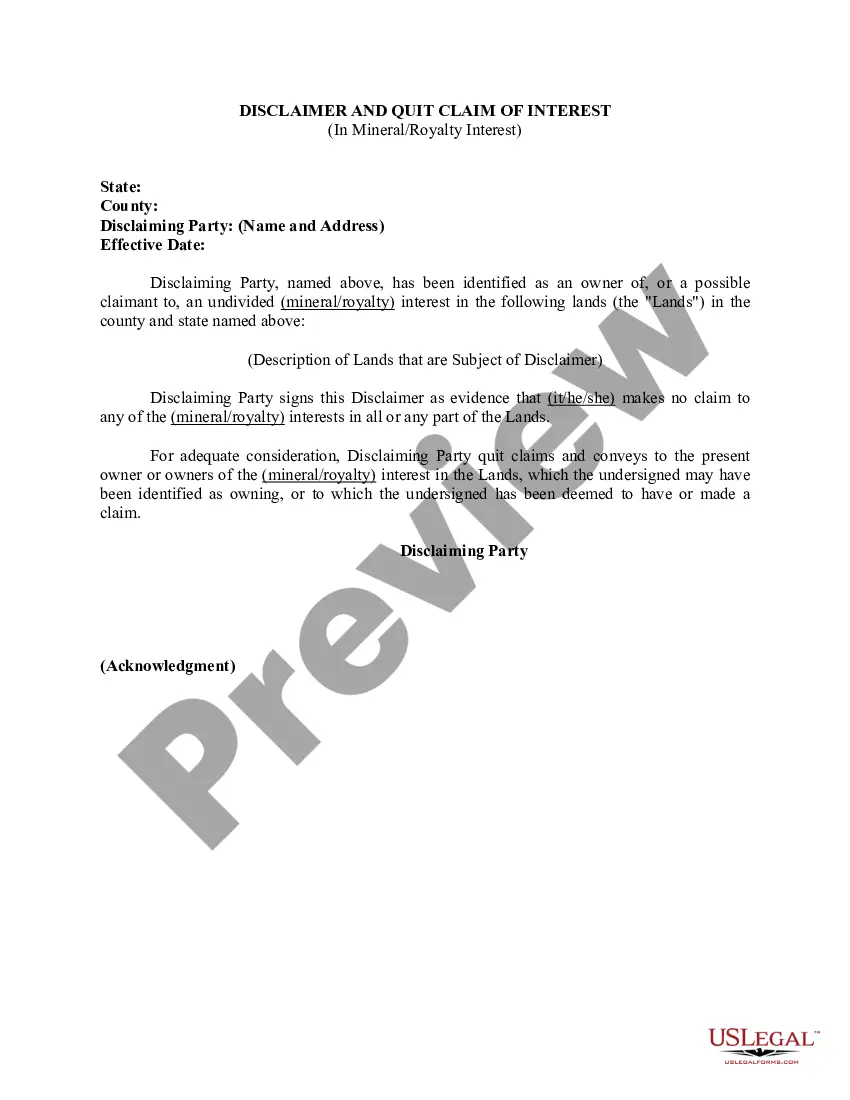
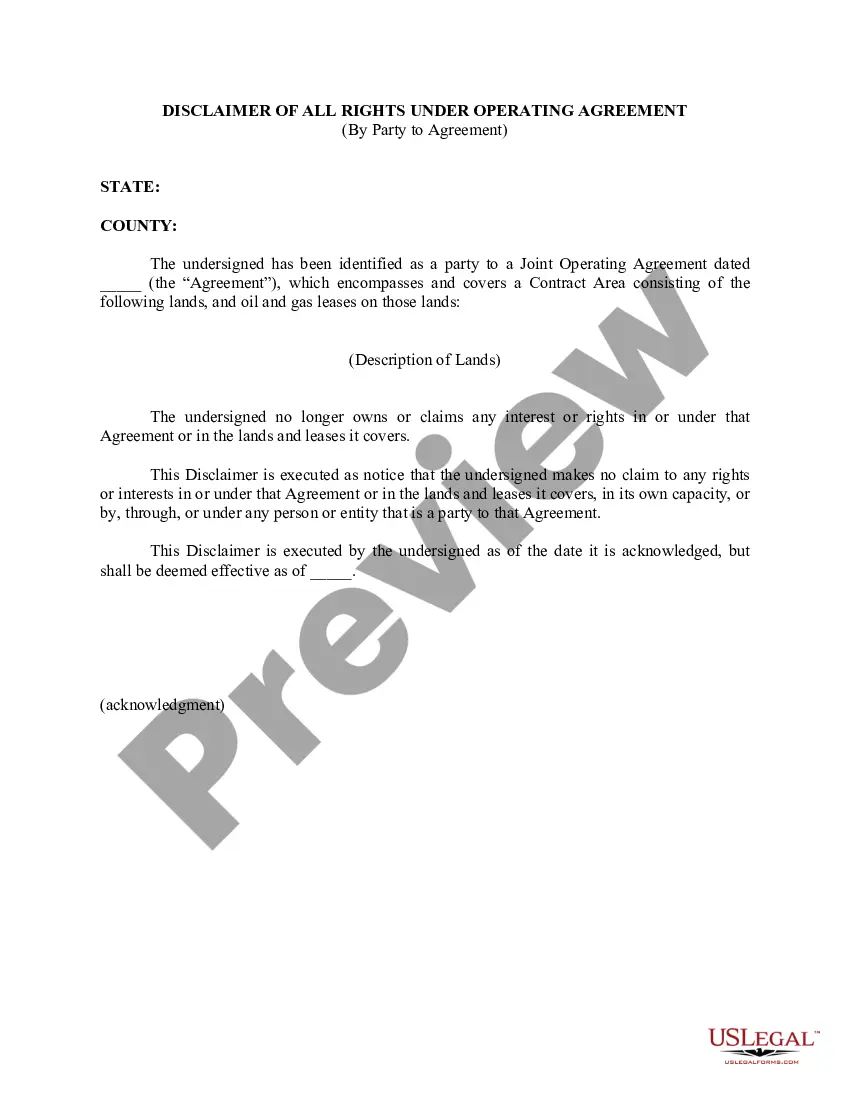
The Disclaimer of All Rights Under Operating Agreement by Successor to Party to Agreement is a legal document that serves to officially declare that a successor party no longer holds any rights or interests in an operating agreement or the associated lands and leases. This form is particularly useful for successors who wish to clarify their non-ownership status and avoid potential disputes regarding rights under the original agreement. Unlike other forms related to operating agreements, this disclaimer explicitly addresses the cessation of claims, ensuring a clear legal delineation of interests.
Key parts of this document
- Parties involved: Identification of the successor party and the original agreement.
- Agreement details: Reference to the Joint Operating Agreement and its effective date.
- Property description: Specification of the lands and oil and gas leases covered by the agreement.
- Disclaimer statement: A clear declaration that the successor relinquishes any claims to rights under the agreement.
- Acknowledgment section: A field for the signature and date to affirm the disclaimer's effectiveness.
When to use this form
This form should be used when a party succeeds to rights under a Joint Operating Agreement but wishes to formally state that they are disclaiming any interest or claims to the rights spelled out in that agreement. It is appropriate in scenarios such as estate transfers, corporate acquisitions, or when a party departs from a group without transferring rights. Utilizing this form prevents future legal disputes regarding ownership rights and ensures clarity for all parties involved.
Who should use this form
- Successors to parties involved in a Joint Operating Agreement.
- Individuals or entities that no longer wish to assert any claim to rights under an operating agreement.
- Legal representatives handling the transfer of rights on behalf of an entity or individual party.
- Anyone in a situation requiring formal confirmation of non-ownership of rights associated with an agreement.
Instructions for completing this form
- Identify the parties: Enter the names and details of the successor and the original parties to the agreement.
- Reference the agreement: Fill in the date and key information regarding the Joint Operating Agreement.
- Describe the property: Provide a detailed description of the lands and leases included in the agreement.
- Execute the disclaimer: Clearly state the disclaimer of rights to eliminate any future claims.
- Get acknowledgment: Ensure the form is signed and dated by the appropriate parties to affirm its validity.
Notarization requirements for this form
This form needs to be notarized to ensure legal validity. US Legal Forms provides secure online notarization powered by Notarize, allowing you to complete the process through a verified video call, available anytime.
Get your form ready online
Our built-in tools help you complete, sign, share, and store your documents in one place.
Make edits, fill in missing information, and update formatting in US Legal Forms—just like you would in MS Word.
Download a copy, print it, send it by email, or mail it via USPS—whatever works best for your next step.
Sign and collect signatures with our SignNow integration. Send to multiple recipients, set reminders, and more. Go Premium to unlock E-Sign.
If this form requires notarization, complete it online through a secure video call—no need to meet a notary in person or wait for an appointment.
We protect your documents and personal data by following strict security and privacy standards.

Make edits, fill in missing information, and update formatting in US Legal Forms—just like you would in MS Word.

Download a copy, print it, send it by email, or mail it via USPS—whatever works best for your next step.

Sign and collect signatures with our SignNow integration. Send to multiple recipients, set reminders, and more. Go Premium to unlock E-Sign.

If this form requires notarization, complete it online through a secure video call—no need to meet a notary in person or wait for an appointment.

We protect your documents and personal data by following strict security and privacy standards.
Typical mistakes to avoid
- Failing to include all necessary parties in the agreement reference.
- Omitting the specific description of lands and leases, leading to potential ambiguity.
- Not executing the form with proper signatures and dates, which may render it ineffective.
- Assuming the form is valid in all states without checking local requirements.
Benefits of completing this form online
- Convenience: Downloadable formats allow for completion at your own pace.
- Editability: Fill in required fields directly and make changes as necessary.
- Reliability: Forms are crafted by licensed attorneys to ensure legal validity.
Looking for another form?
Form popularity
FAQ
The symbol © (the letter C in a circle), or the word "Copyright" or the abbreviation "Copr."; The year of first publication of the work; and. The name of the owner of copyright in the work.
As a copyright owner, you might use the All rights reserved notice to indicate that you retain all rights provided by copyright law. As such, another person cannot reproduce, distribute and/or adapt any part of the work without your permission.
Even though the phrase "all rights reserved" has no legal significance today, it is still used with almost all copyright notices.The phrase then is used as a link text to the applicable Creative Commons license. Their "dedication to the public domain" statement uses the phrase "No rights reserved".
"All rights reserved" is a phrase that originated in copyright law as a formal requirement for copyright notice. It indicates that the copyright holder reserves, or holds for their own use, all the rights provided by copyright law under one specific copyright treaty. That's what it means in this context.
The phrase "All rights reserved" is often used in conjunction with a copyright notice. Today it has no legal significance. In copyright law, by default all rights are reserved; nothing may be done with a copyrighted work without explicit permission.
While not required by law, you can further demonstrate your ownership rights to your website by registering for an official copyright through the U.S. Copyright Office.A website with a registered copyright may be eligible for statutory damages and attorney's fees if a lawsuit is successful.
This means that no one may use your work unless they obtain your permission. This statement is not legally required, and failure to include it has no legal significance. Since others may not use copyrighted works without the copyright holder's permission, the statement is redundant.
Finally, a rights statement is nothing more than an indication in the rights you hold in the work. If you don't wish to allow any copying (or just want everyone to ask permission), simply say All Rights Reserved.