Naturally Occurring Radium, Thorium, Or Other Materials
What is this form?
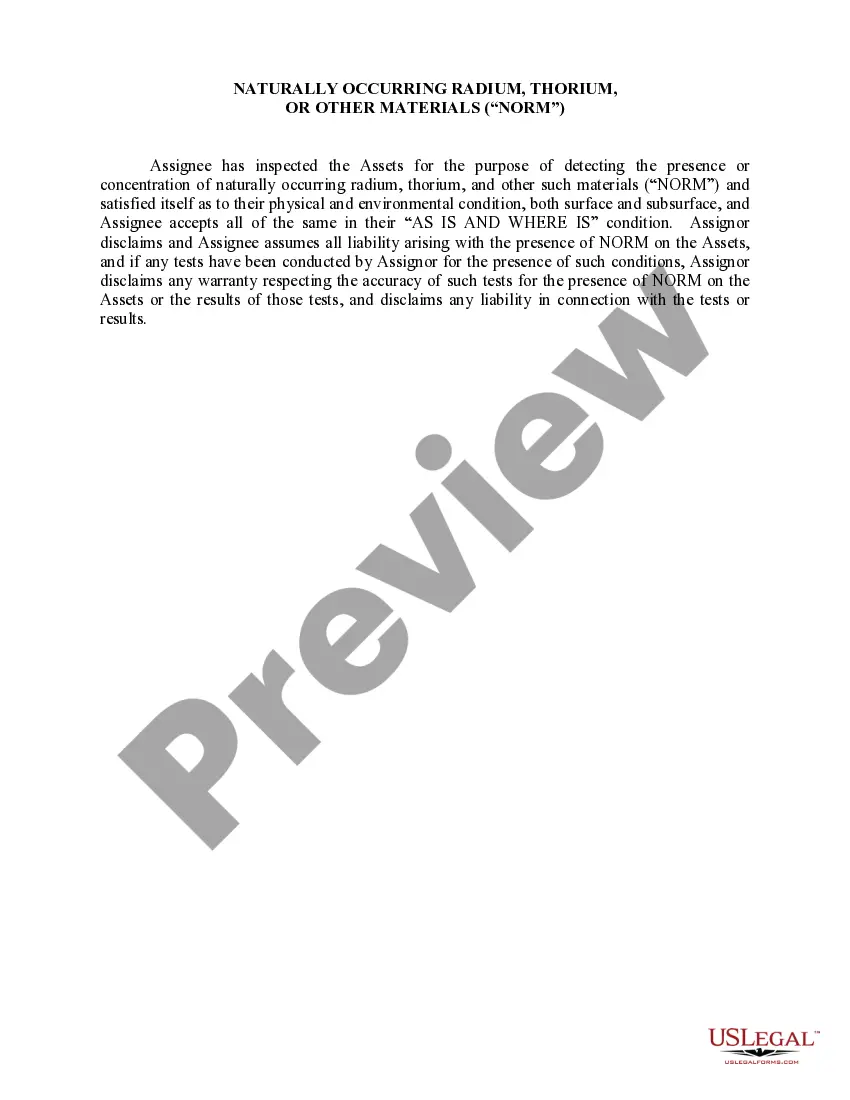
The Naturally Occurring Radium, Thorium, or Other Materials form is a legal document used to acknowledge the inspection of assets for the presence or concentration of naturally occurring radioactive materials (NORM). Its primary purpose is to document the physical and environmental condition of the inspected assets, rather than to assess their value or usability. This form differs from other property inspection forms in that it specifically targets potential environmental hazards associated with NORM, ensuring that both the assignor and assignee have an understanding of the liability involved.
Form components explained
- Inspection confirmation: Assignee acknowledges the inspection of the assets.
- Assessment of NORM presence: Detailed recognition of any naturally occurring radium, thorium, or similar materials found.
- Liability acceptance: Assignee assumes liability for the physical condition of the assets.
- Disclaimers: Assignor disclaims any responsibility for the accuracy of tests related to NORM.
- Condition acceptance: Assignee accepts assets in their "as is and where is" condition.
Common use cases
This form should be used when a party is acquiring or assigning assets that may have been exposed to naturally occurring radium, thorium, or other radioactive materials. It is particularly necessary in industries such as mining, oil and gas, or real estate, where environmental safety is a concern. This form is also essential when a buyer or acquirer wishes to document the known environmental conditions of the assets before finalizing a transaction.
Who needs this form
This form is intended for:
- Asset buyers who need to confirm the environmental conditions of their acquisitions.
- Asset sellers who want to disclaim liability regarding the physical condition of their property.
- Real estate professionals involved in transactions of properties with potential NORM exposure.
- Environmental consultants conducting due diligence assessments.
How to complete this form
- Identify the parties involved: Clearly state the names of the assignor and assignee.
- Enter the asset details: Describe the assets being inspected, including location and type.
- Document the inspection results: Note any findings regarding the presence or concentration of NORM.
- Include disclaimers: Ensure disclaimers regarding test accuracy and liability are explicitly stated.
- Sign and date: Both parties should sign and date the form to acknowledge their agreement and acceptance of the conditions.
Does this form need to be notarized?
This form usually doesn’t need to be notarized. However, local laws or specific transactions may require it. Our online notarization service, powered by Notarize, lets you complete it remotely through a secure video session, available 24/7.
Get your form ready online
Our built-in tools help you complete, sign, share, and store your documents in one place.
Make edits, fill in missing information, and update formatting in US Legal Forms—just like you would in MS Word.
Download a copy, print it, send it by email, or mail it via USPS—whatever works best for your next step.
Sign and collect signatures with our SignNow integration. Send to multiple recipients, set reminders, and more. Go Premium to unlock E-Sign.
If this form requires notarization, complete it online through a secure video call—no need to meet a notary in person or wait for an appointment.
We protect your documents and personal data by following strict security and privacy standards.

Make edits, fill in missing information, and update formatting in US Legal Forms—just like you would in MS Word.

Download a copy, print it, send it by email, or mail it via USPS—whatever works best for your next step.

Sign and collect signatures with our SignNow integration. Send to multiple recipients, set reminders, and more. Go Premium to unlock E-Sign.

If this form requires notarization, complete it online through a secure video call—no need to meet a notary in person or wait for an appointment.

We protect your documents and personal data by following strict security and privacy standards.
Common mistakes
- Failing to accurately describe the assets being inspected.
- Overlooking necessary disclaimers regarding liability and test accuracy.
- Not having both parties sign the form, rendering it unenforceable.
- Using outdated versions of the form that may not comply with current regulations.
Why use this form online
- Convenient access to professionally drafted templates at any time.
- Easy editing options to customize the form to your specific situation.
- Reliable legal compliance as the forms are prepared by licensed attorneys.
Legal use & context
- This form legalizes the acceptance and liability terms concerning assets with potential radioactive materials.
- Ensures transparency between parties in the case of property transactions.
- Helps prevent future disputes related to the condition of the assets.
Key takeaways
- The NORM form is essential for documenting the inspection and acceptance of assets potentially containing radioactive materials.
- Proper completion and understanding of the liabilities outlined are critical to protect all parties involved.
- This form can be tailored for multiple jurisdictions, making it versatile for various transactions.
Looking for another form?

Form popularity
FAQ
The Earth itself is a source of terrestrial radiation. Radioactive materials (including uranium, thorium, and radium) exist naturally in soil and rock. Essentially all air contains radon , which is responsible for most of the dose that Americans receive each year from natural background sources.
Smoke detectors: most smoke detectors available for home use contain americium-241, a radioactive element. Clocks and watches: some luminous watches and clocks contain a small quantity of hydrogen-3 (tritium) or promethium-147.
Thorium (chemical symbol Th) is a naturally occurring radioactive metal found at trace levels in soil, rocks, water, plants and animals.There are natural and man-made forms of thorium, all of which are radioactive. In general, naturally occurring thorium exists as Th-232, Th-230 or Th-228.
Exposure from terrestrial radiation. The composition of the earth's crust is a major source of natural radiation. The main contributors are natural deposits of uranium, potassium and thorium which, in the process of natural decay, release small amounts of ionizing radiation.
Bananas contain potassium, a metal that decays, releasing infinitesimal amounts of radiation. Granite countertops, like the one I'm sitting at now, in the kitchen. Cat litter. TVs. Brazil nuts, which contain radium that the trees absorb from the ground. The house itself. You.
Stone (flint, granite, obsidian, sandstone, sand, gems, glass, etc.) Native metal (copper, iron, gold, silver, etc.) Composites (clay, plasticine, etc.)
Thorium is a naturally occurring radioactive metal that is found in soil, rock, and water. It is formed by the radioactive decay of uranium. Minerals such as monazite, thorite, and thorianite are rich in thorium and may be mined for the metal. Thorium has coloring properties that have made it useful in ceramic glazes.
Thorium is mainly mined in Australia, Canada, the United States, Russia and India, according to Minerals Education Coalition. Trace levels of thorium are found in rocks, soil, water, plants and animals, according to the U.S. Environmental Protection Agency (EPA).
Cosmic Radiation. Terrestrial Radiation. Internal Radiation.