Assignment of Production Payment Measured by Quantity of Production
Understanding this form
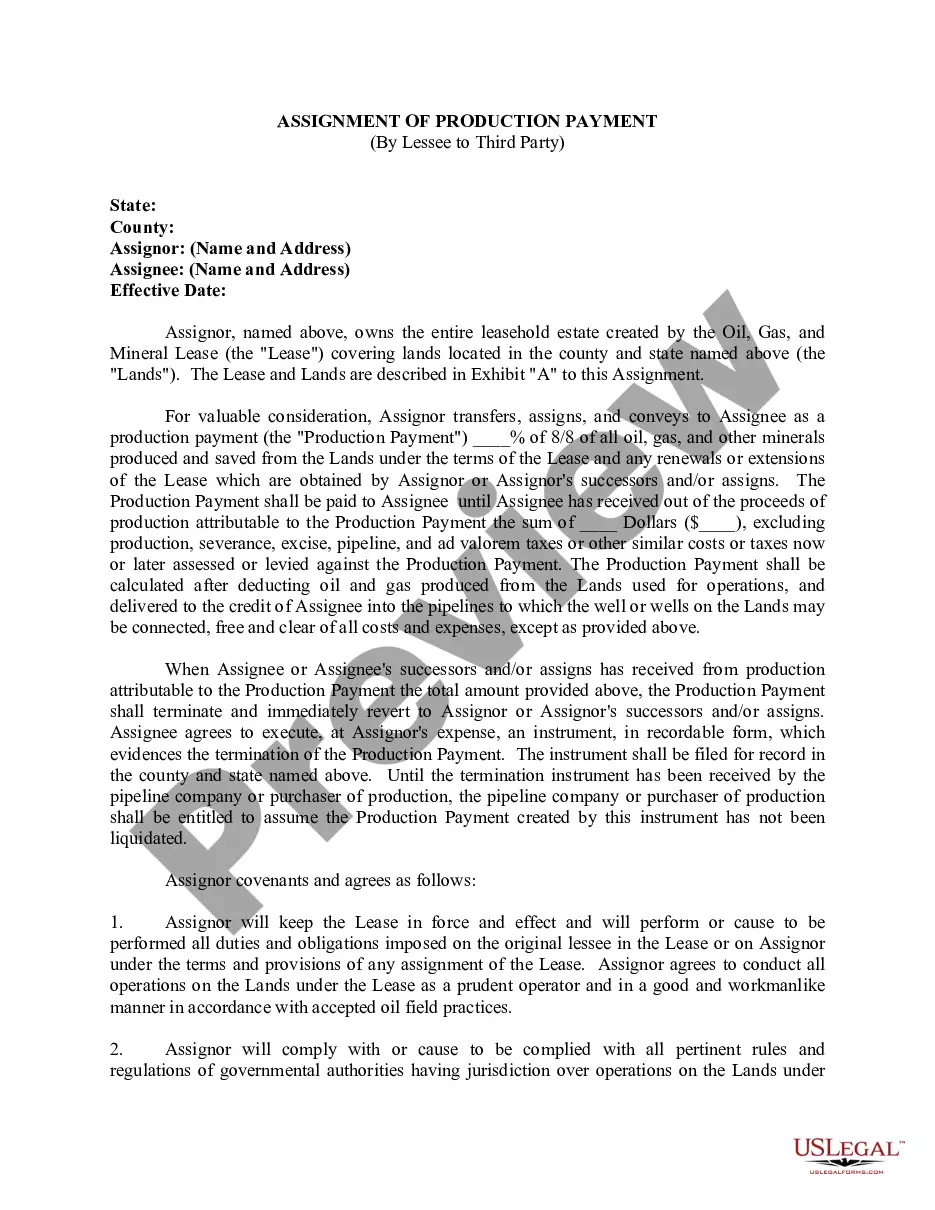
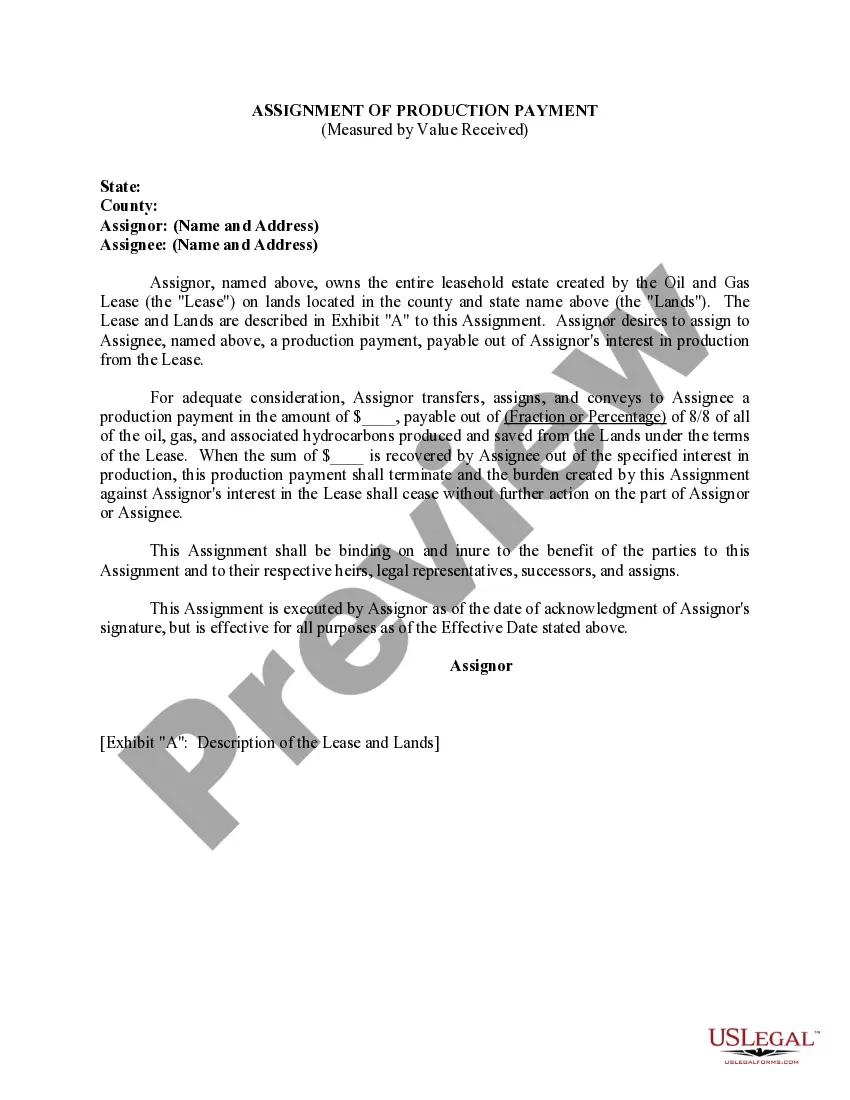
The Assignment of Production Payment Measured by Quantity of Production is a legal document that allows the Assignor to transfer ownership of a production payment based on a specific amount of oil or gas produced. This form is essential for outlining the agreement between the Assignor and Assignee, ensuring clarity on terms of resource extraction rights. Unlike other forms related to property ownership, this document specifically addresses the transfer of payment rights linked to production quantities, making it unique for users involved in oil and gas transactions.
Main sections of this form
- Assignor and Assignee information, including names and addresses.
- Effective Date of the assignment.
- Description of the leasehold estate and lands involved.
- Specification of the production payment based on a fraction of production.
- Termination clause detailing when the payment rights will cease.
- Binding nature of the assignment on heirs and assigns.

When to use this document
This form is typically used when the owner of oil and gas resources (the Assignor) wants to transfer their right to receive a production payment to another party (the Assignee). It is beneficial in scenarios such as selling a portion of production rights, negotiating deals with partners, or securing financing where production payments are a component of the overall agreement. Understanding when to deploy this form can assist parties in managing their rights and financial interests effectively.
Who can use this document
- Landowners or resource owners looking to transfer production payment rights.
- Investors seeking a share of profits from oil or gas production.
- Businesses involved in oil and gas operations needing formal assignments of production payments.
- Legal representatives facilitating the transfer of production rights on behalf of clients.
Completing this form step by step
- Identify the Assignor and Assignee by entering their names and addresses at the beginning of the form.
- Specify the Effective Date for the assignment to become valid.
- Clearly describe the lands and leases involved in Exhibit A to provide context for the assignment.
- Enter the proportion of the production payment that the Assignee will receive from the total output.
- Indicate the quantity of oil or gas production that will trigger the termination of the payment rights.
- Ensure both the Assignor and Assignee sign the document to finalize the agreement.
Notarization requirements for this form
Notarization is not commonly needed for this form. However, certain documents or local rules may make it necessary. Our notarization service, powered by Notarize, allows you to finalize it securely online anytime, day or night.
Get your form ready online
Our built-in tools help you complete, sign, share, and store your documents in one place.
Make edits, fill in missing information, and update formatting in US Legal Forms—just like you would in MS Word.
Download a copy, print it, send it by email, or mail it via USPS—whatever works best for your next step.
Sign and collect signatures with our SignNow integration. Send to multiple recipients, set reminders, and more. Go Premium to unlock E-Sign.
If this form requires notarization, complete it online through a secure video call—no need to meet a notary in person or wait for an appointment.
We protect your documents and personal data by following strict security and privacy standards.

Make edits, fill in missing information, and update formatting in US Legal Forms—just like you would in MS Word.

Download a copy, print it, send it by email, or mail it via USPS—whatever works best for your next step.

Sign and collect signatures with our SignNow integration. Send to multiple recipients, set reminders, and more. Go Premium to unlock E-Sign.

If this form requires notarization, complete it online through a secure video call—no need to meet a notary in person or wait for an appointment.

We protect your documents and personal data by following strict security and privacy standards.
Common mistakes
- Failing to clearly define the quantity of production that ends the payment rights.
- Not providing complete descriptions of the leases and lands in Exhibit A.
- Neglecting to include both parties' signatures, which may invalidate the assignment.
- Using incorrect or incomplete information for the Assignor and Assignee sections.
Why complete this form online
- Convenience of completing the form at your own pace without the need for in-person meetings.
- Editability allows users to easily make changes before finalization.
- Access to professionally drafted templates ensures reliability and compliance with legal standards.
- Quick downloadable format allows for immediate use and distribution.
Looking for another form?


Form popularity
FAQ
A volumetric production payment (VPP) deal is a means of financing that has been used in the oil and gas industry for several decades. A VPP involves the owner of an oil and gas property selling a percentage of their production in exchange for an upfront cash payment.
The royalty mineral owner retains ownership of the interest after production stops. Holders of overriding royalty interests have no ownership rights to the minerals under the ground but a non-possessory undivided interest.
An overriding royalty interest is the right to receive revenue from the production of oil and gas from a well. The overriding royalty is carved out of the lessee's (operator's) working interest and entitles its owner to a fraction of production.
A royalty interest is a non-possessory real property interest in oil and gas production free of production and operating expenses, which may be created by grant or by reservation or exception.
Production payments are commonly defined as a. share of oil or gas as produced, free of costs of. development, operations, and production, that. terminates when a given volume of production has. been paid to, or a specified sum from the sale of such.
A Volumetric Production Payment (VPP) is a type of structured investment that involves the owner of an oil or gas interest selling or borrowing money against a specific volume of production associated with that field or property.
An overriding royalty interest generally entitles the owner of the interest to a specified share of the oil and gas produced under the terms of the lease. In Texas and in many other oil-producing states, overriding royalty interests are generally treated as interests in real estate.