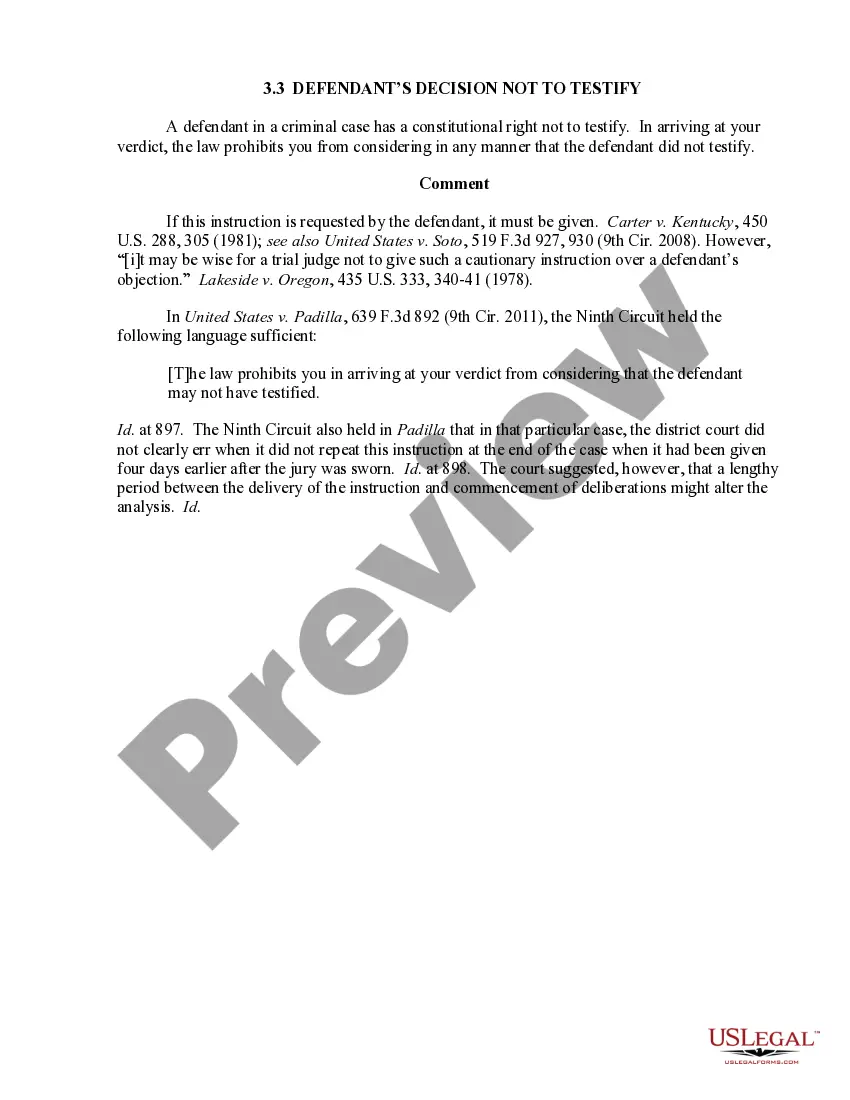
3.4 Defendant's Decision to Testify


Notarization guidance
This form usually doesn’t need to be notarized. However, local laws or specific transactions may require it. Our online notarization service, powered by Notarize, lets you complete it remotely through a secure video session, available 24/7.
Get your form ready online
Our built-in tools help you complete, sign, share, and store your documents in one place.
Make edits, fill in missing information, and update formatting in US Legal Forms—just like you would in MS Word.
Download a copy, print it, send it by email, or mail it via USPS—whatever works best for your next step.
Sign and collect signatures with our SignNow integration. Send to multiple recipients, set reminders, and more. Go Premium to unlock E-Sign.
If this form requires notarization, complete it online through a secure video call—no need to meet a notary in person or wait for an appointment.
We protect your documents and personal data by following strict security and privacy standards.

Make edits, fill in missing information, and update formatting in US Legal Forms—just like you would in MS Word.

Download a copy, print it, send it by email, or mail it via USPS—whatever works best for your next step.

Sign and collect signatures with our SignNow integration. Send to multiple recipients, set reminders, and more. Go Premium to unlock E-Sign.

If this form requires notarization, complete it online through a secure video call—no need to meet a notary in person or wait for an appointment.

We protect your documents and personal data by following strict security and privacy standards.
Looking for another form?
Form popularity
FAQ
If you are not convinced beyond a reasonable doubt that the defendant is guilty of a charged crime, you must find the defendant not guilty of that crime. If you are convinced beyond a reasonable doubt that the defendant is guilty of a charged crime, you must find the defendant guilty of that crime. CPL 300.10(2).
Proof beyond a reasonable doubt is proof that leaves you firmly convinced the defendant is guilty. It is not required that the government prove guilt beyond all possible doubt. A reasonable doubt is a doubt based upon reason and common sense and is not based purely on speculation.
A charge is proved beyond a reasonable doubt if, after you have compared and considered all of the evidence, you have in your minds an abiding conviction, to a moral certainty, that the charge is true.
Reasonable doubt is defined in the California Jury Instructions (CALCRIM) and the Penal Code. The trial judge will inform the jury that: The fact that a criminal charge has been filed against the defendant is not evidence that the charge is true.
Reasonable doubt is insufficient evidence that prevents a judge or jury from convicting a defendant of a crime. If it cannot be proved without a doubt that a defendant in a criminal case is guilty, then that person should not be convicted.
A reasonable doubt is a doubt based upon reason and common sense and is not based purely on speculation. It may arise from a careful and impartial consideration of all the evidence, or from lack of evidence.
A defendant in a criminal action is presumed to be innocent until the contrary is proved, and in case of a reasonable doubt whether his or her guilt is satisfactorily shown, he or she is entitled to an acquittal, but the effect of this presumption is only to place upon the state the burden of proving him or her guilty
Here is an in-depth look at five ways a criminal defense lawyer may be able to establish reasonable doubt in court: Exposing Flaws in the Prosecution's Case.Presenting Contradictory Evidence.Challenging the Prosecution's Evidence.Challenging the Prosecution's Witnesses.Keeping the Prosecution's Evidence Out of Court.