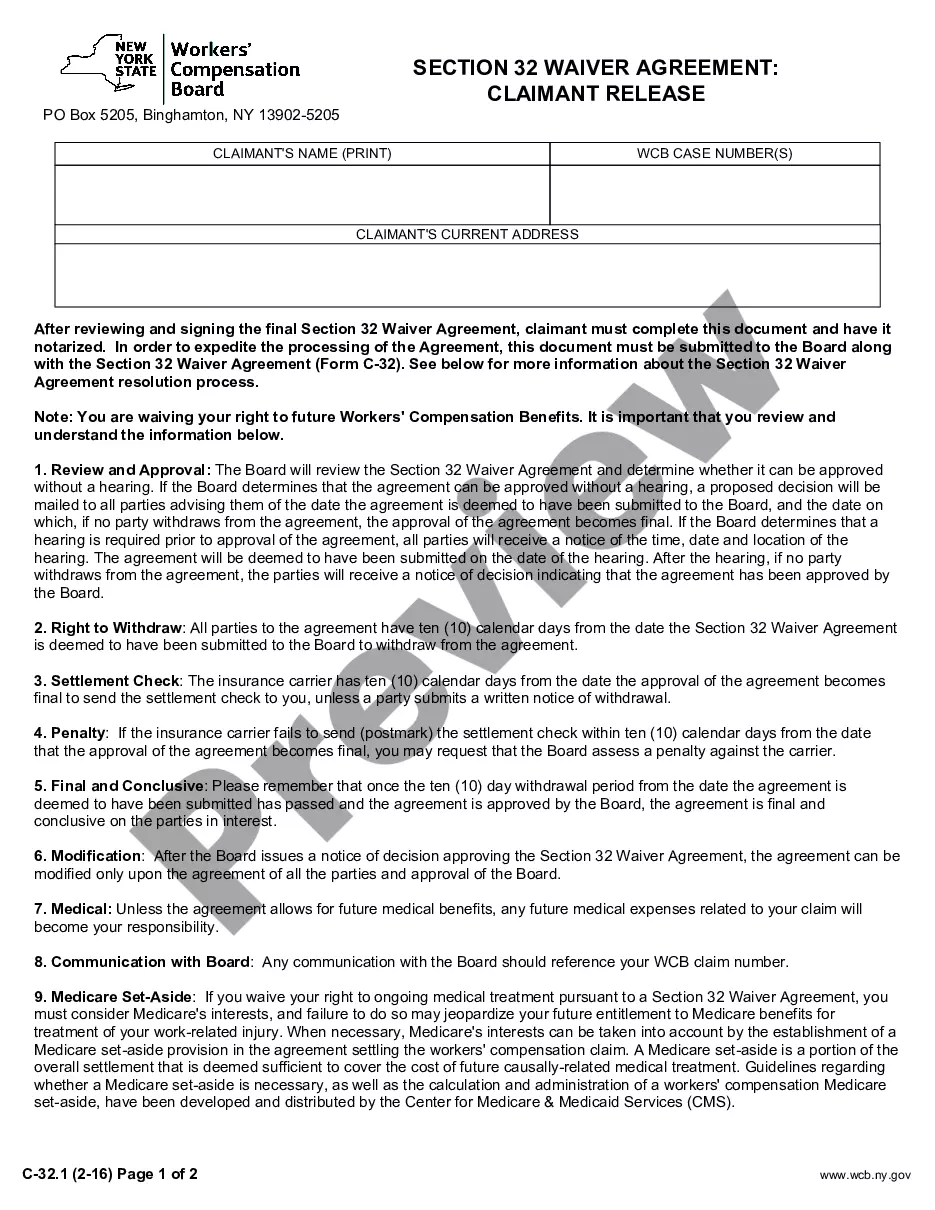
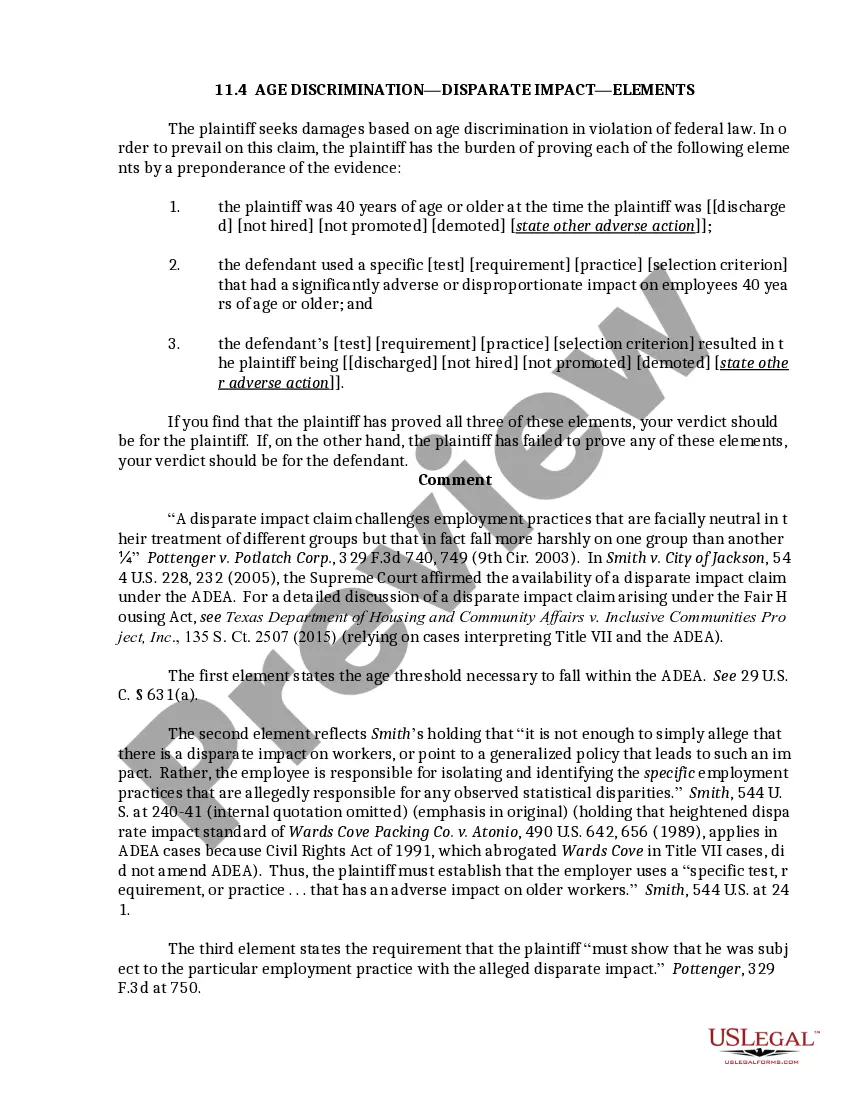
11.4 Age Discrimination-Disparate Impact-Elements


Is notarization required?
Notarization is not commonly needed for this form. However, certain documents or local rules may make it necessary. Our notarization service, powered by Notarize, allows you to finalize it securely online anytime, day or night.
Get your form ready online
Our built-in tools help you complete, sign, share, and store your documents in one place.
Make edits, fill in missing information, and update formatting in US Legal Forms—just like you would in MS Word.
Download a copy, print it, send it by email, or mail it via USPS—whatever works best for your next step.
Sign and collect signatures with our SignNow integration. Send to multiple recipients, set reminders, and more. Go Premium to unlock E-Sign.
If this form requires notarization, complete it online through a secure video call—no need to meet a notary in person or wait for an appointment.
We protect your documents and personal data by following strict security and privacy standards.

Make edits, fill in missing information, and update formatting in US Legal Forms—just like you would in MS Word.

Download a copy, print it, send it by email, or mail it via USPS—whatever works best for your next step.

Sign and collect signatures with our SignNow integration. Send to multiple recipients, set reminders, and more. Go Premium to unlock E-Sign.

If this form requires notarization, complete it online through a secure video call—no need to meet a notary in person or wait for an appointment.

We protect your documents and personal data by following strict security and privacy standards.
Looking for another form?

Form popularity
FAQ
In addition to prohibiting intentional discrimination against older workers (known as "disparate treatment"), the ADEA prohibits practices that, although facially neutral with regard to age, have the effect of harming older workers more than younger workers (known as "disparate impact"), unless the employer can show
To establish an adverse disparate impact, the investigating agency must (1) identify the specific policy or practice at issue; (2) establish adversity/harm; (3) establish significant disparity; 9 and (4) establish causation.
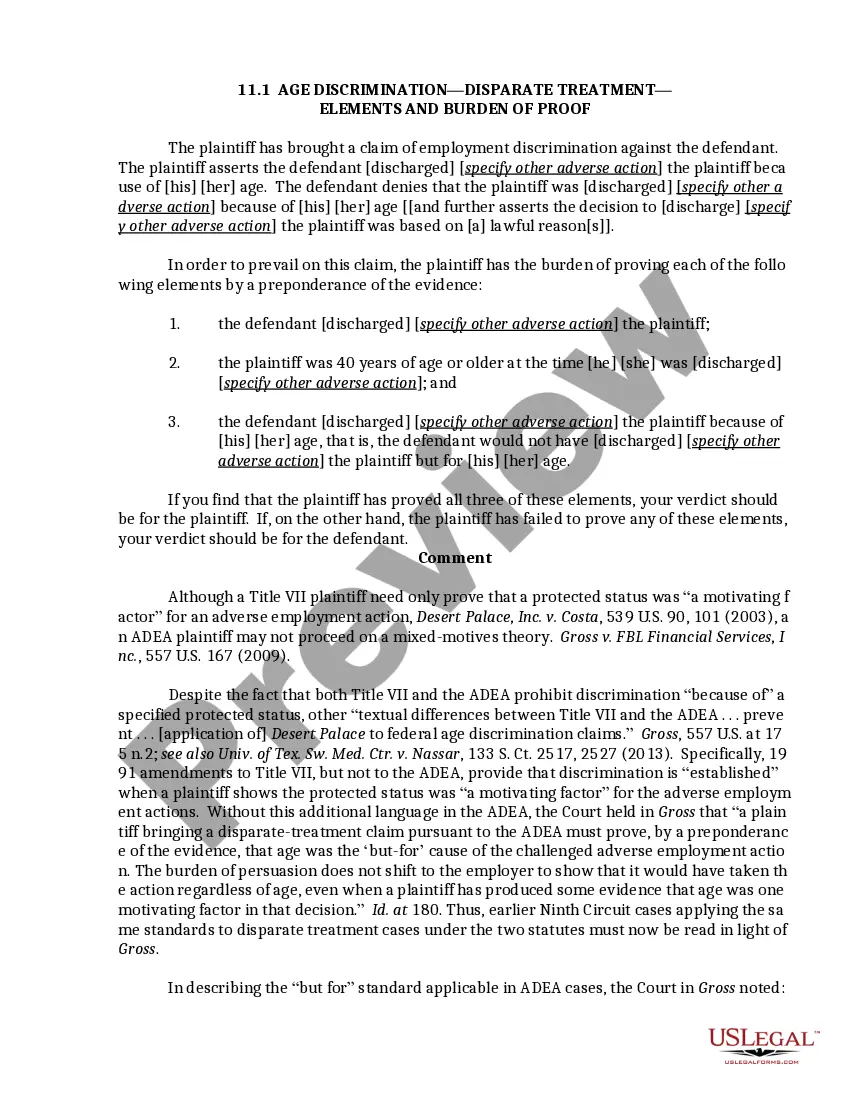
To establish a disparate-treatment claim under the plain language of the ADEA, therefore, a plaintiff must prove that age was the ?but-for? cause of the employer's adverse decision.
Disparate impact occurs when policies, practices, rules or other systems that appear to be neutral result in a disproportionate impact on a protected group.
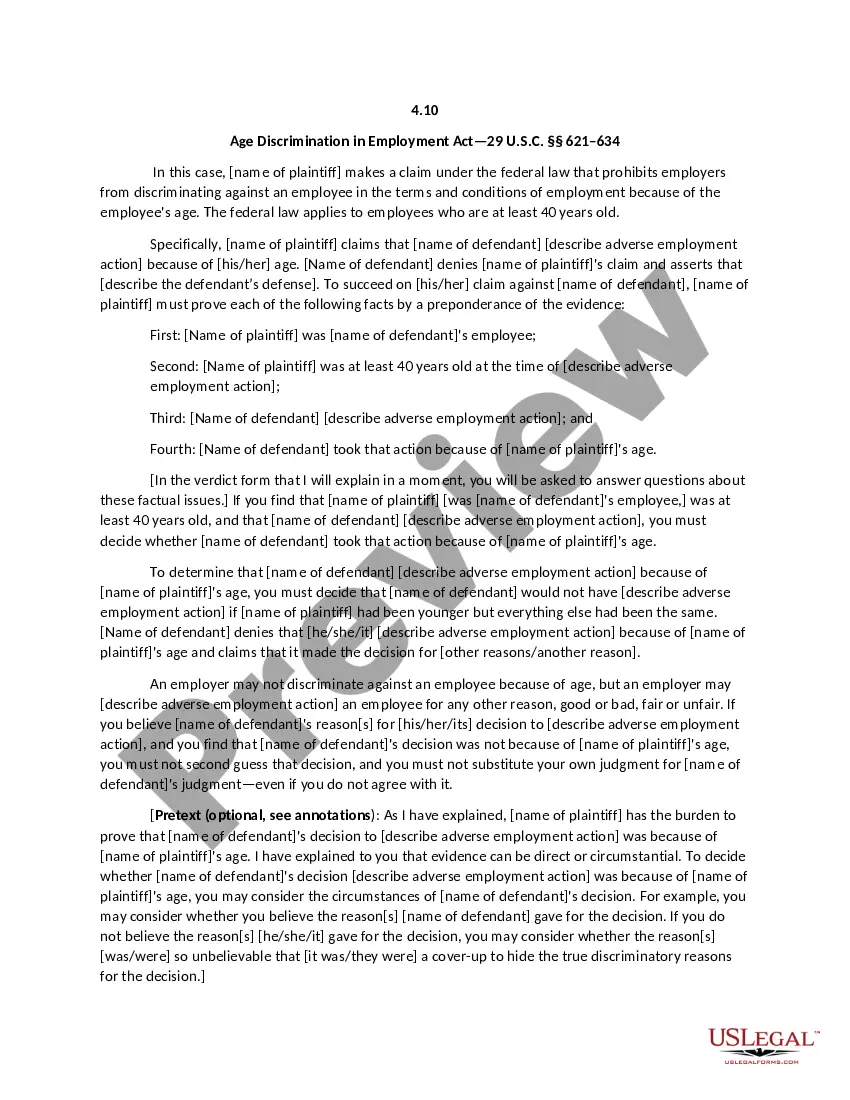
What does an age discrimination claim look like? The employee is at least 40 years old. The employee's work is good enough to meet their employer's legitimate expectations (that is, the employee is qualified for the position) The employer took an adverse action against the employee (such as, the employee was fired)
Disparate treatment refers to scenarios in which an employer intentionally singles out or treats a worker less favorably based on a protected characteristic. Generally, this is the more blatant form of age discrimination. In arguing disparate treatment, you have to prove the intentional discrimination.
There are important differences between Title VII and ADEA disparate impact claims. First, while under Title VII, individuals of every race, color, religion, sex, and national origin are protected, the ADEA applies only to individuals that are 40 years of age and older.