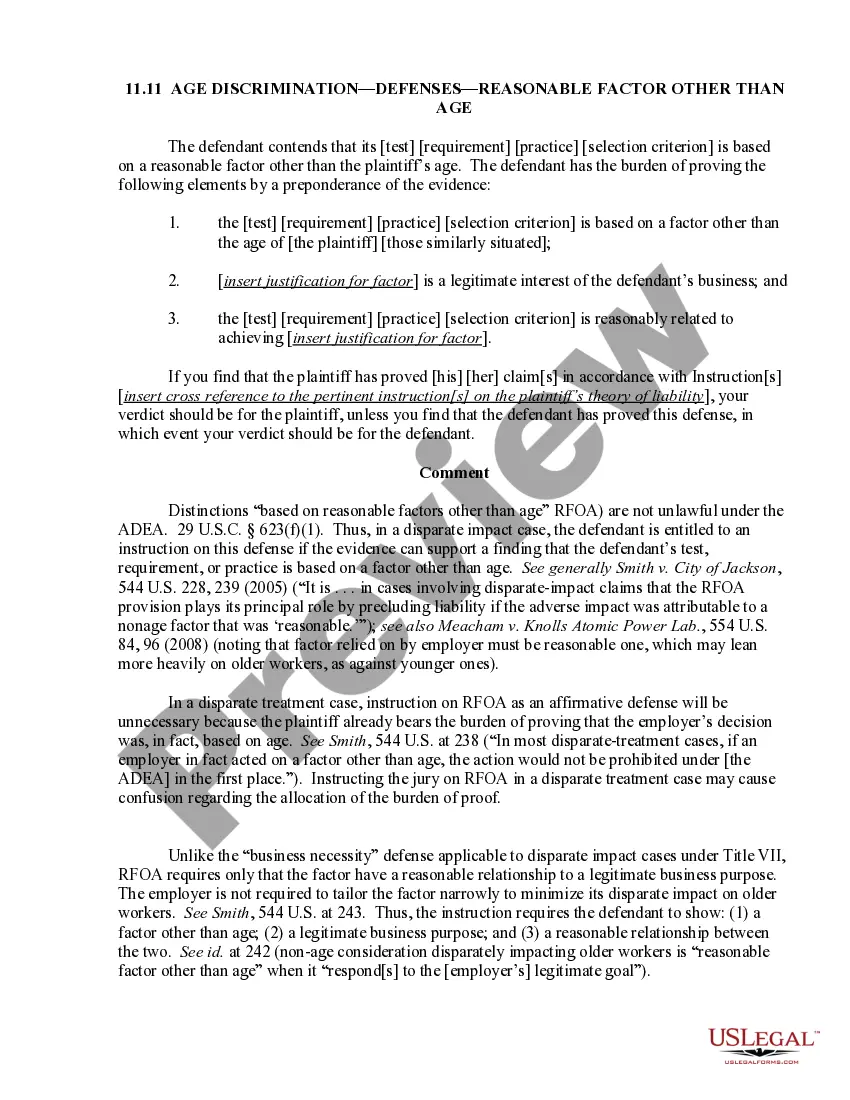
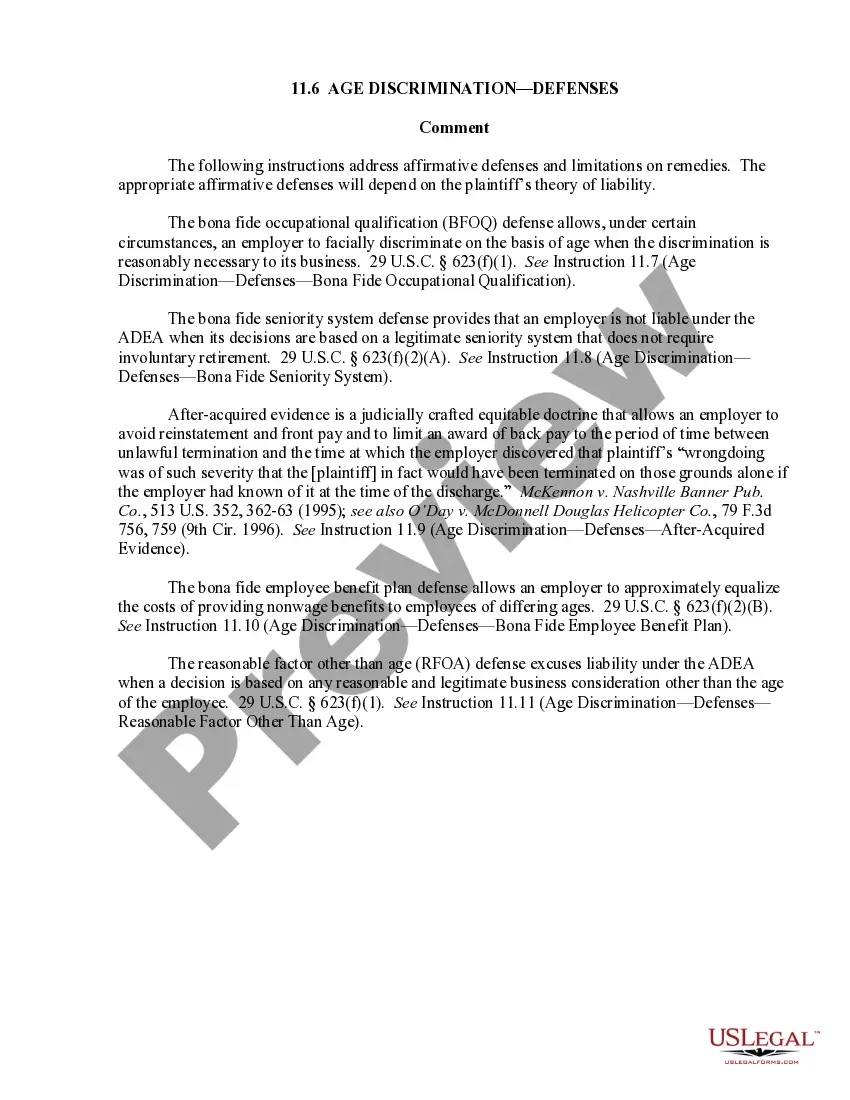
11.11 Age Discrimination-Defenses-Reasonable Factor Other than Age
Notarization guidance
This form usually doesn’t need to be notarized. However, local laws or specific transactions may require it. Our online notarization service, powered by Notarize, lets you complete it remotely through a secure video session, available 24/7.
Get your form ready online
Our built-in tools help you complete, sign, share, and store your documents in one place.
Make edits, fill in missing information, and update formatting in US Legal Forms—just like you would in MS Word.
Download a copy, print it, send it by email, or mail it via USPS—whatever works best for your next step.
Sign and collect signatures with our SignNow integration. Send to multiple recipients, set reminders, and more. Go Premium to unlock E-Sign.
If this form requires notarization, complete it online through a secure video call—no need to meet a notary in person or wait for an appointment.
We protect your documents and personal data by following strict security and privacy standards.

Make edits, fill in missing information, and update formatting in US Legal Forms—just like you would in MS Word.

Download a copy, print it, send it by email, or mail it via USPS—whatever works best for your next step.

Sign and collect signatures with our SignNow integration. Send to multiple recipients, set reminders, and more. Go Premium to unlock E-Sign.

If this form requires notarization, complete it online through a secure video call—no need to meet a notary in person or wait for an appointment.

We protect your documents and personal data by following strict security and privacy standards.
Looking for another form?
Form popularity
FAQ
Self-defense, entrapment, insanity, necessity, and respondeat superior are some examples of affirmative defenses.
Common Defenses in Employment Discrimination and Harassment Cases. One of the most commonly asserted defenses against an employment discrimination claim is that the employer lacked a discriminatory motive.
These reasons may include educational requirements, merit, productivity, the presence of a valid seniority system, or a number of other non-discriminatory reasons used to reach a hiring decision. Employers may also raise affirmative defenses such as a bona fide occupational qualification (BFOQ) and business necessity.
(1) A reasonable factor other than age is a non-age factor that is objectively reasonable when viewed from the position of a prudent employer mindful of its responsibilities under the ADEA under like circumstances.
An affirmative defense is a reason given by the defendant for why the plaintiff should not win the lawsuit, even if what the plaintiff says is true. In Texas, defendants must assert affirmative defenses in their Answer at the beginning of the case or risk not being able to use them later.
2 "Business necessity" is the defense to a claim of disparate impact under Title VII of the Civil Rights Act of 1964, which prohibits employment discrimination based on race, color, religion, sex, or national origin. See 42 U.S.C. § 2000e-2(k)(1)(A)(i).
Our attorneys who defends employers against an age discrimination lawsuit will assert affirmative defenses, including that the employee was not qualified for occupation, business necessity, or seniority system. California laws forbids age discrimination against workers who are age 40 or older.
2 "Business necessity" is the defense to a claim of disparate impact under Title VII of the Civil Rights Act of 1964, which prohibits employment discrimination based on race, color, religion, sex, or national origin.