9.03 Elements - Defendant's FELA Case
Overview of this form
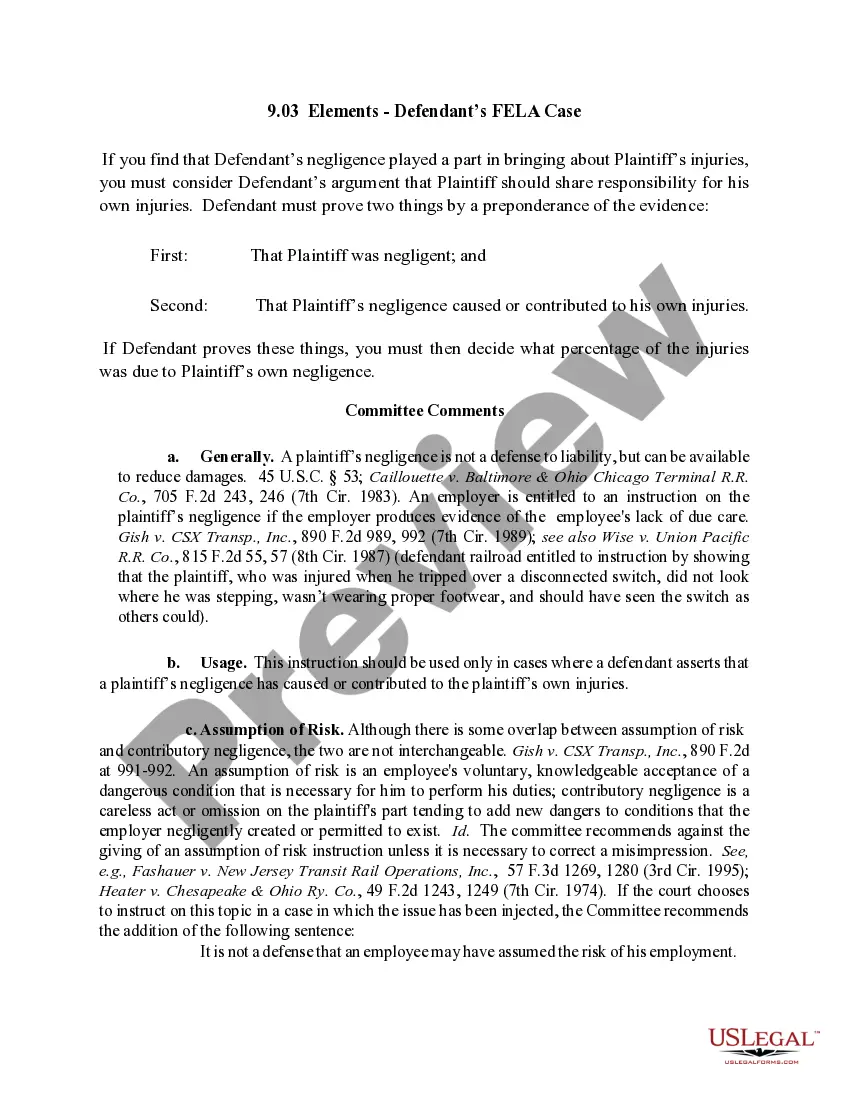
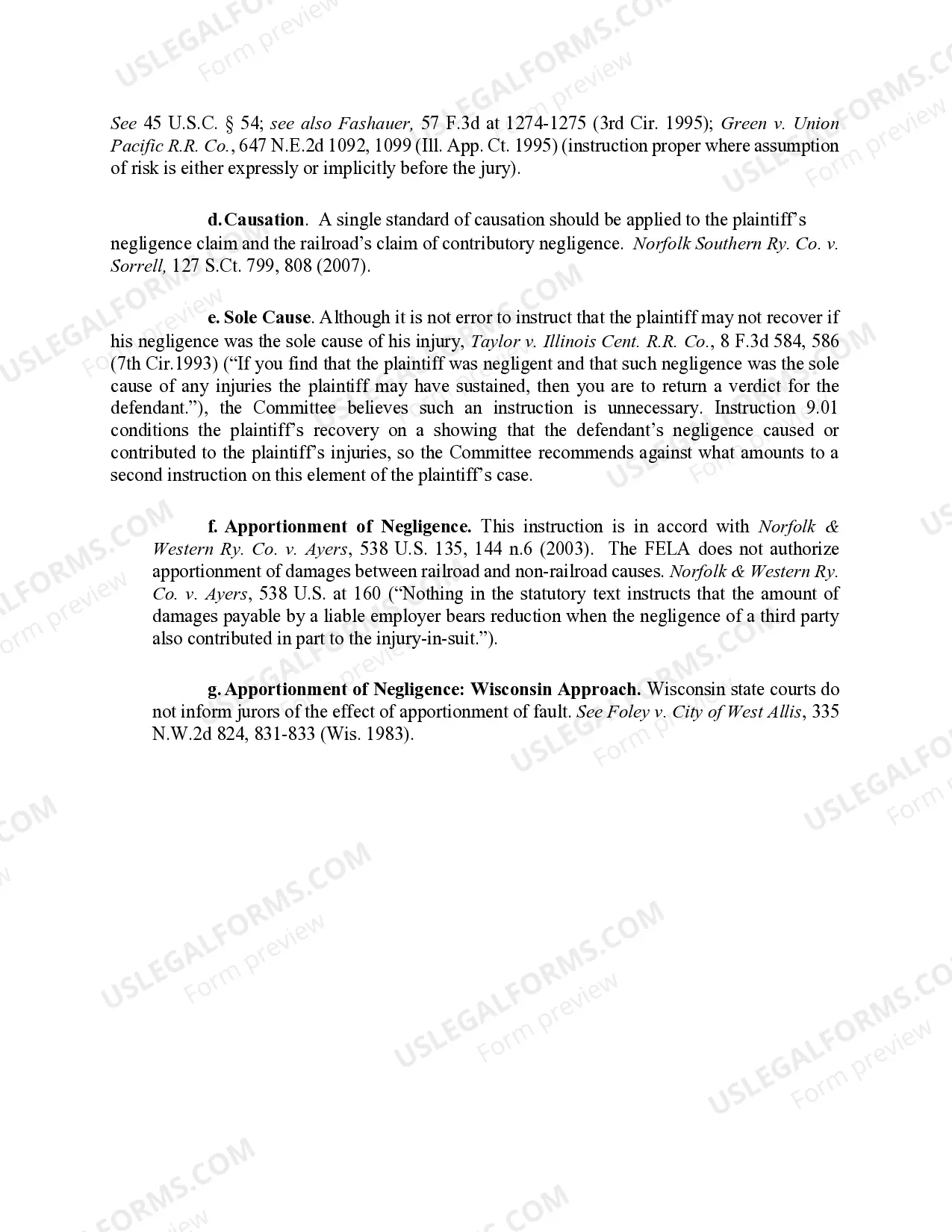
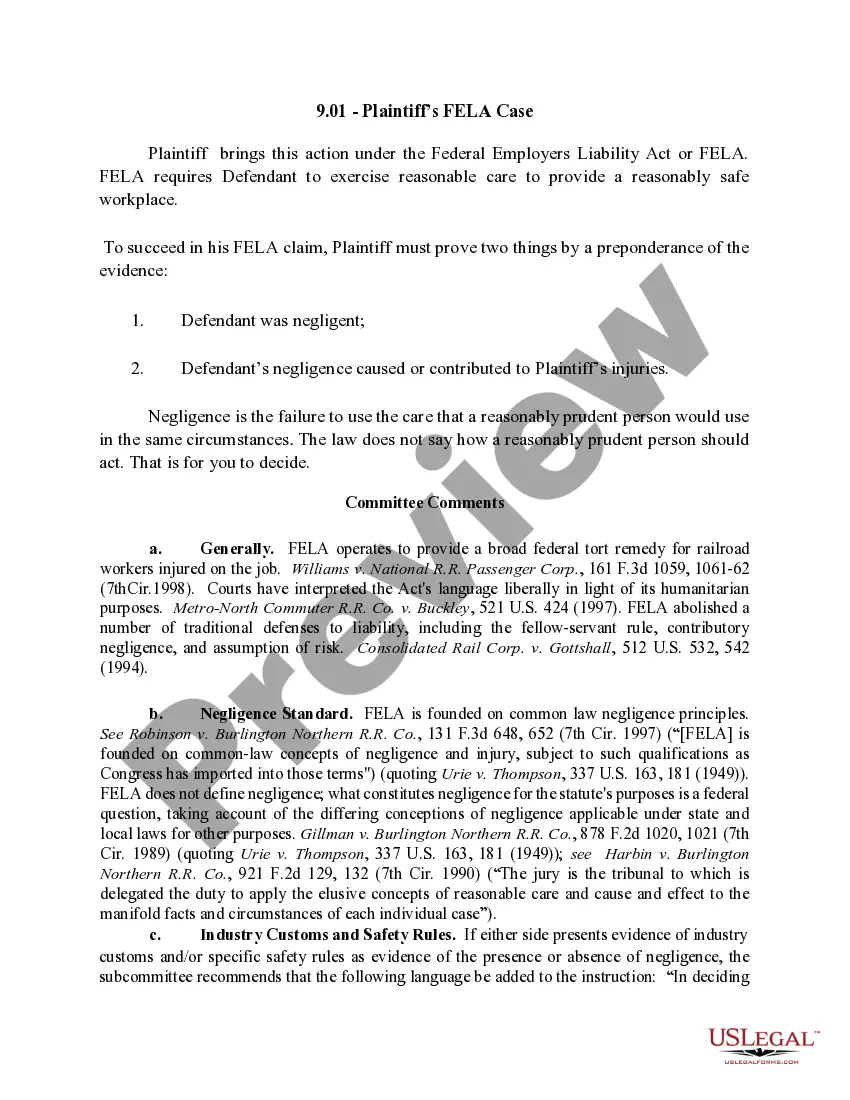
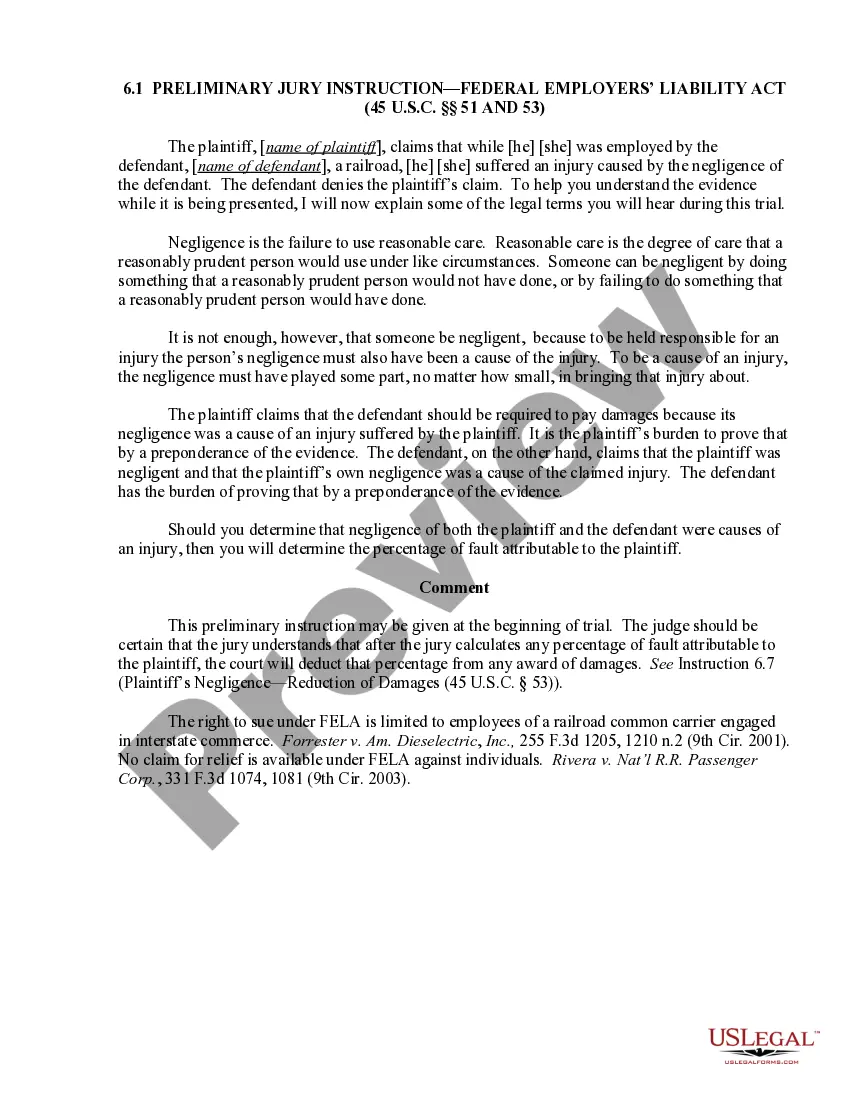
The 9.03 Elements - Defendant's FELA Case form is an official pattern jury instruction adopted by the Federal 7th Circuit Court. This legal document provides guidelines for jurors on how to assess cases involving the Federal Employers Liability Act (FELA), particularly focusing on the responsibilities of the defendant and any contributory negligence by the plaintiff. The form helps clarify how negligence impacts liability and damage calculations in FELA cases, distinguishing it from other jury instructions related to negligence claims.
Key components of this form
- Definition of negligence and its role in the plaintiff's injuries.
- Requirements for the defendant to show plaintiff's negligence and its contribution to the injuries.
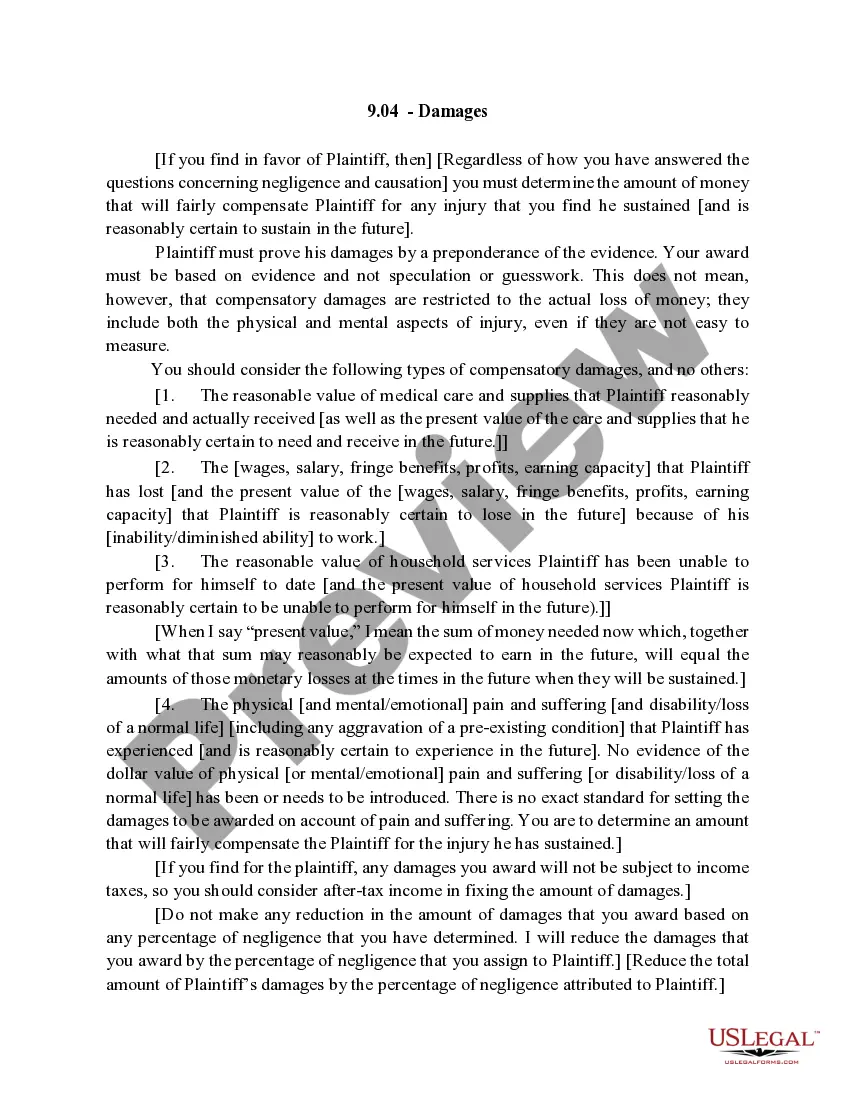
- Instructions on how to apportion damages based on the plaintiffâs degree of negligence.
- Clarifications on the differences between contributory negligence and assumption of risk.
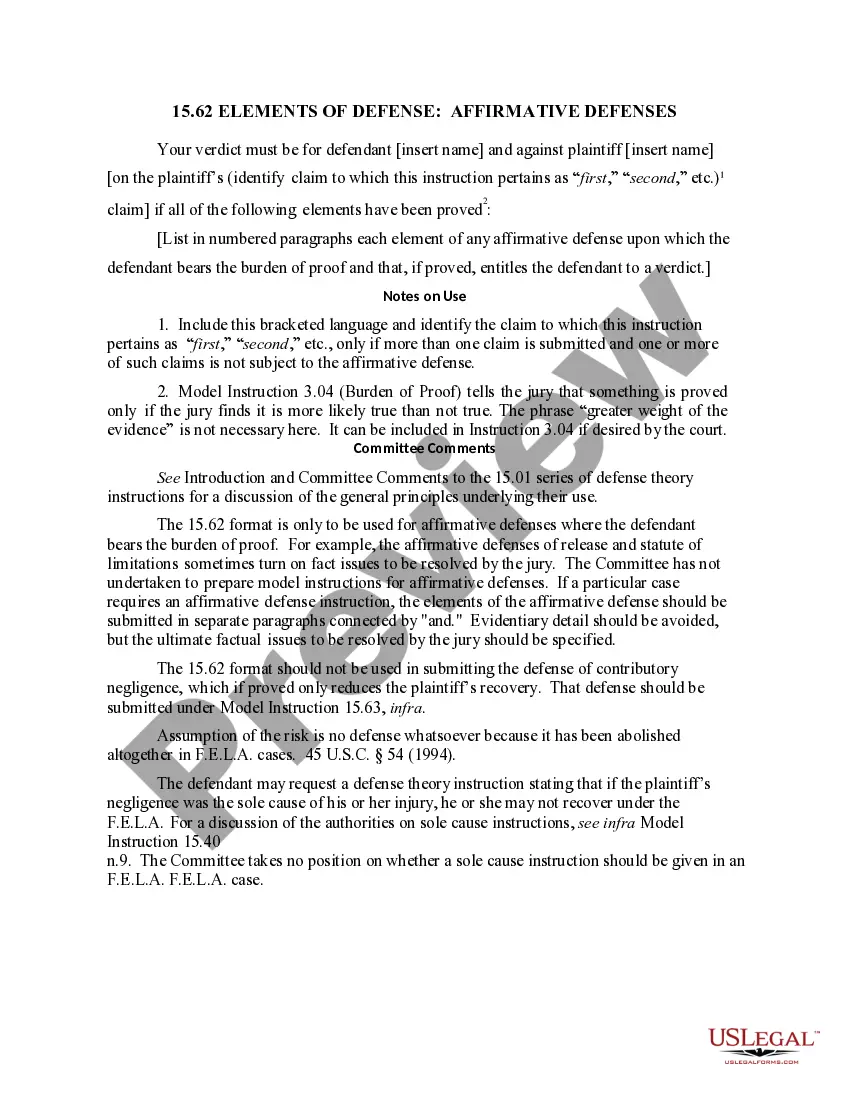
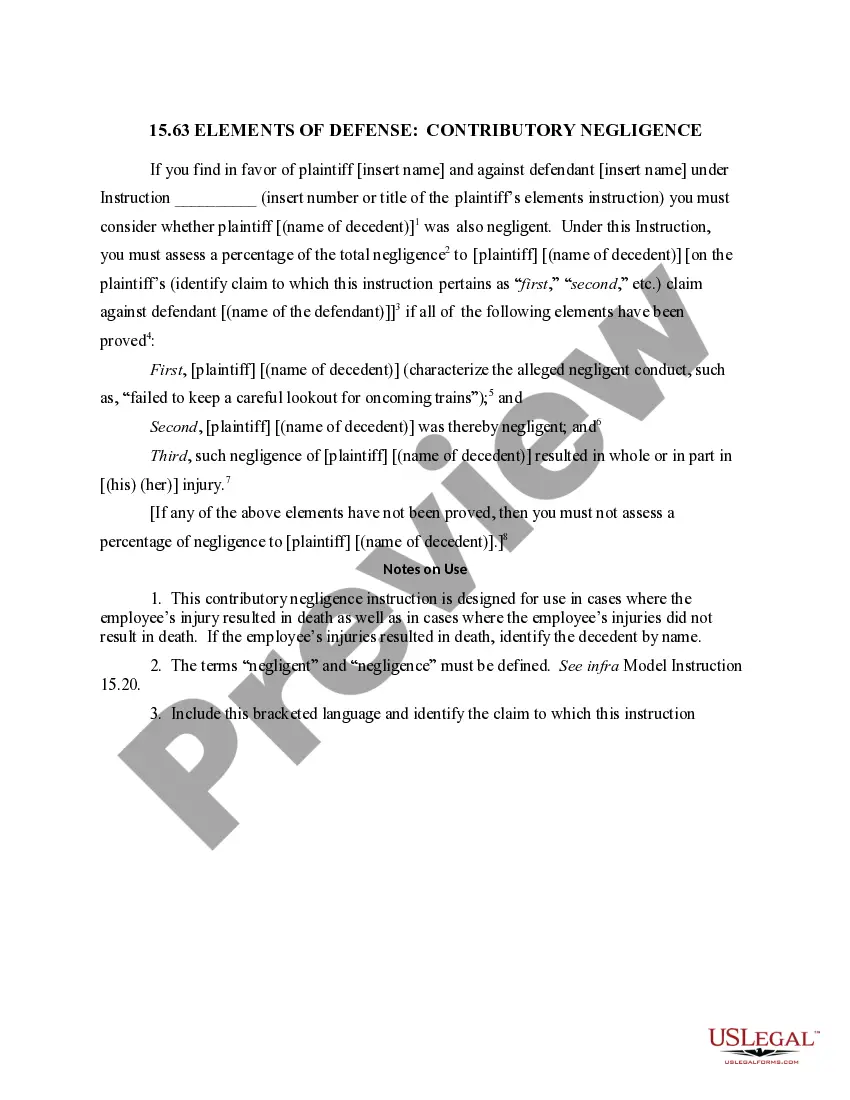
- Committee comments on applicable case law and legal interpretations.
Common use cases
This form is used in legal cases where a defendant claims that the plaintiff's own negligence contributed to their injuries under FELA. It is particularly relevant in situations where the defendant needs to prove that the plaintiff failed to exercise reasonable care, which directly impacted the outcome of the case. This form ensures that jurors understand their responsibility in evaluating shared fault in determining liability and damages.
Intended users of this form
- Legal professionals representing clients in FELA cases.
- Defendants in cases involving claims of contributory negligence.
- Jurors assigned to evaluate FELA negligence cases.
- Judges preparing instructions for jury deliberations in FELA-related trials.
How to complete this form
- Identify the parties involved in the case, namely the plaintiff and the defendant.
- Outline the negligence claim against the defendant, including specific actions that demonstrate negligence.
- Present evidence that suggests the plaintiff's own negligence contributed to their injuries.
- Assign a percentage of fault to the plaintiff if established by the evidence presented.
- Ensure the jury understands the distinction between contributory negligence and assumption of risk.
Does this form need to be notarized?
In most cases, this form does not require notarization. However, some jurisdictions or signing circumstances might. US Legal Forms offers online notarization powered by Notarize, accessible 24/7 for a quick, remote process.
Get your form ready online
Our built-in tools help you complete, sign, share, and store your documents in one place.
Make edits, fill in missing information, and update formatting in US Legal Forms—just like you would in MS Word.
Download a copy, print it, send it by email, or mail it via USPS—whatever works best for your next step.
Sign and collect signatures with our SignNow integration. Send to multiple recipients, set reminders, and more. Go Premium to unlock E-Sign.
If this form requires notarization, complete it online through a secure video call—no need to meet a notary in person or wait for an appointment.
We protect your documents and personal data by following strict security and privacy standards.

Make edits, fill in missing information, and update formatting in US Legal Forms—just like you would in MS Word.

Download a copy, print it, send it by email, or mail it via USPS—whatever works best for your next step.

Sign and collect signatures with our SignNow integration. Send to multiple recipients, set reminders, and more. Go Premium to unlock E-Sign.

If this form requires notarization, complete it online through a secure video call—no need to meet a notary in person or wait for an appointment.

We protect your documents and personal data by following strict security and privacy standards.
Typical mistakes to avoid
- Failing to adequately prove the plaintiff's negligence.
- Confusing contributory negligence with assumption of risk.
- Neglecting to clearly present the apportionment of damages based on negligence findings.
- Overlooking relevant case law that could impact jury instructions.
Benefits of completing this form online
- Convenience: Download and complete from anywhere without the need for physical paperwork.
- Editability: Easily modify the document to suit specific case details.
- Reliability: Use forms drafted by licensed attorneys ensuring legality and compliance with current laws.
Legal use & context
- This instruction is crucial in FELA cases to accurately assess liability.
- Jurors must understand how to apply the principles of negligence and contributory negligence.
- Properly guiding jurors can significantly affect the outcome of the case regarding damages.
Main things to remember
- The 9.03 Elements - Defendant's FELA Case form outlines critical jury instructions for assessing negligence under FELA.
- Understanding the difference between the plaintiff's negligence and assumption of risk is essential for proper jury instruction.
- Jurors must evaluate the evidence to determine the degree of shared responsibility in cases of injury.
Looking for another form?
Form popularity
FAQ
An equitable defense that bars relief to a party who has engaged in inequitable behavior (including fraud, deceit, unconscionability or bad faith) related to the subject matter of that party's claim.
An example would be a car accident in which the defendant has been ordered to pay the plaintiff a certain amount of money in order to compensate her for any medical bills or missed wages caused by the crash. An equitable claim asks the court to order a person to do or not do a particular act.
Elements of Unclean Hands Defense Has the party in question not performed under the terms of the contract? Has the party in question engaged in any fraudulent act? Has the party in question lied with regard to the contract? Has the party in question coerced or otherwise forced you into a contract?
"The unclean hands doctrine demands that a plaintiff act fairly in the matter for which he seeks a remedy. He must come into court with clean hands, and keep them clean, or he will be denied relief, regardless of the merits of his claim." (Kendall-Jackson Winery, Ltd.
There are thirteen courts of appeals: eleven numbered circuits (First through Eleventh), the United States Court of Appeals for the District of Columbia Circuit and the United States Court of Appeals for the Federal Circuit. Not all circuits have published jury instructions: the Second and Fourth Circuits do not.
The Ohio Jury Instructions (OJI) are written by a committee of the Ohio Judicial Conference. The Law Library has the OJI in its Westlaw database as well as in print. You can buy Ohio Jury Instructions in print or electronically from LexisNexis.
The Federal Employers Liability Act (FELA), codified at 45 U.S.C.S. § 51-60, governs the right of railroad employees injured, sickened or killed in the course of their employment through an employer's negligence to sue the employer for damages.