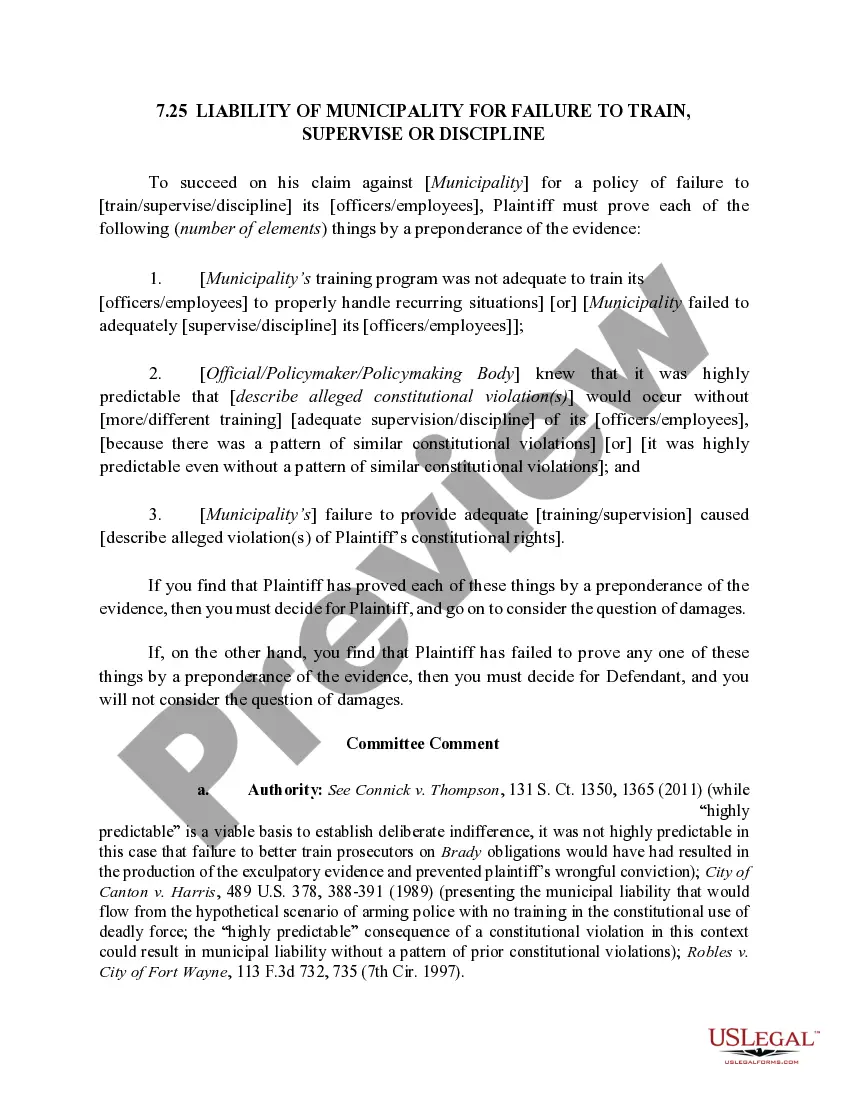
7.23 Liability of Supervisor .
What this document covers
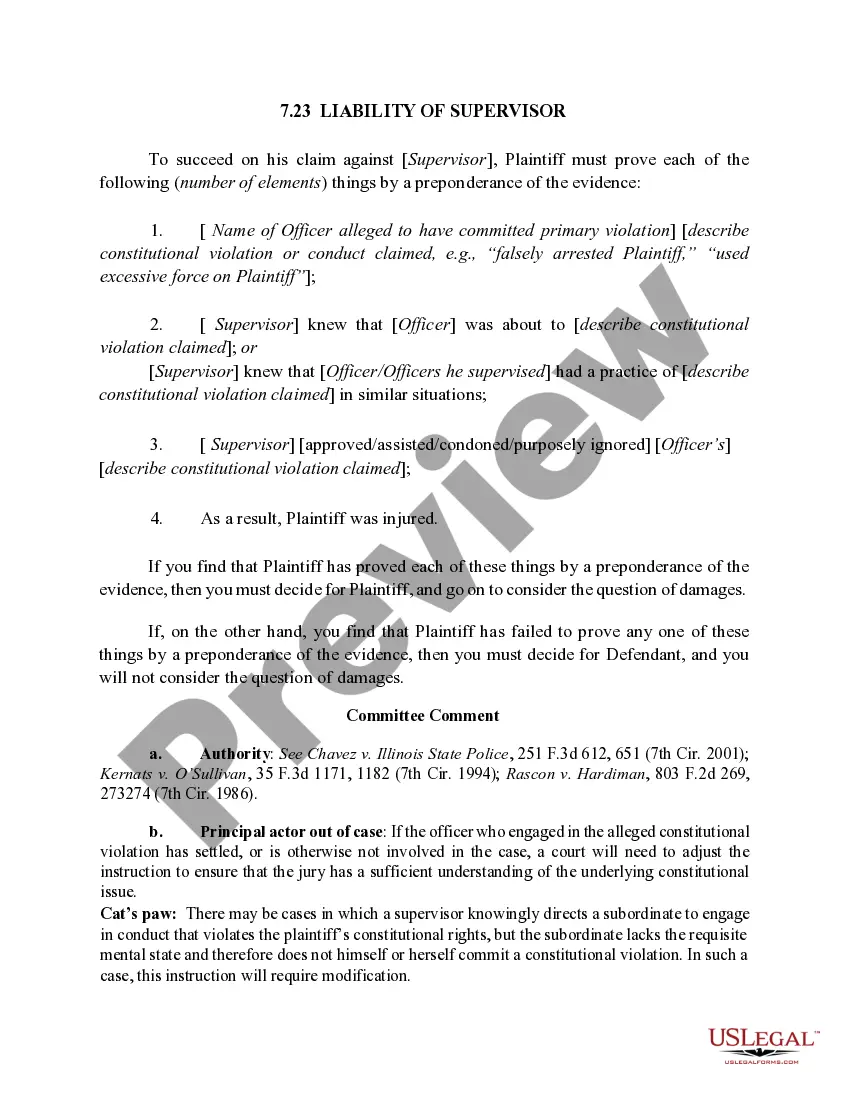
The 7.23 Liability of Supervisor form is a legal document used in federal court cases to establish the liability of a supervisor regarding a subordinate's actions that may violate the constitutional rights of a plaintiff. This form outlines the necessary proof a plaintiff must provide to show that a supervisor knew about, condoned, or ignored improper conduct by an officer, leading to injury. It serves a specific purpose in clarifying the responsibility of supervisors in civil rights litigation, distinguishing it from other legal forms related to employment and civil liabilities.
Form components explained
- Identification of the plaintiff and the supervisor being accused.
- Details of the alleged constitutional violation committed by the officer.
- Evidence the supervisor had prior knowledge of the officer's actions.
- Confirmation of the supervisor's approval or neglect regarding the violations.
- Information on the injuries sustained by the plaintiff as a result of the actions taken.
Situations where this form applies
This form should be used when a plaintiff seeks to hold a supervisor accountable for the actions of an officer that resulted in a constitutional violation. It is particularly relevant in cases involving allegations such as false arrest or use of excessive force by law enforcement officers, where a clear connection between the supervisor's knowledge or actions and the violation necessitates legal examination.
Who this form is for
- Individuals filing a lawsuit against a supervisor in a federal civil litigation.
- Attorneys representing plaintiffs in cases involving constitutional rights violations.
- Legal professionals needing a standard template to prove supervisory liability.
How to prepare this document
- Identify the plaintiff and the supervisor involved in the case.
- Clearly describe the actions of the officer that constitute the constitutional violation.
- State how the supervisor knew or should have known about the officer's actions.
- Specify what actions the supervisor took or failed to take in relation to the violation.
- Document the injuries suffered by the plaintiff as a direct result of the violation.
Notarization guidance
This form does not typically require notarization to be legally valid. However, some jurisdictions or document types may still require it. US Legal Forms provides secure online notarization powered by Notarize, available 24/7 for added convenience.
Get your form ready online
Our built-in tools help you complete, sign, share, and store your documents in one place.
Make edits, fill in missing information, and update formatting in US Legal Forms—just like you would in MS Word.
Download a copy, print it, send it by email, or mail it via USPS—whatever works best for your next step.
Sign and collect signatures with our SignNow integration. Send to multiple recipients, set reminders, and more. Go Premium to unlock E-Sign.
If this form requires notarization, complete it online through a secure video call—no need to meet a notary in person or wait for an appointment.
We protect your documents and personal data by following strict security and privacy standards.

Make edits, fill in missing information, and update formatting in US Legal Forms—just like you would in MS Word.

Download a copy, print it, send it by email, or mail it via USPS—whatever works best for your next step.

Sign and collect signatures with our SignNow integration. Send to multiple recipients, set reminders, and more. Go Premium to unlock E-Sign.

If this form requires notarization, complete it online through a secure video call—no need to meet a notary in person or wait for an appointment.

We protect your documents and personal data by following strict security and privacy standards.
Avoid these common issues
- Failing to adequately establish the supervisor's knowledge of the officerâs actions.
- Not providing sufficient evidence of the resulting injuries to the plaintiff.
- Omitting clear descriptions of the constitutional violations alleged.
- Misidentifying the parties involved in the case.
Why use this form online
- Convenient access to a professionally drafted template.
- Easy to download and fill out, enabling quick completion.
- Editable format allows for tailored adjustments specific to the case.
- Accessible guidance ensures correct completion and submission.
Legal use & context
- This form is essential for establishing liability in cases of civil rights violations.
- Federal courts recognize this form as a guiding standard for jury instructions regarding supervisory liability.
- Using this form can help clarify complex legal standards involving officer conduct and supervisory oversight.
Looking for another form?

Form popularity
FAQ
The Supreme Court agreed with the Seventh Circuit and determined that an employee is a supervisor under Title VII only if he or she is empowered by the employer to take tangible employment actions against the plaintiff.
Personal liability is when you can be personally held accountable for a civil action. In other words, if a claim is brought against your employer, you as a supervisor or manager can also be named in that claim and be required to pay a monetary award to satisfy the claim.
Under State law, police supervisors may have direct liability to the public due to the act of a subordinate when the supervisor authorized, participated in, directed, or ratified the act, or was present at the time the act was committed and could have prevented it but failed to do so.
The California courts have held that supervisors can be held liable for harassing actions towards employees. However, supervisors cannot be held liable for discriminatory or retaliatory actions. Liability for discrimination and retaliation would fall directly on the employer.
Under California's FEHA, an employer is strictly liable for all acts of a supervisor. A supervisor is generally defined as someone who has the discretion and authority to hire, direct, transfer, promote, assign, reward, discipline, direct, or discharge other employees or to recommend these actions.
Instead, they have found that any individual who has authority to direct and oversee another employee's daily work is a supervisor for purposes of Title VII liability. Thus, to the extent such an individual is the harasser, an employer may be vicariously liable for any harassing behavior.
If the supervisor's harassment results in a hostile work environment, the employer can avoid liability only if it can prove that: 1) it reasonably tried to prevent and promptly correct the harassing behavior; and 2) the employee unreasonably failed to take advantage of any preventive or corrective opportunities