3.05A. Supervisor Harassment with Tangible Employment Action
Overview of this form
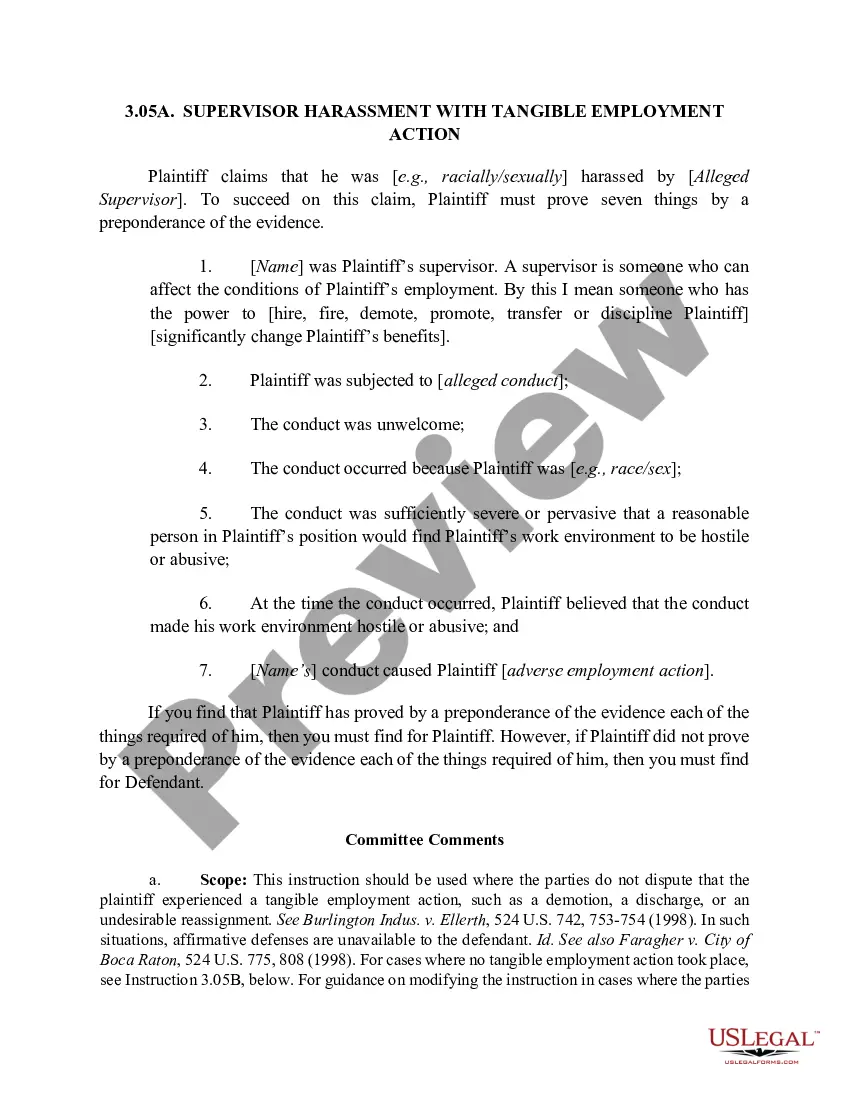
The Supervisor Harassment with Tangible Employment Action form is designed to address legal claims of harassment in the workplace that result in tangible changes in employment status, such as demotion or discharge. This form provides a clear framework for a plaintiff to demonstrate their case against a supervisor, focusing on instances where the harassment led to negative employment outcomes. Unlike other harassment forms, this one specifically outlines the criteria for establishing a hostile work environment when tangible actions have occurred.
What’s included in this form
- Definition of a supervisor and their role in affecting employment conditions.
- The nature and unwelcome aspect of the alleged conduct.
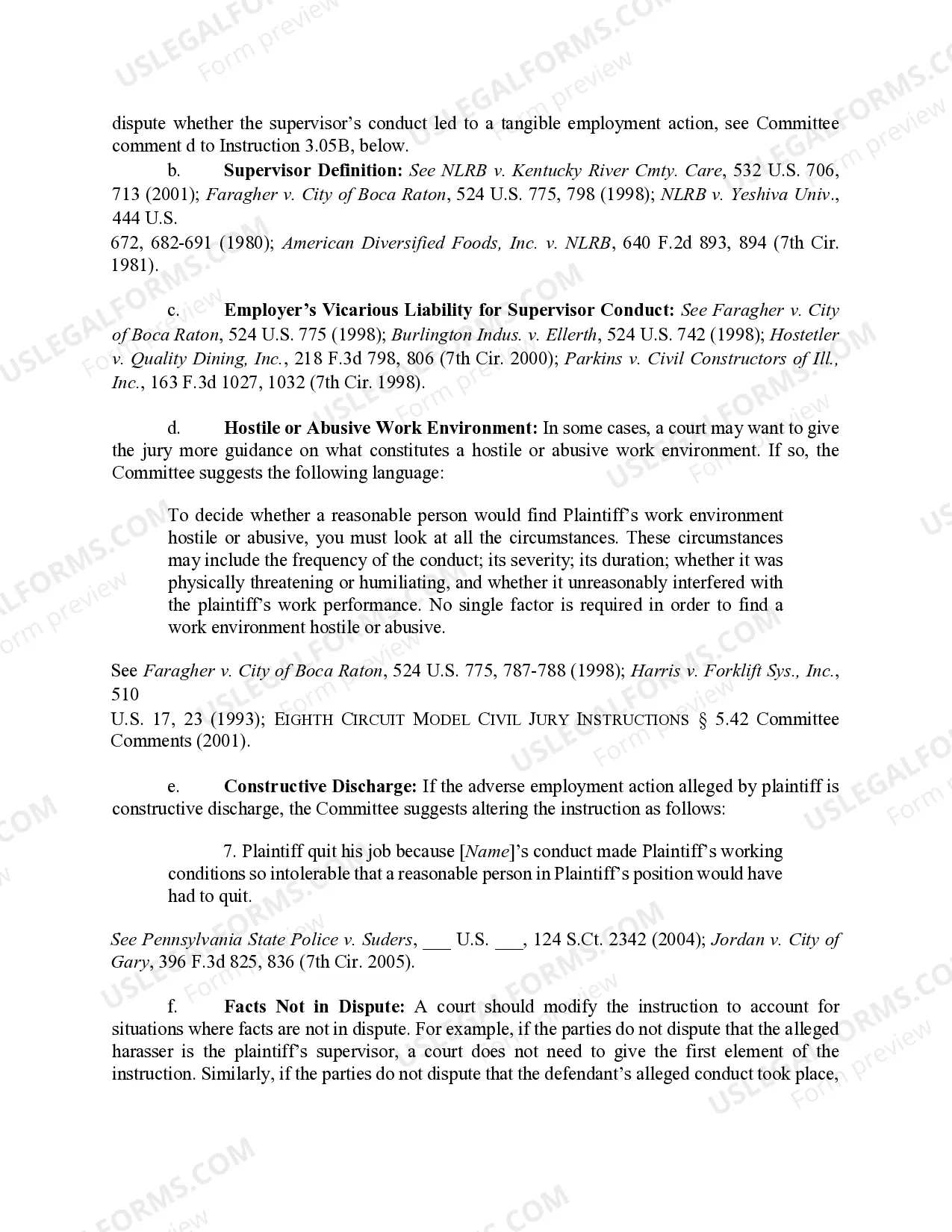
- Criteria for determining if the work environment is hostile or abusive.
- Specification of the adverse employment action caused by the supervisorâs conduct.
- The burden of proof required for the plaintiff to succeed in their claim.
Situations where this form applies
This form should be used when an employee claims to have been harassed by their supervisor and this harassment resulted in an adverse employment action, such as being demoted, fired, or reassigned to an undesirable position. Employees should consider using this form if they feel that their work environment has become intolerable due to supervisor behavior that is discriminatory or harassing in nature.
Who this form is for
- Employees who believe they have been subjected to supervisor harassment.
- Individuals who have experienced negative employment changes due to alleged harassment by a supervisor.
- Human resources professionals assisting employees in filing formal claims related to workplace harassment.
How to prepare this document
- Identify the plaintiff and the supervisor involved in the case.
- Clearly describe the unwelcome conduct experienced by the plaintiff.
- State the specific adverse employment action that occurred as a result of the supervisor's conduct.
- Provide evidence that demonstrates the severity of the harassment and its impact on the work environment.
- Collect any additional documentation that supports the claim, if necessary.
Does this document require notarization?
This form does not typically require notarization unless specified by local law.
Get your form ready online
Our built-in tools help you complete, sign, share, and store your documents in one place.
Make edits, fill in missing information, and update formatting in US Legal Forms—just like you would in MS Word.
Download a copy, print it, send it by email, or mail it via USPS—whatever works best for your next step.
Sign and collect signatures with our SignNow integration. Send to multiple recipients, set reminders, and more. Go Premium to unlock E-Sign.
If this form requires notarization, complete it online through a secure video call—no need to meet a notary in person or wait for an appointment.
We protect your documents and personal data by following strict security and privacy standards.

Make edits, fill in missing information, and update formatting in US Legal Forms—just like you would in MS Word.

Download a copy, print it, send it by email, or mail it via USPS—whatever works best for your next step.

Sign and collect signatures with our SignNow integration. Send to multiple recipients, set reminders, and more. Go Premium to unlock E-Sign.

If this form requires notarization, complete it online through a secure video call—no need to meet a notary in person or wait for an appointment.

We protect your documents and personal data by following strict security and privacy standards.
Common mistakes
- Failing to adequately describe the unwelcome conduct.
- Not specifying the tangible employment action taken against the employee.
- Providing insufficient evidence to support claims of a hostile work environment.
Why complete this form online
- Convenience of downloading and filling out at your own pace.
- Editability allows for customization to fit individual circumstances.
- Reliability as it is drafted by licensed attorneys to meet legal standards.
Legal use & context
This form is part of federal legal standards concerning workplace harassment. It is essential for plaintiffs to understand that they must provide evidence of both the harassment and the ensuing adverse action to establish their claim. Jurisdictions may have additional stipulations regarding the submission or handling of such claims, affecting legal outcomes.
What to keep in mind
- The form is essential for employees experiencing detrimental actions from supervisor harassment.
- Clear identification of both conduct and consequences are crucial for a successful claim.
- Understanding the legal definitions and requirements outlined in the form is vital for effectiveness.
Looking for another form?
Form popularity
FAQ
Examples include, but are not limited to 1) obscene, rude, or threatening phone calls, e-mails or letters, 2) public humiliation, mocking or ridicule, 3) denial of support, exclusion or isolation, 4) disrespect, rudeness or sarcasm, 5) work sabotage, 6) bashing due to gender or sexual orientation, 7) initiating or
To be unlawful, the conduct must create a work environment that would be intimidating, hostile, or offensive to a reasonable person.
There are two basic types of unlawful workplace harassment: harassment that results in a ?tangible employment action? (also referred to as ?Quid Pro Quo?) and ?hostile work environment? harassment.
The three types of hostile work environment in California are: verbal, non-verbal, and environmental. These three categories encompass every hostile work environment in California workplaces, and are prohibited under California law.
Employer Liability for Harassment The employer is automatically liable for harassment by a supervisor that results in a negative employment action such as termination, failure to promote or hire, and loss of wages.
Name-calling or epithets, offensive jokes, slurs, threats or physical attacks, displeasing photos or objects, or interference with workers' ability to execute their tasks are examples of offensive behaviour or unlawful harassment.
Harassment can take the form of slurs, graffiti, offensive or derogatory comments, or other verbal or physical conduct. Sexual harassment (including unwelcome sexual advances, requests for sexual favors, and other conduct of a sexual nature) is also unlawful.