1.21 Expert Witnesses
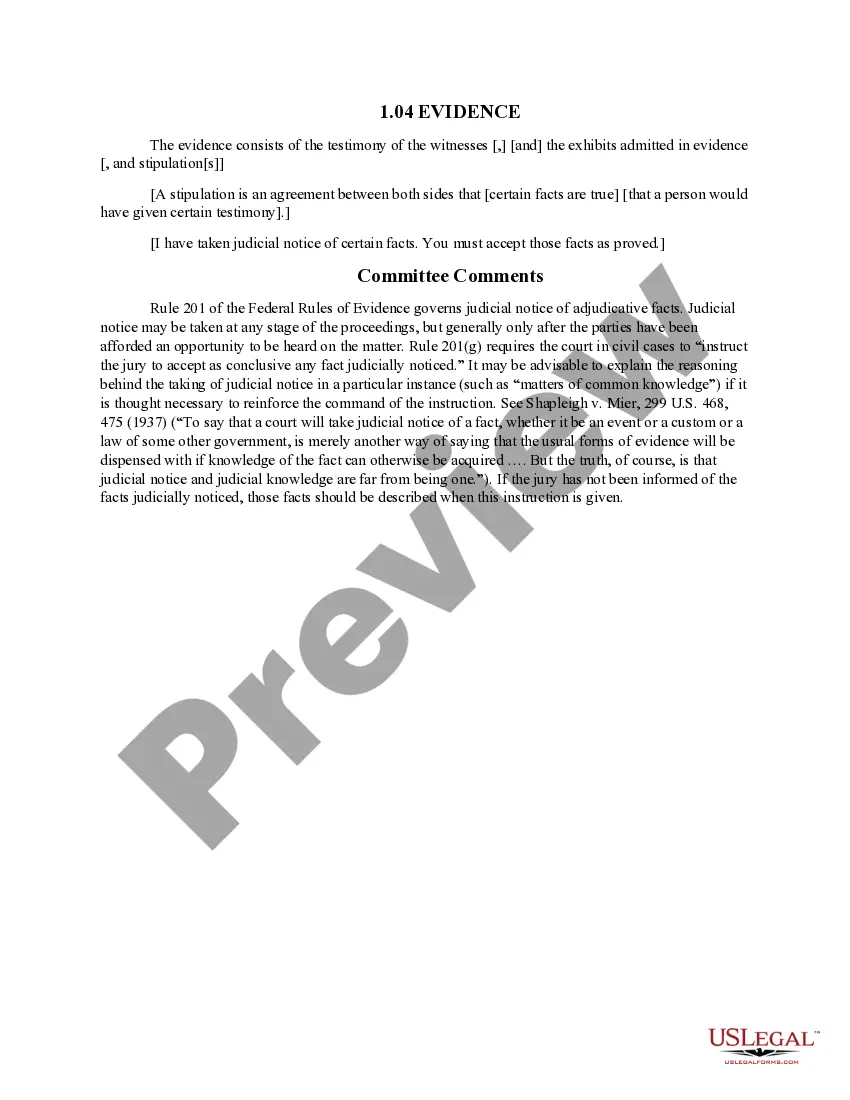
Overview of this form
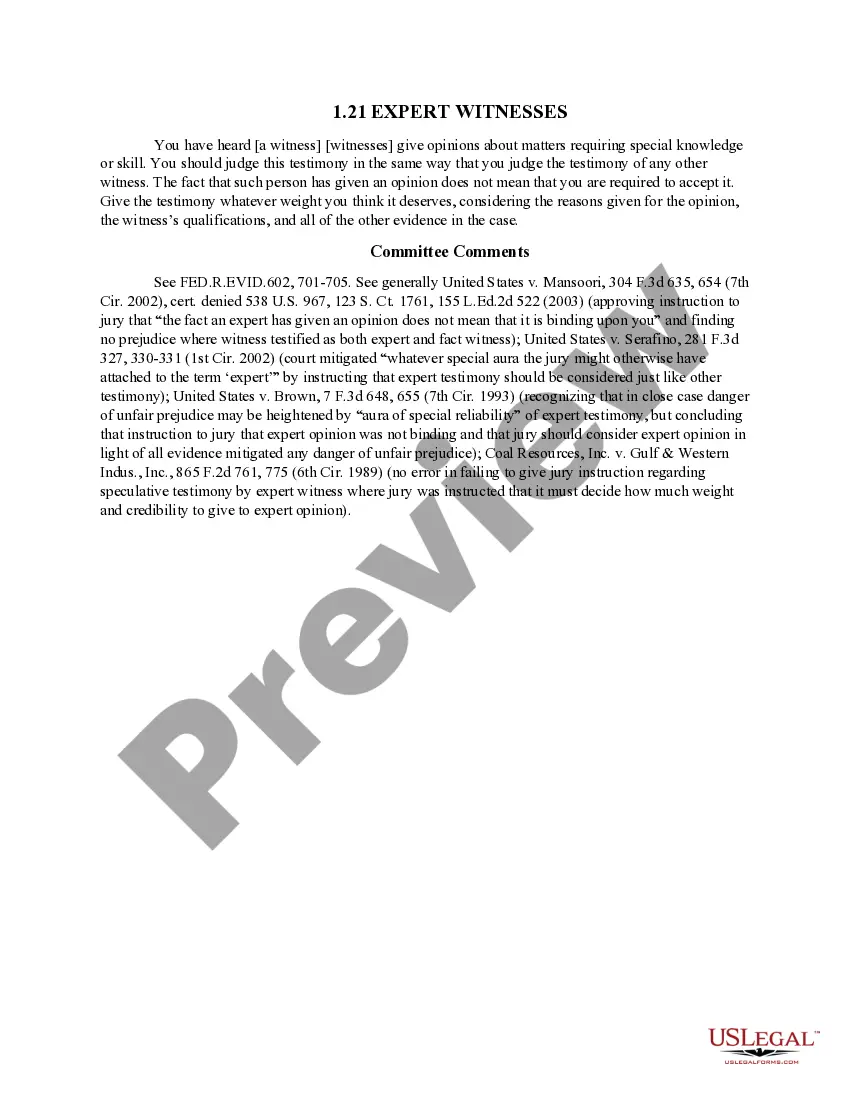
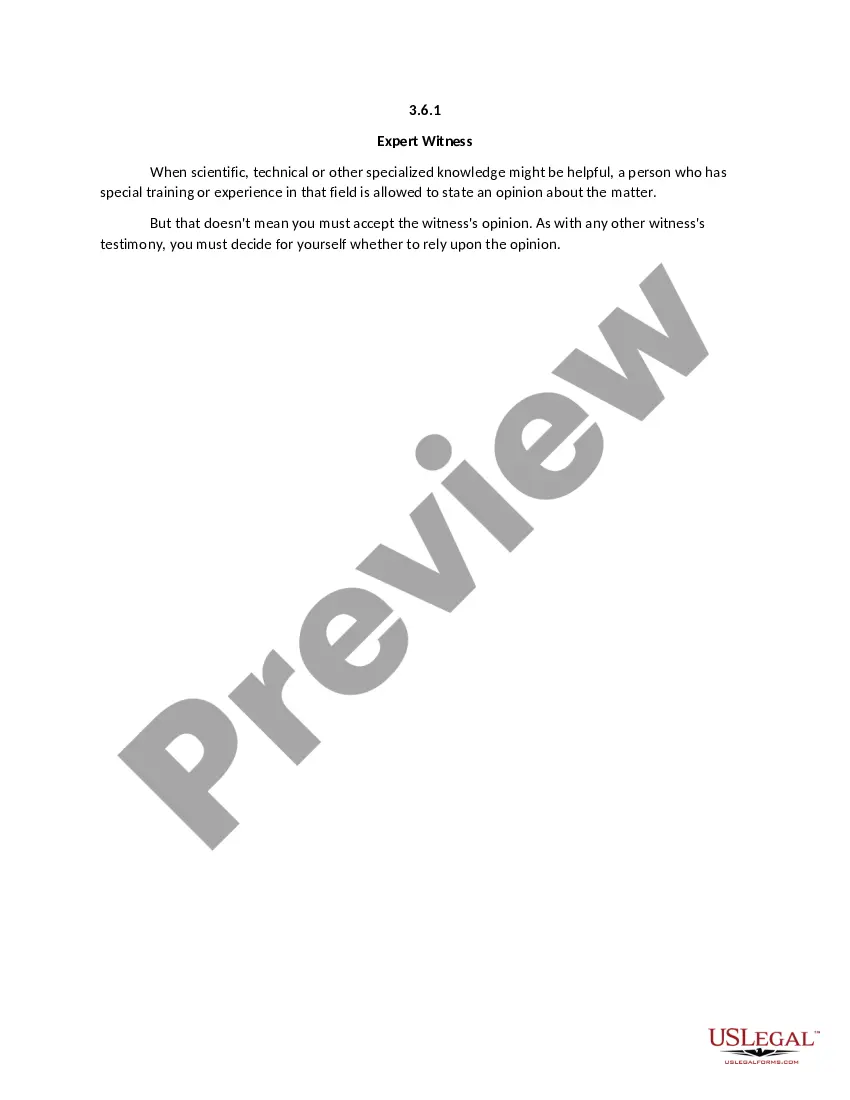
The Expert Witnesses form provides official jury instructions adopted by the Federal 7th Circuit Court relating to the evaluation of expert testimony. This form guides jurors on how to assess the credibility and weight of an expertâs opinion, emphasizing that the opinion of an expert witness is not binding and must be considered alongside other evidence in the case. This form is essential for legal proceedings where expert testimony is presented, helping to clarify its role within the broader spectrum of trial evidence.
Key components of this form
- General guidance on treating expert witness testimony like other witness testimony.
- Direction for jurors on how to weigh expert opinions based on qualifications and evidence.
- References to relevant federal rules and previous court cases for context.
- Instruction that expert opinions are not mandatory to accept.
Common use cases
This form is used in legal cases where expert witnesses are presented to provide specialized knowledge or skill. It serves as a crucial guideline for jurors in determining how much value to assign to expert opinions. You would use this form in civil or criminal trials involving technical questions, scientific evidence, or complex issues that require expert clarification.
Who needs this form
- Judges overseeing cases involving expert witnesses.
- Jurors tasked with evaluating expert testimony during trials.
- Attorneys preparing jury instructions regarding expert evidence.
Steps to complete this form
- Identify the relevant case and parties involved.
- Review the qualifications and background of the expert witness.
- Evaluate the expert testimony in conjunction with all other evidence in the case.
- Prepare to deliberate on the weight of the expert opinion presented.
- Consult the form for guidance during jury instructions about evaluating expert testimony.
Is notarization required?
Notarization is generally not required for this form. However, certain states or situations might demand it. You can complete notarization online through US Legal Forms, powered by Notarize, using a verified video call available anytime.
Get your form ready online
Our built-in tools help you complete, sign, share, and store your documents in one place.
Make edits, fill in missing information, and update formatting in US Legal Forms—just like you would in MS Word.
Download a copy, print it, send it by email, or mail it via USPS—whatever works best for your next step.
Sign and collect signatures with our SignNow integration. Send to multiple recipients, set reminders, and more. Go Premium to unlock E-Sign.
If this form requires notarization, complete it online through a secure video call—no need to meet a notary in person or wait for an appointment.
We protect your documents and personal data by following strict security and privacy standards.

Make edits, fill in missing information, and update formatting in US Legal Forms—just like you would in MS Word.

Download a copy, print it, send it by email, or mail it via USPS—whatever works best for your next step.

Sign and collect signatures with our SignNow integration. Send to multiple recipients, set reminders, and more. Go Premium to unlock E-Sign.

If this form requires notarization, complete it online through a secure video call—no need to meet a notary in person or wait for an appointment.

We protect your documents and personal data by following strict security and privacy standards.
Typical mistakes to avoid
- Failing to consider all evidence alongside expert opinions.
- Misunderstanding the non-binding nature of expert testimony.
- Overemphasizing one expert's opinion without considering qualifications.
Benefits of completing this form online
- Instant access to updated legal language and guidelines.
- Ability to download and edit the form for specific case details.
- Secure and reliable resource, drafted by licensed attorneys.
Legal use & context
- This form provides standardized jury instructions that help ensure fairness in trials where expert testimony is presented.
- The guidance facilitates the juryâs understanding, aligning with established case law and rules of evidence.
- Used correctly, it enhances the clarity and effectiveness of trials involving experts, supporting just outcomes in the judicial process.
Summary of main points
- The Expert Witnesses form provides essential instruction for jurors regarding expert testimony.
- It emphasizes that expert opinions are advisory, not mandatory.
- This form is applicable in any legal setting involving expert witness evaluation.
Looking for another form?

Form popularity
FAQ
Expert Witness Salary Annual SalaryMonthly PayTop Earners$400,000$33,33375th Percentile$156,000$13,000Average$140,373$11,69725th Percentile$50,000$4,166
The expert may testify in terms of opinion or inference and give his reasons therefor without prior disclosure of the underlying facts or data, unless the court requires otherwise. The expert may in any event be required to disclose the underlying facts or data on cross-examination.
The state of Virginia does not follow either the Frye or Daubert tests for the admissibility of expert witness testimony. Instead, Virginia follows its own set of rules and precedent.
The proffered witness must be an expert. i.e., the witness must be qualified; the expert must testify about matters requiring scientific, technical, or specialized knowledge; and. the expert's testimony must assist the trier of fact.
Rule 2 TESTIMONY BY EXPERTS (a) Use of Expert Testimony. a fact in issue, a witness qualified as an expert by knowledge, skill, experience, training, or education may testify thereto in the form of an opinion or otherwise.
Expert witnesses must have knowledge, skill, experience, training, or education, which should help understand the evidence or determine a fact in an issue. Different jurisdictions may have different ways in which these requirements can be met.
In order to be admissible, an expert witness must: Practice in a profession relevant to the issue of the case. Be skilled in their particular profession. Have specialized knowledge through training, education, or practical experience.
Lawyers may believe that if expert testimony is helpful or necessary, two experts are better than one. Having a second (or third or fourth) expert offer the same opinion insures against the risk that the jury will question a lone expert's credibility.