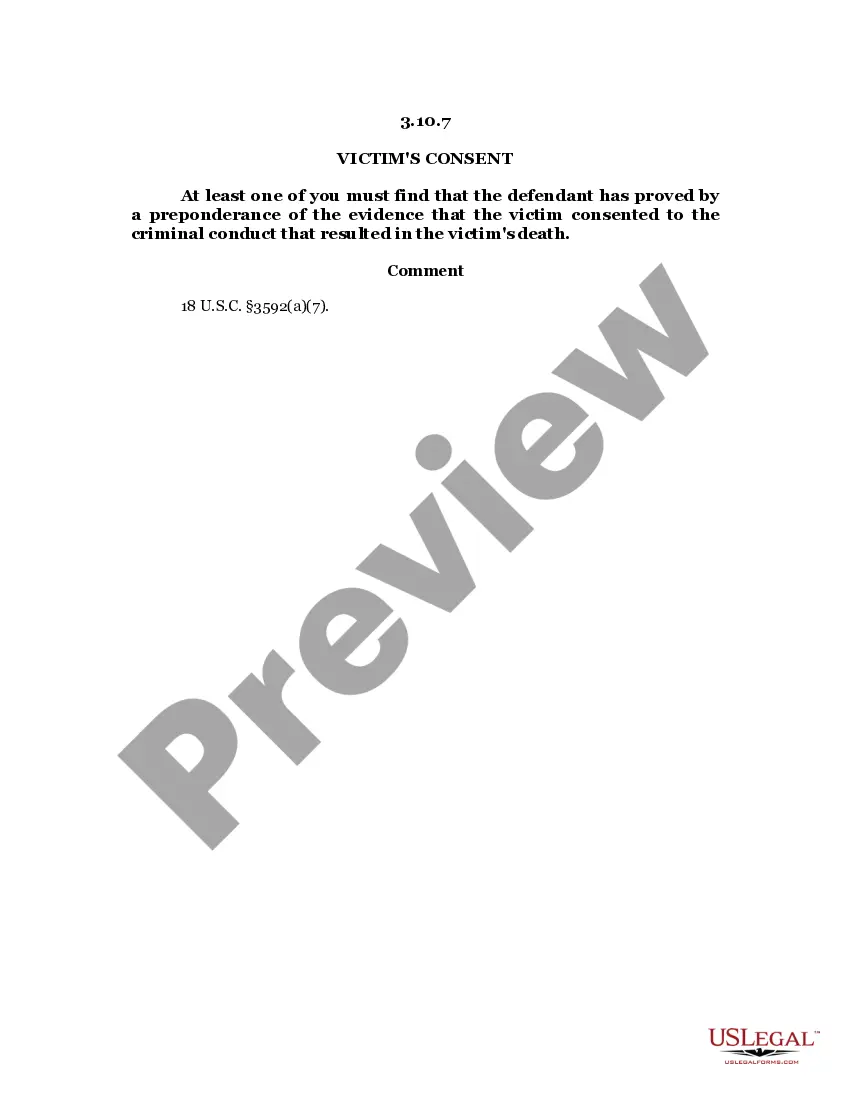
VICTIM'S CONSENT
What this document covers
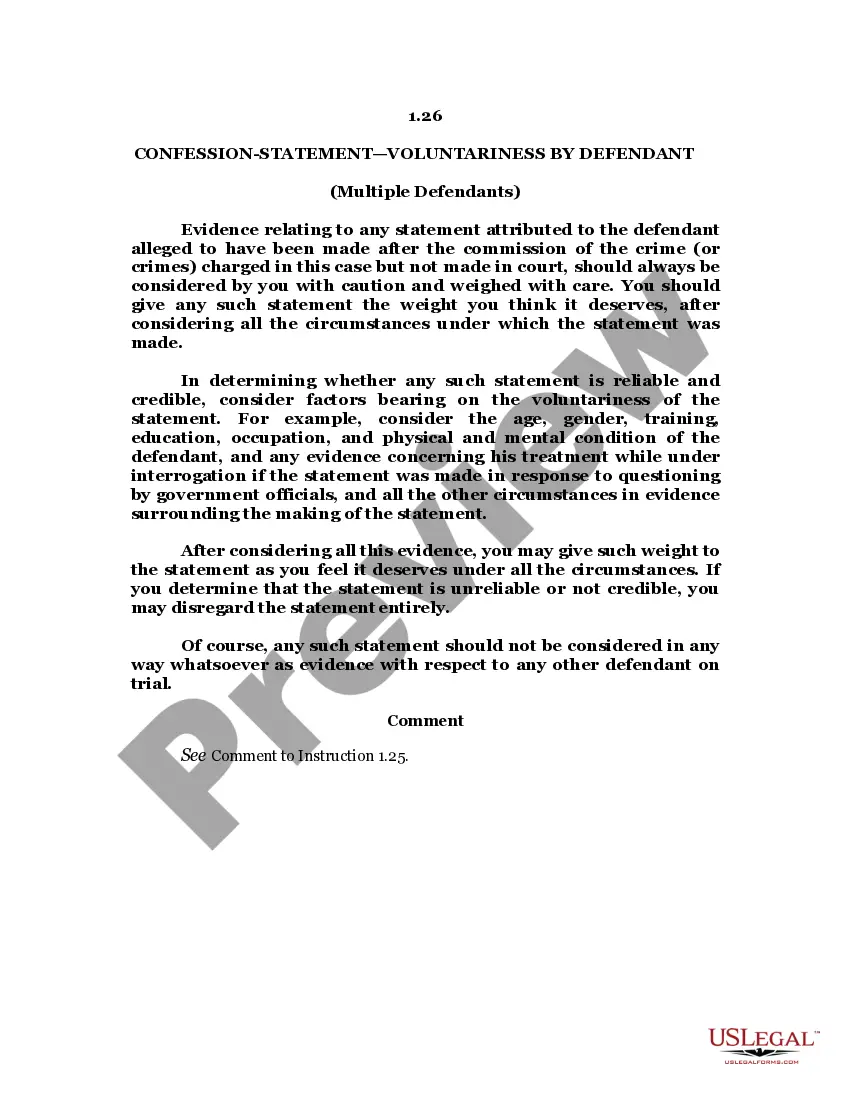
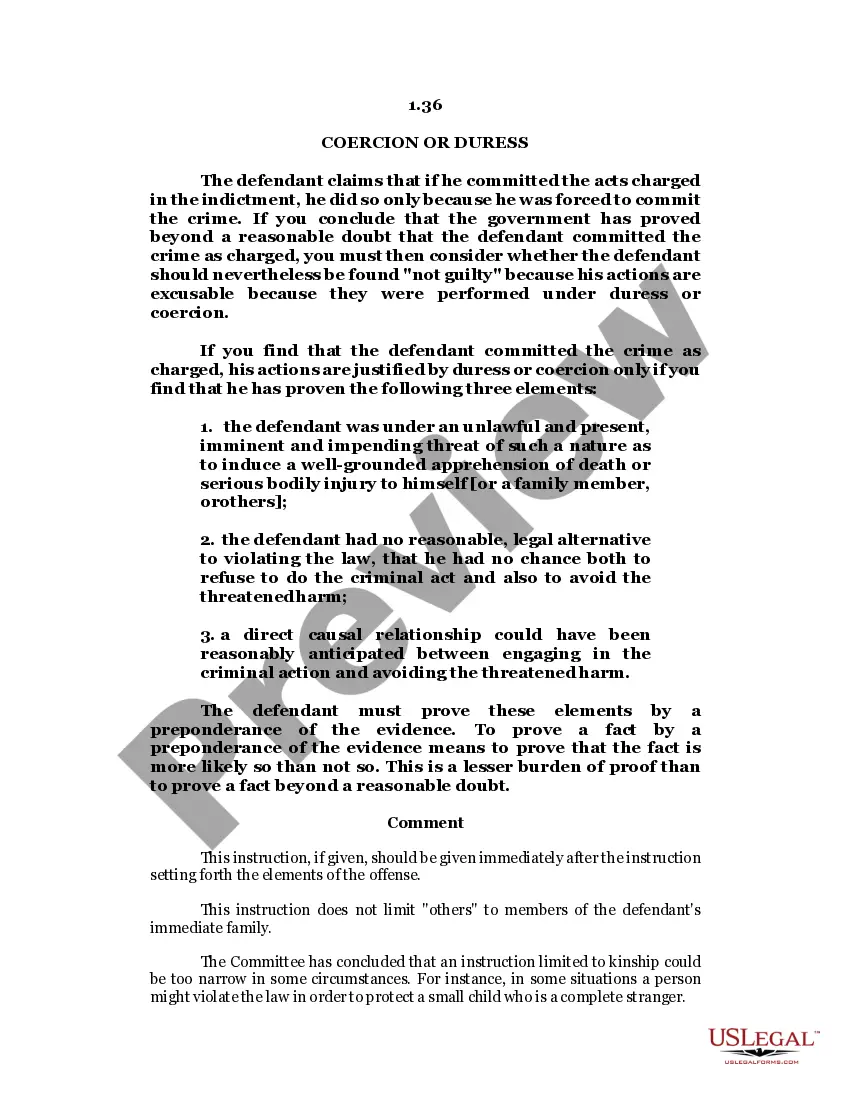
The Victim's Consent form is a legal document used in criminal proceedings to establish whether the victim consented to the actions that resulted in their death. This form is significant as it outlines the requirement for the defendant to prove, by a preponderance of the evidence, that the victim's consent played a role in the alleged criminal conduct. It is distinct from other forms in that it specifically addresses consent in relation to criminal law and is utilized in serious cases involving homicide or manslaughter.
Form components explained
- The requirement that the defendant must prove the victim's consent to the criminal conduct.
- The standard of proof is specified as "preponderance of the evidence."
- Reference to 18 U.S.C. §3592(a)(7), which governs this area of law.
When to use this form
This form is necessary in criminal cases where the defendant aims to demonstrate that the victim consented to the actions leading to their death. For example, it might be used in self-defense cases or situations involving consensual activities that resulted in harm. Legal counsel may advise on using this form when defending against charges related to homicide.
Who this form is for
- Defendants involved in criminal cases where consent is a critical component of their defense.
- Criminal defense attorneys representing clients who claim the victim consented to the conduct.
- Legal practitioners seeking to establish facts regarding victim consent in court proceedings.
How to prepare this document
- Identify the defendant and outline the charges against them.
- Gather evidence that supports the claim of victim consent.
- Complete the necessary sections to demonstrate the victim's agreement to the purported conduct.
- Review and confirm that all legal standards, such as the preponderance of evidence, are addressed.
- File the form with the appropriate court as advised by legal counsel.
Notarization requirements for this form
This form does not typically require notarization unless specified by local law. However, consulting with a legal professional is recommended to confirm any requirements pertinent to your specific case.
Get your form ready online
Our built-in tools help you complete, sign, share, and store your documents in one place.
Make edits, fill in missing information, and update formatting in US Legal Forms—just like you would in MS Word.
Download a copy, print it, send it by email, or mail it via USPS—whatever works best for your next step.
Sign and collect signatures with our SignNow integration. Send to multiple recipients, set reminders, and more. Go Premium to unlock E-Sign.
If this form requires notarization, complete it online through a secure video call—no need to meet a notary in person or wait for an appointment.
We protect your documents and personal data by following strict security and privacy standards.

Make edits, fill in missing information, and update formatting in US Legal Forms—just like you would in MS Word.

Download a copy, print it, send it by email, or mail it via USPS—whatever works best for your next step.

Sign and collect signatures with our SignNow integration. Send to multiple recipients, set reminders, and more. Go Premium to unlock E-Sign.

If this form requires notarization, complete it online through a secure video call—no need to meet a notary in person or wait for an appointment.

We protect your documents and personal data by following strict security and privacy standards.
Mistakes to watch out for
- Failing to meet the burden of proof required for demonstrating consent.
- Inaccurate or incomplete information regarding the nature of consent.
- Neglecting to reference the applicable legal statutes that support the claim.
Advantages of online completion
- Convenience of downloading and completing the form at your own pace.
- Ensured reliability with forms drafted by licensed attorneys.
- Editability to customize the form as your situation evolves.
Looking for another form?

Form popularity
FAQ
Sexual Assault Defenses: Consent One of the elements of sexual assault is that the sexual behavior must occur against the alleged victim's will. If the defendant, therefore, can demonstrate that the victim consented to the sexual contact, there is a solid defense to the allegations of sexual assault.
Applying the Consent Defense Consent is an affirmative defense that may be available to you if you are being sued for an intentional tort. Under this theory, a person who voluntarily consents to a particular act cannot also claim that the same act is an intentional tort.
Some crimes for which consent may be a defense include those that result in bodily harm, including assault and battery. In very limited circumstances, victims can be held to consent to these crimes. One common example is in physical contact sports.
Adults can use the consent defense to forcible fondling charges even when the victim is a child. Defendants have the right to cross-examine the technician who performed the DNA analysis at trial. The UCR's new definition of rape includes sexual assault with an object.
Neal, 68 M.J. 289 (consent and mistake of fact as to consent are affirmative defenses for the sexual conduct in issue in a prosecution for aggravated sexual contact; an affirmative defense is any special defense which, although not denying that the accused committed the objective acts constituting the offense charged,
Consent is an affirmative defense that may be available to you if you are being sued for an intentional tort. Under this theory, a person who voluntarily consents to a particular act cannot also claim that the same act is an intentional tort.
Consent is an essential constituent of a contract and a defense to a tort. However, consent is generally not a defense to criminal charges, with the possible exceptions of rape and sexual assault. In cases of rape and sexual assault, someone's consent is not their true intent if they are under duress or fear.
Non-Verbal Consent Head nod. Thumbs up. Pulling someone closer. Nodding yes. Making direct eye contact. Actively touching someone. Initiating sexual activity.