Copyright Assignment Agreement for Musical Compositions
Understanding this form
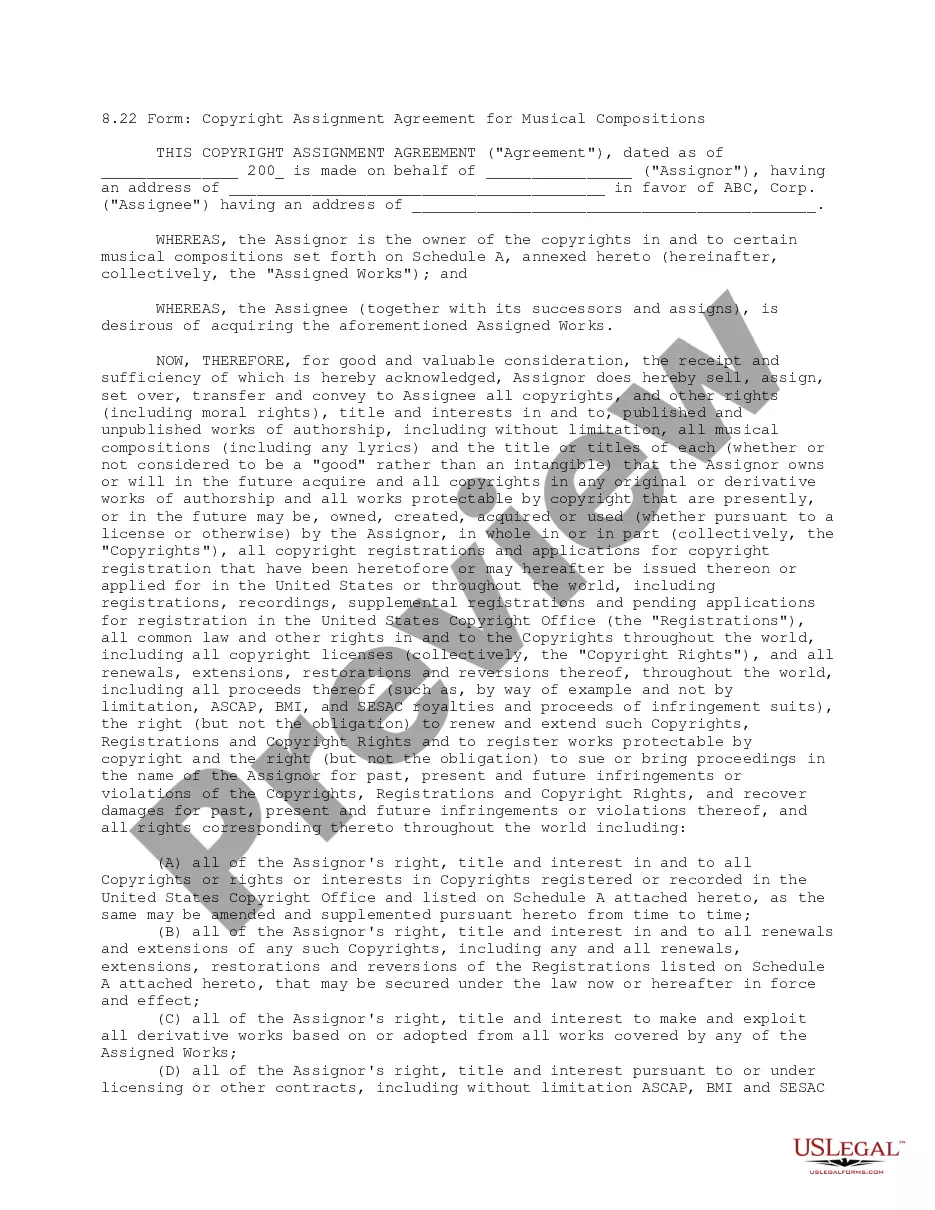
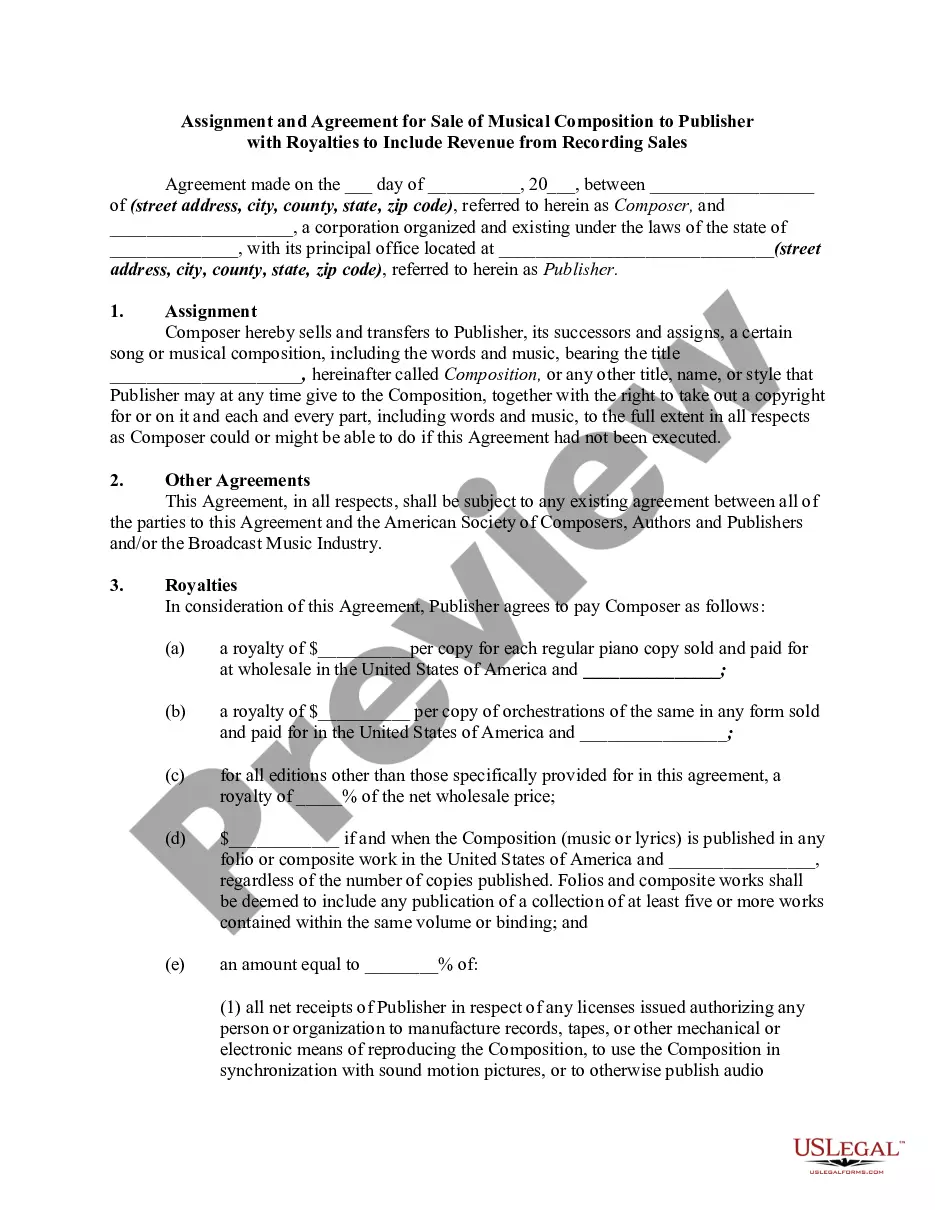
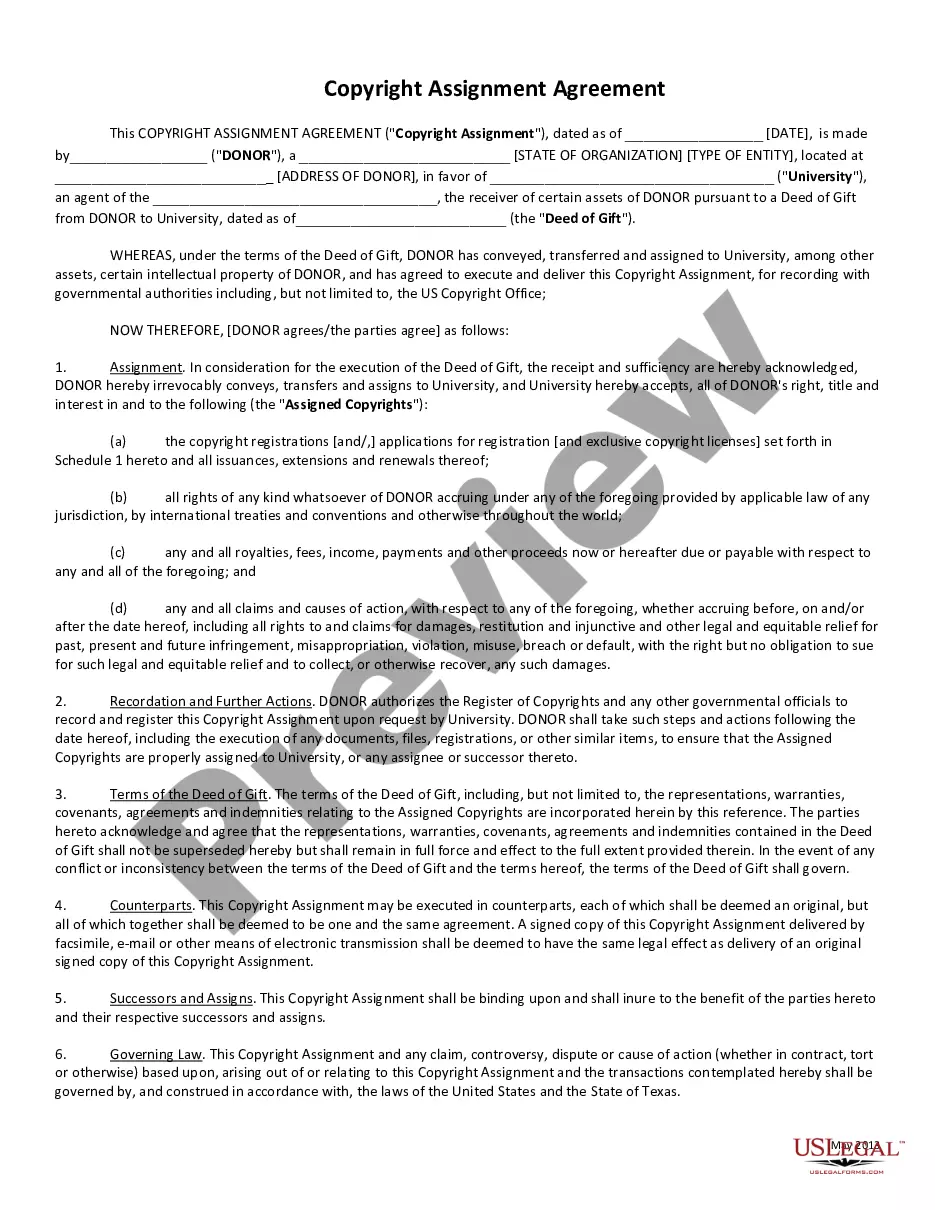
The Copyright Assignment Agreement for Musical Compositions is a legal document that allows an individual or company (the assignor) to transfer their copyrights in musical works to another entity (the assignee). This form is essential for ensuring that the rights to musical compositions are clearly defined and officially transferred, making it distinct from other copyright forms that may not specifically address musical works.
Main sections of this form
- Parties Involved: Identifies the assignor and assignee, including their addresses.
- Assignment of Rights: Specifies the copyrights being transferred, including published and unpublished compositions.
- Proceeds and Royalties: Outlines the rights to royalties, damages from infringement, and any renewals/extensions of copyright.
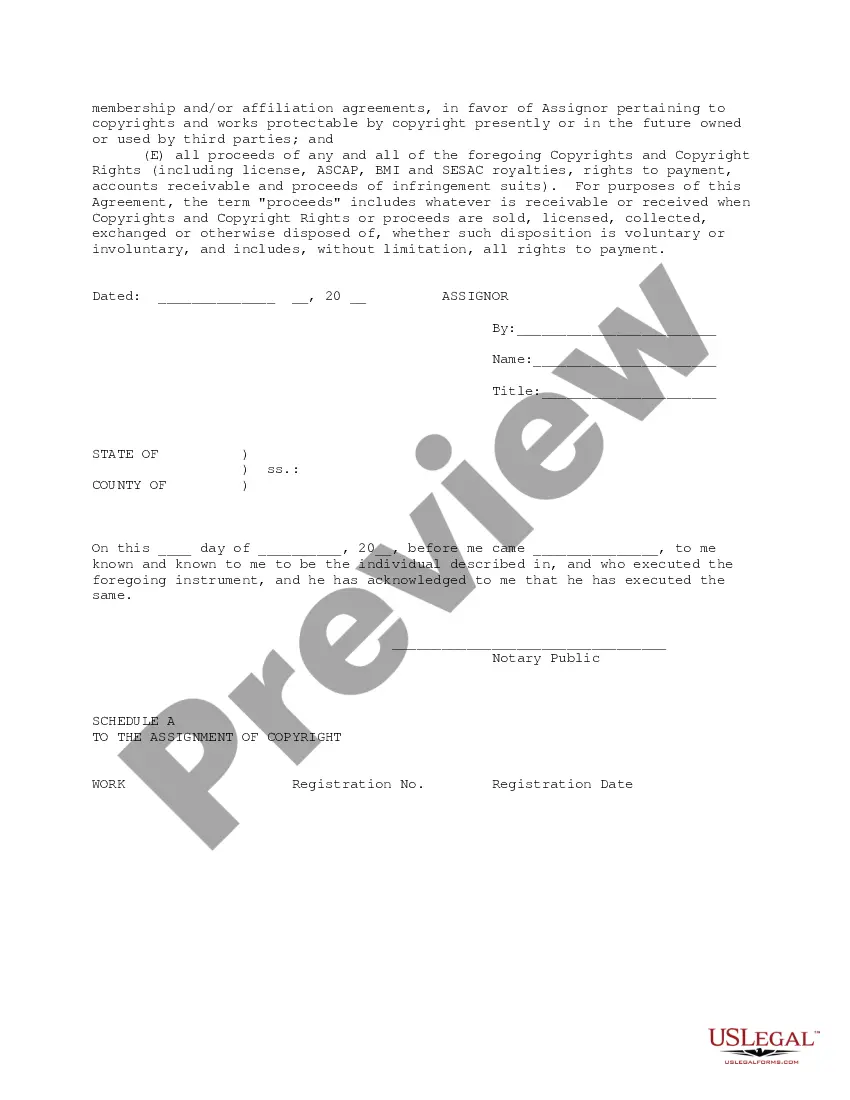
- Notarization Clause: States the requirement for the assignment to be notarized for legal validity.
- Schedule A: A section for listing specific musical compositions that are the subject of the assignment.
When to use this document
This form should be used when a songwriter, composer, or musical entity wishes to sell or transfer their copyrights in musical compositions to another party. It is particularly important in situations where a corporation or producer intends to use the compositions in commercial projects, such as albums, films, or advertisements, ensuring that copyright ownership is clearly established.
Who should use this form
- Musicians or songwriters seeking to assign their copyrights to a publisher or production company.
- Music publishers or companies acquiring rights to musical works.
- Legal representatives acting on behalf of the assignor or assignee in copyright transfers.
How to prepare this document
- Identify the parties: Fill in the names and addresses of both the assignor and assignee.
- Specify the assigned works: List the musical compositions on Schedule A.
- Enter the date: Fill in the date of the agreement at the designated section.
- Sign the document: The assignor must sign the agreement in the presence of a notary public.
- Complete notarization: Have the document notarized to ensure its legal validity.
Does this form need to be notarized?
Notarization is required for this form to take effect. Our online notarization service, powered by Notarize, lets you verify and sign documents remotely through an encrypted video session, available 24/7.
Get your form ready online
Our built-in tools help you complete, sign, share, and store your documents in one place.
Make edits, fill in missing information, and update formatting in US Legal Forms—just like you would in MS Word.
Download a copy, print it, send it by email, or mail it via USPS—whatever works best for your next step.
Sign and collect signatures with our SignNow integration. Send to multiple recipients, set reminders, and more. Go Premium to unlock E-Sign.
If this form requires notarization, complete it online through a secure video call—no need to meet a notary in person or wait for an appointment.
We protect your documents and personal data by following strict security and privacy standards.

Make edits, fill in missing information, and update formatting in US Legal Forms—just like you would in MS Word.

Download a copy, print it, send it by email, or mail it via USPS—whatever works best for your next step.

Sign and collect signatures with our SignNow integration. Send to multiple recipients, set reminders, and more. Go Premium to unlock E-Sign.

If this form requires notarization, complete it online through a secure video call—no need to meet a notary in person or wait for an appointment.

We protect your documents and personal data by following strict security and privacy standards.
Typical mistakes to avoid
- Failing to list all relevant musical works on Schedule A.
- Not ensuring both parties sign the document.
- Neglecting to notarize the agreement, which can lead to enforcement issues.
- Using outdated forms that do not comply with current copyright laws.
Benefits of completing this form online
- Convenience of downloading the form at any time, from any location.
- Editability allows customization to specific needs without legal jargon confusion.
- Ensured reliability through attorney-reviewed templates that meet legal standards.
- Access to additional resources and support in completing the form correctly.
Legal use & context
- Establishes clear ownership of copyrights for musical compositions.
- Protects the assignor's rights while allowing the assignee to exploit the works commercially.
- Facilitates legal recourse for copyright infringement claims.
Main things to remember
- The Copyright Assignment Agreement is essential for musicians transferring rights.
- Clarity and completeness in the form are critical to avoid disputes.
- This form is versatile for use across multiple states, though specific laws should be checked.
Looking for another form?
Form popularity
FAQ
Once a copyright is created, protection generally lasts for 70 years after the death of the author and in some cases 95 years from publication or 120 years from creation. That's a long time!
To register a claim to copyright in a musical composition, you must submit the following to the Copyright Office: (1) a completed application form; (2) a nonrefundable filing fee; and (3) the required deposit copies of your work. This circular highlights issues common to registrations of musical compositions.
Music is copyrighted as soon as it has been created and fixed in a tangible object such as an audio recording or sheet music. You don't need to register a musical work with the U.S. Copyright Office or attach a copyright notice to receive copyright protection.
Copyright protects the musician even if the song is never registered with the Copyright Office. Mailing a copy of the work to yourself provides no additional legal protection and is unlikely to prove useful evidence for establishing the date a song was written.
If the musical composition is protected by copyright then copying its sheet music is unlawful without a print license -- yes, even if the sheet music is solely for your personal use.
The use of sheet music is covered by copyright law, which means misuse of sheet music can get you or your school into trouble.Composers and publishers who sell copyrighted sheet music earn their money through those sales.
You don't actually need to register your song with the Federal copyright office to own the copyright (at least in the United States). The moment you put your song into tangible form written down or recorded you automatically get the six exclusive rights we just looked at.
When you buy a piece of digital sheet music, you are purchasing one copy of the piece, the same as if you visited a store and bought a single copy of sheet music.Making additional copies, digitally scanning or sharing copies without paying for them is considered stealing and is illegal.
To register a claim to copyright in a musical composition, you must submit the following to the Copyright Office: (1) a completed application form; (2) a nonrefundable filing fee; and (3) the required deposit copies of your work. This circular highlights issues common to registrations of musical compositions.