Discipline Problem - Analysis and Corrective Action Plan
What is this form?
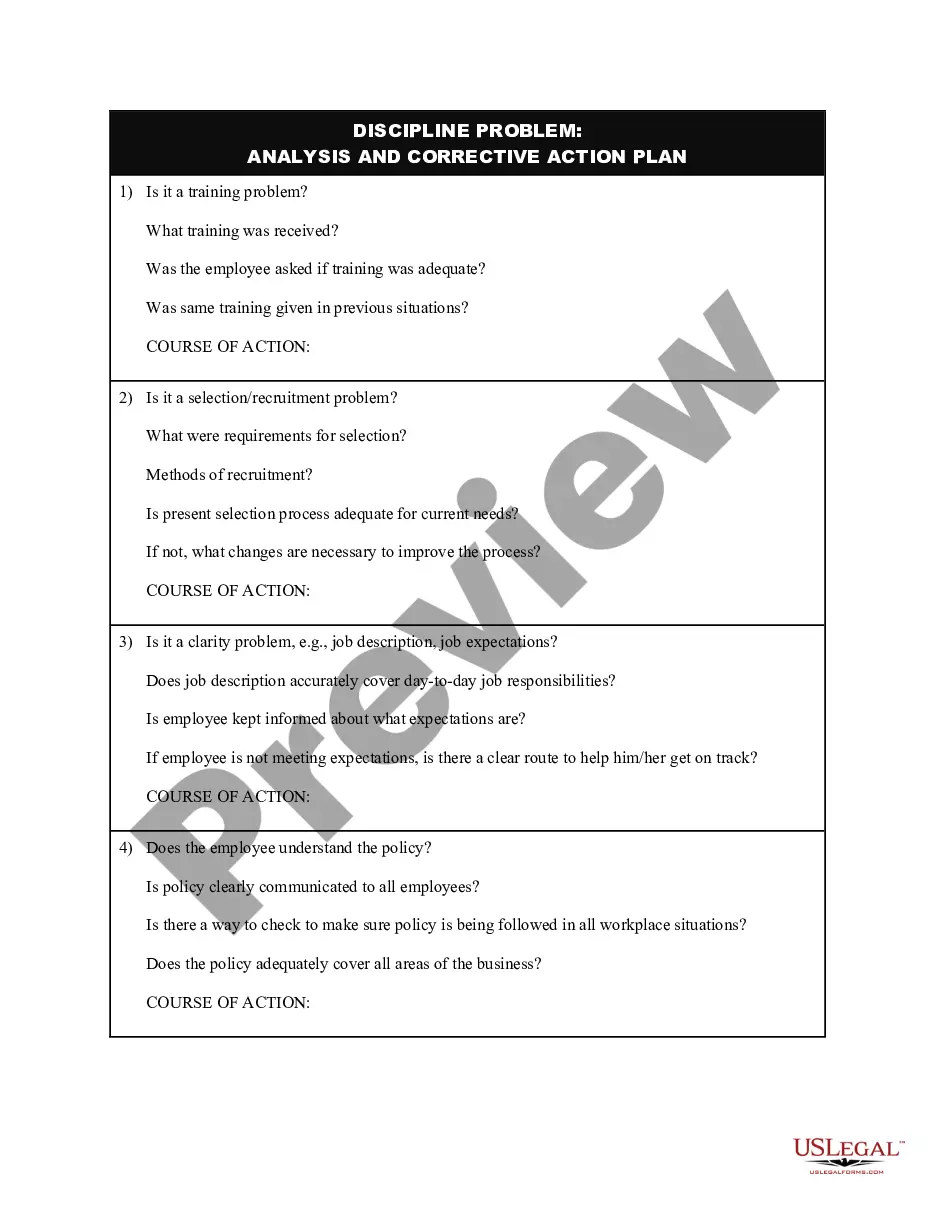
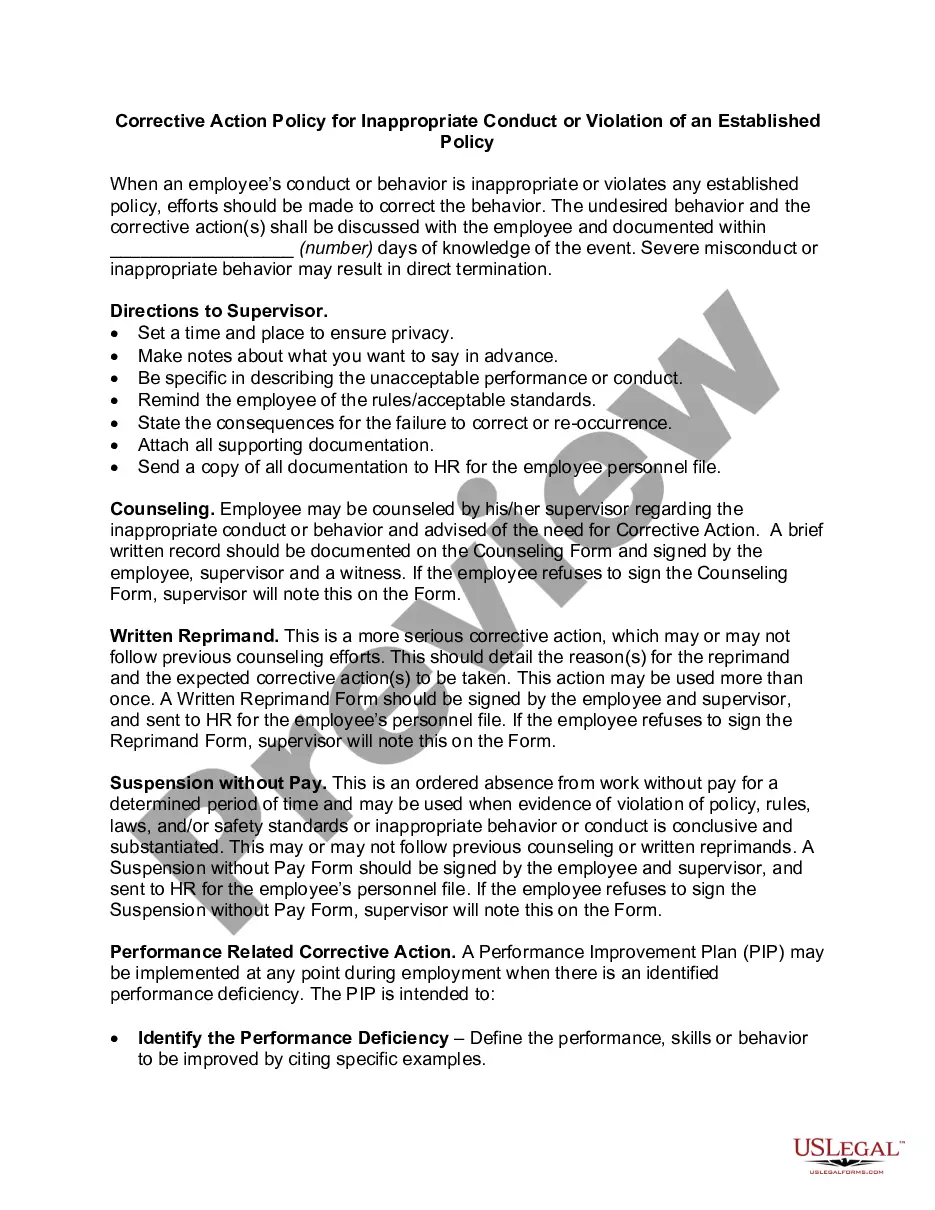
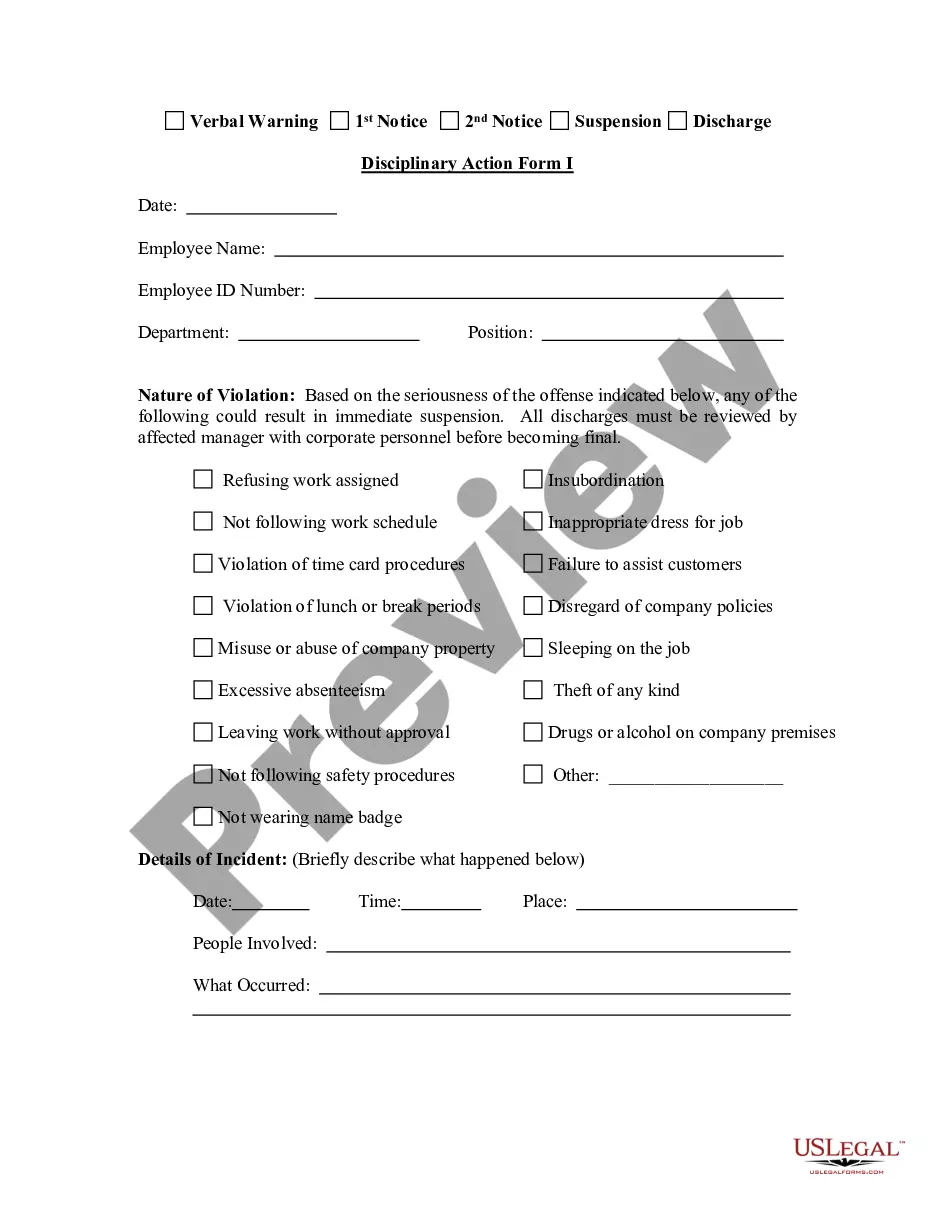
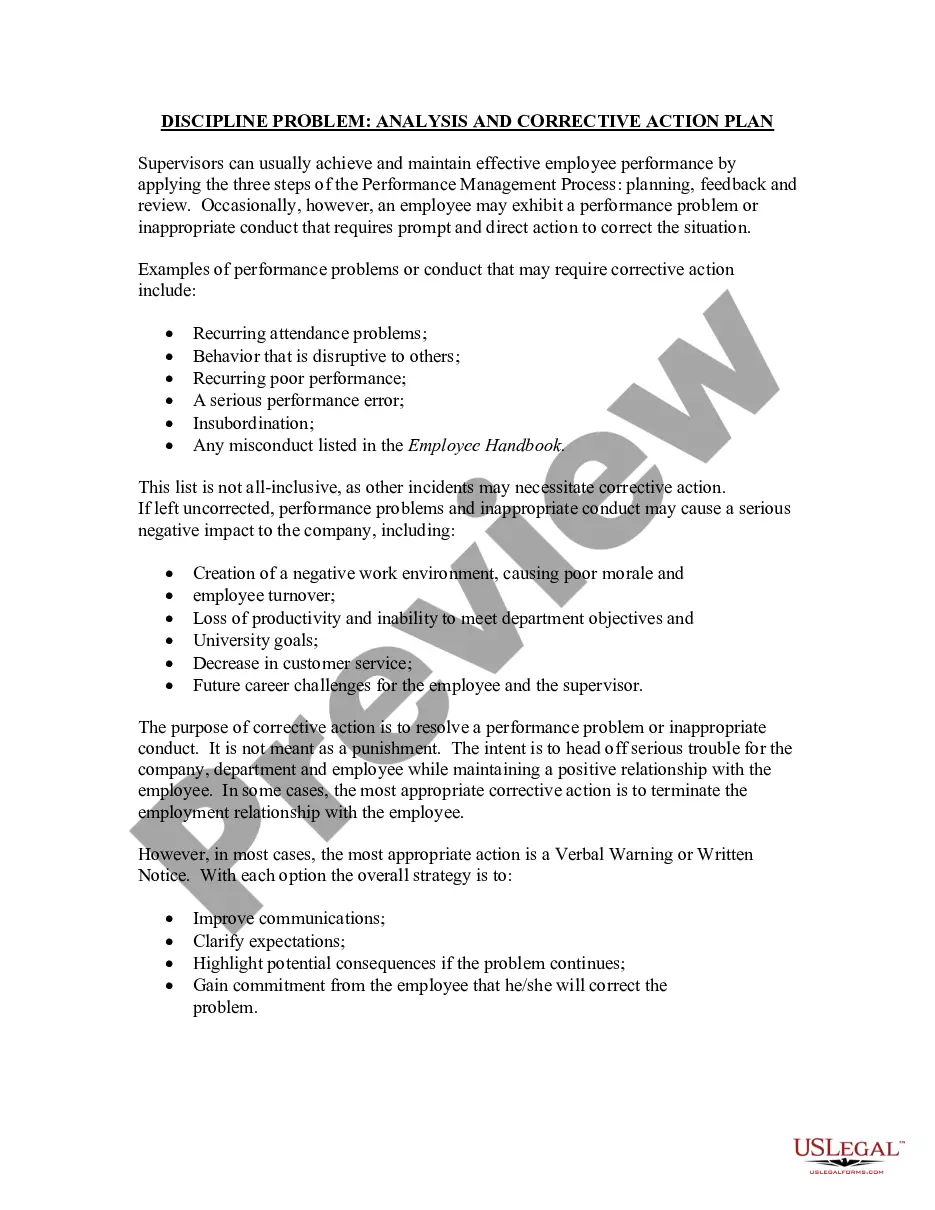
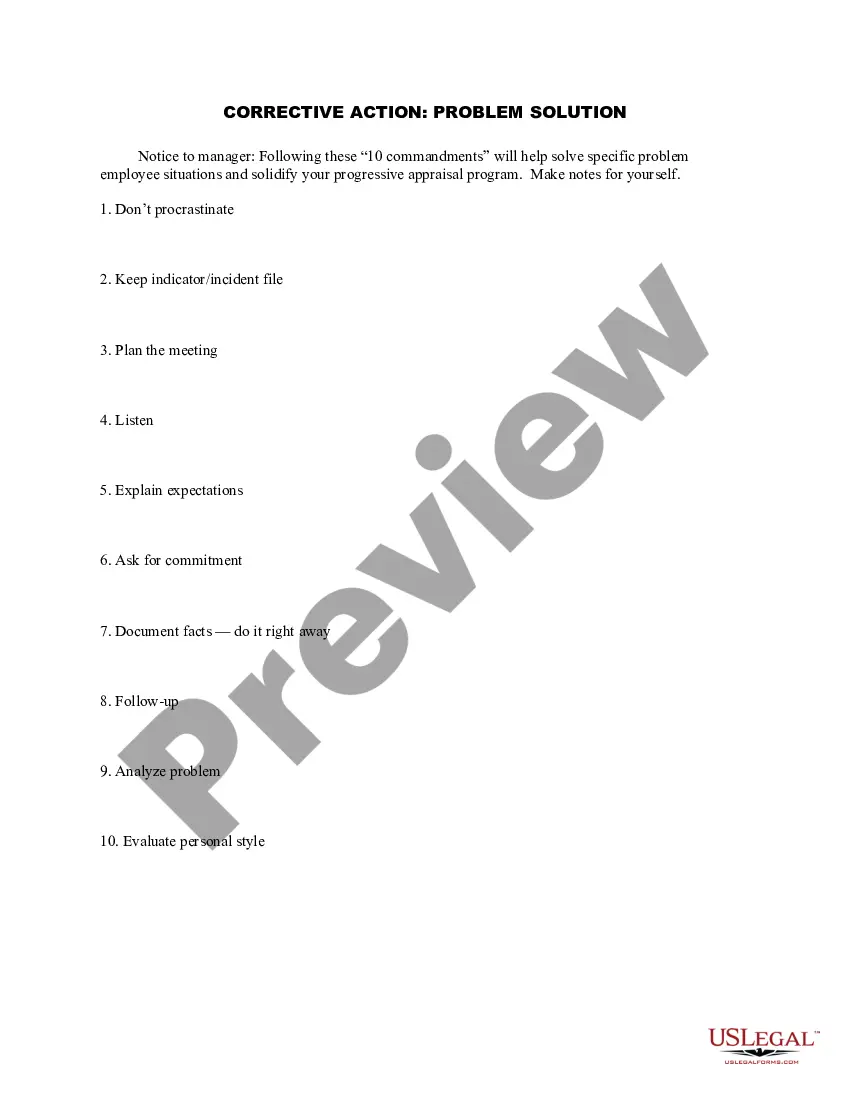
The Discipline Problem - Analysis and Corrective Action Plan is a legal form that assists employers in addressing employee performance issues. This form guides employers in identifying underlying problems, such as training or communication shortcomings, and outlines steps to take for corrective action. Unlike generic performance evaluation forms, this specialized plan helps streamline the disciplinary process and ensure compliance with employment laws.
What’s included in this form
- Employee Information: Capture the employee's details and position.
- Issue Identification: Sections to detail the specific performance issues and any training that has been provided.
- Analysis Questions: Provisions for employers to assess whether the issues are due to training, recruitment, clarity of job expectations, or personal problems.
- Course of Action: A designated section for outlining the steps to rectify the issues identified.
- Documentation: Spaces for recording any correspondence related to the disciplinary process.
When to use this form
This form should be used when an employer encounters persistent performance issues with an employee despite previous efforts to resolve them. It is crucial when an employer wishes to document the analysis process and implement a structured corrective action plan, ensuring that the employee receives the support needed to improve.
Who can use this document
This form is intended for:
- Human resources professionals.
- Managers and supervisors responsible for employee performance.
- Business owners who wish to maintain standards in their workforce.
- Organizations looking to document their disciplinary procedures.
Completing this form step by step
Steps to complete this form:
- Identify the employee: Enter the employeeâs name, position, and relevant details.
- Describe the problem: Clearly explain the performance issues that need to be addressed.
- Analyze contributing factors: Use the provided questions to evaluate whether the problems are due to training, selection, clarity, or personal issues.
- Formulate a corrective action plan: Outline what steps will be taken to help the employee improve, including any training or support.
- Document findings: Keep records of the meeting and any written communication for future reference.
Notarization guidance
This form does not typically require notarization unless specified by local law.
Get your form ready online
Our built-in tools help you complete, sign, share, and store your documents in one place.
Make edits, fill in missing information, and update formatting in US Legal Forms—just like you would in MS Word.
Download a copy, print it, send it by email, or mail it via USPS—whatever works best for your next step.
Sign and collect signatures with our SignNow integration. Send to multiple recipients, set reminders, and more. Go Premium to unlock E-Sign.
If this form requires notarization, complete it online through a secure video call—no need to meet a notary in person or wait for an appointment.
We protect your documents and personal data by following strict security and privacy standards.

Make edits, fill in missing information, and update formatting in US Legal Forms—just like you would in MS Word.

Download a copy, print it, send it by email, or mail it via USPS—whatever works best for your next step.

Sign and collect signatures with our SignNow integration. Send to multiple recipients, set reminders, and more. Go Premium to unlock E-Sign.

If this form requires notarization, complete it online through a secure video call—no need to meet a notary in person or wait for an appointment.

We protect your documents and personal data by following strict security and privacy standards.
Avoid these common issues
- Neglecting to document previous communications about performance issues.
- Failing to involve the employee in the analysis process.
- Overlooking specific training needs before implementing corrective action.
- Not keeping a copy of the completed form for HR records.
Why complete this form online
- Easy access: Downloadable and editable for convenience and customization.
- Structured approach: Provides a clear framework for addressing performance issues.
- Legal compliance: Assists in aligning documentation with employment laws.
- Increased transparency: Ensures all parties involved are aware of the issues and solutions proposed.
- Important for documenting employee performance issues to prevent legal disputes.
- Facilitates clear communication strategies between employer and employee.
- Helps maintain organizational standards and compliance with labor regulations.
Summary of main points
- The Discipline Problem - Analysis and Corrective Action Plan is essential for managing employee performance issues effectively.
- Completing this form assists in a structured approach to disciplinary action that helps improve employee performance.
- Proper documentation is key to ensuring the legality and effectiveness of the corrective measures taken.
Key terms explained
- Corrective action plan: A structured plan aimed at addressing and fixing performance issues within the workplace.
- Discipline issue: Challenges related to an employeeâs performance or behavior that require intervention.
- Training adequacy: Assessment of whether an employee received sufficient preparation to fulfill their job responsibilities.
Looking for another form?

Form popularity
FAQ
The objective/purpose of the 8D Methodology is to identify and define the problem statement effectively for necessary Corrective and Preventive actions CAPA to stop/prevent recurrence and occurrence of the problem.that are commonly applied in variety of organizations to identify and solve work related problems.
The Eight Disciplines (8D) model is a problem-solving methodology used primarily within the automotive industry to identify root causes, correct them in the short term and prevent them in the long term.Fortunately, mitigating the risk of importing 8D into a CAPA program is mainly a matter of understanding the problem.
The purpose of the 8D methodology is to identify, correct, and eliminate recurring problems, making it useful in product and process improvement.Although it originally comprised eight stages, or disciplines, the eight disciplines system was later augmented by an initial planning stage.
A CAPA is written to identify a discrepancy or problem in the conduct of the clinical research study, note the root cause of the identified problem, identify the corrective action taken to prevent recurrence of the problem, and document that the corrective action has resolved the problem.
The Eight Disciplines of Problem Solving (8D) is a problem solving methodology designed to find the root cause of a problem, devise a short-term fix and implement a long-term solution to prevent recurring problems.
The CAPA (corrective and preventative actions) quality system consists of the specific improvements an organization makes to its processes to eliminate non-conformities.
The purpose of the 8D methodology is to identify, correct, and eliminate recurring problems, making it useful in product and process improvement.Although it originally comprised eight stages, or disciplines, the eight disciplines system was later augmented by an initial planning stage.
8D stands for the 8 disciplines or the 8 critical steps for solving problems. It is a highly disciplined and effective scientific approach for resolving chronic and recurring problems.
The Eight Disciplines of Problem Solving (8D) is a problem solving methodology designed to find the root cause of a problem, devise a short-term fix and implement a long-term solution to prevent recurring problems.8D has become very popular among manufacturers because it is effective and reasonably easy to teach.
Define corrective action for the problem occurred. Identify the root cause. Identify when to issue CARs. Define levels of corrective action. Identify contractual requirements impacting the schedule and delivery of the products. Continuous follow ups. Recording of the end result for future reference.