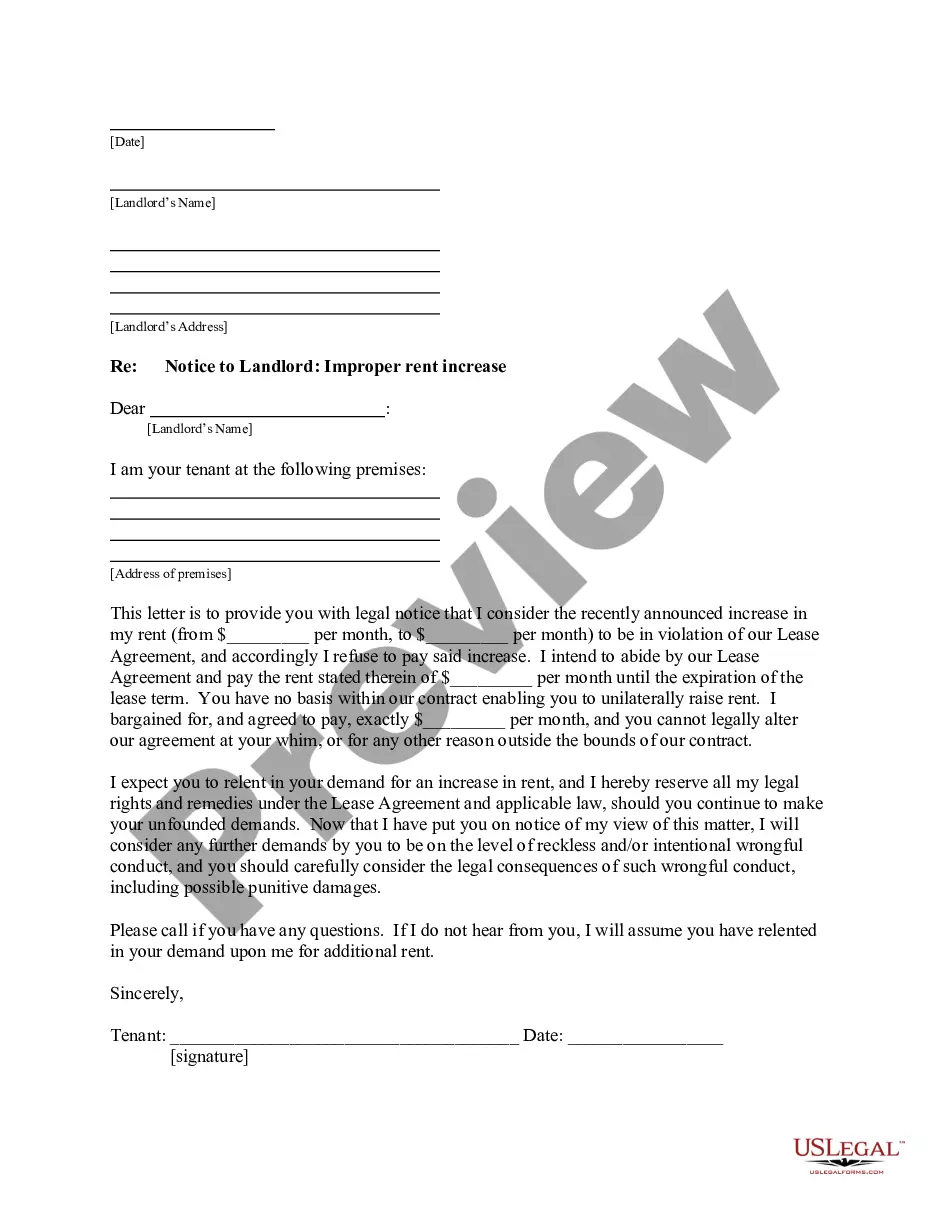
Comprehensive Special Tax Notice Regarding Plan Payments
Understanding this form
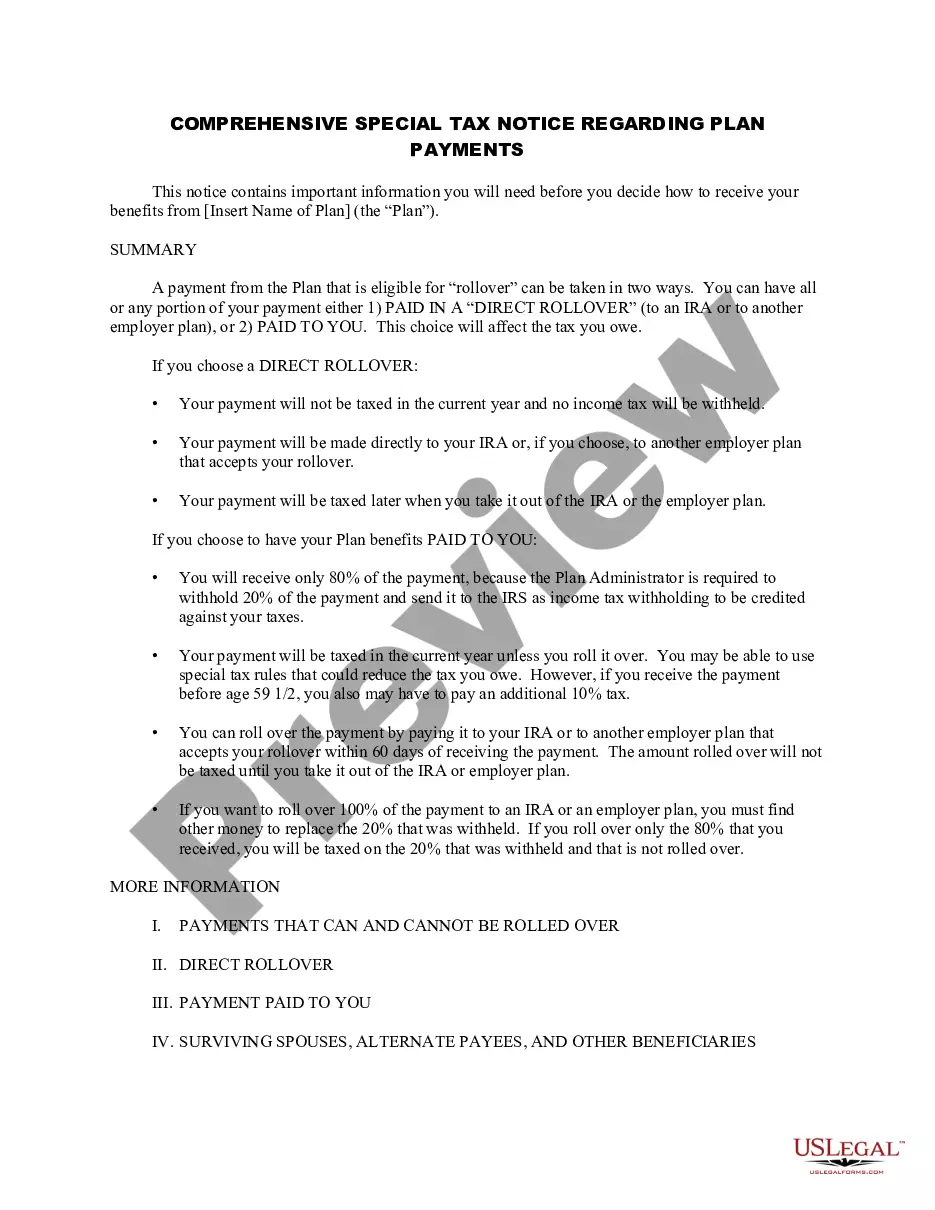
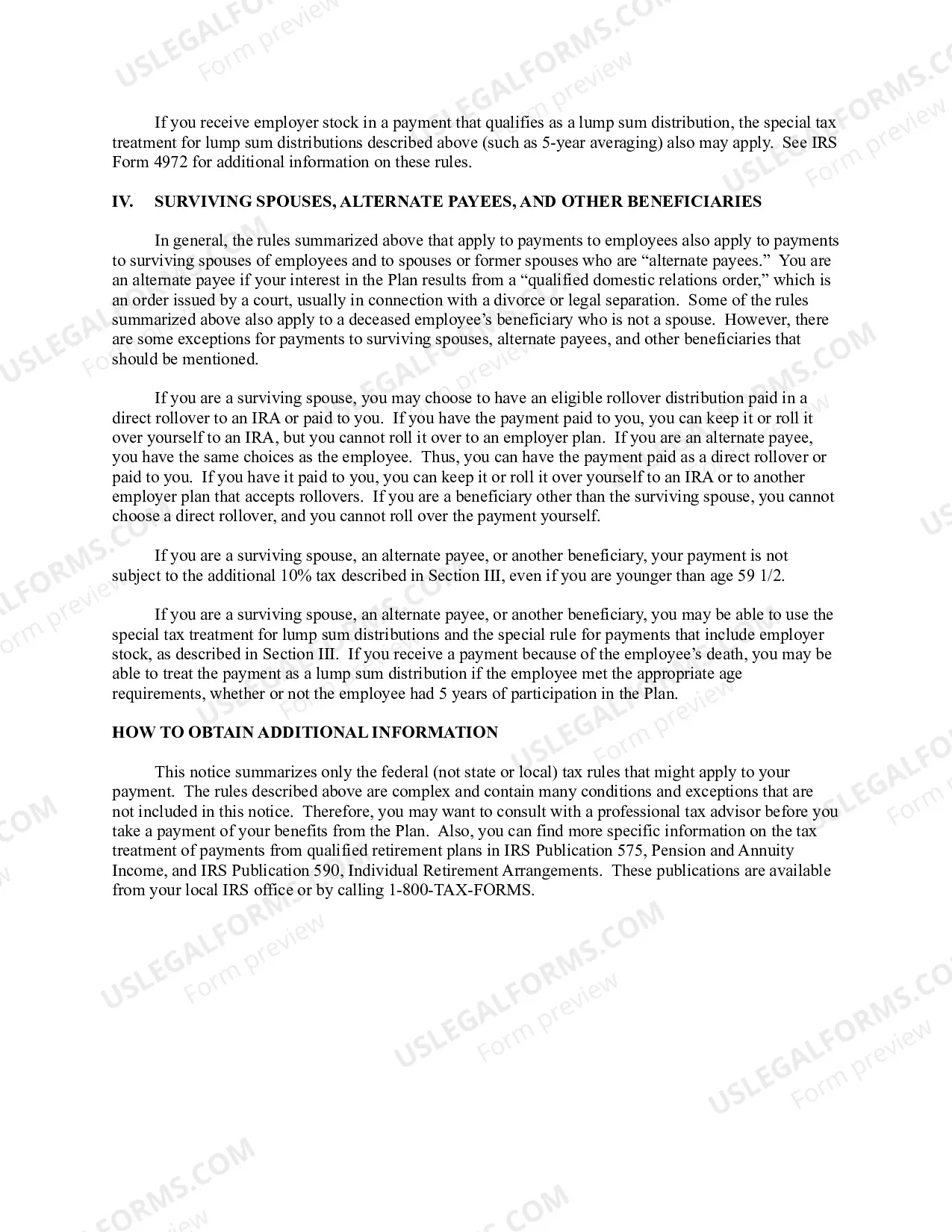
The Comprehensive Special Tax Notice Regarding Plan Payments is an important document that provides detailed information on how to handle your benefits from a retirement plan. It outlines your options for receiving payments and the tax implications associated with each option. This form is particularly essential for individuals considering a rollover of their retirement funds to avoid immediate tax liabilities. It sets itself apart from other tax-related forms by focusing specifically on retirement plan distributions and their consequences.
Key parts of this document
- Summary of payment options: Direct rollover or payment to you.
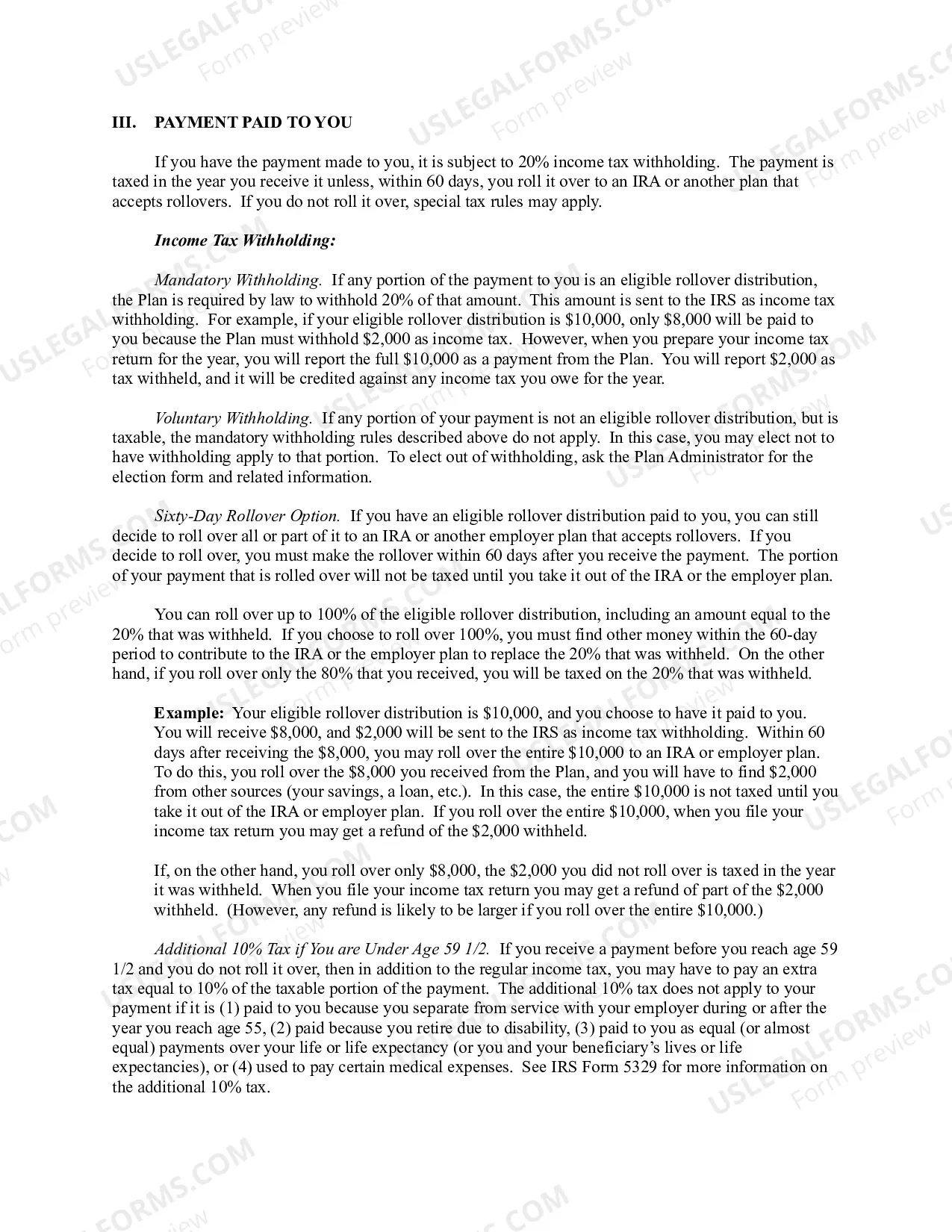
- Details about tax withholding on distributions.
- Eligibility criteria for roles such as surviving spouses and alternate payees.
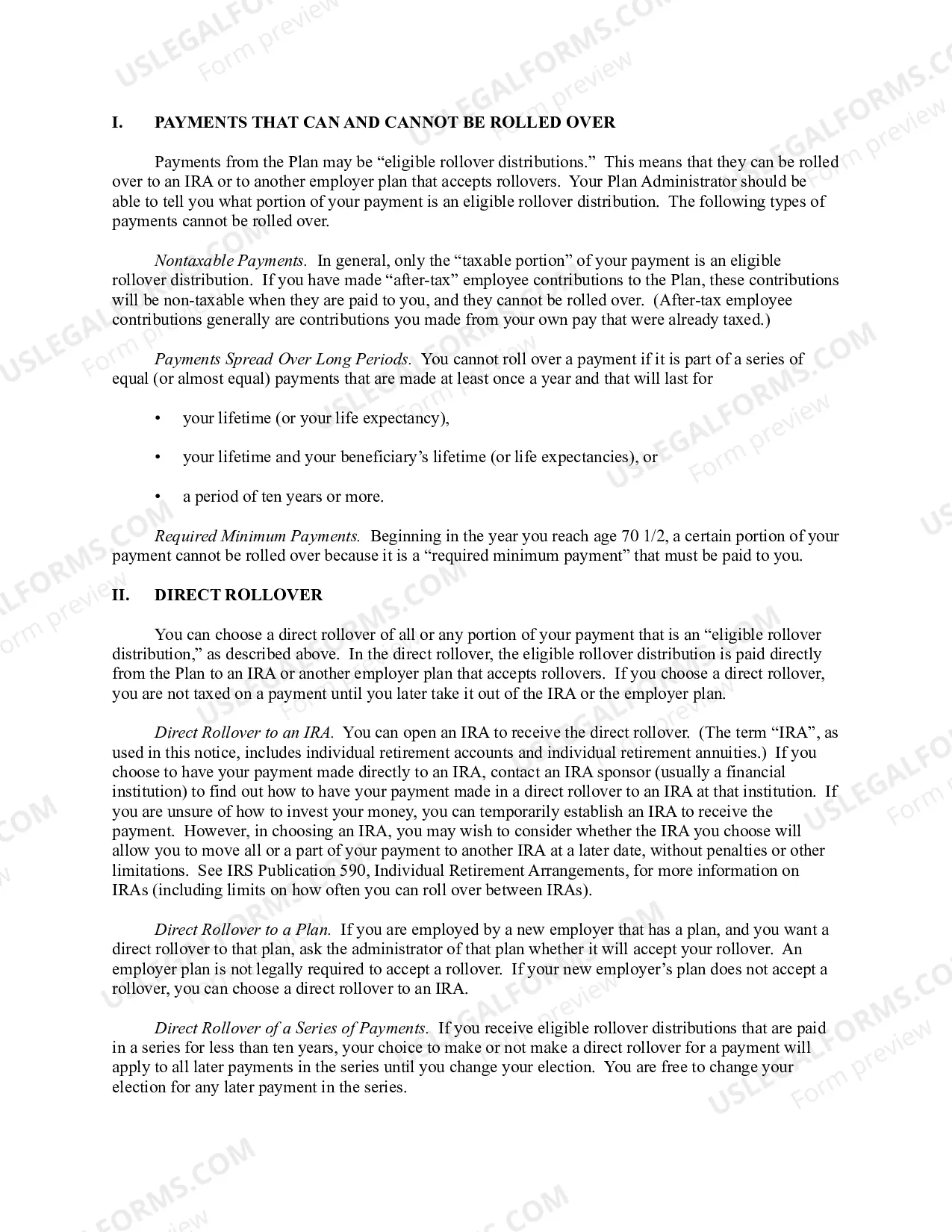
- Information on eligible and non-eligible rollover distributions.
- Special tax treatment options for lump-sum distributions.

When to use this document
This form is applicable when you receive benefits from a retirement plan and need guidance on how to proceed with your payments. It is particularly useful in scenarios where you are considering your options for rolling over a distribution or if you are approaching retirement and looking to manage your plan payments while minimizing tax liabilities.
Who this form is for
- Plan participants approaching distribution age.
- Individuals considering rolling over their retirement funds.
- Surviving spouses or alternate payees of retirement plans.
- Anyone needing clarity on the tax implications of receiving retirement plan benefits.
Completing this form step by step
- Identify the name of your retirement plan.
- Review the summary section for payment options like direct rollover or payment to you.
- Determine eligibility if transitioning retirement benefits to surviving spouses or alternate payees.
- Consult the tax withholding section based on your chosen payment option.
- Sign and date the form as required, if applicable.
Does this form need to be notarized?
This form does not typically require notarization unless specified by local law. It is advisable to confirm whether notarization is required based on your specific circumstances and state regulations.
Get your form ready online
Our built-in tools help you complete, sign, share, and store your documents in one place.
Make edits, fill in missing information, and update formatting in US Legal Forms—just like you would in MS Word.
Download a copy, print it, send it by email, or mail it via USPS—whatever works best for your next step.
Sign and collect signatures with our SignNow integration. Send to multiple recipients, set reminders, and more. Go Premium to unlock E-Sign.
If this form requires notarization, complete it online through a secure video call—no need to meet a notary in person or wait for an appointment.
We protect your documents and personal data by following strict security and privacy standards.

Make edits, fill in missing information, and update formatting in US Legal Forms—just like you would in MS Word.

Download a copy, print it, send it by email, or mail it via USPS—whatever works best for your next step.

Sign and collect signatures with our SignNow integration. Send to multiple recipients, set reminders, and more. Go Premium to unlock E-Sign.

If this form requires notarization, complete it online through a secure video call—no need to meet a notary in person or wait for an appointment.

We protect your documents and personal data by following strict security and privacy standards.
Mistakes to watch out for
- Not reading the entire document, leading to misunderstandings about tax consequences.
- Overlooking the deadlines for rolling over funds to avoid taxes.
- Failing to consult with a tax advisor when unsure about the implications of a distribution.
Why use this form online
- Convenience: Download and complete the form at your own pace.
- Editability: Easily fill in your personal information and choice of benefits.
- Reliability: Access templates prepared by licensed attorneys to ensure legal compliance.
- This notice serves as an official document that informs beneficiaries of their rights and options under the law.
- Understanding this notice is essential for making informed decisions about retirement benefits and avoiding unnecessary tax liabilities.
- Failure to comply with tax rules outlined in this document may result in penalties and loss of tax-deferred status.
What to keep in mind
- The Comprehensive Special Tax Notice helps individuals understand their retirement payment options and how to manage them to avoid tax penalties.
- It is essential for participants to consult the document before making distributions from their retirement plans.
- Being aware of tax ramifications and deadlines can save you money and hassle in the long run.
Looking for another form?
Form popularity
FAQ
/20. 402(f) Notice of Special Tax Rules. on Distributions. If you roll over your payment to a Roth IRA. If you roll over a payment from the Plan to a Roth IRA, a special rule applies under which the amount of the payment rolled over (reduced by any after-tax amounts) will be taxed.
(Alternative to IRS Safe Harbor Notice - For Participant) This notice explains how you can continue to defer federal income tax on your retirement plan savings in the Plan and contains important information you will need before you decide how to receive your Plan benefits.
It explains when and how you can continue to defer federal income tax on your retirement savings when you receive a distribution.A rollover to an eligible employer plan or Traditional IRA allows you to continue to postpone taxation of that benefit until it is paid to you.
The Plan is required to provide you with information that explains your distribution options and the federal income tax implications of a Plan distribution prior to the receipt of assets from your account.
ANSWER: Generally, an eligible rollover distribution is any distribution to a participant, spouse beneficiary, spouse (or former spouse) alternate payee, or designated non-spouse beneficiary that is paid in a lump-sum payment or a series of installments over a period of less than ten years.
There is no income tax withholding required on an in-plan Roth direct rollover. However, if you receive a distribution from your plan, the plan must withhold 20% federal income tax on the untaxed amount even if you later roll over the distribution to a designated Roth account within 60 days.
The Case for Special Tax Treatment of Qualified Dividends and Long-Term Capital Gains.If individuals are required to pay tax on these dividends at ordinary rates, this income may be completely taxed away taking into account both federal and state income taxes at both the corporate and individual level.