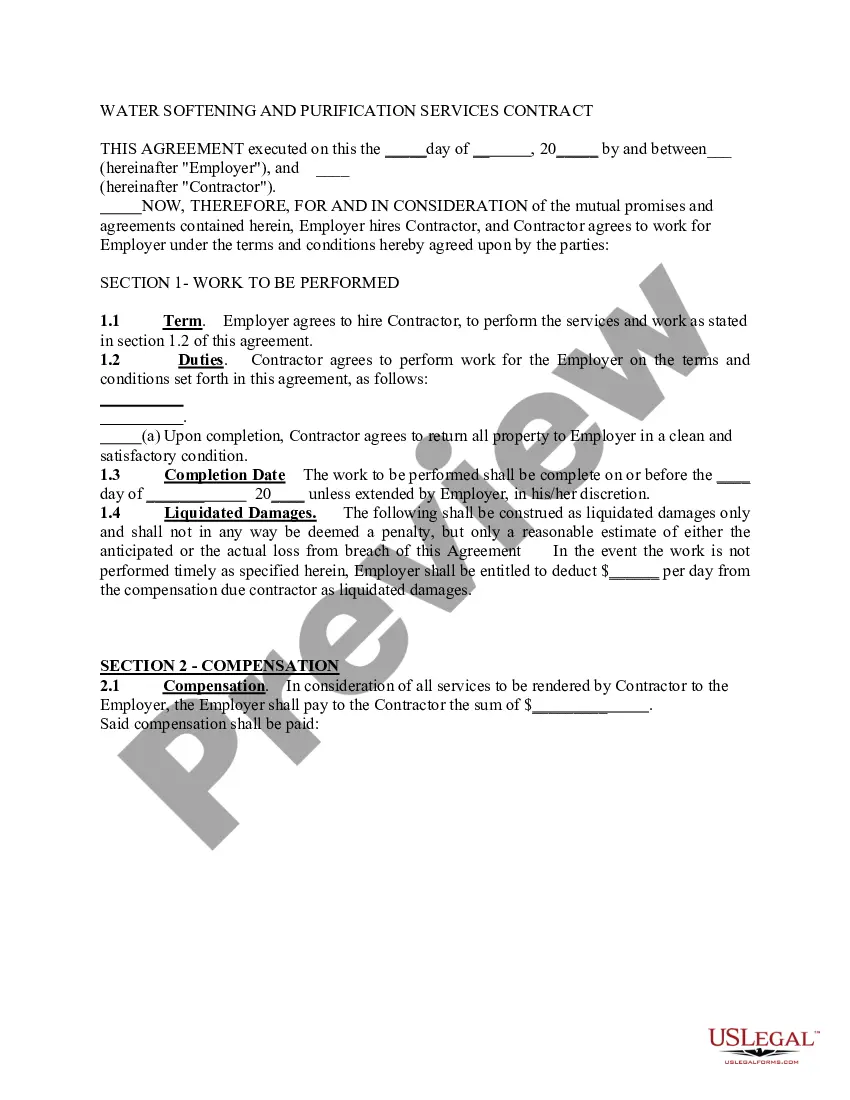
Water Softening And Purification Services Contract
Understanding this form
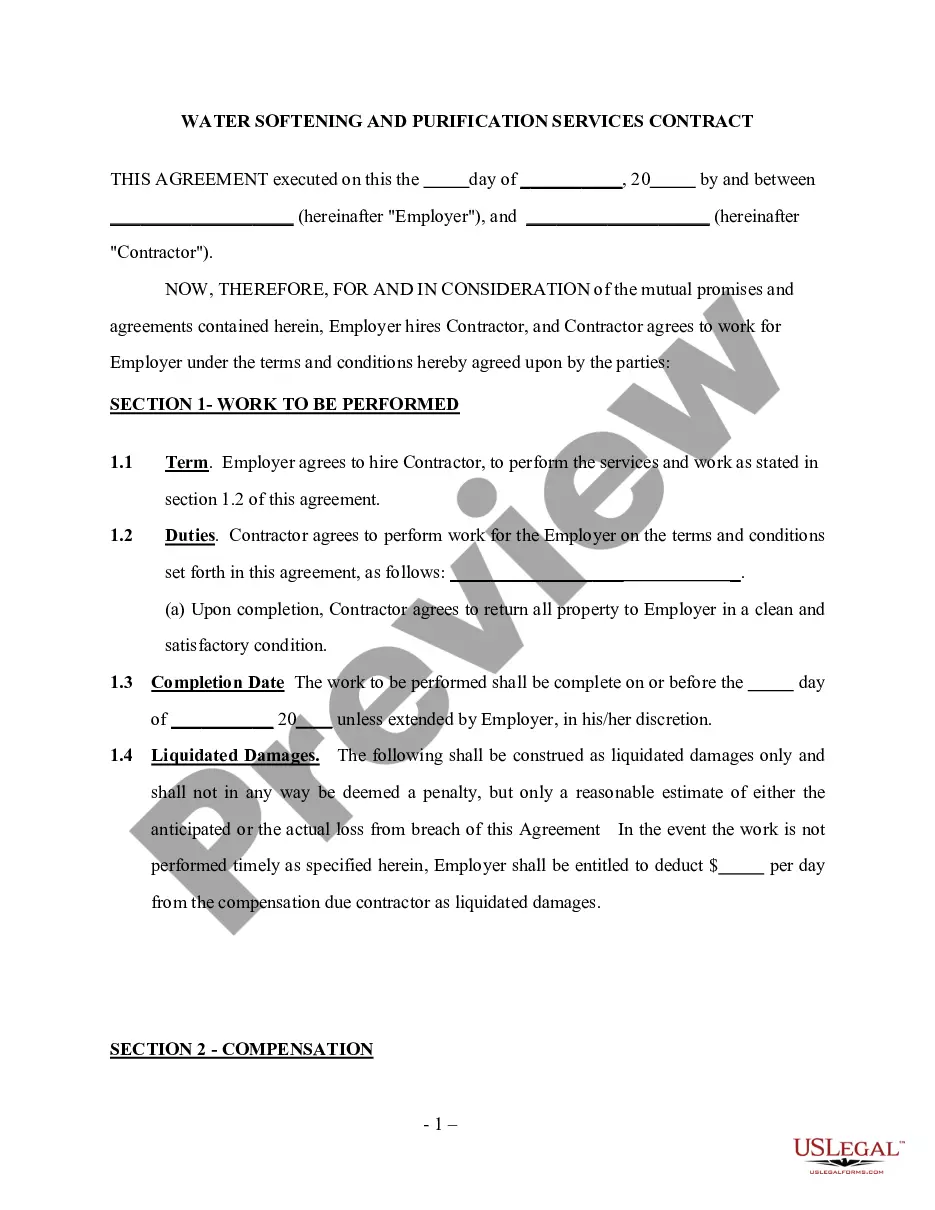
The Water Softening and Purification Services Contract is a legal agreement between an employer and an independent contractor. This form outlines the terms under which the contractor will provide water softening and purification services, including specific duties and compensation. It is essential for setting clear expectations, responsibilities, and protections for both parties involved in the service agreement.
What’s included in this form
- Work to be performed: Details the services the contractor will provide, including completion dates.
- Compensation: Specifies the payment terms for the contractor's services.
- Independent contractor status: Clarifies the relationship between the parties, ensuring the contractor is not an employee of the employer.
- Insurance requirements: Outlines necessary insurance coverage the contractor must maintain.
- Miscellaneous provisions: Covers legal and procedural agreements related to defaults, terminations, and dispute resolutions.
When to use this form
This form is useful when an employer wishes to hire an independent contractor for specific tasks related to water softening and purification. Scenarios for its use include residential properties needing improved water quality, businesses requiring reliable water supply services, or any situation demanding contractual clarity in service engagements.
Who should use this form
- Employers: Individuals or companies seeking to hire contractors for water treatment services.
- Independent contractors: Professionals or businesses specializing in water softening and purification looking to formalize their service agreements.
- Property managers: Those managing multiple properties that require consistent water quality upgrades.
Instructions for completing this form
- Identify the parties involved by entering the employer and contractor's information.
- Specify the scope of work, describing the exact services the contractor will perform.
- Enter the agreed-upon compensation and payment schedule.
- Review and check any required insurance coverage that the contractor must maintain.
- Include signature lines for both parties to formalize the agreement.
Notarization guidance
This form usually doesn’t need to be notarized. However, local laws or specific transactions may require it. Our online notarization service, powered by Notarize, lets you complete it remotely through a secure video session, available 24/7.
Get your form ready online
Our built-in tools help you complete, sign, share, and store your documents in one place.
Make edits, fill in missing information, and update formatting in US Legal Forms—just like you would in MS Word.
Download a copy, print it, send it by email, or mail it via USPS—whatever works best for your next step.
Sign and collect signatures with our SignNow integration. Send to multiple recipients, set reminders, and more. Go Premium to unlock E-Sign.
If this form requires notarization, complete it online through a secure video call—no need to meet a notary in person or wait for an appointment.
We protect your documents and personal data by following strict security and privacy standards.

Make edits, fill in missing information, and update formatting in US Legal Forms—just like you would in MS Word.

Download a copy, print it, send it by email, or mail it via USPS—whatever works best for your next step.

Sign and collect signatures with our SignNow integration. Send to multiple recipients, set reminders, and more. Go Premium to unlock E-Sign.

If this form requires notarization, complete it online through a secure video call—no need to meet a notary in person or wait for an appointment.

We protect your documents and personal data by following strict security and privacy standards.
Avoid these common issues
- Failing to clearly define the scope of work, which can lead to misunderstandings.
- Not specifying payment terms leading to disputes over compensation.
- Ignoring insurance requirements which may expose the employer to liability.
- Neglecting to have both parties sign and date the agreement.
Why use this form online
- Convenience of instant access and downloadable format.
- Editability allows customization to fit specific agreements.
- Reliability with forms drafted by licensed attorneys to meet legal standards.
Looking for another form?
Form popularity
FAQ
A commercial water softener removes magnesium and calcium minerals and replaces them with sodium ions. The exchange of hard water minerals for sodium happens inside the water softener's tank. With proper water softener maintenance, your system should serve your building for many years with little or no complications.
Typically, the regeneration should occur after every 12 to 14 days or it should occur after a predetermined gallons of water that you use. You can set the number of gallons used before it regenerates through the water softener's valve.
Water softeners do not filter water, they only remove calcium and magnesium minerals to address hard water. In order to remove contaminants so water is safer for drinking, cooking, and showering ? you'll need to use a water filter even if you already have a water softener installed.
A commercial water softener removes magnesium and calcium minerals and replaces them with sodium ions. The exchange of hard water minerals for sodium happens inside the water softener's tank. With proper water softener maintenance, your system should serve your building for many years with little or no complications.
While both help enhance the flavor of your water, each serves a different purpose. Water purifiers remove a variety of harmful contaminants from your water and water softeners remove calcium and magnesium from your water but also add trace amounts of sodium.
Here's a breakdown of how a water softener works: Hard water enters your home from a main water pipe or well, and travels to the water softener. Resin beads in the tank attract and hold onto hard water minerals, removing them from the water. Softened water exits the tank and flows to the plumbing throughout your home.
Incoming water enters the water softener vessel that is filled with the resin bed. The velocity of the water slows, spreading over the wider surface area of the bed, and travels through the millions of tiny beads. During this process, the minerals in the water are attracted to the resin surface areas.
Water Conditioner vs Water Softeners ? The Basics A water conditioner will remove additional chemicals, such as chlorine, from your water, and wastes less water than a water softener. Conversely, a water softener removes hardness particles from your water.