Theft Concerning a Program Receiving Federal Funds - Determining Value of Property
Overview of this form
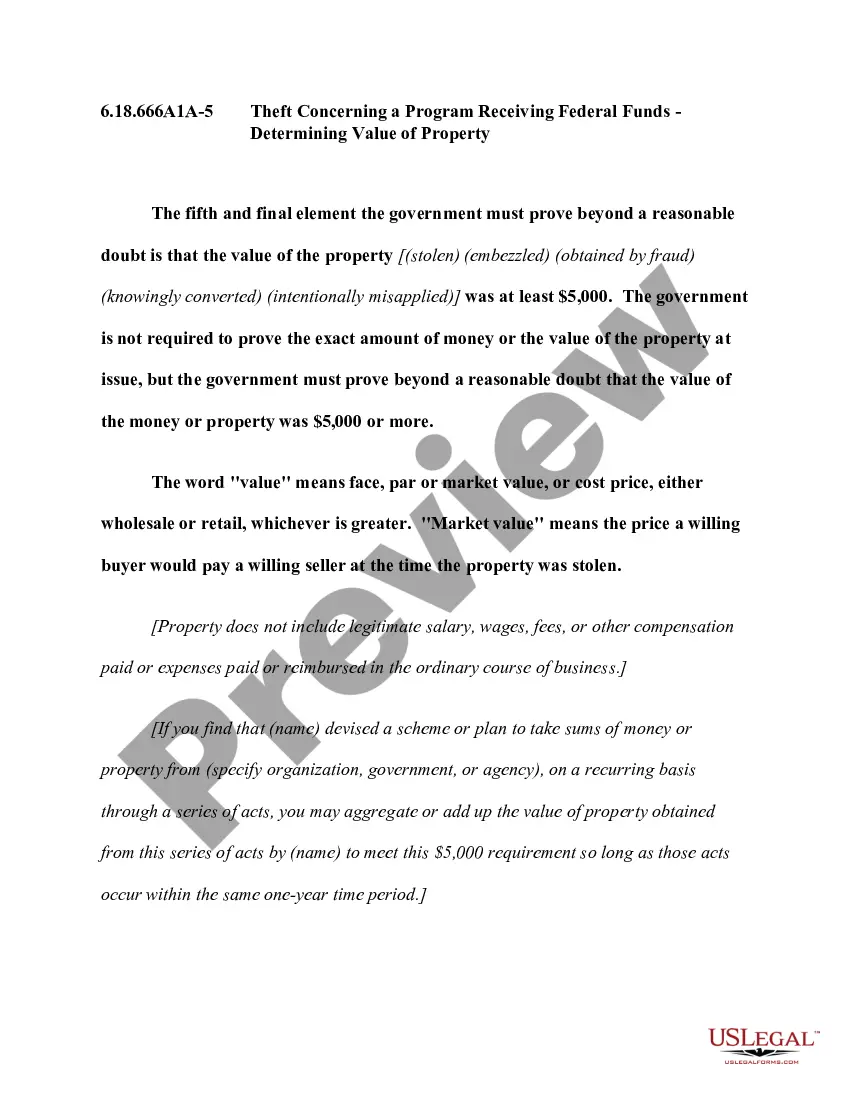
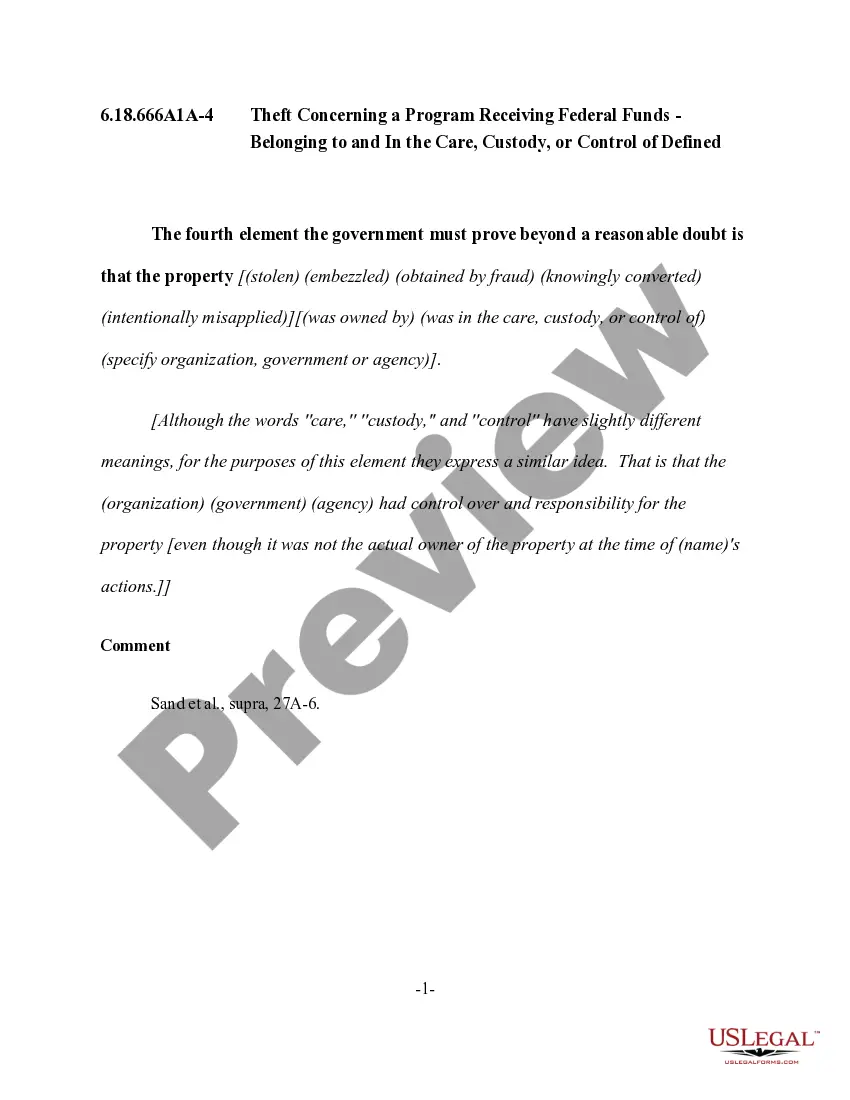
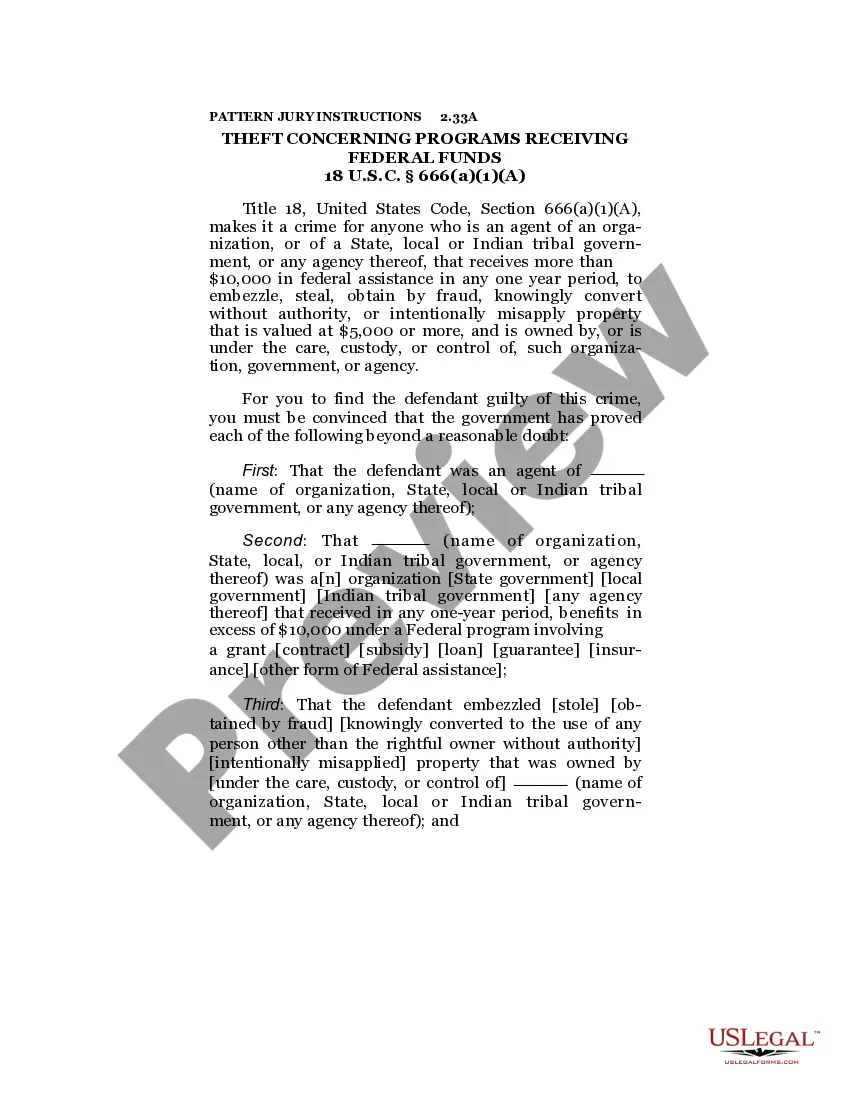
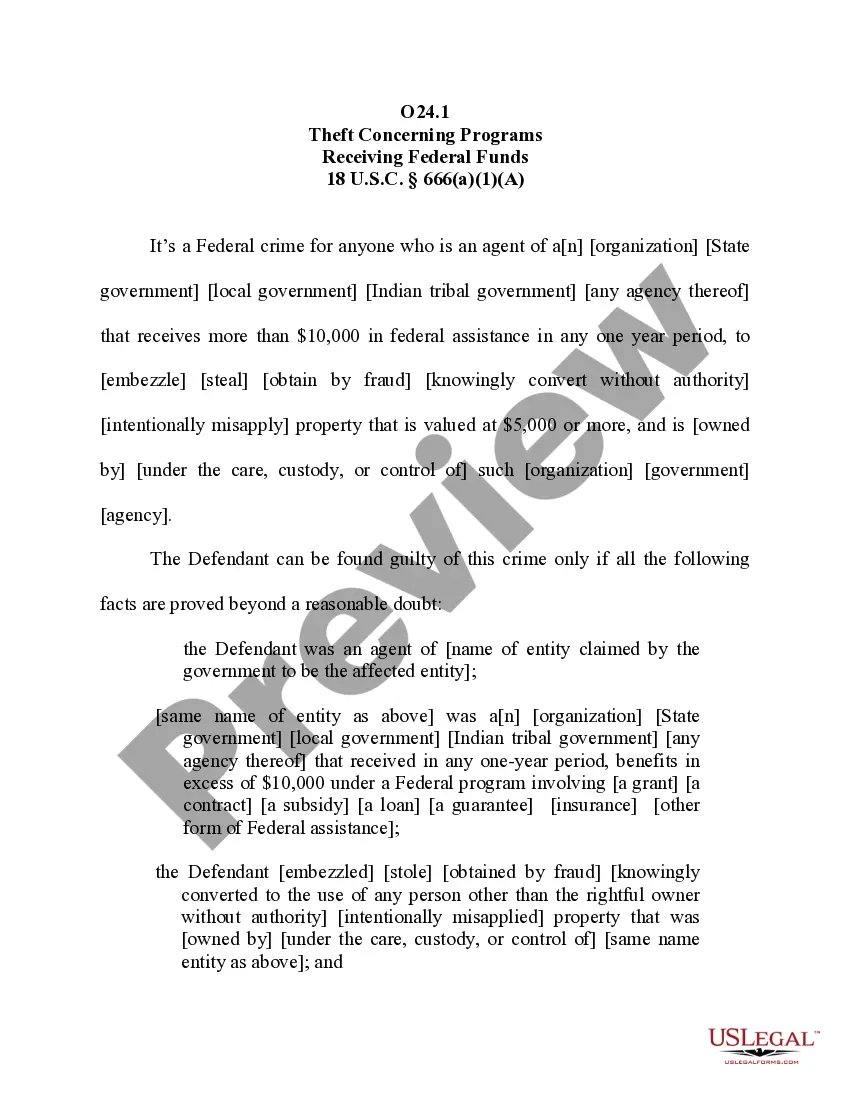
The Theft Concerning a Program Receiving Federal Funds - Determining Value of Property form is a legal document used to define and assess the value of property involved in theft or fraud relating to federally funded programs. This form distinguishes itself by focusing specifically on federal programs and the value threshold of $5,000, which is critical for legal proceedings related to such theft. It serves as a guide to ensure the government can meet its burden of proof in theft cases involving federal funds.
Key components of this form
- Definition of value: Specifies how to determine the value of stolen property, including face, par, or market value.
- Aggregation of values: Allows aggregation of multiple thefts within one year to meet the $5,000 threshold.
- Exclusions: Clarifies that legitimate salaries and compensation are not included in the valuation.
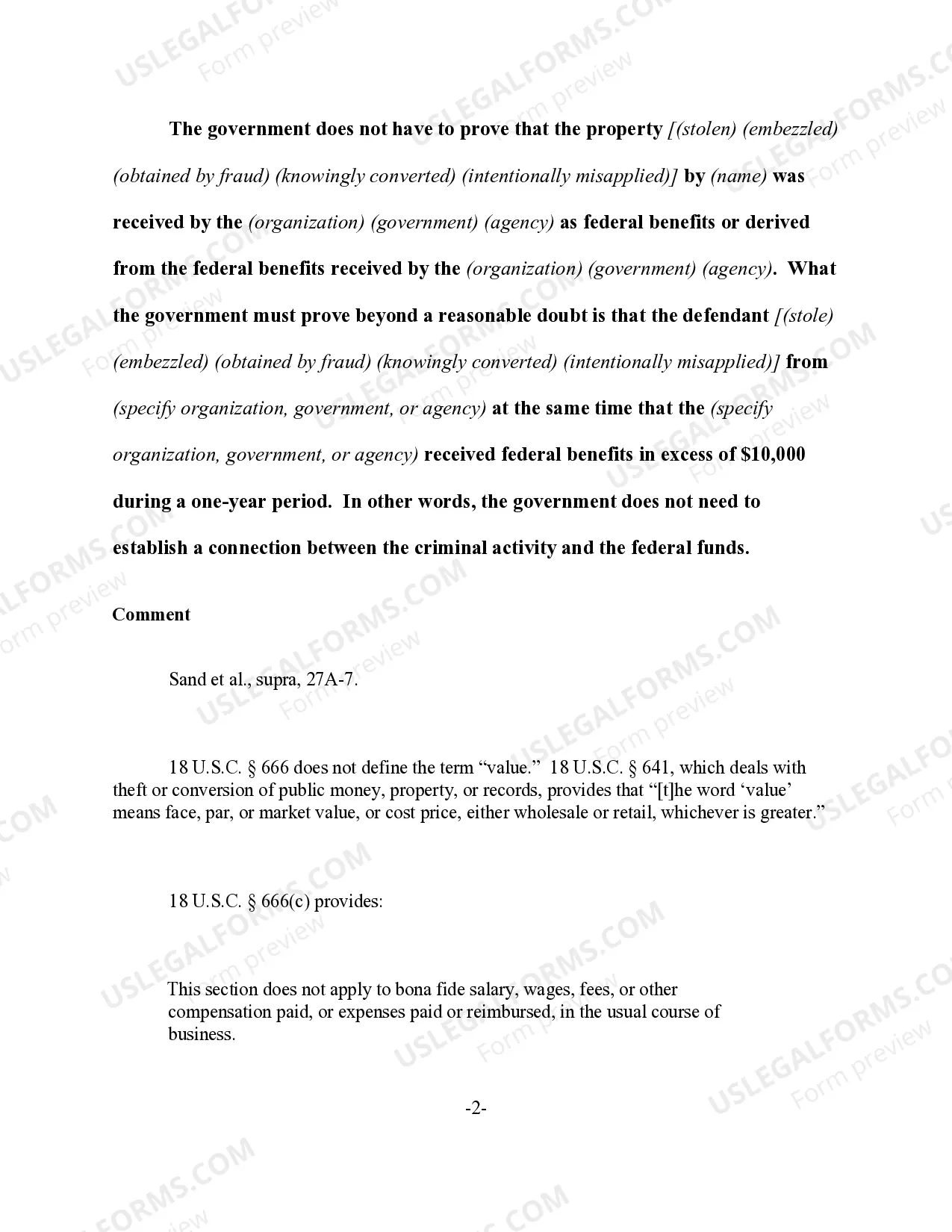
- Connection to federal funds: Explains that the government does not need to demonstrate a direct link between the theft and federal benefits received.
- Proof requirements: Outlines what the government must prove beyond a reasonable doubt regarding the theft.
Situations where this form applies
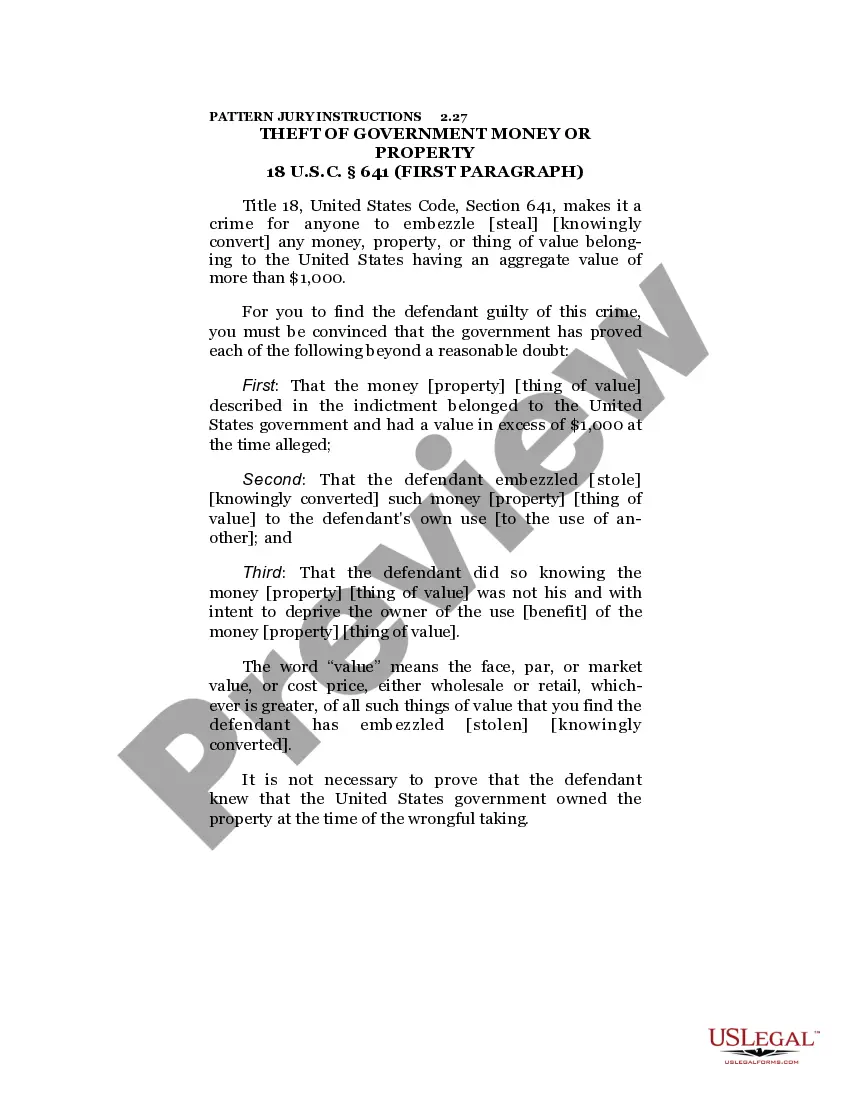
This form is needed in situations where an individual or entity is accused of theft, embezzlement, or fraud involving property or funds related to a program that receives federal money. It is particularly relevant when the value of the stolen property is at least $5,000, and it helps clarify the government's proof requirements in these cases.
Who should use this form
- Legal practitioners representing clients in theft cases involving federal funds.
- Individuals or entities who need to understand the value determination in their theft case.
- Prosecutors seeking to build a case regarding theft from federally funded programs.
Completing this form step by step
- Identify the parties involved, including the accused and the affected organization.
- Specify the property involved, detailing its value and the circumstances of the theft.
- Enter the time period over which the theft occurred if it involves multiple acts.
- Document any relevant evidence that supports the valuation of the property.
- Ensure all information is accurate before submitting for legal review.
Does this document require notarization?
This form usually doesn’t need to be notarized. However, local laws or specific transactions may require it. Our online notarization service, powered by Notarize, lets you complete it remotely through a secure video session, available 24/7.
Get your form ready online
Our built-in tools help you complete, sign, share, and store your documents in one place.
Make edits, fill in missing information, and update formatting in US Legal Forms—just like you would in MS Word.
Download a copy, print it, send it by email, or mail it via USPS—whatever works best for your next step.
Sign and collect signatures with our SignNow integration. Send to multiple recipients, set reminders, and more. Go Premium to unlock E-Sign.
If this form requires notarization, complete it online through a secure video call—no need to meet a notary in person or wait for an appointment.
We protect your documents and personal data by following strict security and privacy standards.

Make edits, fill in missing information, and update formatting in US Legal Forms—just like you would in MS Word.

Download a copy, print it, send it by email, or mail it via USPS—whatever works best for your next step.

Sign and collect signatures with our SignNow integration. Send to multiple recipients, set reminders, and more. Go Premium to unlock E-Sign.

If this form requires notarization, complete it online through a secure video call—no need to meet a notary in person or wait for an appointment.

We protect your documents and personal data by following strict security and privacy standards.
Mistakes to watch out for
- Failing to accurately calculate the total value of stolen property may result in insufficient proof.
- Neglecting to document the correct time frame for aggregated thefts can lead to legal complications.
- Misunderstanding what constitutes federally funded programs might weaken the case.
Why use this form online
- Convenient access to essential legal documents anytime, anywhere.
- Editable forms allow users to customize information easily.
- Reliable templates drafted by licensed attorneys enhance the validity of the form.
Looking for another form?
Form popularity
FAQ
Federal grant dollars are susceptible to several forms of financial theft, most commonly in the form of specific federal violations, including: Embezzlement. Theft or bribery concerning programs receiving federal funds. False statements. False claims. Mail fraud and wire fraud.
The theft of government property, also classified as stealing property from government officials, is the act of performing theft of property from federal, state or local governments; the crime is a felony in most areas. They include, though are not limited to: embezzlement, stealing any records, vouchers, money, etc.
18 U.S. Code Chapter 31 - EMBEZZLEMENT AND THEFT.
Section 641 protects "any record, voucher, money, or thing of value of the United States or any department or agency thereof, or any property made or being made under contract for the United States or any department or agency thereof."
18 U.S. Code § 666 - Theft or bribery concerning programs receiving Federal funds U.S. Code US Law LII / Legal Information Institute.
Theft of government property under 18 U.S.C. § 641 makes it a crime to steal, embezzle, or knowing convert with intent for your own personal gain the property, or to sell, convey, or dispose of any record, voucher, money, or something of value issued by a department of the United States government.
Legal Definition of Misappropriation of Public Funds These include: Using public funds for your own use or the use of another person. Loan public funds or make a profit from them, or use public the funds for any unauthorized purpose.
Theft of government property under 18 U.S.C. § 641 makes it a crime to steal, embezzle, or knowing convert with intent for your own personal gain the property, or to sell, convey, or dispose of any record, voucher, money, or something of value issued by a department of the United States government.