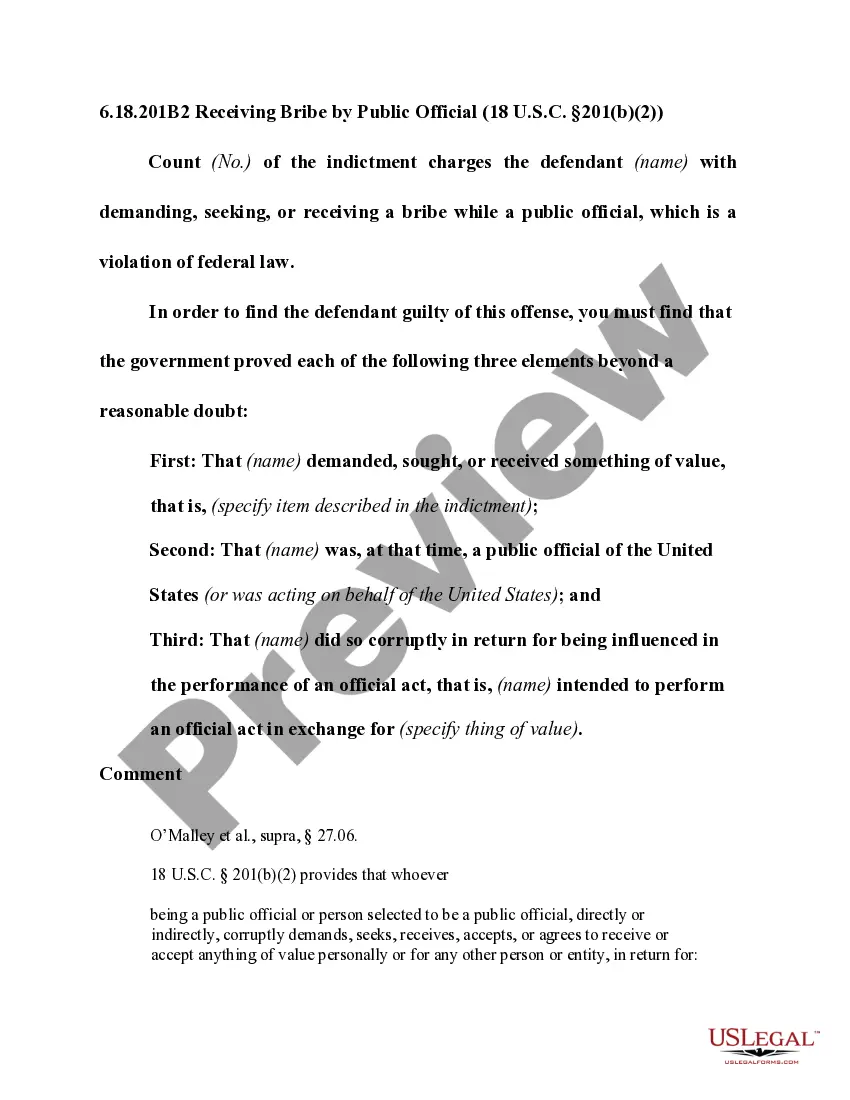
Receiving Bribe by Public Official (18 U.S.C. Sec.201(b)(2))
What is this form?
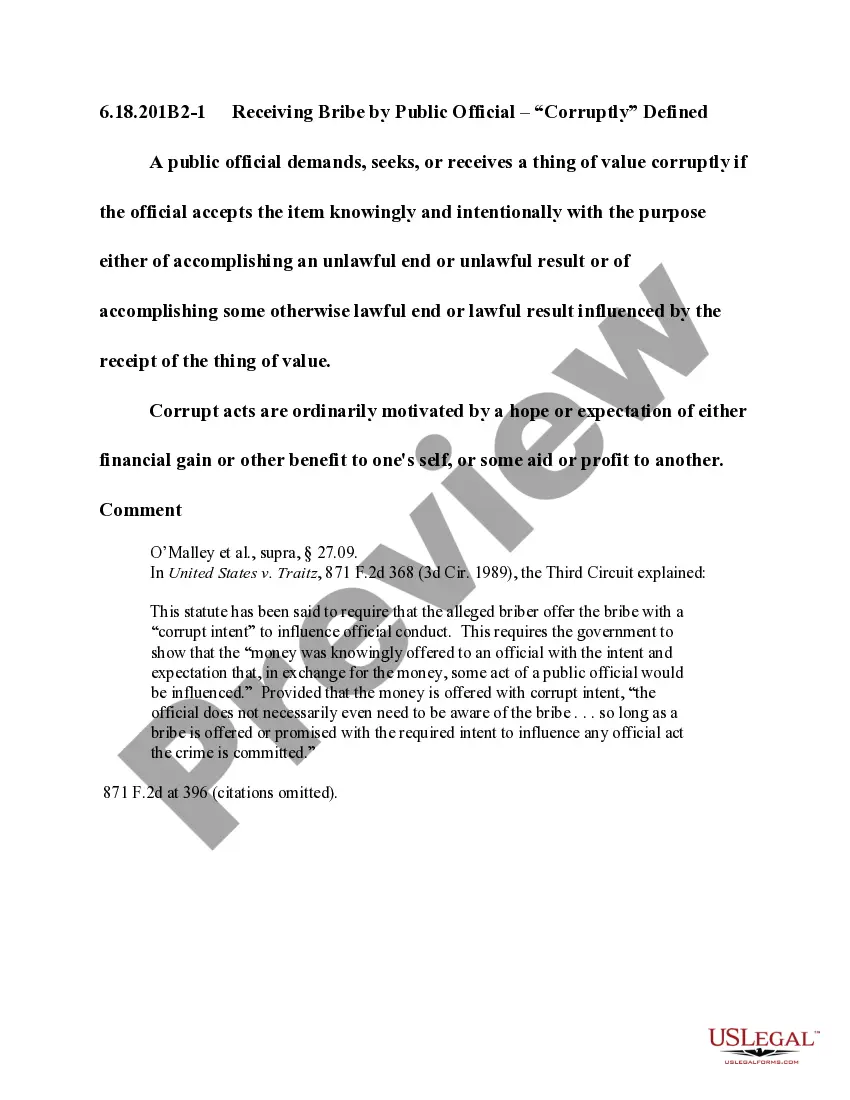
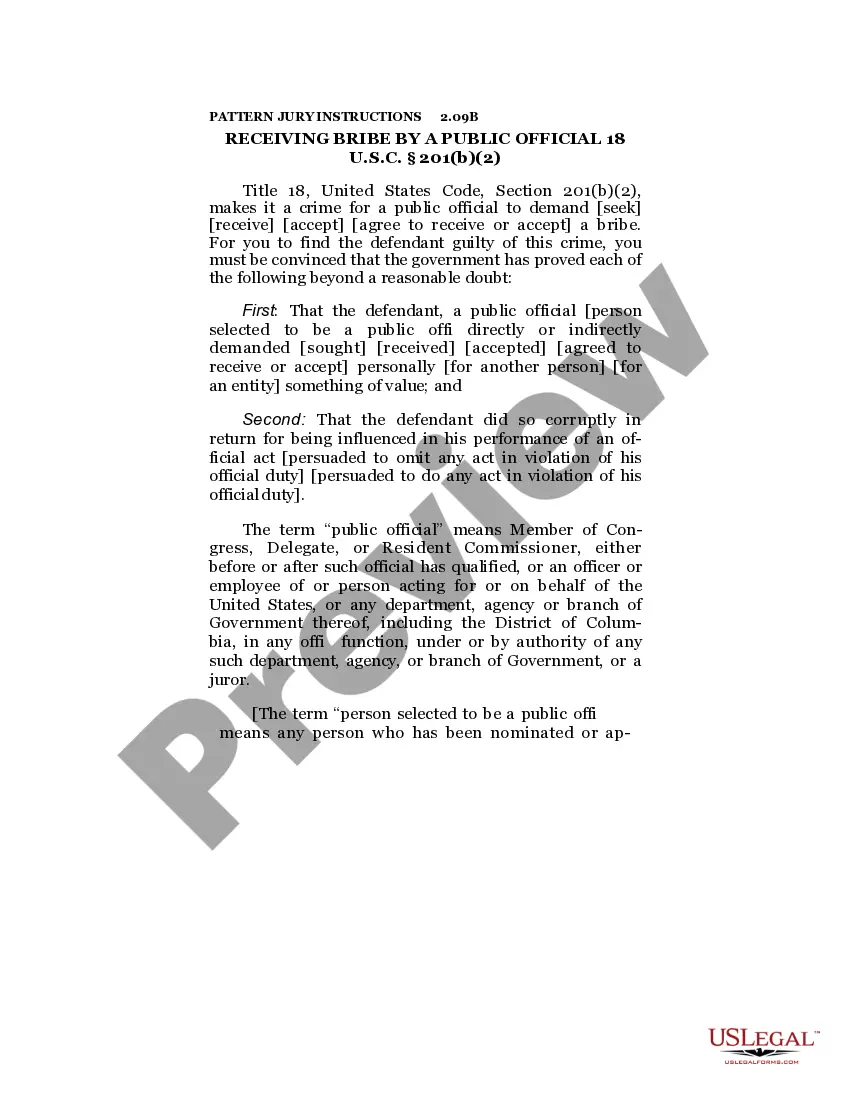
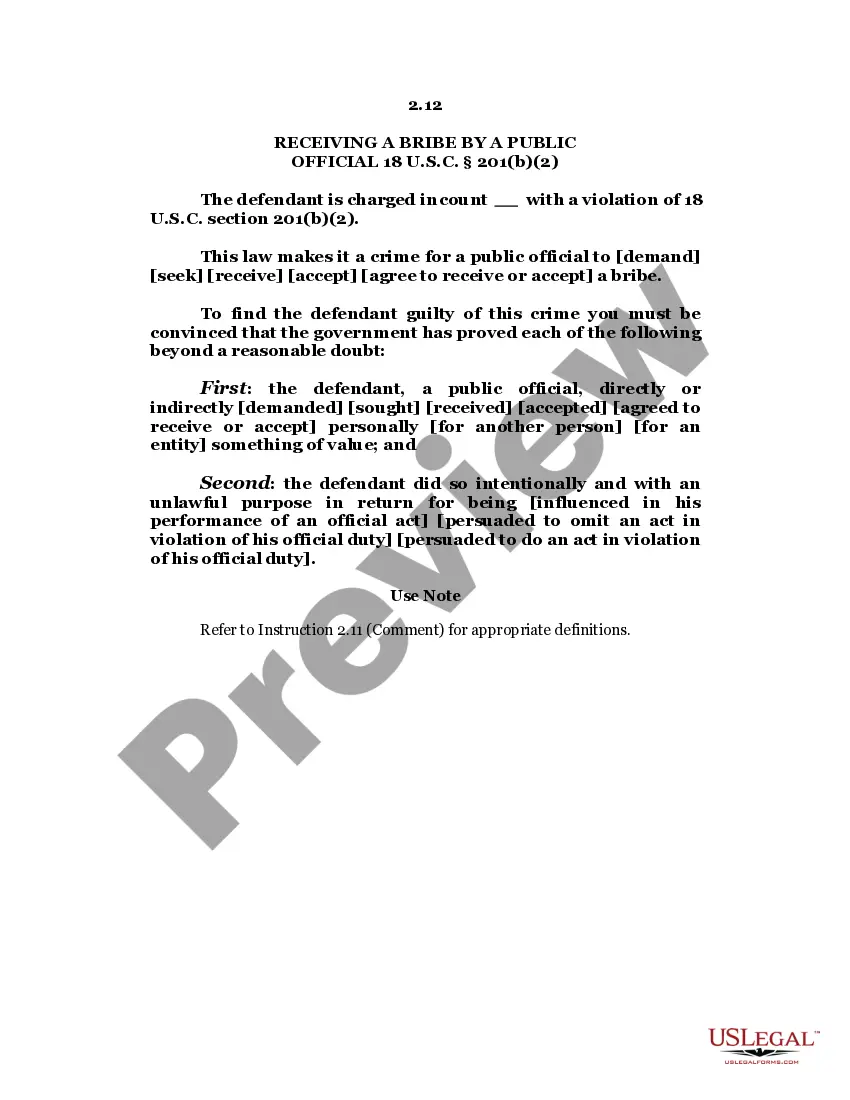
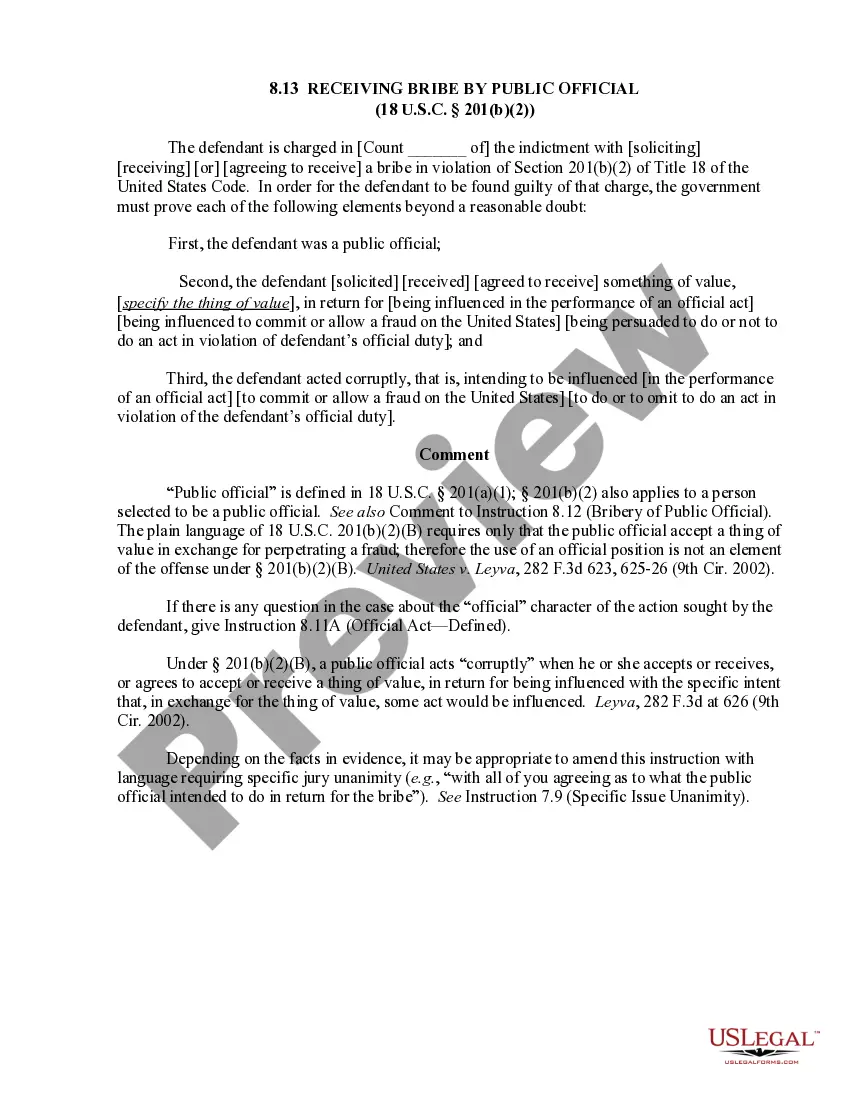
The Receiving Bribe by Public Official form (18 U.S.C. Sec. 201(b)(2)) is a legal document that outlines the federal offense of a public official demanding, seeking, or receiving a bribe. This formal accusation is relevant for cases involving public officials who accept bribes in exchange for influence over official acts. This form is crucial for understanding the specific legal criteria that constitute this offense, distinguishing it from other bribery-related forms.
Form components explained
- The indictment counts against the defendant for demanding or receiving something of value.
- Identification of the defendant as a public official at the time of the offense.
- Corrupt intent behind the action, including the specific act the bribe was meant to influence.
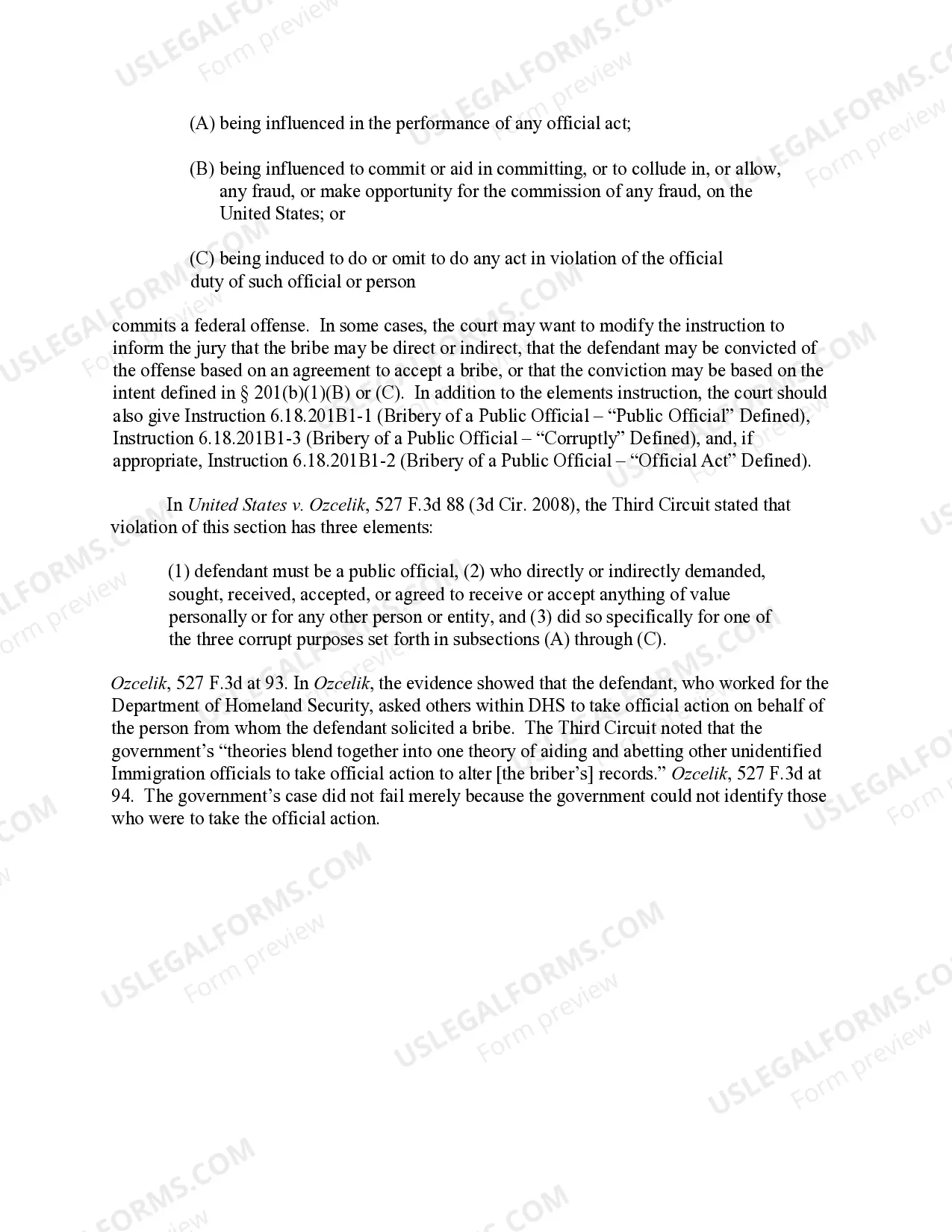
- Legal definitions of key terms, such as "public official" and "official act."
- Instructions related to the burden of proof and the elements needed for conviction.
Situations where this form applies
This form should be used when a public official has been accused of receiving a bribe. It is applicable in legal contexts where formal charges are brought against public officials under federal law. Situations may include government investigations, grand jury proceedings, or formal court indictments. It is essential to ensure that the legal elements of the crime are clearly stated and properly documented.
Who can use this document
- Legal professionals involved in prosecuting bribery cases.
- Federal prosecutors working on indictments against public officials.
- Investigators gathering evidence for bribery allegations.
- Public officials who have been accused and need to understand the legal framework related to their charges.
How to prepare this document
- Identify the defendant by entering their name and relevant details.
- Specify the item or value that was demanded, sought, or received as a bribe.
- Confirm the status of the defendant as a public official at the relevant time.
- Clearly state the intended official act related to the bribe.
- Include any additional evidence or context necessary for the charge.
Is notarization required?
In most cases, this form does not require notarization. However, some jurisdictions or signing circumstances might. US Legal Forms offers online notarization powered by Notarize, accessible 24/7 for a quick, remote process.
Get your form ready online
Our built-in tools help you complete, sign, share, and store your documents in one place.
Make edits, fill in missing information, and update formatting in US Legal Forms—just like you would in MS Word.
Download a copy, print it, send it by email, or mail it via USPS—whatever works best for your next step.
Sign and collect signatures with our SignNow integration. Send to multiple recipients, set reminders, and more. Go Premium to unlock E-Sign.
If this form requires notarization, complete it online through a secure video call—no need to meet a notary in person or wait for an appointment.
We protect your documents and personal data by following strict security and privacy standards.

Make edits, fill in missing information, and update formatting in US Legal Forms—just like you would in MS Word.

Download a copy, print it, send it by email, or mail it via USPS—whatever works best for your next step.

Sign and collect signatures with our SignNow integration. Send to multiple recipients, set reminders, and more. Go Premium to unlock E-Sign.

If this form requires notarization, complete it online through a secure video call—no need to meet a notary in person or wait for an appointment.

We protect your documents and personal data by following strict security and privacy standards.
Common mistakes to avoid
- Failing to accurately identify the defendant's role as a public official.
- Omitting critical details about the bribe or what was exchanged.
- Neglecting to establish the corrupt intent behind the actions described.
Why complete this form online
- Convenient access to legally vetted templates prepared by licensed attorneys.
- Easy editing capabilities to customize the form as needed.
- Reliable guidance on legal requirements, ensuring compliance with federal law.
Legal use & context
- This form is rooted in federal law under 18 U.S.C. Sec. 201(b)(2).
- It is essential for formalizing charges against individuals accused of public corruption.
- Understanding the legal definitions provided is crucial for a successful prosecution.
Summary of main points
- The Receiving Bribe by Public Official form is vital for federal bribery prosecution.
- Understanding the elements required for conviction is essential for legal professionals.
- Accurate and complete information is necessary to support the legal case.
Looking for another form?

Form popularity
FAQ
Section 201(c) prohibits that same public official from accepting the same thing of value, if he does so "for or because of" any official act, and prohibits anyone from giving any such thing to him for such a reason.
The statute requires proof that the defendant intended to influence an official act. ?In other words, for bribery there must be a quid pro quo-a specific intent to give or receive something of value in exchange for an official act.? United States v.
18 U.S. Code § 201 - Bribery of public officials and witnesses.
18 U.S.C. 201 You are prohibited from demanding, seeking, receiving, accepting or agreeing to receive or accept anything of value as a bribe to influence your Government actions or as a gratuity for or because of your Government actions. 18 U.S.C.
However, in the United State, bribery of public officials is a criminal act, for both the person offering the bribe, and for the individual who solicits or accepts a bribe. Bribery generally involves giving some item of value, such as a gift or money, in order to gain influence with the recipient.
Penalties for 18 U.S.C. If convicted of bribery of a public official under 18 U.S.C. 201(b), the penalties include up to 15 years in prison and/or a fine of up to three times the monetary amount of the something of value that you offered to the public official.
Bribery Penalties The penalties for bribery of a public official includes a fine of up to three times the value of the bribe, and imprisonment for up to 15 years in a federal penitentiary. A conviction can also disqualify the individual from holding any office of honor, trust or profit under the United States.
Section 201(b) requires that the offender have acted with the intent (as to the giver of a bribe) to influence or (as to the taker of a bribe) to be influenced. Thus, the bribery statute requires proof of an actual or intended quid pro quo: one thing given in exchange for another.