Credibility of Witnesses — Law Enforcement Officer refers to the level of trustworthiness of sworn testimony by a law enforcement officer in a court of law. This type of witness is typically considered to have a higher degree of credibility than other types of witnesses due to their experience, training, and expertise in the field of law enforcement. The main types of Credibility of Witnesses — Law Enforcement Officer are: 1. Expert Testimony: This type of testimony is based on the witness's knowledge, skill, and expertise in the field of law enforcement. It is often used to explain complex concepts to the jury and provide additional insight into the evidence presented. 2. Lay Testimony: This type of testimony is based on the witness's observations and experiences in the field of law enforcement. It is often used to establish the facts of a case and provide the jury with a firsthand account of what happened. 3. Corroborative Testimony: This type of testimony is based on the witness's ability to provide independent corroboration of other evidence presented. This type of testimony is often used to strengthen the credibility of other witnesses and provide additional insight into the case. Overall, Credibility of Witnesses — Law Enforcement Officer is an important factor in the court of law. It is important that the jury can trust the testimony of a law enforcement officer in order to make the best decisions possible for the case.
Credibility of Witnesses - Law Enforcement Officer
Description

How to fill out Credibility Of Witnesses - Law Enforcement Officer?
How much time and resources do you often spend on drafting formal paperwork? There’s a greater option to get such forms than hiring legal experts or spending hours browsing the web for a suitable blank. US Legal Forms is the premier online library that offers professionally designed and verified state-specific legal documents for any purpose, such as the Credibility of Witnesses - Law Enforcement Officer.
To get and complete a suitable Credibility of Witnesses - Law Enforcement Officer blank, adhere to these easy steps:
- Look through the form content to make sure it complies with your state laws. To do so, read the form description or take advantage of the Preview option.
- If your legal template doesn’t meet your requirements, locate another one using the search bar at the top of the page.
- If you already have an account with us, log in and download the Credibility of Witnesses - Law Enforcement Officer. Otherwise, proceed to the next steps.
- Click Buy now once you find the right blank. Choose the subscription plan that suits you best to access our library’s full opportunities.
- Sign up for an account and pay for your subscription. You can make a transaction with your credit card or through PayPal - our service is absolutely secure for that.
- Download your Credibility of Witnesses - Law Enforcement Officer on your device and complete it on a printed-out hard copy or electronically.
Another advantage of our service is that you can access previously acquired documents that you securely keep in your profile in the My Forms tab. Obtain them at any moment and re-complete your paperwork as often as you need.
Save time and effort completing official paperwork with US Legal Forms, one of the most trusted web solutions. Sign up for us today!
Form popularity
FAQ
A credible witness is a witness who comes across as competent and worthy of belief. Their testimony is assumed to be more than likely true due to their experience, knowledge, training, and sense of honesty. The judge and jurors will use these factors to determine whether they believe the witness is credible.
Admitting misstatements as soon as possible and correcting them builds credibility with the jury and can avoid having those misstatements magnified by opposing counsel later on in your testimony.
The judge or jury must determine in every case with respect to every witness whether the witness is credible in his or her testimony.
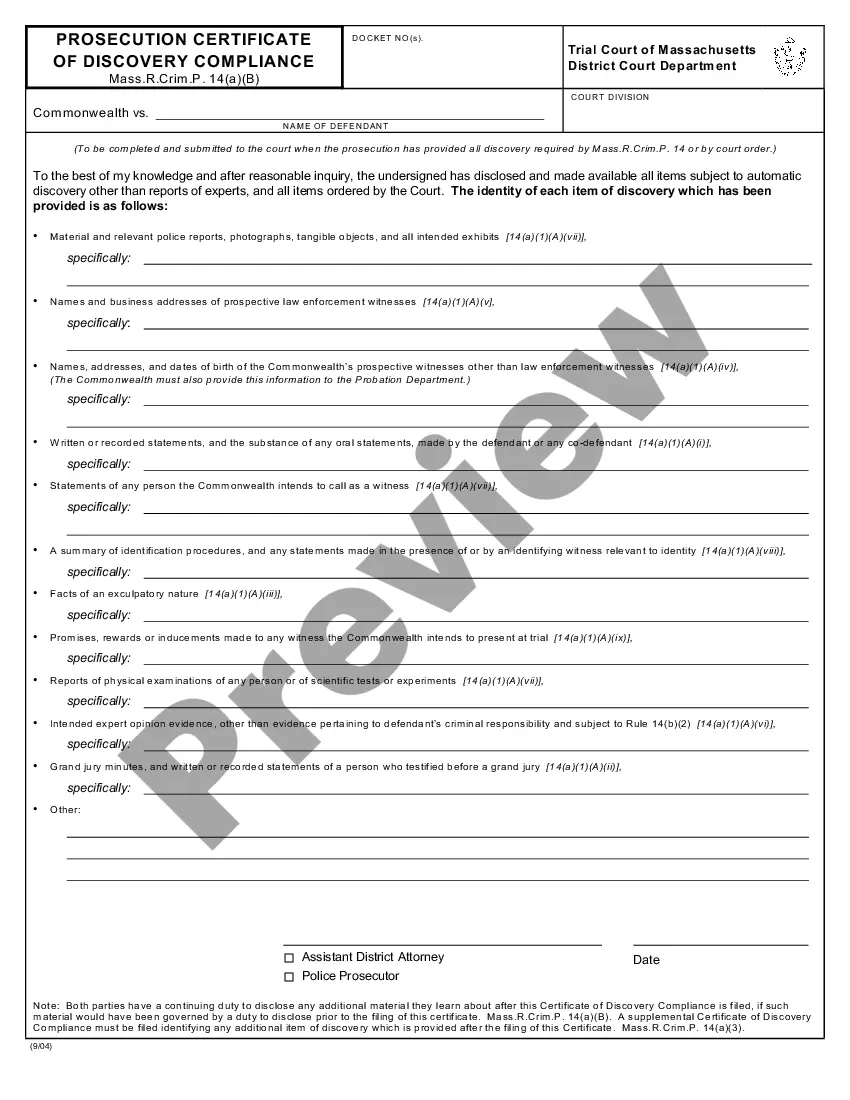
In Brady v. Maryland, the United States Supreme Court held that prosecutors must provide exculpatory information to defense counsel, and in Giglio v. United States, it extended the holding to include information suggesting a witness may not be credible.
As a practical matter, there are four factors critical to assessing wit- ness credibility: demeanor, consis- tency, chronology, and past history and motivations. How a witness presents himself or herself can be invaluable when judg- ing the truth of conflicting stories and contradictory versions of events.
There is no law on judging credibility. Judges and jurors receive guidelines and elementary observations in the form of stock instructions but are essentially free to decide for themselves. Because the entire trial process rests on persuasion,determining credibility is more than evaluating testimony.
The way that a witness comes off, their personality, the consistency of their statements, their background, if they have a criminal past, their connection to the case, and more can all go into what makes up a trustworthy witness or one who is suspect.
WHAT FACTORS DETERMINE A CREDIBLE WITNESS? Trustworthiness. The first issue with a witness is whether or not they are telling the truth.Conflict of Interest. Another issue for witness credibility is if they have anything to gain from a particular slant of testimony.Honesty.Personal Background Issues.