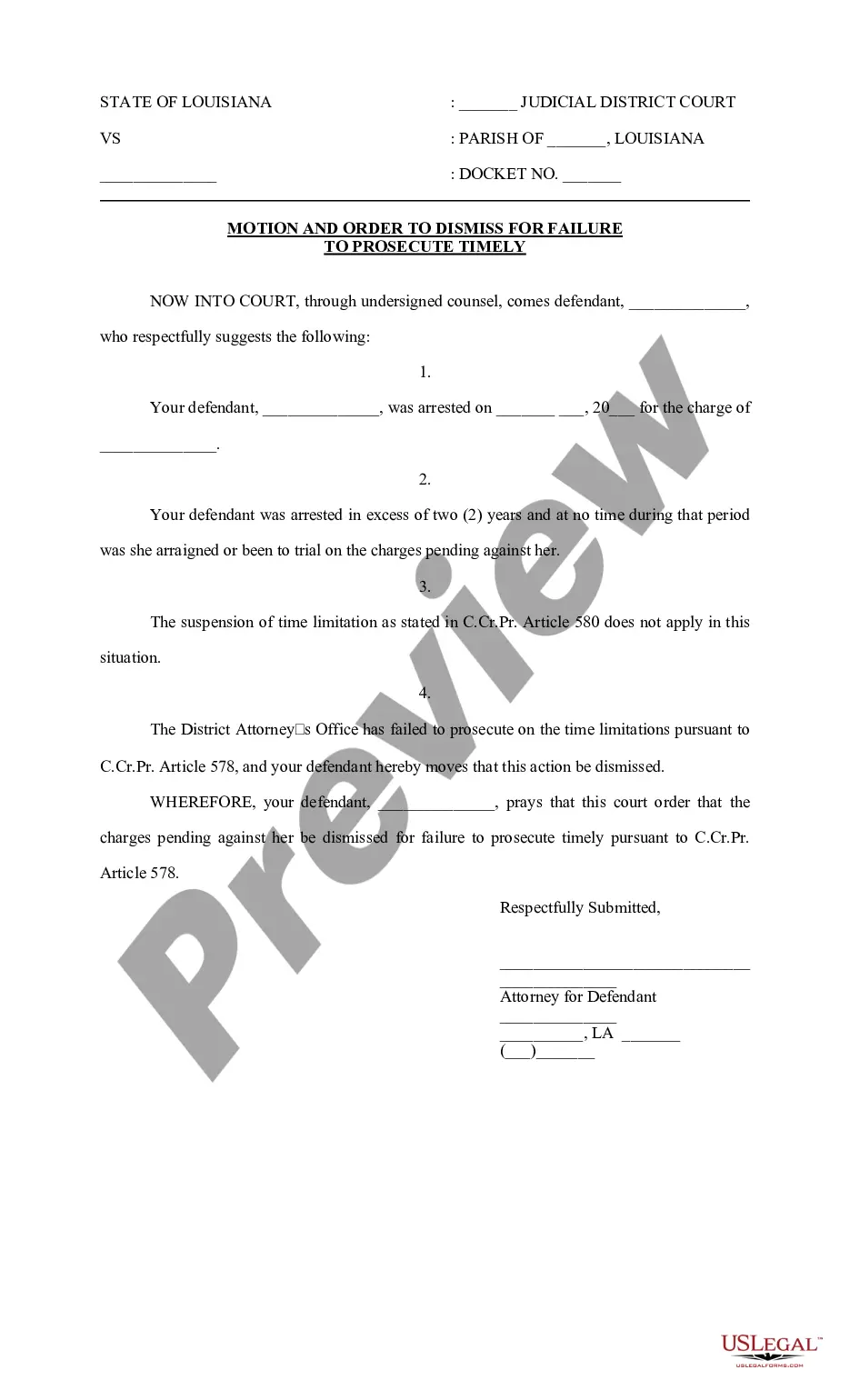
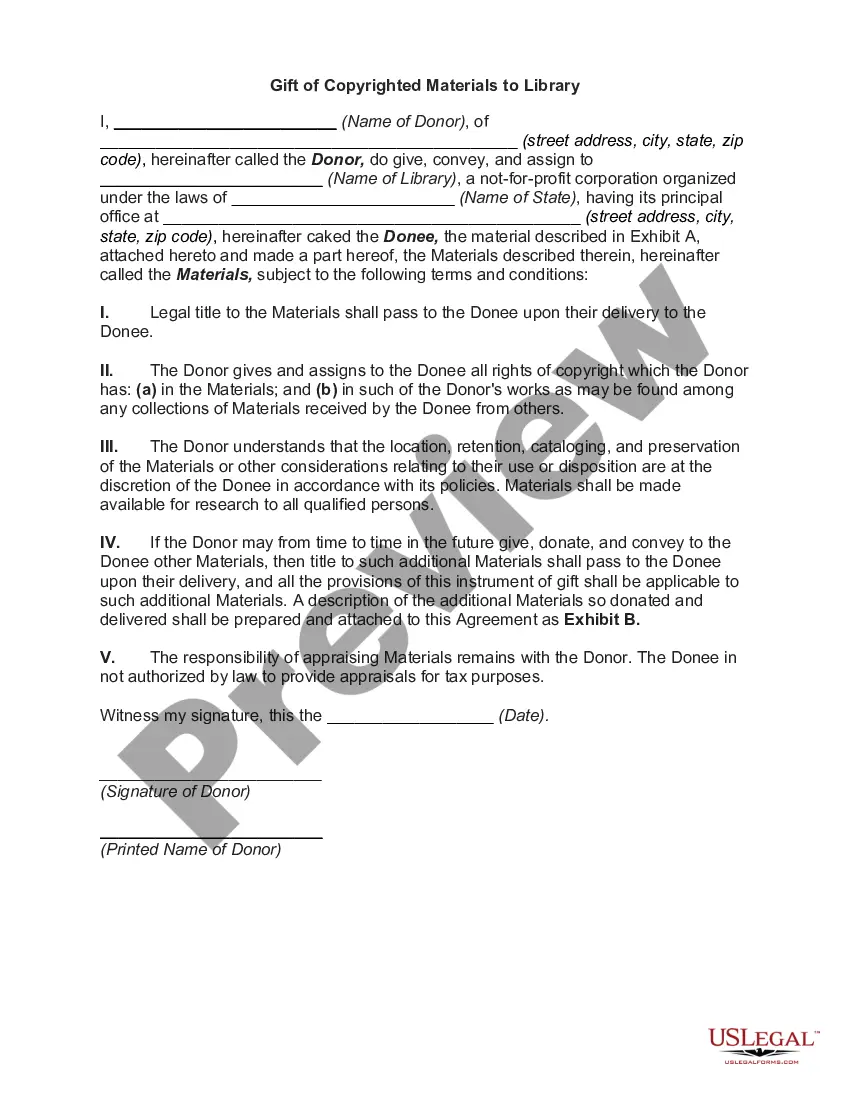
Gift of Copyrighted Materials to Library
Understanding this form
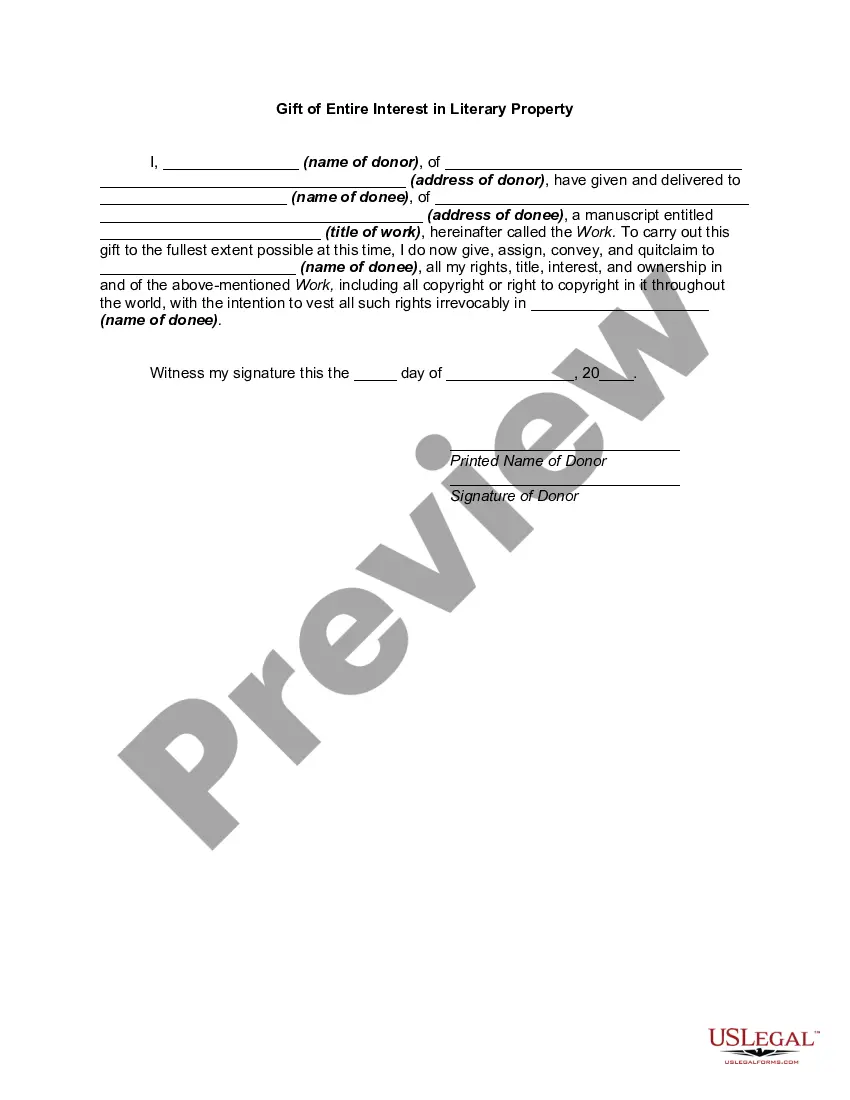
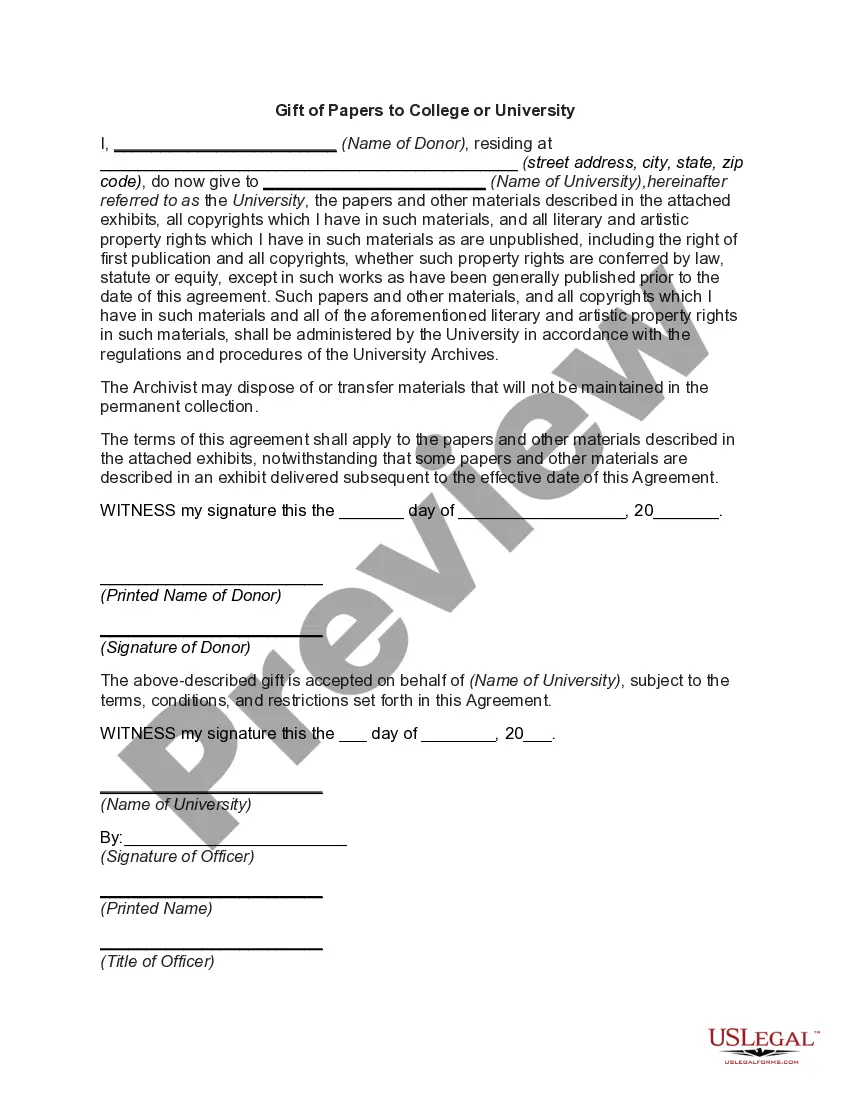
The Gift of Copyrighted Materials to Library form is a legal document that allows an individual, known as the donor, to gift copyrighted materials to a library, known as the donee. This document ensures that the transfer of copyright ownership is clear, establishing the donor's intent to donate specific materials while outlining the terms and conditions of the gift. This form differs from other donation agreements as it specifically pertains to copyrighted materials, ensuring the rights of use and retention are addressed effectively.
Main sections of this form
- Name and contact information of the donor.
- Name and address of the library receiving the materials.
- Description of the copyrighted materials attached as Exhibit A.
- Terms regarding the passage of legal title upon delivery.
- Conditions related to the use and preservation of the materials by the library.
- Signature and dating fields for both the donor and the library representative.
Situations where this form applies
This form should be used when an individual intends to donate copyrighted materials to a library. It is suitable in circumstances where the donor wishes to clarify the terms of the donation, including the rights of copyright and how the materials may be used or preserved. Using this form can help prevent misunderstandings and ensure compliance with legal requirements for transferring ownership of intellectual property.
Who can use this document
This form is intended for:
- Individuals or entities possessing copyrighted materials that wish to donate them to a library.
- Donors who want to ensure clear legal title transfer and outline specific conditions of their donation.
- Libraries receiving such donations, to formalize the acceptance and terms of the gift.
How to complete this form
- Identify the parties involved by entering the names and addresses of the donor and the library.
- Clearly describe the copyrighted materials in the attached Exhibit A.
- Specify any terms and conditions related to the receipt and use of the materials.
- Sign and date the form to finalize the donation agreement.
- Ensure a library representative also signs the form to validate acceptance of the gift.
Notarization requirements for this form
This form does not typically require notarization unless specified by local law. It is advisable to check local regulations to confirm any additional notarization requirements for the donation of copyrighted materials to a library.
Get your form ready online
Our built-in tools help you complete, sign, share, and store your documents in one place.
Make edits, fill in missing information, and update formatting in US Legal Forms—just like you would in MS Word.
Download a copy, print it, send it by email, or mail it via USPS—whatever works best for your next step.
Sign and collect signatures with our SignNow integration. Send to multiple recipients, set reminders, and more. Go Premium to unlock E-Sign.
If this form requires notarization, complete it online through a secure video call—no need to meet a notary in person or wait for an appointment.
We protect your documents and personal data by following strict security and privacy standards.

Make edits, fill in missing information, and update formatting in US Legal Forms—just like you would in MS Word.

Download a copy, print it, send it by email, or mail it via USPS—whatever works best for your next step.

Sign and collect signatures with our SignNow integration. Send to multiple recipients, set reminders, and more. Go Premium to unlock E-Sign.

If this form requires notarization, complete it online through a secure video call—no need to meet a notary in person or wait for an appointment.

We protect your documents and personal data by following strict security and privacy standards.
Typical mistakes to avoid
- Failing to adequately describe the materials in Exhibit A.
- Not including specific terms or conditions that the donor wishes to impose on the use of the materials.
- Leaving out signatures or dates, making the form legally ineffective.
Benefits of completing this form online
- Convenient access to the form allows for easy completion and download.
- Editable fields can be filled out digitally, ensuring clarity and accuracy.
- Reliance on forms drafted by licensed attorneys provides assurance of legal validity.
Looking for another form?
Form popularity
FAQ
Under the fair use doctrine of the U.S. copyright statute, it is permissible to use limited portions of a work including quotes, for purposes such as commentary, criticism, news reporting, and scholarly reports.
As long as the library has no actual knowledge of infringing material on its system and no awareness of facts or circumstances through which infringing activity is apparent, it can shield itself from liability by registering a copyright agent with the US Copyright Office.
A. The first sale doctrine (section 109a) of the Copyright Act) allows owners of a legal copy of a tangible (physical) work to resell, rent, lend, or give away that copy without the copyright owner's permission. This explicitly permits libraries to lend books from their collections.
Without it, libraries would be unable to loan books, preserve content, and exercise fair use. Libraries have a privileged position in the law with individual exceptions that apply only to non-profit libraries and archives.
Title 17, section 108 of the U.S. Code permits libraries and archives to use copyrighted material in specific ways without permission from the copyright holder.
As part of the Library of Congress since 1870, and recognized by Congress as a separate department of the Library since 1897, the Copyright Office registers copyright claims, records information about copyright ownership, provides information to the public, and assists Congress and other parts of the government on a
Congress enacted section 108 of title 17 in 1976, authorizing libraries and archives to reproduce and distribute certain copyrighted works without permission on a limited basis for the purposes of preservation, replacement, and research.
Librarians must apply their particular facts to the law to determine when and whether permission is needed to use copyright materials. They must make judgment calls (especially with principles such as fair use) and be confident copyright decision makers.