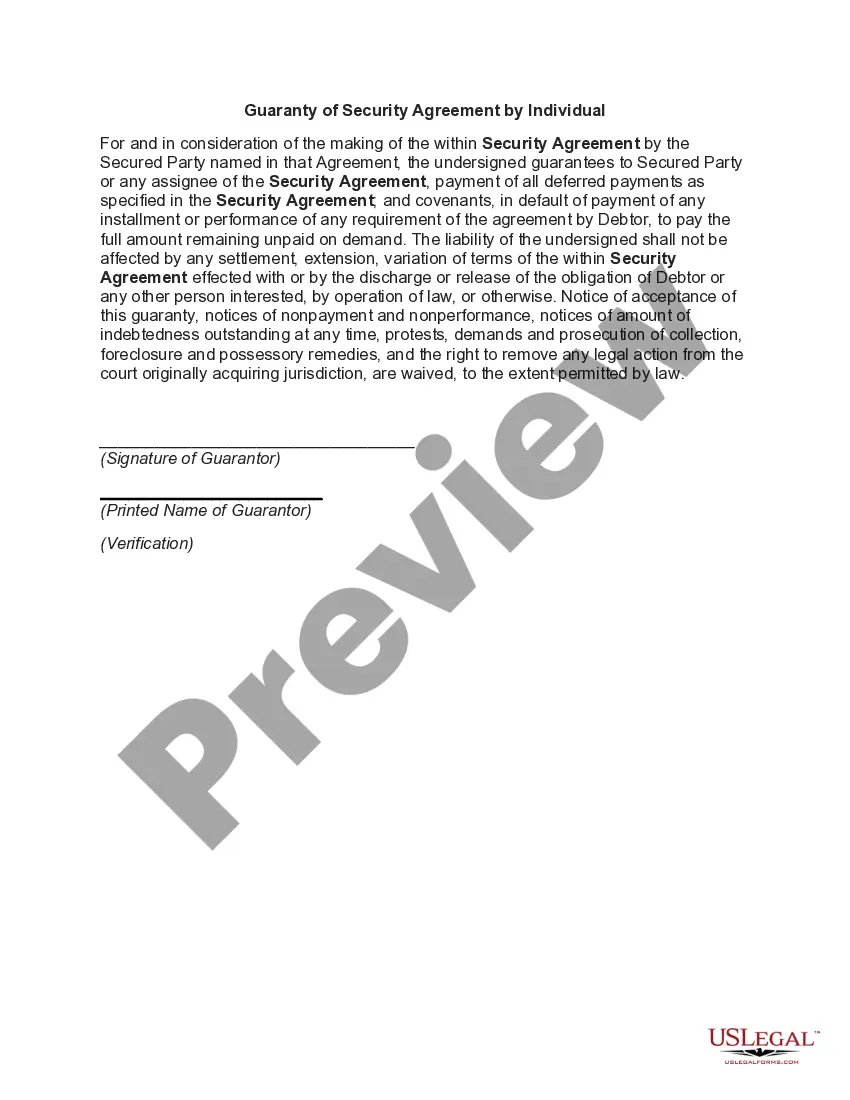
Guaranty of Security Agreement by Individual
Overview of this form
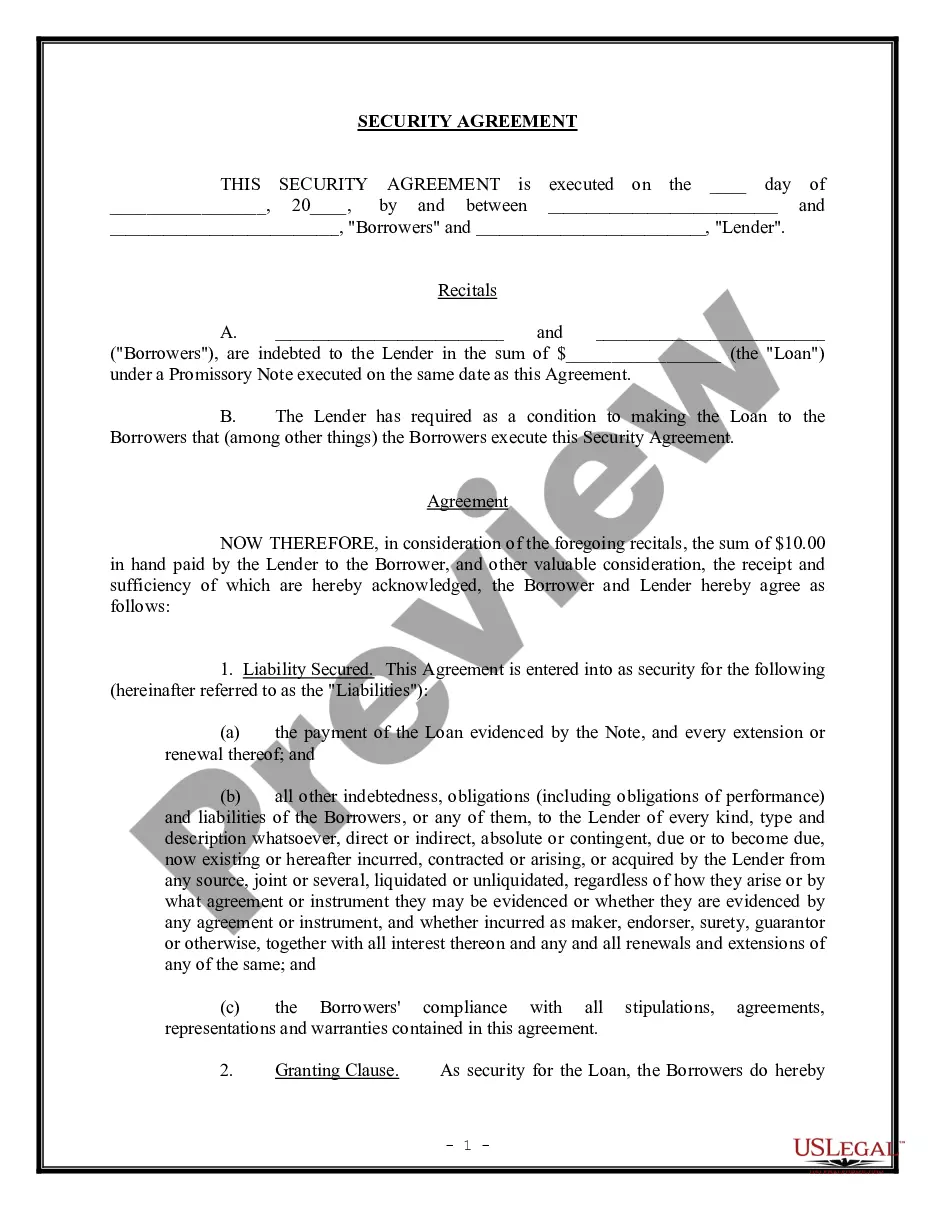
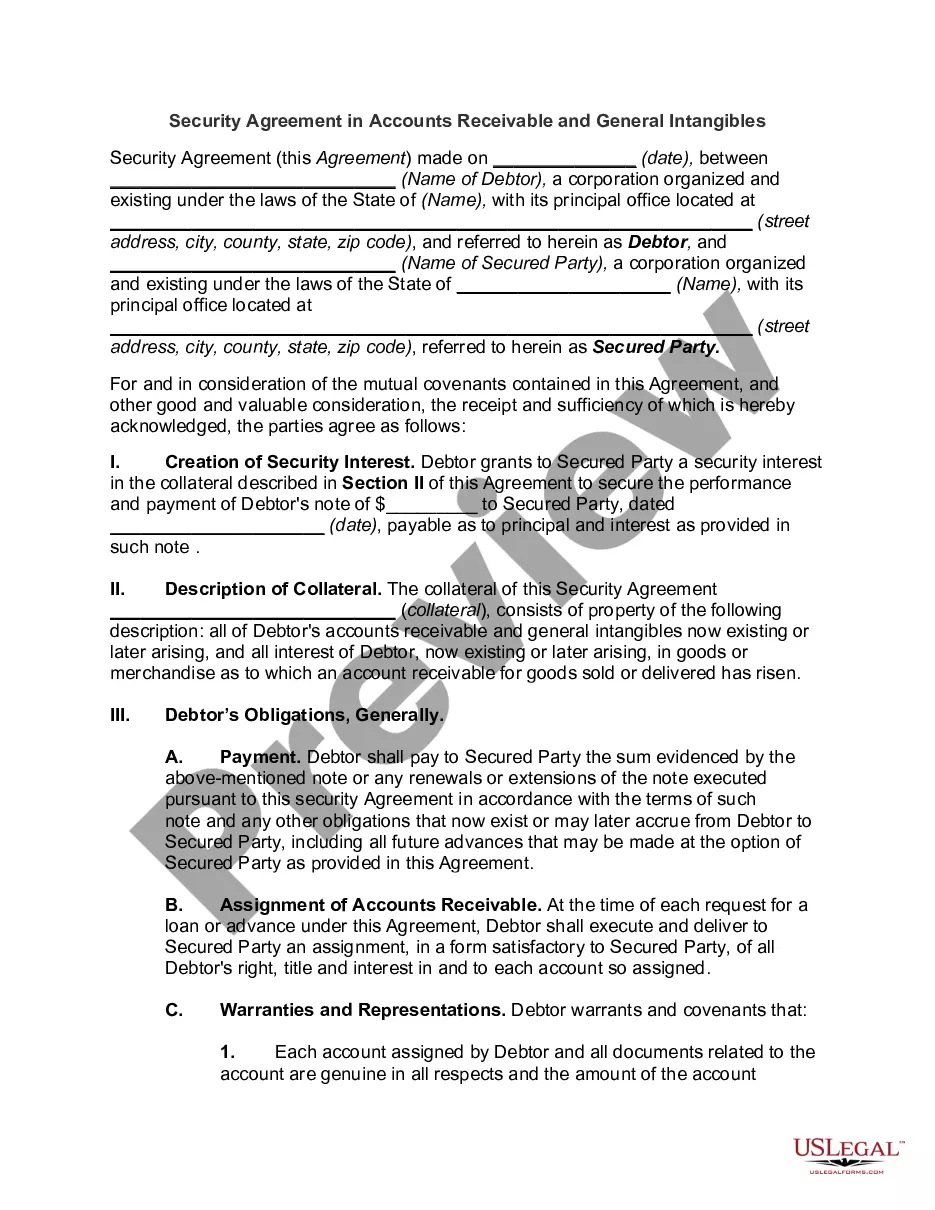
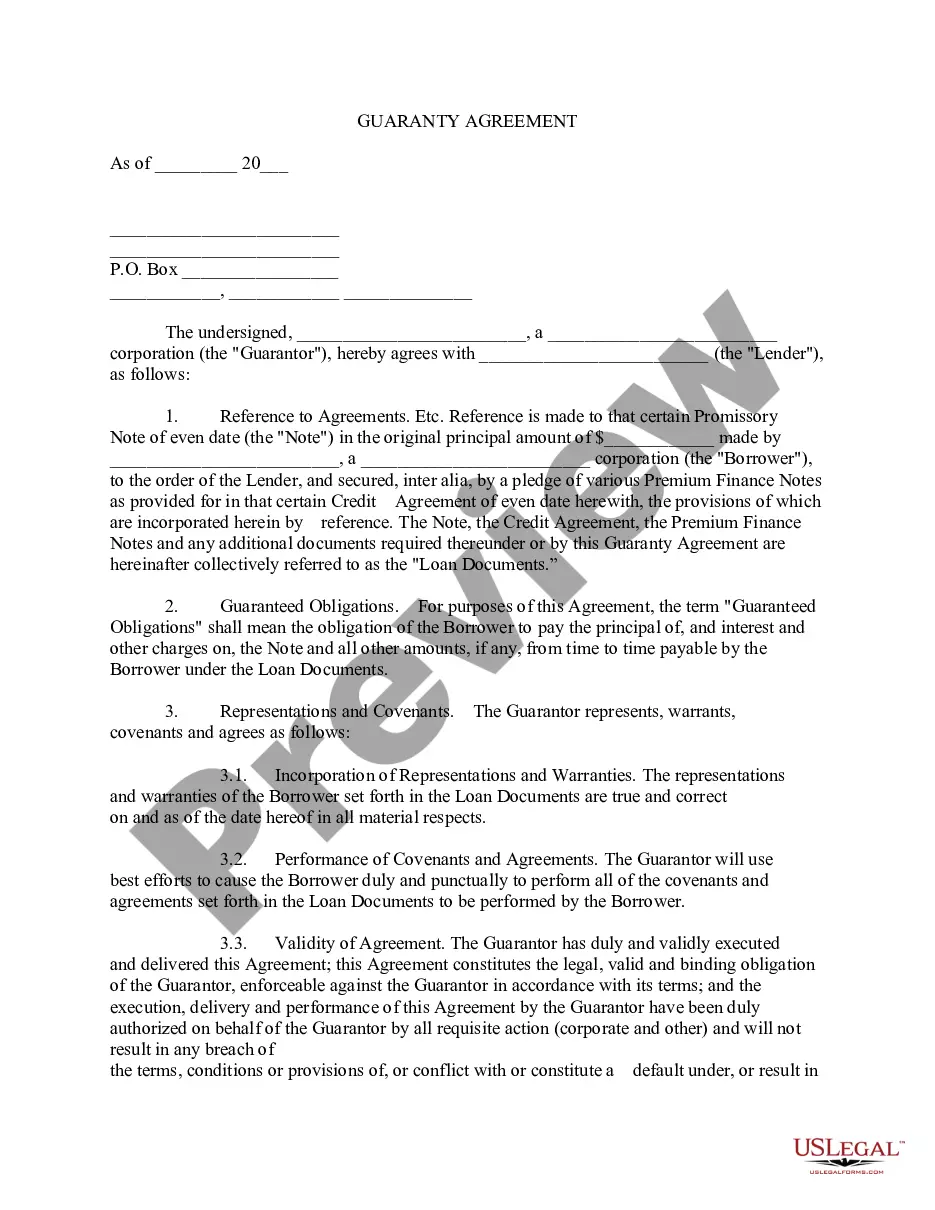
The Guaranty of Security Agreement by Individual is a legal document in which an individual (the guarantor) agrees to take responsibility for the payment of a debt or fulfillment of duties outlined in a security agreement if the primary debtor fails to do so. This form is essential for establishing an additional layer of security for creditors, ensuring they can collect due payments from the guarantor if necessary. Unlike other legal agreements, this specific guaranty emphasizes the unconditional responsibility of the guarantor, even in the event of any changes to the terms of the original security agreement.
Form components explained
- Identification of the parties involved: This includes the secured party and the guarantor.
- Terms of the security agreement: Specifies the original debt or duty that the guarantor is agreeing to cover.
- Guarantee clause: States the guarantorâs obligation to pay the full amount due upon the debtor's default.
- Waivers: Includes waivers of notices regarding nonpayment, protests, and other legal proceedings.
- Signature of the guarantor: A signed acknowledgment of responsibility by the individual providing the guaranty.
When to use this form
This form is typically used when an individual is asked to guarantee a debt or obligation under a security agreement, such as a loan or lease. Situations may include personal loans, vehicle financing, or any instance where a creditor requires assurance that they can collect payment from someone other than the primary debtor. It can be beneficial when dealing with arrangements involving substantial financial commitments where the creditor seeks additional security in case of nonpayment.
Who this form is for
- Individuals acting as guarantors for loans or credit agreements.
- Creditors seeking assurance of payment from a third party.
- Businesses needing to secure transactions with personal guarantees.
How to prepare this document
- Identify the secured party and the guarantor by entering their names and relevant details.
- Review the security agreement to specify the terms of the debt or obligation being guaranteed.
- Include the specific amounts and conditions concerning the payments that the guarantor agrees to cover.
- Read through the waivers and clauses to understand the implications of your agreement.
- Sign and date the form to validate your acceptance of the guaranty.
Does this form need to be notarized?
This form does not typically require notarization unless specified by local law. However, having the guaranty notarized can enhance its legal standing and establish authenticity, making it advisable if there are significant sums involved.
Get your form ready online
Our built-in tools help you complete, sign, share, and store your documents in one place.
Make edits, fill in missing information, and update formatting in US Legal Forms—just like you would in MS Word.
Download a copy, print it, send it by email, or mail it via USPS—whatever works best for your next step.
Sign and collect signatures with our SignNow integration. Send to multiple recipients, set reminders, and more. Go Premium to unlock E-Sign.
If this form requires notarization, complete it online through a secure video call—no need to meet a notary in person or wait for an appointment.
We protect your documents and personal data by following strict security and privacy standards.

Make edits, fill in missing information, and update formatting in US Legal Forms—just like you would in MS Word.

Download a copy, print it, send it by email, or mail it via USPS—whatever works best for your next step.

Sign and collect signatures with our SignNow integration. Send to multiple recipients, set reminders, and more. Go Premium to unlock E-Sign.

If this form requires notarization, complete it online through a secure video call—no need to meet a notary in person or wait for an appointment.

We protect your documents and personal data by following strict security and privacy standards.
Avoid these common issues
- Failing to review the terms of the underlying security agreement before signing.
- Not providing accurate information about the parties involved.
- Overlooking the waiver clauses, which may significantly impact your rights.
- Neglecting to sign and date the form appropriately.
Benefits of using this form online
- Convenient access and immediate downloads, allowing for quick completion.
- Editability ensures you can customize the form as per your specific needs.
- Reliability of legal form templates drafted by licensed attorneys, minimizing errors.
Legal use & context
The Guaranty of Security Agreement is enforceable in a court of law, provided it is executed properly. The guarantor must fully understand the obligations being accepted, as this agreement binds them to pay the debt or fulfill the obligations outlined if the debtor defaults. Legal limitations may apply depending on specific circumstances or local laws, so it is important to seek legal advice if there are questions regarding the enforceability of this form.
Main things to remember
- The Guaranty of Security Agreement protects creditors by ensuring additional avenues for debt recovery.
- Individuals should fully understand their obligations before signing as guarantors.
- Consultation with a legal professional can provide clarity and ensure compliance with state laws.
Looking for another form?
Form popularity
FAQ
Guarantee is both a verb and a noun. Guaranty is a spelling variant for the noun, used in certain legal contexts. I can guarantee that Vicky will be back here within the week. What guarantee (or guaranty) can you offer to the other parties?
A personal guaranty is unenforceable without adequate consideration. In fact, no contract is enforceable without adequate consideration. A personal guaranty is a type of contract. A contract is an enforceable promise.
A personal guarantee is a provision a lender puts in a business loan agreement that requires owners to be personally responsible for their company's debt in case of default. Lenders often ask for personal guarantees because they have concerns over the credit history, age or financial stability of your business.
A personal guarantee is an agreement between a business owner and lender, stating that the individual who signs is responsible for paying back a loan should the business ever be unable to make payments. There are a number of scenarios when a personal guarantee would be used, for example: Business loans.
A personal guarantee is a provision a lender puts in a business loan agreement that requires owners to be personally responsible for their company's debt in case of default. Lenders often ask for personal guarantees because they have concerns over the credit history, age or financial stability of your business.
If CLIENT is a corporation, LLC, partnership, or other artificial entity, the undersigned person hereby personally and unconditionally guarantees punctual payment by CLIENT as required by this Agreement.
A continuing guaranty is a guarantee by one party in a contract providing goods or services to another party. A guarantor company may also use a continuing guaranty. The contract states that if one party fails to fulfill their part of the agreement, they will provide compensation for that failure.
Guarantee can refer to the agreement itself as a noun, and the act of making the agreement as a verb. Guaranty is a specific type of guarantee that is only used as a noun.