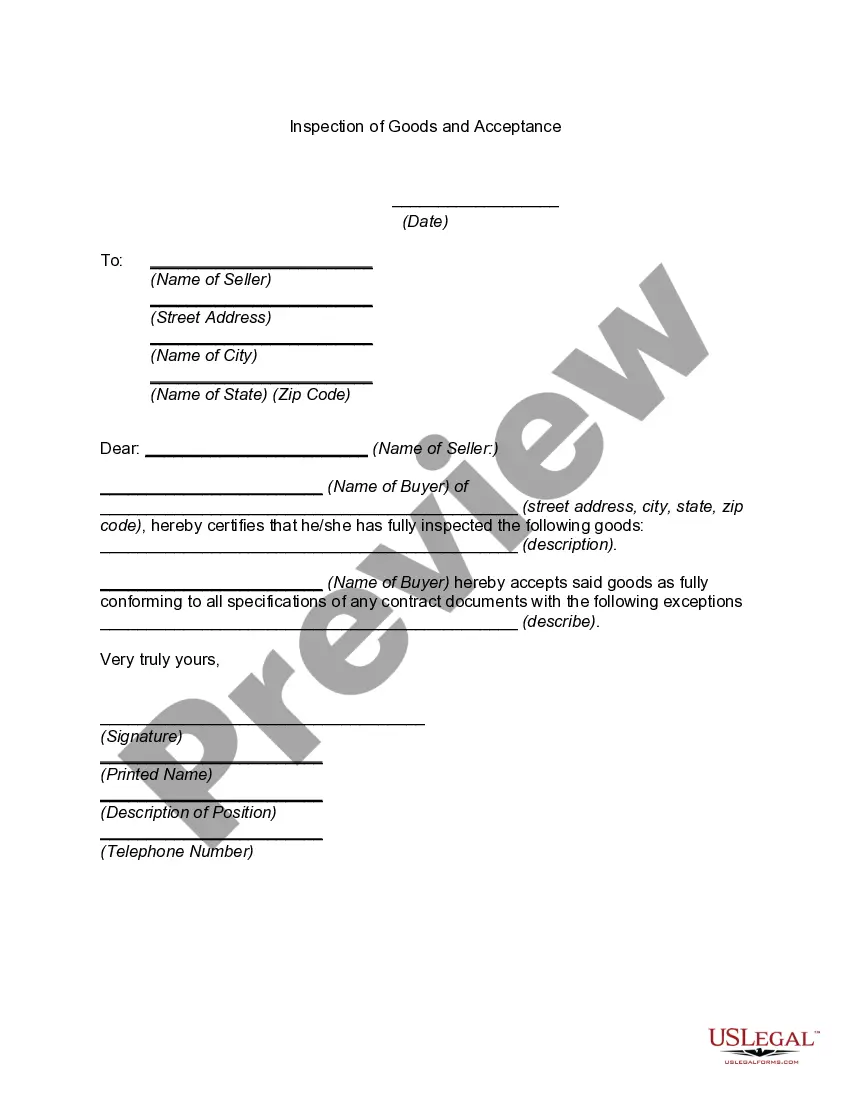
Inspection of Goods and Acceptance
Understanding this form
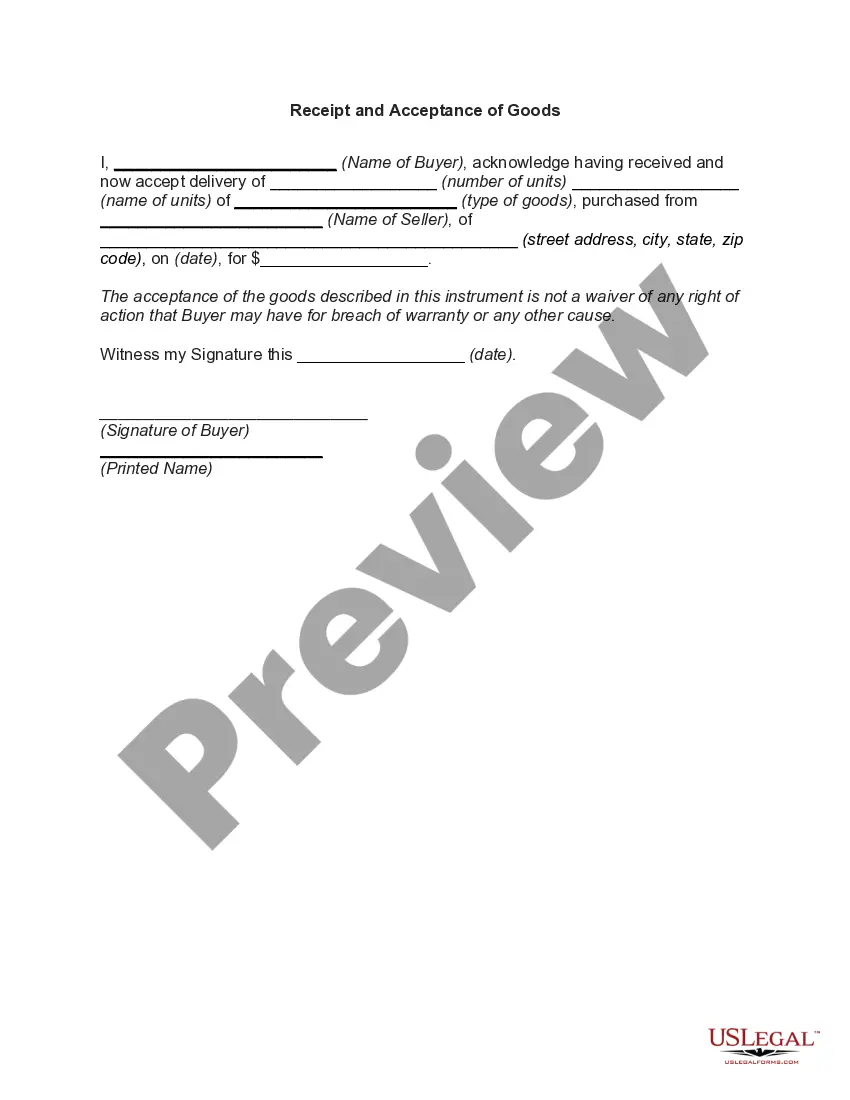
The Inspection of Goods and Acceptance form is a legal document used to confirm that a buyer has inspected goods prior to acceptance. This form serves to document the buyer's approval of the goods, indicating any discrepancies from the specifications outlined in the contract. It is essential for protecting both the buyer and seller by providing clear evidence of acceptance and any conditions or exceptions that apply.
Key parts of this document
- Date of inspection.
- Name and address of the seller.
- Name and address of the buyer.
- Description of the inspected goods.
- Signature, printed name, position, and contact information of the buyer.
When to use this document
This form is necessary in situations where a buyer needs to formally acknowledge the acceptance of goods after inspecting them. Use this form when you have received goods from a seller and want to ensure that both parties are aware of the condition of the goods, including any exceptions or discrepancies from the contract specifications.
Intended users of this form
This form is suitable for:
- Businesses purchasing goods from suppliers.
- Individuals buying items in large quantities or through formal contracts.
- Any buyer wishing to document the acceptance of goods while noting exceptions.
Completing this form step by step
- Enter the date of the inspection at the top of the form.
- Fill in the seller's name and address in the specified fields.
- Include the buyer's name and complete address in the designated section.
- Describe the goods being inspected clearly.
- List any exceptions to the acceptance of the goods, if applicable.
- Sign the form, and print your name, title, and provide your contact information.
Does this form need to be notarized?
This form does not typically require notarization unless specified by local law.
Get your form ready online
Our built-in tools help you complete, sign, share, and store your documents in one place.
Make edits, fill in missing information, and update formatting in US Legal Forms—just like you would in MS Word.
Download a copy, print it, send it by email, or mail it via USPS—whatever works best for your next step.
Sign and collect signatures with our SignNow integration. Send to multiple recipients, set reminders, and more. Go Premium to unlock E-Sign.
If this form requires notarization, complete it online through a secure video call—no need to meet a notary in person or wait for an appointment.
We protect your documents and personal data by following strict security and privacy standards.

Make edits, fill in missing information, and update formatting in US Legal Forms—just like you would in MS Word.

Download a copy, print it, send it by email, or mail it via USPS—whatever works best for your next step.

Sign and collect signatures with our SignNow integration. Send to multiple recipients, set reminders, and more. Go Premium to unlock E-Sign.

If this form requires notarization, complete it online through a secure video call—no need to meet a notary in person or wait for an appointment.

We protect your documents and personal data by following strict security and privacy standards.
Common mistakes
- Not providing a detailed description of the goods.
- Failing to list exceptions during the inspection.
- Leaving the form unsigned or not including a printed name.
Benefits of using this form online
- Quick and easy access to the form for immediate use.
- Edit and customize the form to fit specific needs without hassle.
- Reliable and secure way to document acceptance and inspect goods.
What to keep in mind
- The Inspection of Goods and Acceptance form is vital for documenting the acceptance of goods.
- It helps establish a clear agreement between buyer and seller regarding the condition of goods.
- Accurate completion of this form protects both parties in case of disputes.
Looking for another form?
Form popularity
FAQ
Under California law, the seller has an affirmative duty to report any defects and the buyer does not have to ask about the conditions on the property to learn of such defects. Whether a defect is considered material depends on the characteristics of the property and the statements made by the buyer to the seller.
The UCC helps promote uniformity among state laws, which is often useful in commercial sales as goods are frequently purchased and shipped across state lines. The UCC often comes into play when addressingbreach of contractand related civil litigation rising from the sale of goods.
Generally, the seller's primary obligations are to transfer ownership of the goods and deliver the goods. A seller may agree with the buyer to perform other obligations. For instance, a seller may agree to package or label the goods in a certain way or service the goods for a specific period of time.
U.C.C. § 2-205 provides: An offer by a merchant to buy or sell goods in a signed writing which by its. terms gives assurance that it will be held open is not revocable, for lack of. consideration, during the time stated or if no time is stated for a reasonable.
Under the UCC, a seller's primary obligation is "tender of delivery." In other words, delivering the goods to the buyer.In other cases, it may mean that the seller holds the goods where the buyer can take possession of them. Often the manner in which the goods are to be tendered is specified in the sales contract.
Under the law, acceptance occurs when: 1) after a reasonable opportunity to inspect the goods the Buyer signifies to the Seller that the goods are conforming or that the goods will be retained in spite of any non-conformity; or 2) after a reasonable opportunity to inspect the goods the Buyer fails to make an
Under the UCC, a seller can accept a buyer's offer to purchase goods for prompt or current shipment in 1 of 3 ways.shipping nonconforming goods - seller can also accept the buyer's offer by shipping nonconforming goods.
What is the UCC Definition of Goods? Generally speaking, the UCC and its guidelines applies to all contracts involving the sale of goods. Under the UCC, goods are defined as all things (including specially manufactured goods) which are movable at the time of identification to the contract for sale.
Typically a Right of Inspection document provides directors with a nearly absolute right to inspect corporate documents, and gives members or shareholders a wide but more limited right to inspect documents, and may require them to provide a proper reason before being allowed access.