Amendment to Oil and Gas Lease to Extend Primary Term
What this document covers
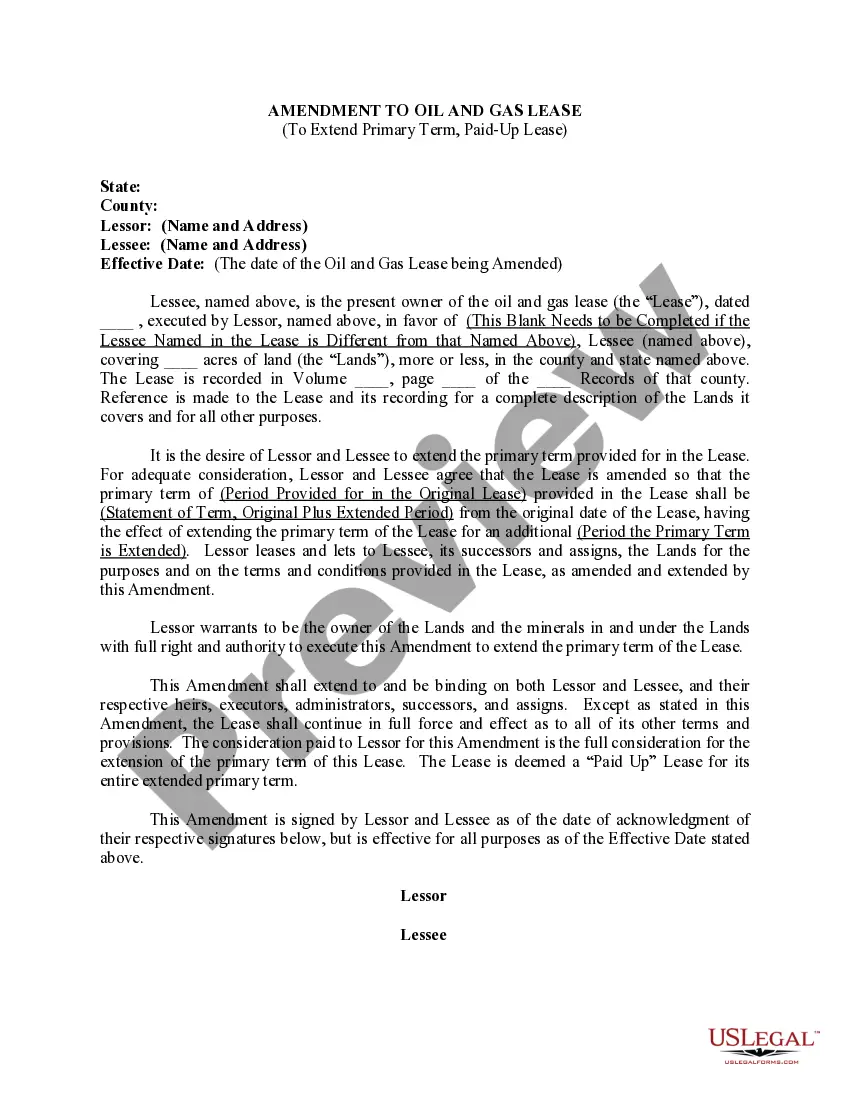
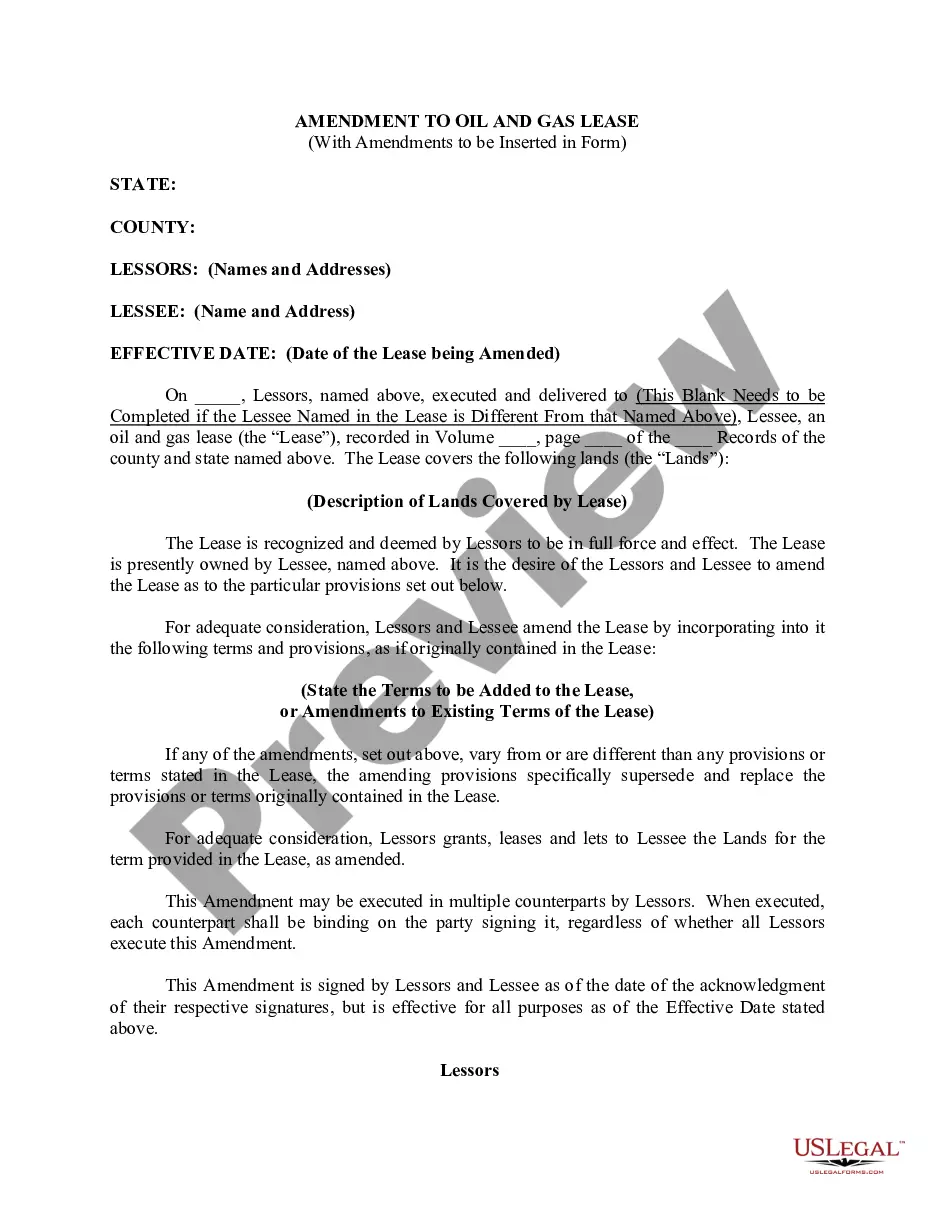
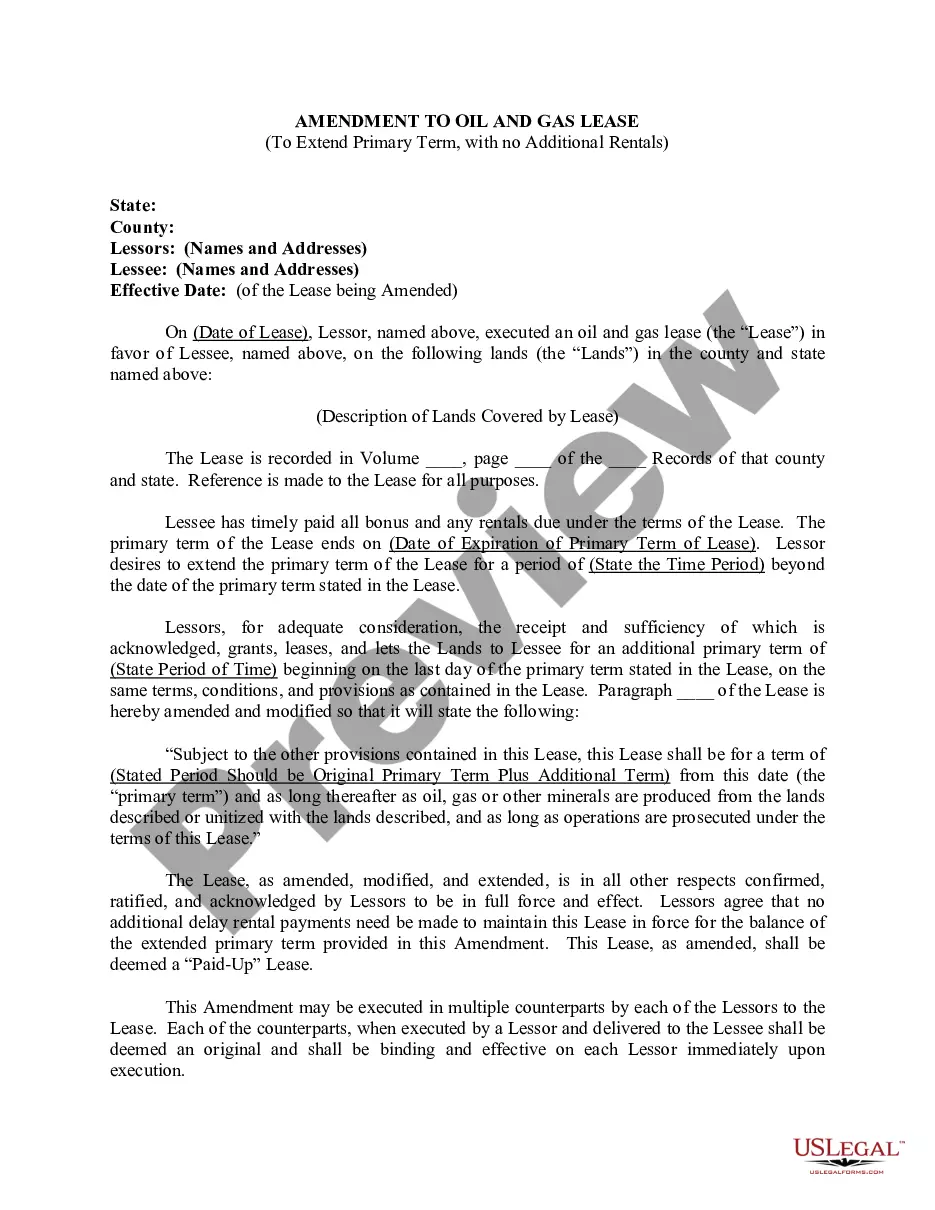
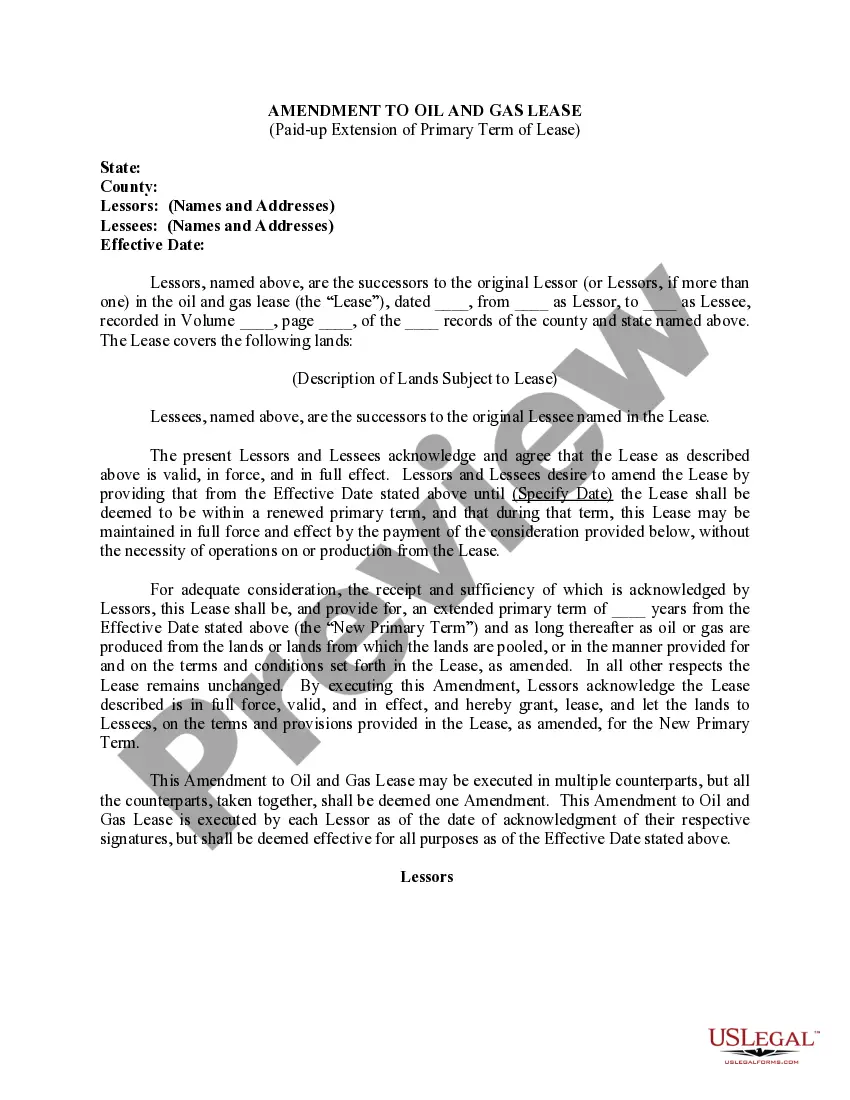
The Amendment to Oil and Gas Lease to Extend Primary Term is a legal document used to modify an existing oil and gas lease. This amendment allows the lessee to extend the primary term of the lease without needing to create a new agreement. This form is essential when the lease is set to expire, and both parties wish to maintain the terms of the original lease while ensuring that operations can start later, if desired.
Key parts of this document
- Information about the lessor and lessee, including name and address.
- The effective date of the original oil and gas lease being amended.
- Details regarding the property covered by the lease, including acreage and location.
- Provisions for extending the primary term of the lease.
- A statement confirming the lessee's ownership and rights to amend the lease.
- Signatures of the lessor and lessee to validate the amendment.
When this form is needed
This form should be used when an existing oil and gas lease is nearing its expiration, and the lessee wants to prolong the lease period without starting operations immediately. This situation often arises when parties agree to maintain the terms of the original lease and wish to avoid the complexities of negotiating a new agreement.
Who should use this form
- Lessee seeking to extend the term of an oil and gas lease.
- Lessor who agrees to amend the lease terms and wants to ensure legal compliance.
- Both parties involved in an oil and gas lease looking for a cost-effective solution to prolong their existing agreement.
Instructions for completing this form
- Identify and enter the names and addresses of the lessor and lessee.
- Specify the effective date of the original lease that is being amended.
- Provide details of the property involved, including the number of acres.
- Detail the extended primary term in conjunction with the original lease dates.
- Ensure both parties sign the amendment, noting the effective date of the change.
Does this document require notarization?
Notarization is required for this form to take effect. Our online notarization service, powered by Notarize, lets you verify and sign documents remotely through an encrypted video session, available 24/7.
Get your form ready online
Our built-in tools help you complete, sign, share, and store your documents in one place.
Make edits, fill in missing information, and update formatting in US Legal Forms—just like you would in MS Word.
Download a copy, print it, send it by email, or mail it via USPS—whatever works best for your next step.
Sign and collect signatures with our SignNow integration. Send to multiple recipients, set reminders, and more. Go Premium to unlock E-Sign.
If this form requires notarization, complete it online through a secure video call—no need to meet a notary in person or wait for an appointment.
We protect your documents and personal data by following strict security and privacy standards.

Make edits, fill in missing information, and update formatting in US Legal Forms—just like you would in MS Word.

Download a copy, print it, send it by email, or mail it via USPS—whatever works best for your next step.

Sign and collect signatures with our SignNow integration. Send to multiple recipients, set reminders, and more. Go Premium to unlock E-Sign.

If this form requires notarization, complete it online through a secure video call—no need to meet a notary in person or wait for an appointment.

We protect your documents and personal data by following strict security and privacy standards.
Typical mistakes to avoid
- Failing to include the effective date of the original lease.
- Not specifying the correct acreage or property details.
- Omitting signatures from one or both parties.
- Neglecting to properly outline the terms of the lease extension.
Benefits of completing this form online
- Access to professionally drafted legal language tailored for your needs.
- Convenience of downloading and filling out the form from home.
- Editability allows customization to specific circumstances.
- Quick access without needing to schedule in-person meetings with attorneys.
Legal use & context
- This form legally amends the terms of an existing oil and gas lease.
- Both parties must agree to the amendment for it to take effect.
- It is enforceable in court if properly executed according to state laws.
What to keep in mind
- The Amendment to Oil and Gas Lease helps extend lease terms effectively.
- Both lessor and lessee must agree to the changes outlined in the amendment.
- Careful completion is crucial to avoid common mistakes that can invalidate the amendment.
Looking for another form?
Form popularity
FAQ
(Oil & Gas) This form is a memorandum of lease that summarizes an oil and gas lease without disclosing confidential information contained in the lease itself. It is filed in the county in which the leased property is located to put third parties on notice that a lease exists.
Oil & gas royalties are paid monthly, consistent with the normal accounting cycle of the producer, unless the obligation does not meet the minimum check requirement for that particular state. These laws are generally known as aggregate pay laws, usually set at either $25 or $100.
For many years, almost all oil and gas leases reserved a 1/8th royalty. Today, the royalty fraction is negotiable, and is usually between 1/8th and 1/4th. Bonus. The bonus is the amount paid to the Lessor as consideration for his/her execution of the lease.
Not necessarily. Where your royalty is based on volume of production and your lease is for a period of years and as much longer as oil and gas is produced, or similar language is contained in your lease, your lease may not automatically expire at the end of its primary term.
A royalty is the portion of production the landowner receives. A royalty clause in the oil or gas title process will typically give a percentage of the lease that the company pays to the owner of the mineral rights, minus production costs. Royalties are free from costs and charges, other than taxes.
Consideration paid to the lessor by a lessee to extend the terms of an oil and gas lease in the absence of operations and/or production that is contractually required to hold the lease.
Delay Rental is another type of Rental payment. Within the lease, a Delay Rental is a yearly payment made to the lessor by the lessee during the primary term of the lease to compensate for drilling that is going to be delayed.
Whenever oil or gas production begins, the landowner is entitled to part of the total production. A royalty is agreed upon as a percentage of the lease, minus what was reasonably used in the Lessee's production costs. The royalty is paid by the Lessee to the owner of the mineral rights, the Lessor in the Lease.
In the event oil and gas were found and the wells produce, then the royalties kick in. So if the oil well produce 100 barrels a day, and the price of oil is $80 per barrel that month, then the cash flow is 100x$80 = $8,000/day The royalty owner, who agreed to 15% royalty, would receive $8,000 x 0.15 = $1,200/day.