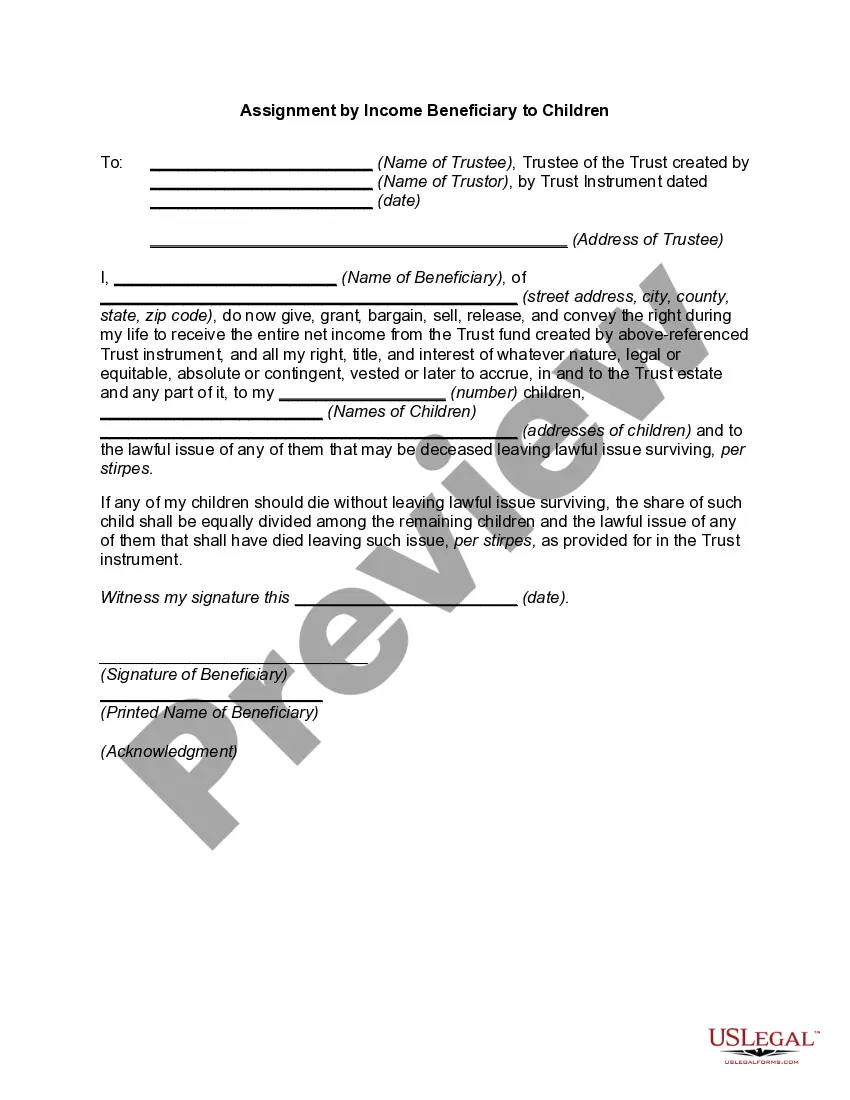
Assignment by Income Beneficiary to Children
What this document covers
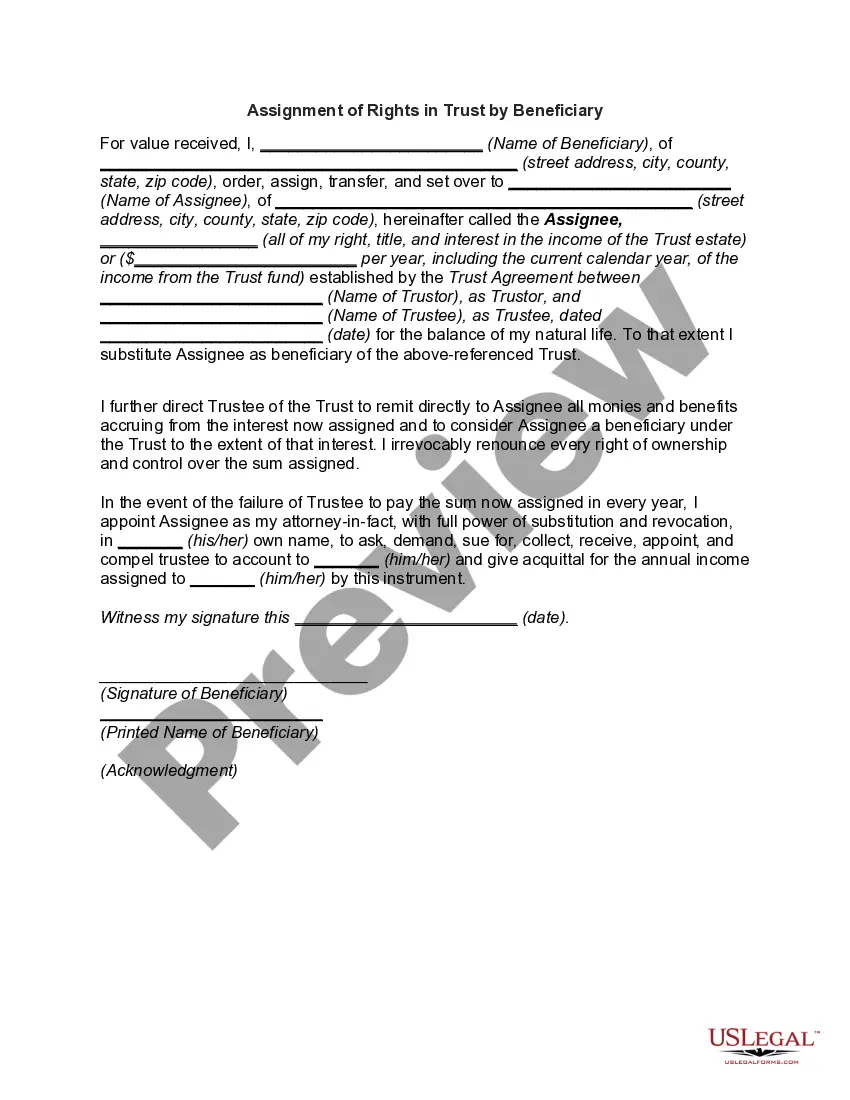
The Assignment by Income Beneficiary to Children is a legal document that allows a beneficiary of a trust to transfer their right to receive income generated by the trust to their children. This form specifies the terms of the transfer, distinguishing it from other trust-related forms by focusing solely on the assignment of income rights rather than the entire trust estate. This form is crucial for ensuring that beneficiaries clearly express their intent and distribution preferences to their heirs.
Form components explained
- Name and contact information of the trustee.
- Name of the trust and trustor, along with the date of the trust instrument.
- The name of the beneficiary intending to make the assignment.
- Details of the children receiving the transfer, including their names and addresses.
- Instructions on how to handle shares if a child passes away without lawful issue.
- Signature block for the beneficiary and space for the date of signing.

When this form is needed
This form is used when a beneficiary decides to assign their right to receive income from a trust to their children. Common scenarios include instances where the beneficiary wants to ensure financial support for their children or wishes to establish an equitable distribution of trust income while they are still alive. It may also be useful in estate planning to clarify expectations and avoid disputes about income distribution among heirs.
Who should use this form
- Beneficiaries of a trust who wish to transfer their income rights to their children.
- Parents planning for the financial security of their children through trust income.
- Individuals engaged in estate planning who want to clearly outline income distribution preferences.
How to complete this form
- Identify and enter the name of the trustee and the trust instrument details.
- Provide the beneficiary's full name and contact information.
- List the names and addresses of all children receiving the assigned income rights.
- Be sure to specify how shares will be distributed in case any child passes away.
- Sign and date the document to validate the assignment.
Is notarization required?
This form does not typically require notarization to be legally valid. However, some jurisdictions or document types may still require it. US Legal Forms provides secure online notarization powered by Notarize, available 24/7 for added convenience.
Get your form ready online
Our built-in tools help you complete, sign, share, and store your documents in one place.
Make edits, fill in missing information, and update formatting in US Legal Forms—just like you would in MS Word.
Download a copy, print it, send it by email, or mail it via USPS—whatever works best for your next step.
Sign and collect signatures with our SignNow integration. Send to multiple recipients, set reminders, and more. Go Premium to unlock E-Sign.
If this form requires notarization, complete it online through a secure video call—no need to meet a notary in person or wait for an appointment.
We protect your documents and personal data by following strict security and privacy standards.

Make edits, fill in missing information, and update formatting in US Legal Forms—just like you would in MS Word.

Download a copy, print it, send it by email, or mail it via USPS—whatever works best for your next step.

Sign and collect signatures with our SignNow integration. Send to multiple recipients, set reminders, and more. Go Premium to unlock E-Sign.

If this form requires notarization, complete it online through a secure video call—no need to meet a notary in person or wait for an appointment.

We protect your documents and personal data by following strict security and privacy standards.
Avoid these common issues
- Failing to provide complete names and addresses of the trustee and children.
- Not specifying distribution instructions clearly if a child dies.
- Leaving out the date of signing, which can invalidate the document.
Advantages of online completion
- Convenience: Complete and download forms from the comfort of your home.
- Editability: Customize the form to meet your specific needs before finalizing.
- Reliability: Access templates drafted by licensed attorneys to ensure legal compliance.
Looking for another form?
Form popularity
FAQ
You can, but it's not recommended because a minor can't legally receive a life insurance payout. Should your beneficiary be your spouse or your child? You should designate a legal adult as your beneficiary. Most people name their spouse, partner, or a trust to ensure that the funds are used appropriately.
Income beneficiary:? can only receive income generated by the trust, not the principal. Principal beneficiary: must wait to receive income from the trust until the income beneficiary interest ends (such as death or a specific period of time).
Set up a trust One of the easiest ways to shield your assets is to pass them to your child through a trust. The trust can be created today if you want to give money to your child now, or it can be created in your will and go into effect after you are gone.
It's perfectly fine to name a minor?that is, a child younger than 18 years old?as a POD payee. If the account is worth more than a few thousand dollars, however, you will probably want to arrange for an adult to manage the money in case the beneficiary is still a child at your death.
Income beneficiary includes someone who receives payments from (1) a pooled income fund, (2) a charitable remainder annuity trust, or (3) a charitable remainder unitrust. Return to Life Cycle of a Private Foundation.
When you purchase a life insurance policy, you can choose your child or children when you're asked to name beneficiaries who can receive the payout when you pass away.
Yes, minor children can be life insurance beneficiaries. In fact, policyowners can choose any person or entity to be the beneficiary of their life insurance policy ? their spouse, children, siblings, parents, friends or even a trust, a company, an estate or a charity.
Most life insurance policies will not allow you to directly leave money to beneficiaries who are minors. If you name a minor as a beneficiary, they will have to settle the matter in probate court. In which an adult will be delegated to manage the money until the minor is old enough to be responsible for it themselves.