Covenant Not to Sue by Husband and Wife for Accidental Injuries
Description
Key Concepts & Definitions
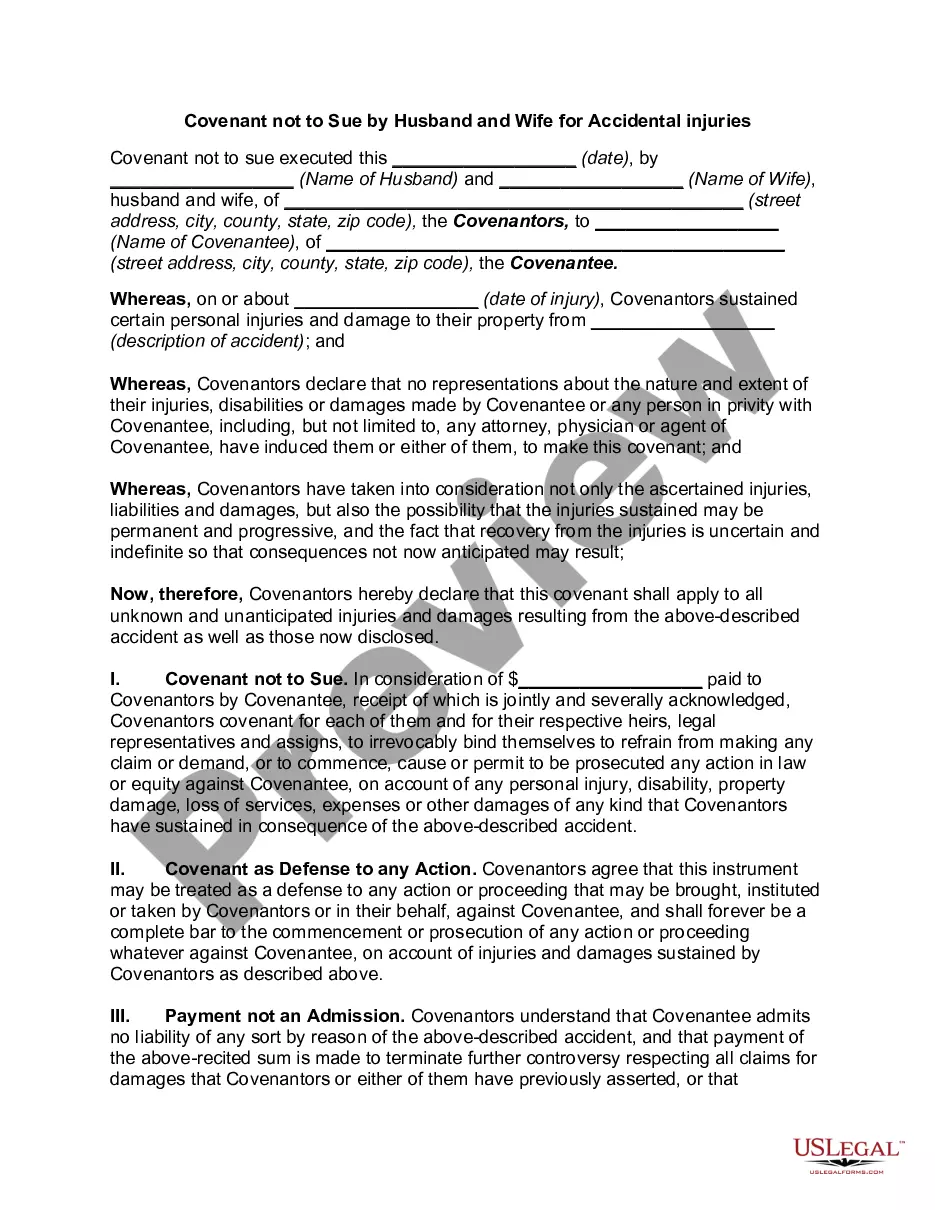
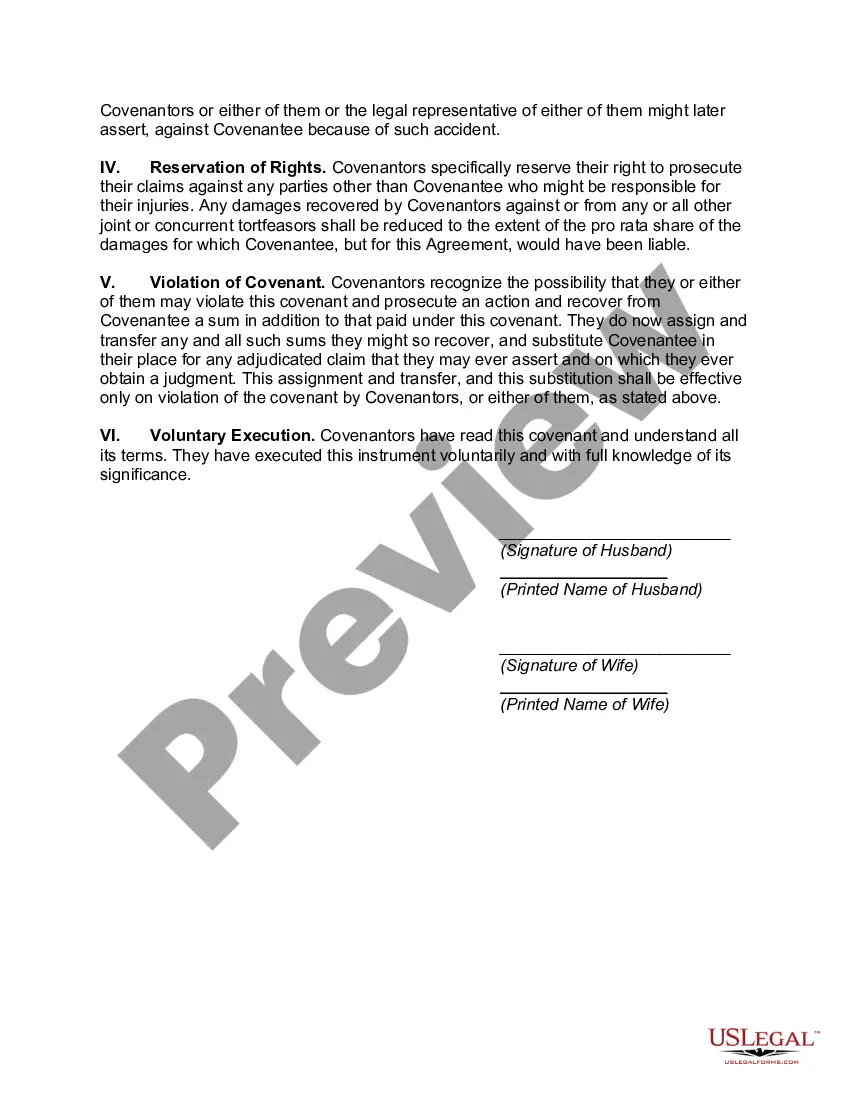
Covenant Not to Sue - This legal agreement involves a promise by one party not to pursue litigation against another party. In the context of 'covenant not to sue by husband and wife for', it typically relates to agreements where both spouses agree not to sue a third party, possibly in relation to business or personal disputes.
Step-by-Step Guide
- Identify the Need: Determine why a covenant not to sue is necessary and what issues it will address between the husband and wife and the third party.
- Consult a Lawyer: Engage a legal professional to ensure that the covenant adheres to state laws and genuinely protects all parties involved.
- Draft the Agreement: Include specifics such as the rights being waived, duration of the covenant, and any compensation involved.
- Sign the Agreement: Both spouses and the third party should sign the document, ideally in the presence of a witness or notary.
- Keep Records: Retain copies of the signed agreement for all parties' records.
Risk Analysis
- Legal Compliance: If not properly structured, the covenant may not hold up in court, potentially leading to unanticipated lawsuits.
- Future Claims: The agreement might prevent either spouse from filing future claims that could be legitimate if situations change.
- Relationship Impact: Such agreements can strain relationships, particularly if one party feels coerced into signing.
Key Takeaways
Understanding the nature and legal implications of a covenant not to sue is vital for protecting personal and business interests without risking future conflicts.
Common Mistakes & How to Avoid Them
- Vague Terms: Avoid ambiguities by clearly defining all terms and conditions within the covenant.
- Neglecting Legal Advice: Always consult with a legal expert to ensure that the agreement is enforceable and tailored to the specific needs of the parties involved.
- Ignoring State Laws: Each state may have different laws affecting the validity of a covenant not to sue, hence the importance of localized legal counsel.
How to fill out Covenant Not To Sue By Husband And Wife For Accidental Injuries?
Utilize the most complete legal library of forms. US Legal Forms is the perfect place for getting updated Covenant Not to Sue by Husband and Wife for Accidental Injuries templates. Our platform offers a large number of legal forms drafted by certified lawyers and categorized by state.
To download a sample from US Legal Forms, users simply need to sign up for a free account first. If you are already registered on our platform, log in and select the document you are looking for and purchase it. Right after buying forms, users can find them in the My Forms section.
To obtain a US Legal Forms subscription on-line, follow the steps below:
- Check if the Form name you have found is state-specific and suits your requirements.
- In case the form features a Preview option, use it to review the sample.
- In case the template doesn’t suit you, utilize the search bar to find a better one.
- PressClick Buy Now if the template corresponds to your needs.
- Select a pricing plan.
- Create a free account.
- Pay via PayPal or with yourr debit/visa or mastercard.
- Choose a document format and download the sample.
- As soon as it is downloaded, print it and fill it out.
Save your time and effort with the service to find, download, and complete the Form name. Join a huge number of pleased clients who’re already using US Legal Forms!
Form popularity
FAQ
In many cases, the waiver is not enforceable.If you've been injured due to negligent actions, you can sue even if you signed a waiver. Winning a lawsuit concerning negligence is not uncommon. Many celebrities have sued for negligence even though they signed documents stating they understood the risks.
While signing a waiver does not mean an injured person cannot sue, it also weakens an injured person's claim and in some cases can lead to the case being dismissed.Waivers most often attempt to limit a business owner's liability in the event of injury to business customers.
Is two years. After two years is up, you lose all rights to get a remedy from that other driver as a result of that accident. So it's important that no matter what, you consult a lawyer and that you have a lawsuit filed within two years. But there really is no reason to wait that long.
In California, a liability waiver must be clear, unambiguous, and explicit. In other words, waivers cannot be printed in faded ink, in small font, on the back of a paper, or in an otherwise ambiguous form. If the waiver that you sign is not represented clearly, it may not hold up in the event of a lawsuit.
The Waiver must be clearly worded and unambiguous in its intent to relieve any and all legal liability, even liability for negligence. The Waiver should be prominent and not hidden in the fine print of a long contract. The Waiver must be signed by the person who it is being used against.
Under California law, a liability waiver cannot excuse an injury caused by a defendant's gross negligence, recklessness or intentional wrongful act.Additionally, to be enforceable in California a waiver of liability must be clear, unambiguous, and explicit in expressing the parties' intent.
No one wins in an adulterous relationshipleast of all is the jilted spousebut luckily, there is legal recourse for some situations: You can sue someone for breaking up a marriage.You may file a suit charging the other man or the other woman with intentionally interfering in your marital relationship.
A covenant not to sue legally obliges a party that could initiate a lawsuit not to do so. The covenant is made explicitly between two parties, and any third party that wants to make a claim is legally allowed to do so. Covenants not to sue are used to settle specific legal issues outside of the court system.
In California, the statute of limitations for personal injury cases gives an injured person two years from the date of the injury to go to court and file a lawsuit against those who could be at fault.