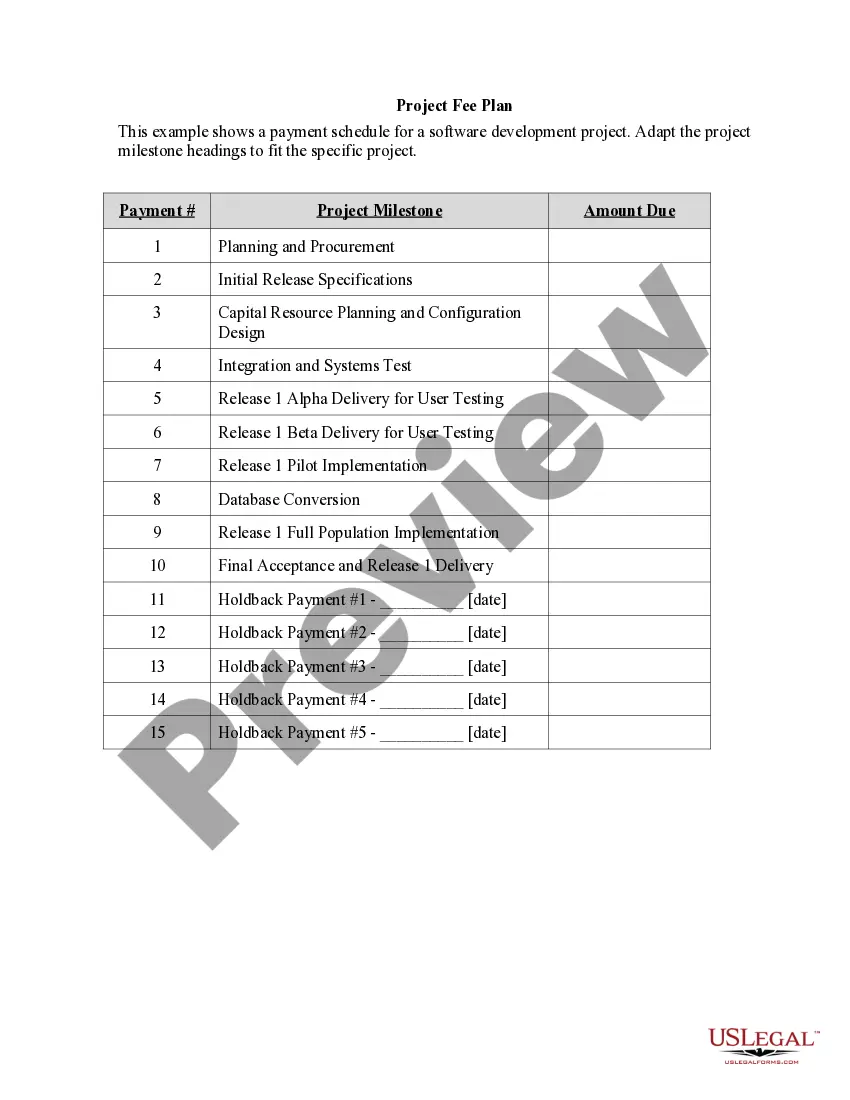
Project Fee Plan
About this form
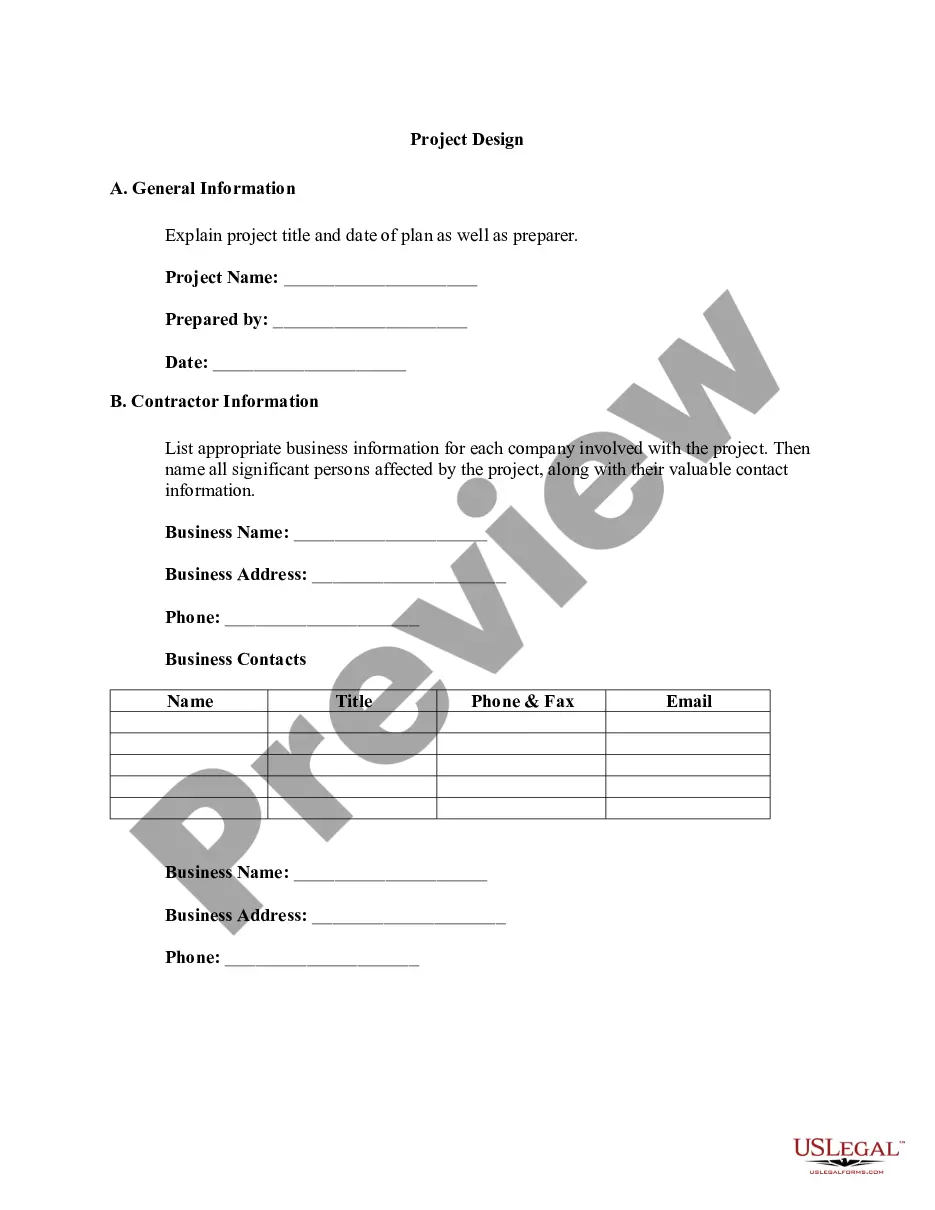
The Project Fee Plan is a structured payment schedule designed for software development projects. This legal form outlines project milestones and associated payment amounts, helping ensure that both parties agree on payment terms as work progresses. It differs from other project agreements by focusing specifically on payment milestones rather than overall project terms or deliverables.
Key parts of this document
- Project milestone headings to customize according to specific project phases.
- Payment amounts due at each milestone to ensure clarity on financial obligations.
- Holdback payments to hold a portion of payment until project completion and acceptance.
Common use cases
This form is ideal for software development companies and clients looking to establish clear financial terms in their contracts. Use the Project Fee Plan when you want to ensure payments are tied to specific project milestones, such as planning, development phases, and testing, to safeguard both parties' financial interests throughout the project lifecycle.
Intended users of this form
- Software development companies planning projects with multiple payment phases.
- Clients seeking to establish clear payment terms for software development services.
- Freelancers or contractors involved in software projects who need to set payment milestones.
How to complete this form
- Identify the parties involved and include their contact information.
- Customize the project milestone headings based on your specific project phases.
- Enter the agreed-upon payment amounts for each milestone.
- Specify dates for holdback payments, if applicable.
- Review the completed form carefully and ensure both parties sign it upon agreement.
Does this form need to be notarized?
Notarization is generally not required for this form. However, certain states or situations might demand it. You can complete notarization online through US Legal Forms, powered by Notarize, using a verified video call available anytime.
Get your form ready online
Our built-in tools help you complete, sign, share, and store your documents in one place.
Make edits, fill in missing information, and update formatting in US Legal Forms—just like you would in MS Word.
Download a copy, print it, send it by email, or mail it via USPS—whatever works best for your next step.
Sign and collect signatures with our SignNow integration. Send to multiple recipients, set reminders, and more. Go Premium to unlock E-Sign.
If this form requires notarization, complete it online through a secure video call—no need to meet a notary in person or wait for an appointment.
We protect your documents and personal data by following strict security and privacy standards.

Make edits, fill in missing information, and update formatting in US Legal Forms—just like you would in MS Word.

Download a copy, print it, send it by email, or mail it via USPS—whatever works best for your next step.

Sign and collect signatures with our SignNow integration. Send to multiple recipients, set reminders, and more. Go Premium to unlock E-Sign.

If this form requires notarization, complete it online through a secure video call—no need to meet a notary in person or wait for an appointment.

We protect your documents and personal data by following strict security and privacy standards.
Avoid these common issues
- Failing to customize milestone headings to accurately reflect the project.
- Not specifying clear payment amounts for each milestone, leading to misunderstandings.
- Neglecting to include or specify holdback payment dates.
Advantages of online completion
- Convenience of downloading and editing the form to suit your project needs.
- Reliable legal templates drafted by licensed attorneys ensure compliance with legal standards.
- Quick access to necessary legal documentation without scheduling appointments.
Looking for another form?


Form popularity
FAQ
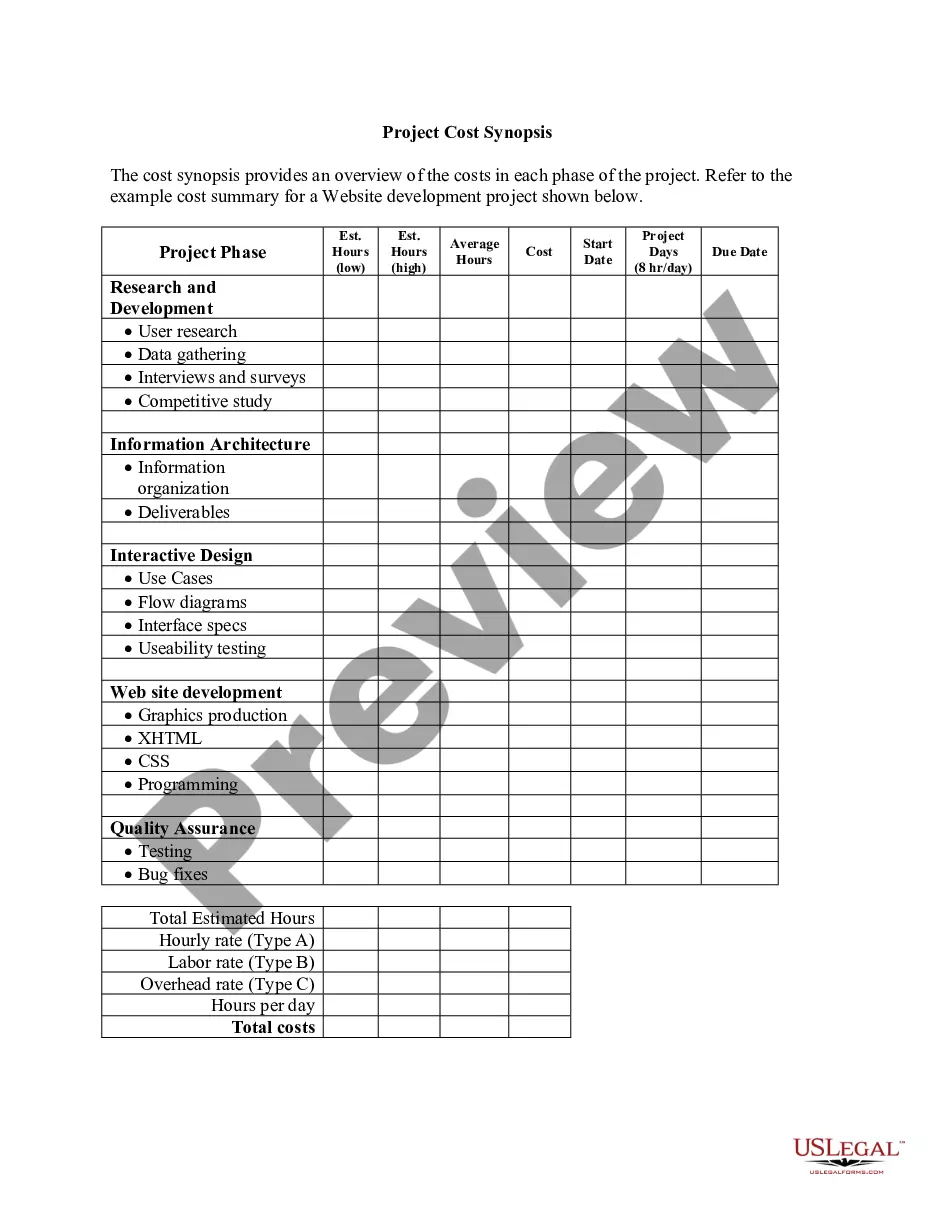
The Four Steps in Project Cost Management Project Resource Planning. Resource planning is the process of identifying the resources required to execute a project and take it to completion.Cost Estimation.Cost Budgeting.Cost Control.
Project Cost Schedule means an itemized schedule of all Project Costs set forth in the Project Budget. Project Cost Schedule means an itemized schedule in the form of SCHEDULE 1 to the Disbursement Request.
The number of projects a project manager should manage typically ranges anywhere from three to 20 and depends on the employee's expertise and the complexity of the projects assigned.
The percentage of revenue method applies a project management fee percentage (anywhere from 1%-3% typically) and multiplies that percentage by the total effective gross income, or EGI.
A Project Management Fee (PM fee) is charged to generate funding to pay for expenses. This fee is based on a percentage of the total project cost minus the PM fees. The fees will be charge incrementally to the projects at strategic milestones, minimally during design, construction, and at the completion of the project.
A Project Management Fee (PM fee) is charged to generate funding to pay for expenses. This fee is based on a percentage of the total project cost minus the PM fees.
They typically fall into two categories: Direct costs: Examples of direct costs include fixed labor, materials, and equipment. They are typically one-off costs that come from a single department or the project itself. Indirect costs: Examples of indirect costs include utilities and quality control.
For projects from $0 ? $500,000, the project management fee totals 5%. So, for a $100,000 project, you would expect to pay the project manager $5,000. As the cost of the project goes up, the percentage-based fee decreases.