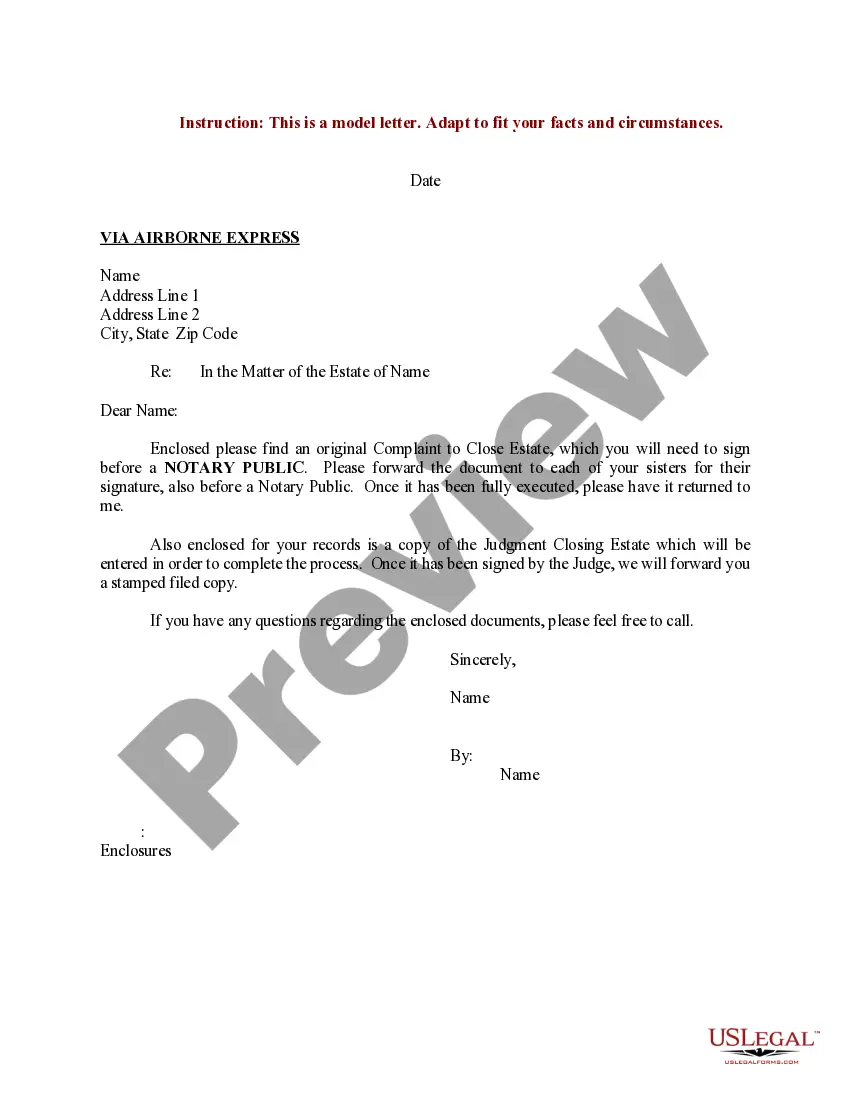
Sample Letter for Complaint to Close Estate - Request to Forward to Sisters
About this form
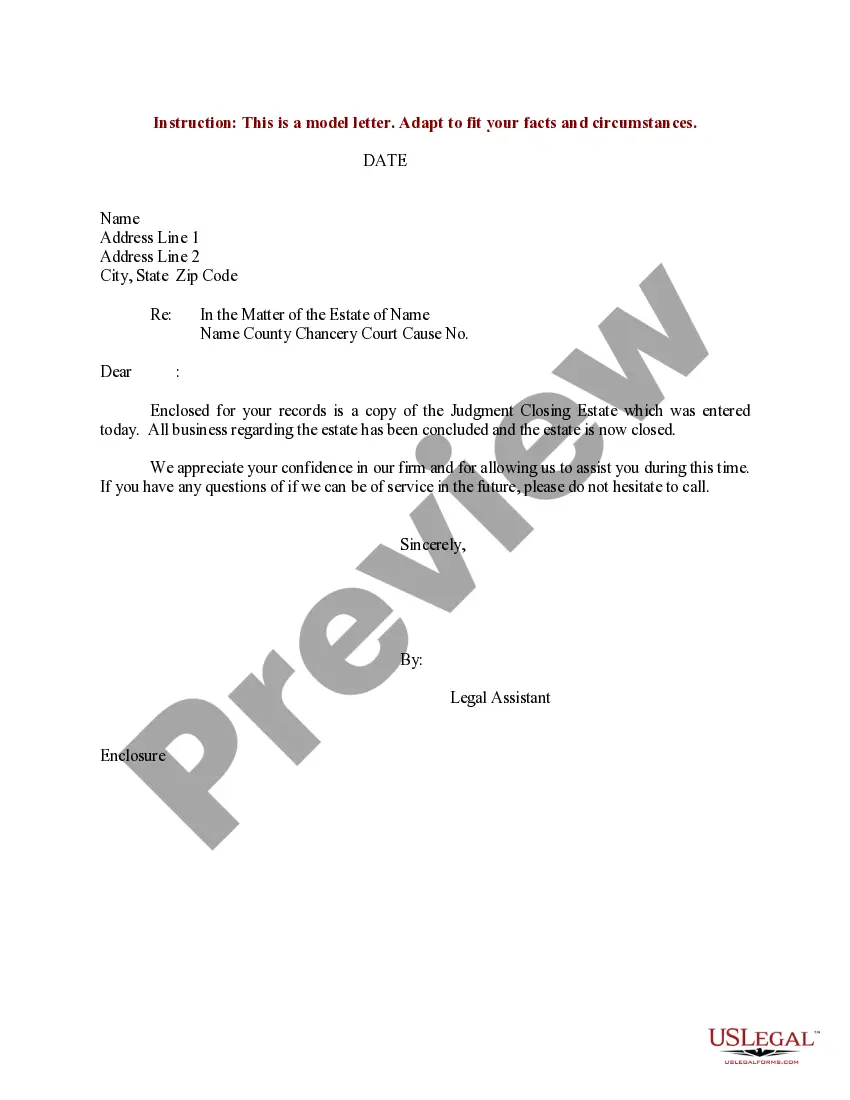
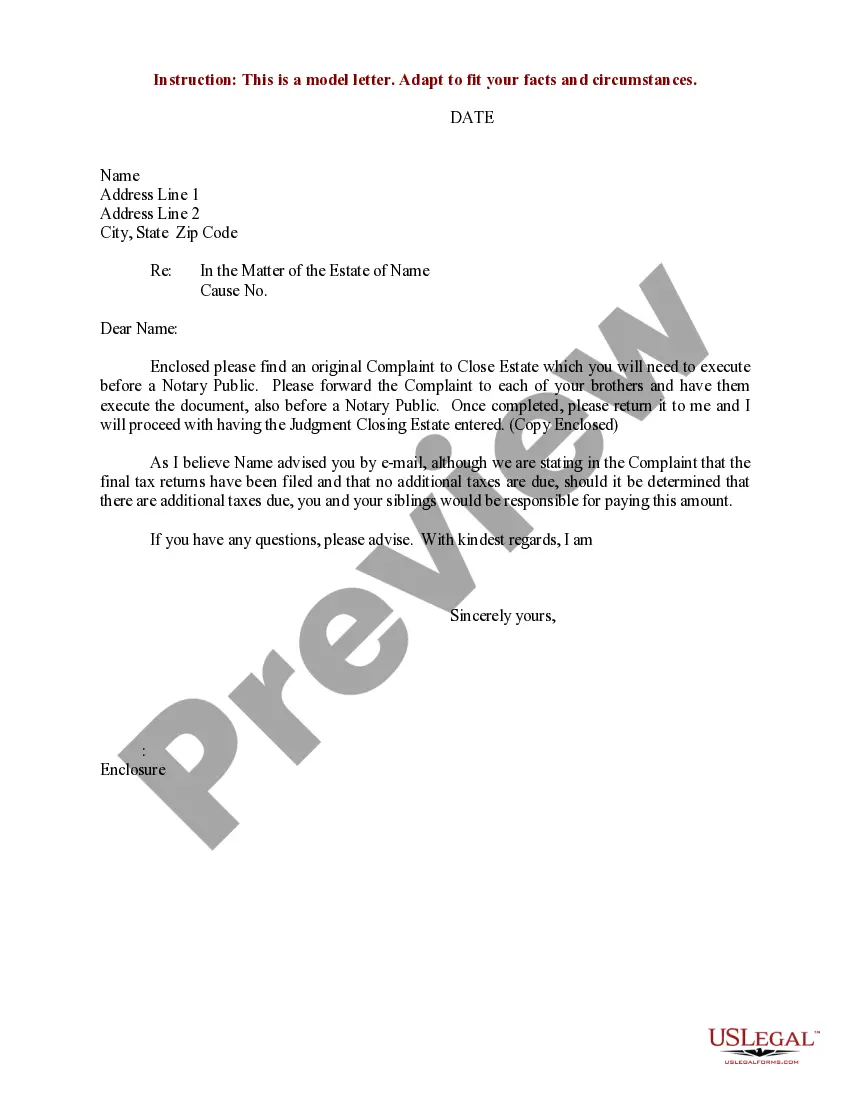
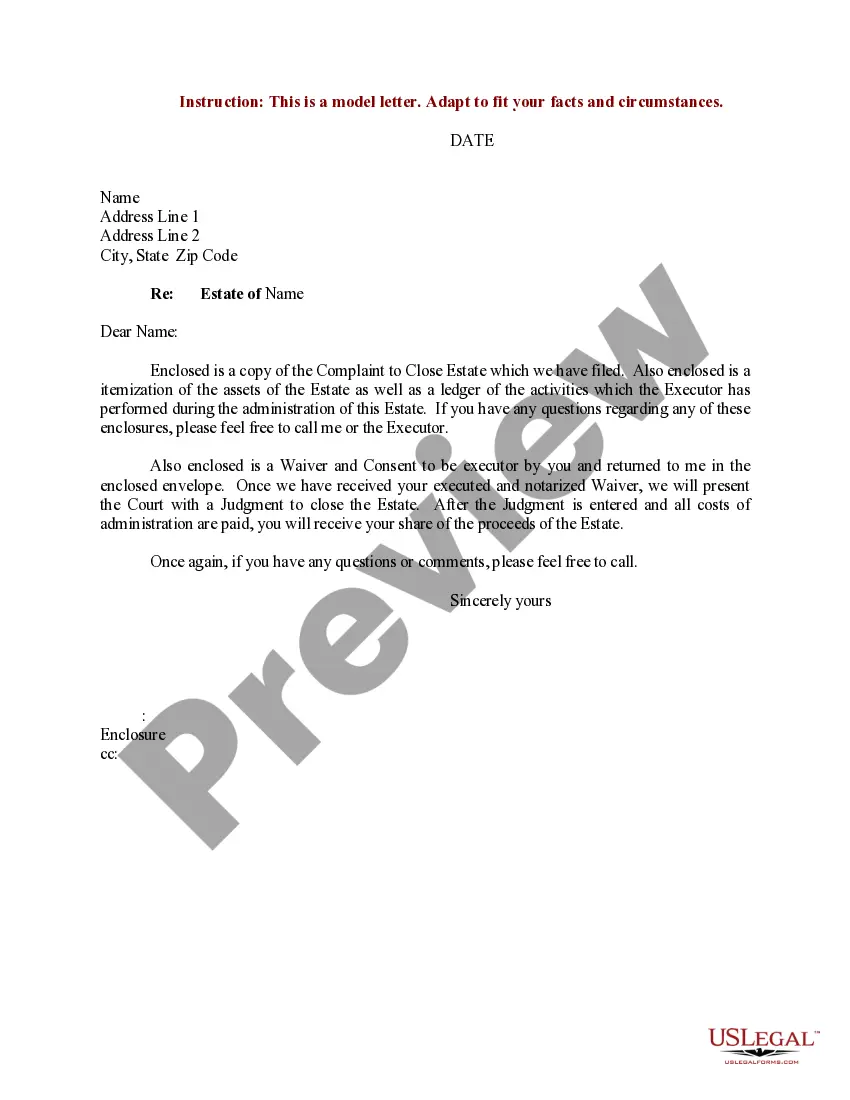
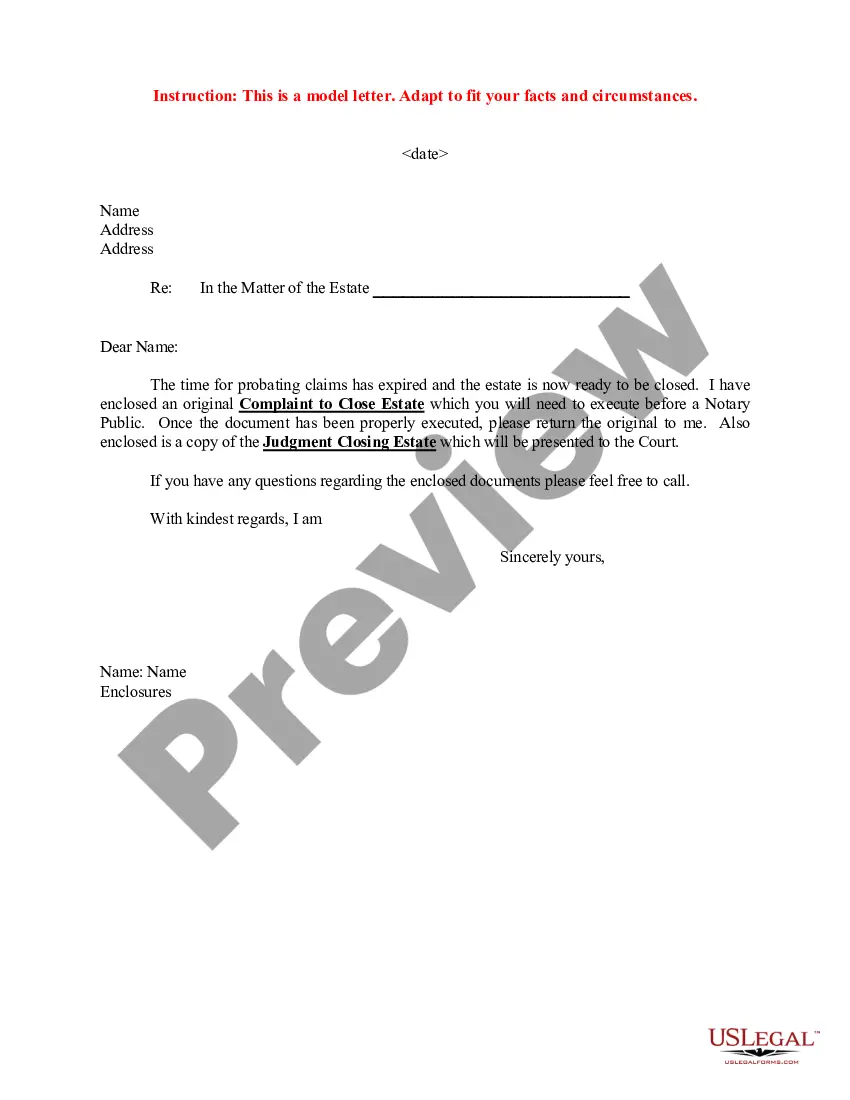
The Sample Letter for Complaint to Close Estate - Request to Forward to Sisters is a customizable Word document designed for notifying family members about the process of closing an estate. This form facilitates the communication necessary to obtain signatures from sisters involved in the estate closure, differing from general complaint letters by focusing specifically on estate matters and required signatures.
Main sections of this form
- Date: The date when the letter is being sent.
- Recipient details: Name and address of the person receiving the letter.
- Subject line: Clearly states the matter regarding the estate.
- Instructions: Directions on signing the enclosed complaint before a Notary Public.
- Documentation: Inclusion of the Judgment Closing Estate for the recipient's records.

When to use this form
This form is useful when you need to notify sisters about the closing of an estate and request their signatures on the necessary complaint documents. It is particularly applicable in situations where prompt action is needed to meet legal deadlines in estate administration.
Who can use this document
- Personal representatives or executors of an estate.
- Heirs or beneficiaries needing to coordinate signatures for estate closure.
- Individuals not familiar with legal correspondence but needing to follow proper procedures.
Instructions for completing this form
- Fill in the date at the top of the letter.
- Provide the recipient's name and address accurately.
- Clearly state the subject matter regarding the estate.
- Include instructions for signing and notarization requirements.
- Attach the original Complaint to Close Estate and a copy of the Judgment Closing Estate.
Notarization requirements for this form
This form must be notarized to be legally valid. US Legal Forms provides secure online notarization powered by Notarize, allowing you to complete the process through a verified video call.
Get your form ready online
Our built-in tools help you complete, sign, share, and store your documents in one place.
Make edits, fill in missing information, and update formatting in US Legal Forms—just like you would in MS Word.
Download a copy, print it, send it by email, or mail it via USPS—whatever works best for your next step.
Sign and collect signatures with our SignNow integration. Send to multiple recipients, set reminders, and more. Go Premium to unlock E-Sign.
If this form requires notarization, complete it online through a secure video call—no need to meet a notary in person or wait for an appointment.
We protect your documents and personal data by following strict security and privacy standards.

Make edits, fill in missing information, and update formatting in US Legal Forms—just like you would in MS Word.

Download a copy, print it, send it by email, or mail it via USPS—whatever works best for your next step.

Sign and collect signatures with our SignNow integration. Send to multiple recipients, set reminders, and more. Go Premium to unlock E-Sign.

If this form requires notarization, complete it online through a secure video call—no need to meet a notary in person or wait for an appointment.

We protect your documents and personal data by following strict security and privacy standards.
Common mistakes to avoid
- Failing to include all required documents with the letter.
- Neglecting to address the letter to all involved siblings.
- Omitting the signature line for the sender.
- Forgetting to check for correct notarization requirements in your state.
Benefits of using this form online
- Convenient access to a legally vetted template.
- Ability to fill out and edit the document easily on your device.
- Time-saving by downloading the form instantly.
- Reliable format ensures compliance with typical legal standards.
Looking for another form?
Form popularity
FAQ
Naming a Qualified Executor The most important guideline in naming an executor is to choose some-one you trust enough to have access to your personal records and finances after your death. Many people choose someone who is also named to get a substantial amount of property under the will.
Identify persons the executor should notify of your death. Include family members, close friends and business associates, including your attorney. Provide contact information for each person, as well as any final message or instructions to be given. Describe your important estate documents and their exact location.
An executor letter authorizes a person or organization to act on behalf of a decedent's estate as an executor.It's also called "letters of testamentary" or "letters of administration" in some jurisdictions.
A Letter of Testamentarysometimes called a Letter of Administration or Letter of Representationis a document granted by a local court. The document simply states that you are the legal executor for a particular estate and that you have the ability to act as such.
Keep the letter brief and straightforward as it is a legal document. Confirm the situation whereby probate has been granted. Was it written in the will? Clearly outline the obligations of the recipient so they know what is required of them. Sign the letter to make it legally binding.
A letter of instructions is an informal document that gives your survivors information concerning important financial and personal matters that must be attended to after your demise.
A Letter of Appointment of Executor helps prove you have been put in charge of someone's estate after they have passed away. As Executor, you've been given the duty to manage the estate and carry out the directions of the will; however, a court may require official documentation.
The Letters of Executorship and Letters of Authority can only be obtained from the Office of the Master of the High Court.
Give the letter a personal touch and address each of your heirs and beneficiaries personally. Tell them any last wishes you may have or any hopes you have for their future. Write as clearly as possible. Use specific details and avoid using shorthand.