Joint Motion to Postpone Pretrial Conference and Submission of Pretrial Order
Overview of this form
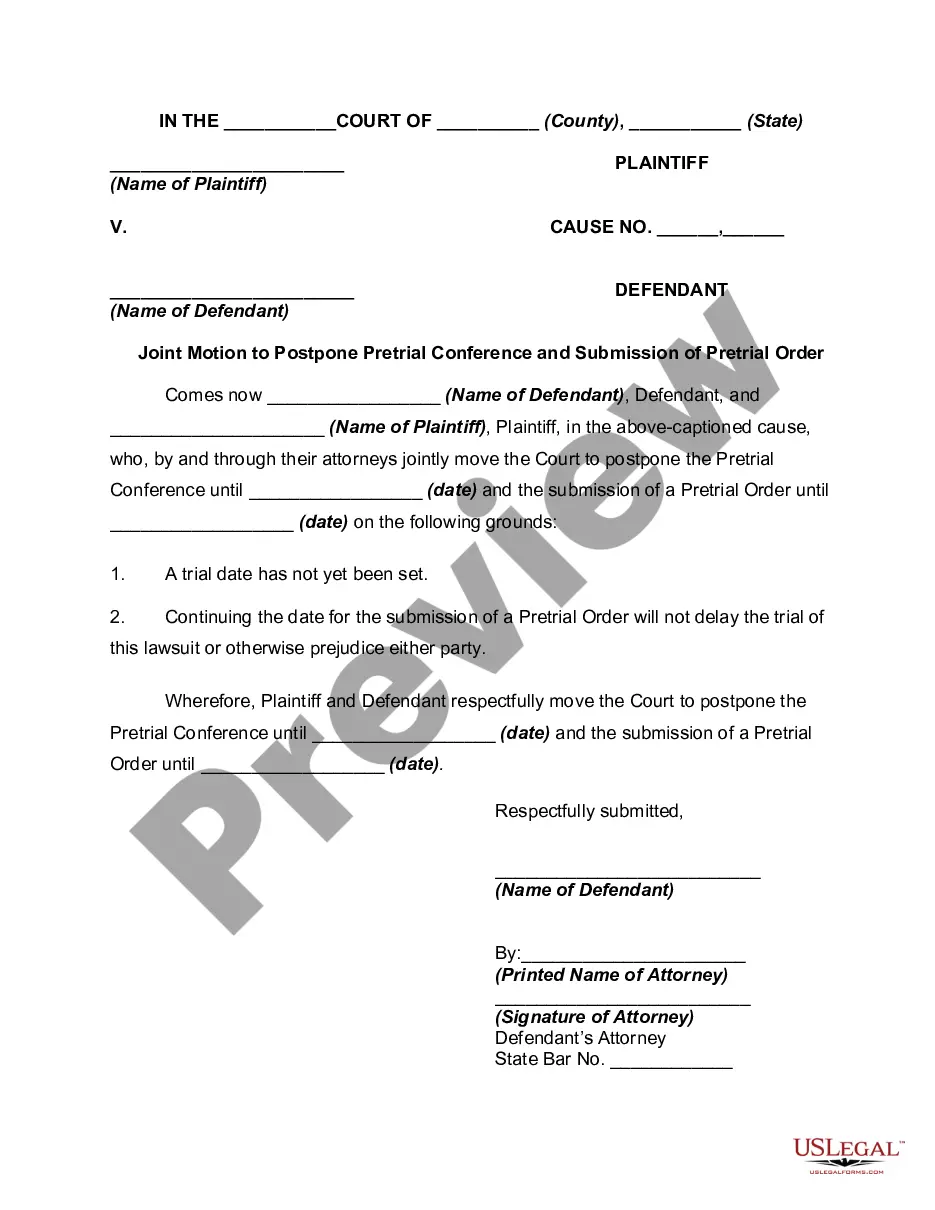
The Joint Motion to Postpone Pretrial Conference and Submission of Pretrial Order is a legal document used by both parties in a lawsuit to request a delay in the scheduled pretrial conference and the submission of a pretrial order. This form differs from other motions as it specifically addresses postponements related to pretrial matters, allowing parties to agree on new dates without necessitating a court appearance for each request. It is primarily utilized in civil litigation within federal and some state courts.
Key parts of this document
- Identification of the parties involved in the case (plaintiff and defendant).
- Proposed new dates for the pretrial conference and pretrial order submission.
- Grounds for the motion, indicating no trial date has been set and that postponement won't prejudice either party.
- Signature blocks for attorneys representing both parties.

Situations where this form applies
This form should be used when both parties in a lawsuit agree to postpone a scheduled pretrial conference and the related submission of pretrial orders. It is appropriate in situations where a trial date has not yet been set and the parties believe that additional time is necessary to prepare for the pretrial phase or to explore settlement options.
Who this form is for
- Parties involved in civil litigation, including plaintiffs and defendants.
- Attorneys representing either party who need to file a motion jointly.
- Legal professionals seeking to manage pretrial procedures efficiently.
How to complete this form
- Identify and enter the names of the plaintiff and defendant at the top of the form.
- Specify the grounds for the motion in the designated section.
- Propose new dates for both the pretrial conference and the submission of the pretrial order.
- Ensure that both attorneys' names, signatures, and State Bar numbers are included in the appropriate sections.
- Review the form for accuracy before submission to the court.
Does this document require notarization?
Notarization is not commonly needed for this form. However, certain documents or local rules may make it necessary. Our notarization service, powered by Notarize, allows you to finalize it securely online anytime, day or night.
Get your form ready online
Our built-in tools help you complete, sign, share, and store your documents in one place.
Make edits, fill in missing information, and update formatting in US Legal Forms—just like you would in MS Word.
Download a copy, print it, send it by email, or mail it via USPS—whatever works best for your next step.
Sign and collect signatures with our SignNow integration. Send to multiple recipients, set reminders, and more. Go Premium to unlock E-Sign.
If this form requires notarization, complete it online through a secure video call—no need to meet a notary in person or wait for an appointment.
We protect your documents and personal data by following strict security and privacy standards.

Make edits, fill in missing information, and update formatting in US Legal Forms—just like you would in MS Word.

Download a copy, print it, send it by email, or mail it via USPS—whatever works best for your next step.

Sign and collect signatures with our SignNow integration. Send to multiple recipients, set reminders, and more. Go Premium to unlock E-Sign.

If this form requires notarization, complete it online through a secure video call—no need to meet a notary in person or wait for an appointment.

We protect your documents and personal data by following strict security and privacy standards.
Avoid these common issues
- Failing to include the names of both parties involved in the case.
- Overlooking the necessity of both attorneys' signatures on the motion.
- Not providing parties with a clear and agreed-upon new date for the pretrial conference.
- Submitting the form without reviewing local court rules that may impact the motion.
Benefits of using this form online
- Immediate access to an accurate and attorney-drafted motion template.
- The ability to fill in and edit the form at your convenience.
- Reduced risk of errors through guided input sections.
- Quick download for timely filing with the court.
Looking for another form?
Form popularity
FAQ
(a) Contents of Joint Pretrial Statement. (1) A brief statement of the nature of the case, including a reference to any particular sections of the Code that are involved;No witness shall be used at the trial other than those listed, except for good cause shown. or for the sole purpose of impeachment.
In general, pretrial hearings give both sides the chance to see how strong or weak a case is. If a case is weak the prosecutor will want to settle it. If a case is strong the accused will probably want to obtain the least possible punishment. Please note that someone accused of a crime has the right to a speedy trial.
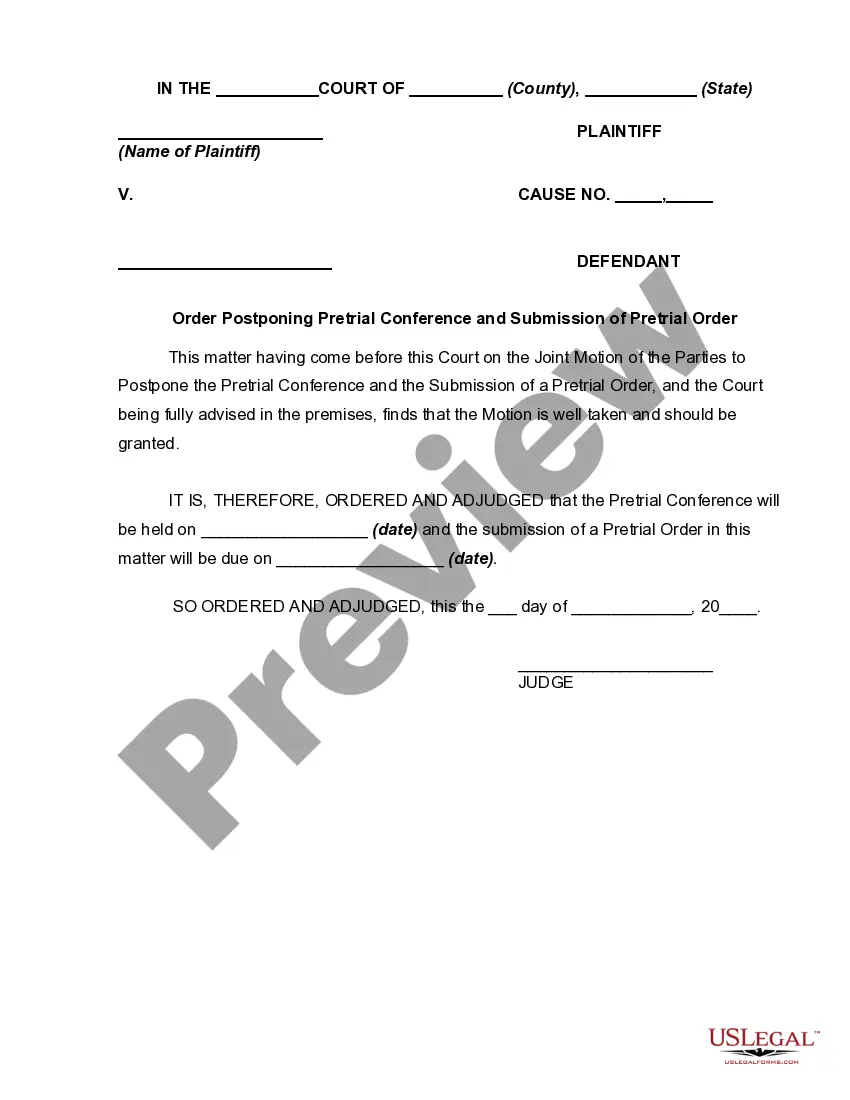
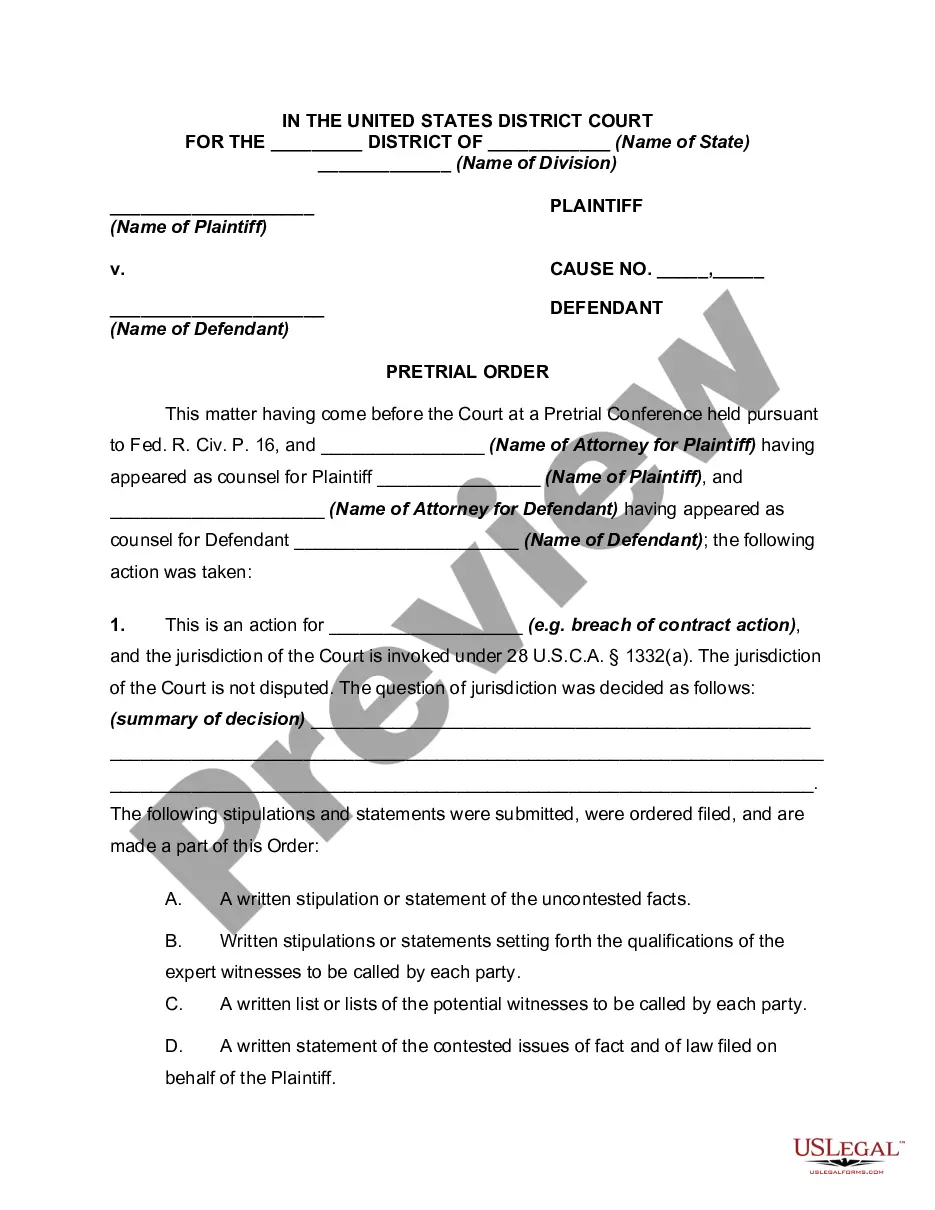
An order setting forth the substantive and procedural framework of a case to be tried, specifying the parties' claims and defenses, stipulations, and procedural rules.
A scheduling order is a court order designed to manage the flow of a case from the date it is entered through the beginning of trial. The court may enter the order on its own motion, or either party may seek one by motion.
Common pre-trial motions include: Motion to Dismiss an attempt to get the judge to dismiss a charge or the case. This may be done if there is not enough evidence, if the alleged facts do not amount to a crime. Motion to Suppress an attempt to keep certain statements or evidence from being introduced as evidence.
Write a short introduction stating who you are -- plaintiff or defendant -- and that you are asking the court to reschedule the hearing set for a certain date. For example, "For good cause shown, defendant John Brown asks this court to continue the pretrial conference set for (date) at p.m."
Your pretrial statement is a statement to the judge where you tell the judge what it is that you're asking for at trial.It's not uncommon for people who are representing themselves not to include an issue that is in dispute in the pre-trial statement.
The joint pretrial order is an important document, especially in federal court. It is meant to be a comprehensive document wherein all parties lay bare their case.
The scheduling order must limit the time to join other parties, amend the pleadings, complete discovery, and file motions.A represented party must authorize at least one of its attorneys to make stipulations and admissions about all matters that can reasonably be anticipated for discussion at a pretrial conference.