Nanny Contract
Understanding this form
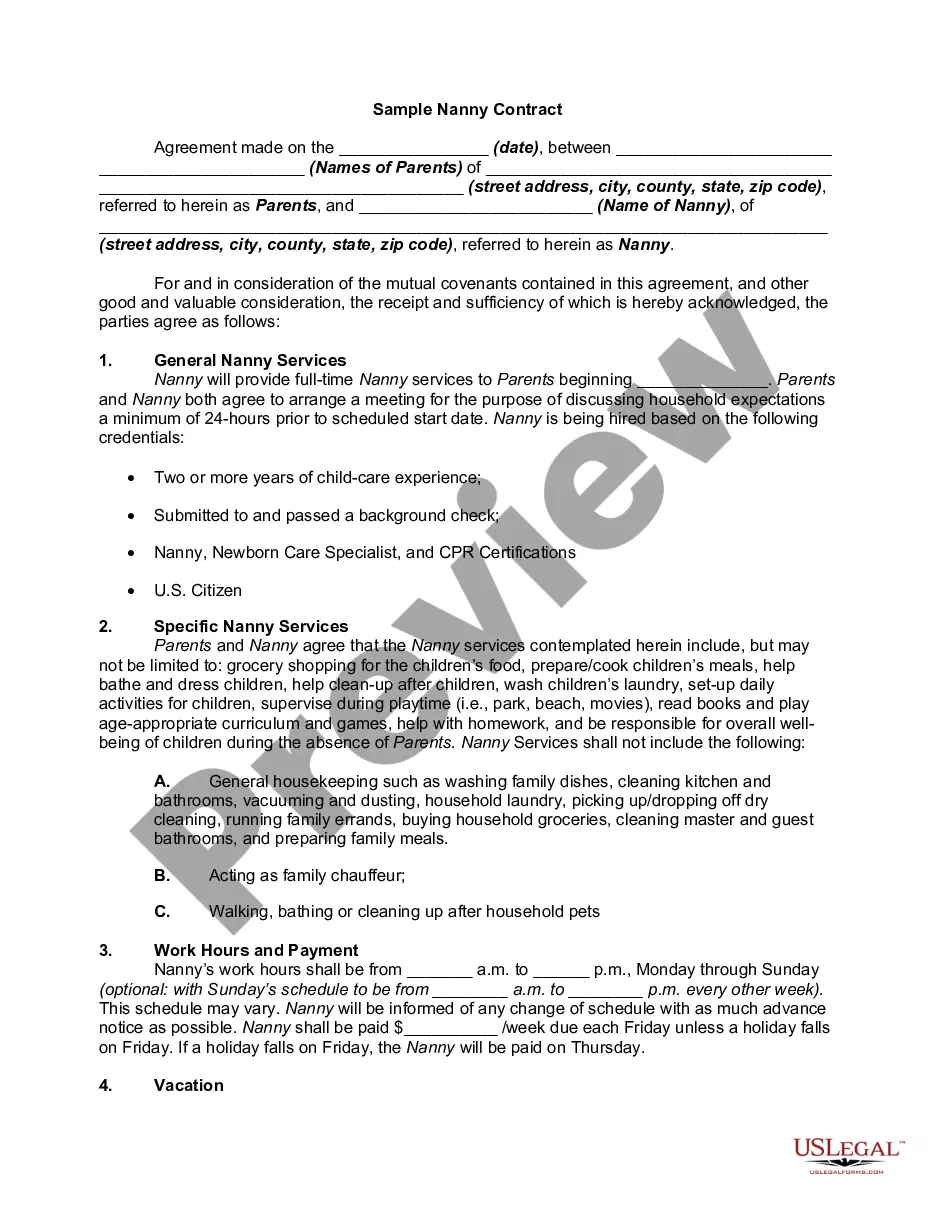
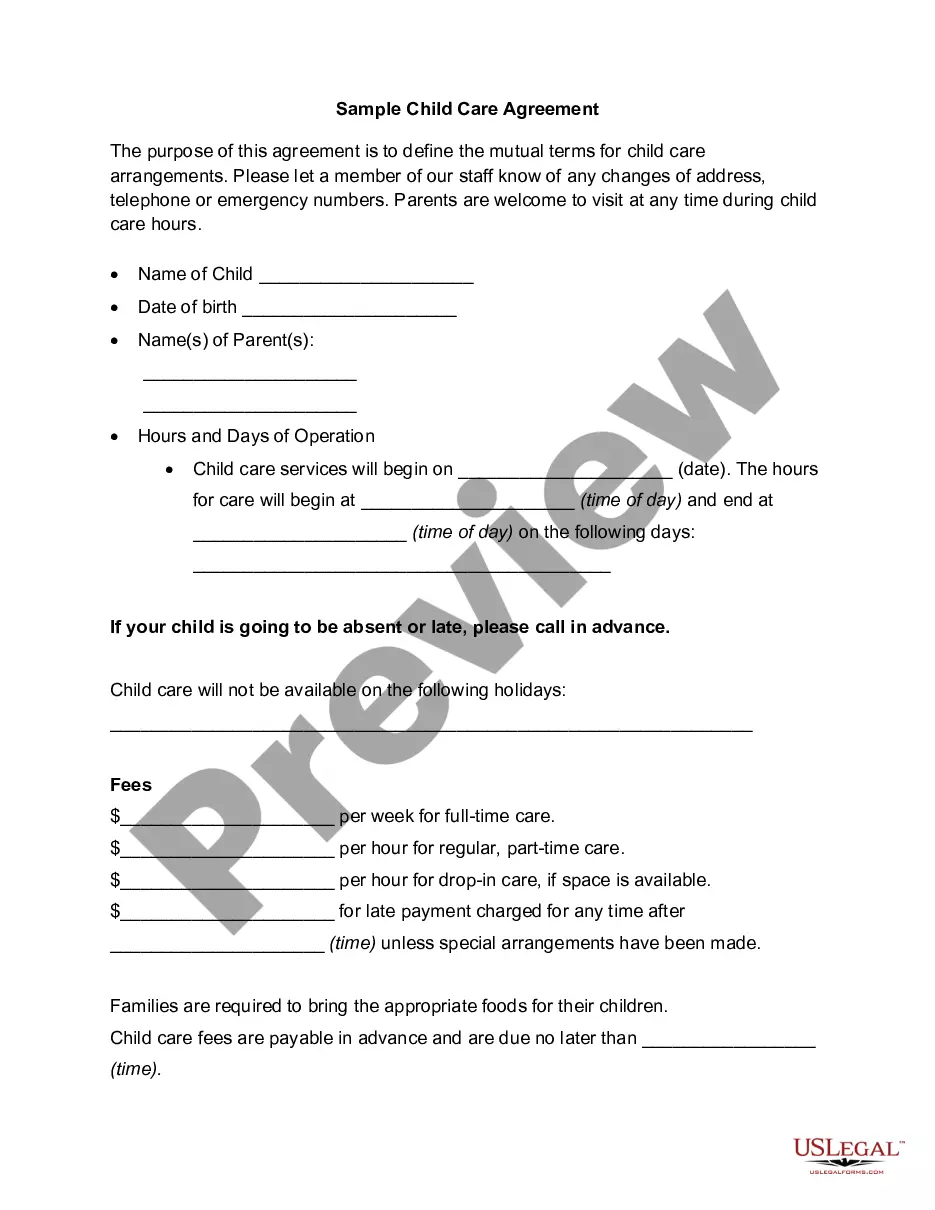
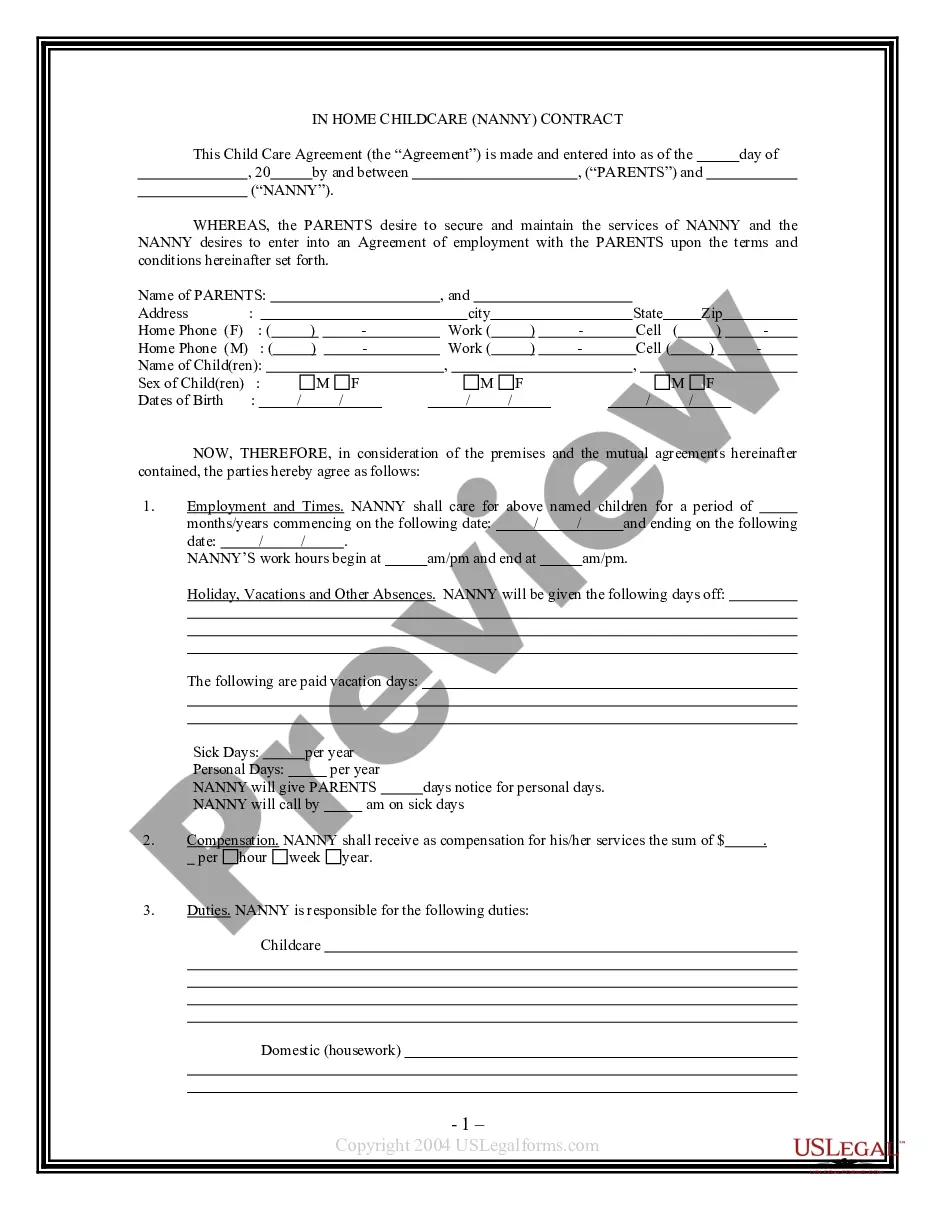
The Nanny Contract is a legal agreement between parents and a nanny detailing the terms of employment for childcare services. This form outlines the responsibilities, work hours, payment terms, and other essential aspects related to hiring a nanny. Unlike informal agreements, this contract provides clarity on expectations and legal protections for both parties.
What’s included in this form
- General nanny services: Defines the overall responsibilities of the nanny.
- Specific nanny services: Outlines the exact duties, such as childcare tasks and limitations on household chores.
- Work hours and payment: Specifies the nanny's work schedule and compensation details.
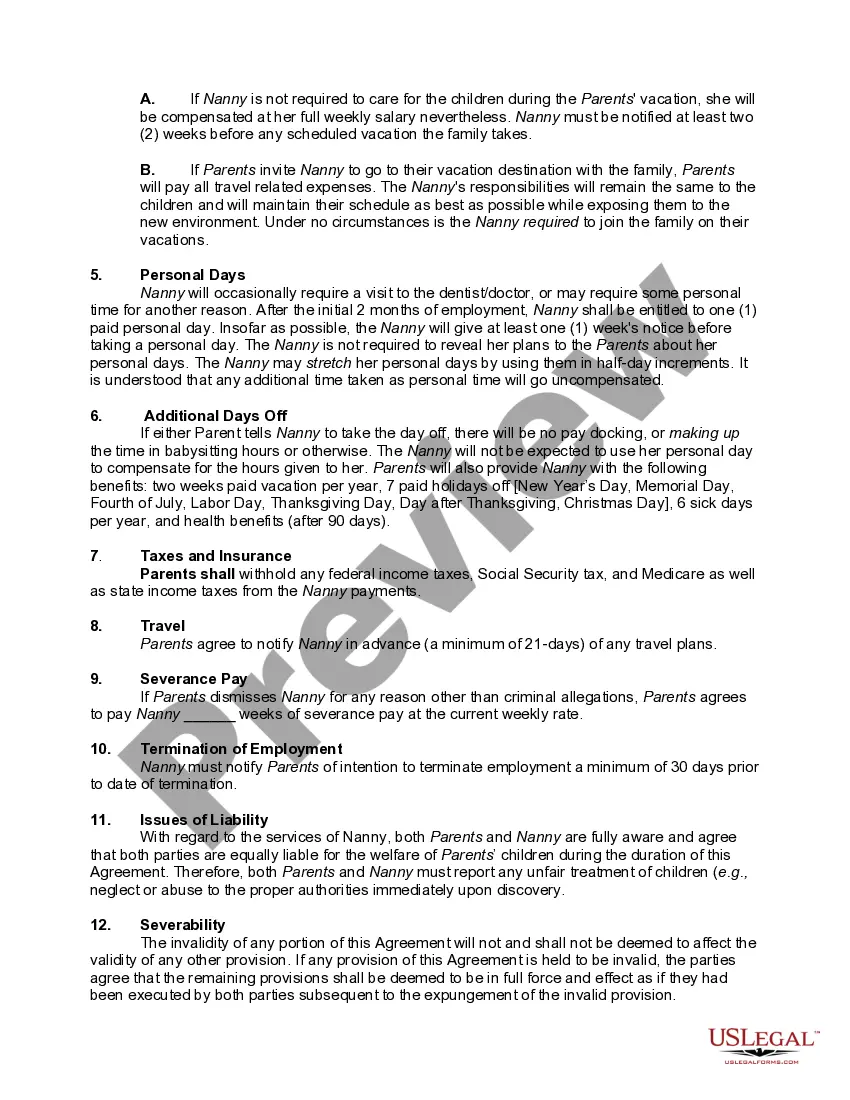
- Vacation and personal days: Discusses payment and notification requirements for time off.
- Termination of employment: Details the notice period required for ending the contract.

Situations where this form applies
This Nanny Contract should be used when parents decide to hire a nanny for full or part-time child care. It is particularly useful for families wanting to ensure clear expectations and a sound legal framework for the nanny's duties and obligations. This contract can be used in both live-in and live-out nanny situations.
Who needs this form
- Families hiring a nanny for childcare support.
- Parents seeking to create a formal employment arrangement with a nanny.
- Nannies who want to have a clear understanding of their responsibilities and rights.
How to complete this form
- Enter the date of the agreement at the top of the contract.
- Fill in the names and addresses of the parents and the nanny.
- Specify the start date for the nanny's employment and work hours.
- Detail the agreed-upon payment terms, including any compensation for time off.
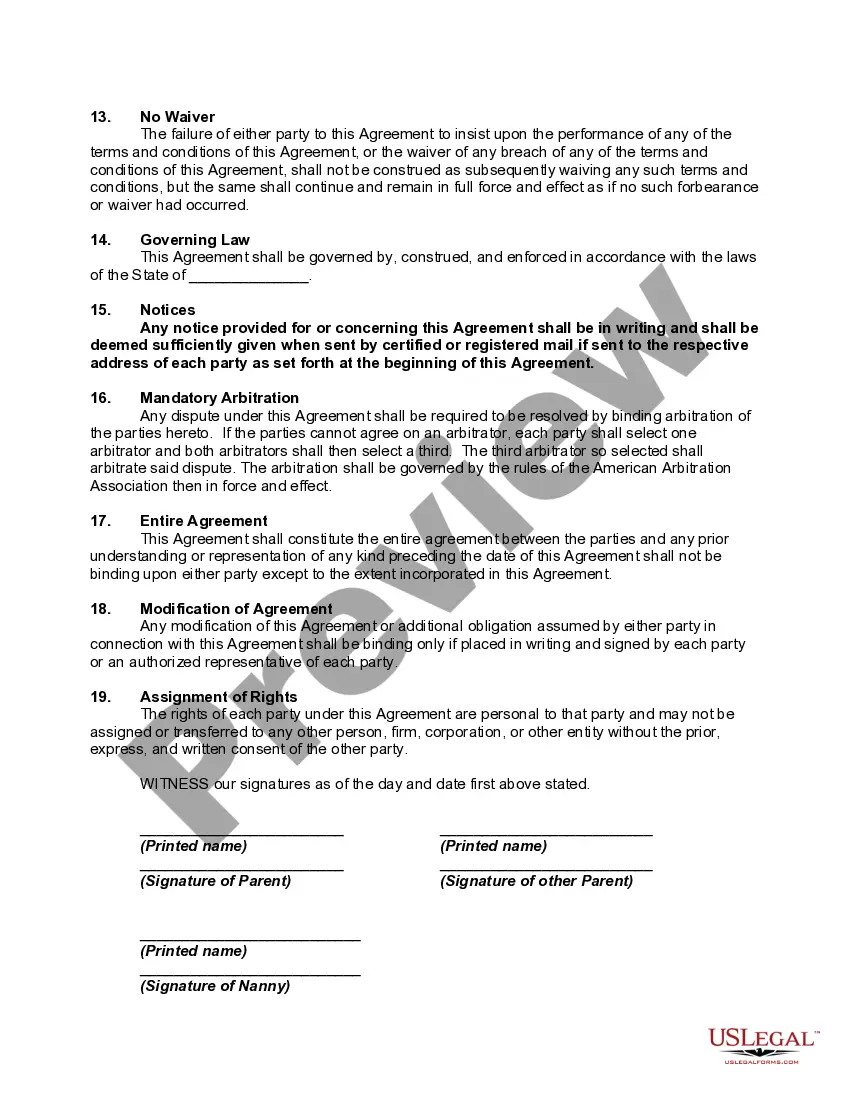
- Both parties should review and sign the contract to make it legally binding.
Notarization requirements for this form
This form does not typically require notarization unless specified by local law. Ensure that you check with your state's regulations to confirm, and utilize US Legal Formsâ online notarization service if needed.
Get your form ready online
Our built-in tools help you complete, sign, share, and store your documents in one place.
Make edits, fill in missing information, and update formatting in US Legal Forms—just like you would in MS Word.
Download a copy, print it, send it by email, or mail it via USPS—whatever works best for your next step.
Sign and collect signatures with our SignNow integration. Send to multiple recipients, set reminders, and more. Go Premium to unlock E-Sign.
If this form requires notarization, complete it online through a secure video call—no need to meet a notary in person or wait for an appointment.
We protect your documents and personal data by following strict security and privacy standards.

Make edits, fill in missing information, and update formatting in US Legal Forms—just like you would in MS Word.

Download a copy, print it, send it by email, or mail it via USPS—whatever works best for your next step.

Sign and collect signatures with our SignNow integration. Send to multiple recipients, set reminders, and more. Go Premium to unlock E-Sign.

If this form requires notarization, complete it online through a secure video call—no need to meet a notary in person or wait for an appointment.

We protect your documents and personal data by following strict security and privacy standards.
Mistakes to watch out for
- Failing to specify the nanny's duties fully, leading to misunderstandings.
- Not including payment details or vacation policies explicitly.
- Neglecting to have both parties sign and date the contract for validity.
Benefits of using this form online
- Easy access: Download and fill out the form anytime, anywhere.
- Editability: Customize the contract to fit your specific needs.
- Legal reliability: Use templates drafted by licensed attorneys to ensure compliance with the law.
Looking for another form?
Form popularity
FAQ
Name and contact information. Effective start date. Compensation. Benefits. Schedule and time commitment. Termination procedure.
While paid sick days aren't as common as paid holidays and vacation, the INA reports that 67 percent of employers include paid sick days in their nanny benefits. It's most common for families to provide four or five days, but you should agree on an amount that is best for everyone.
Nannies who take their jobs seriously likely won't take your position if you plan to pay them under the table. They know the benefits of being paid on the books even if it means a little less in their paychecks each week. They have verifiable incomes and legal employment histories.
If you have a nanny or sitter who works for you on a full-time basis, it's a good idea to have a written contract so that the salary, responsibilities, and hours are clearly laid out. When someone works for you full-time, you want to be sure there are absolutely no misunderstandings.
When employees are getting paid under the table, taxes aren't withheld from their wages.Because employers who pay cash under the table forego their tax and insurance liabilities, paying employees cash under the table is illegal. Employers who pay employees under the table do not comply with employment laws.
Do I need a nanny contract or work agreement? A nanny contract or work agreement is not legally required under Federal law, but you SHOULD take the time to write one up anyway. It is a best practice that protects the family and provides a point of reference to both parties when there are questions or misunderstandings.
Names and ages of children, parents/guardians and caregiver, as well as contact info for parents/guardians and caregiver. Effective start date and end date (if applicable) Compensation information: The babysitter's commitments: Emergency procedures: Termination procedures:
Babysitting has become quite a lucrative business! The average hourly rate for a babysitter is $16.75 for one child and $19.26 for two kids, according to the 2019 annual study compiled by UrbanSitter. For comparison, that's more than twice the federal minimum wage of $7.25 per hour.
Don't Watch Inappropriate Movies or Shows. Must Be CPR Certified. Watch Your Language! Don't Gossip About The Family. Remember To Clean Up After Yourself (And The Kids!) Follow Bath Time Instructions.