Collection Reports on Current Status of Debt
What is this form?
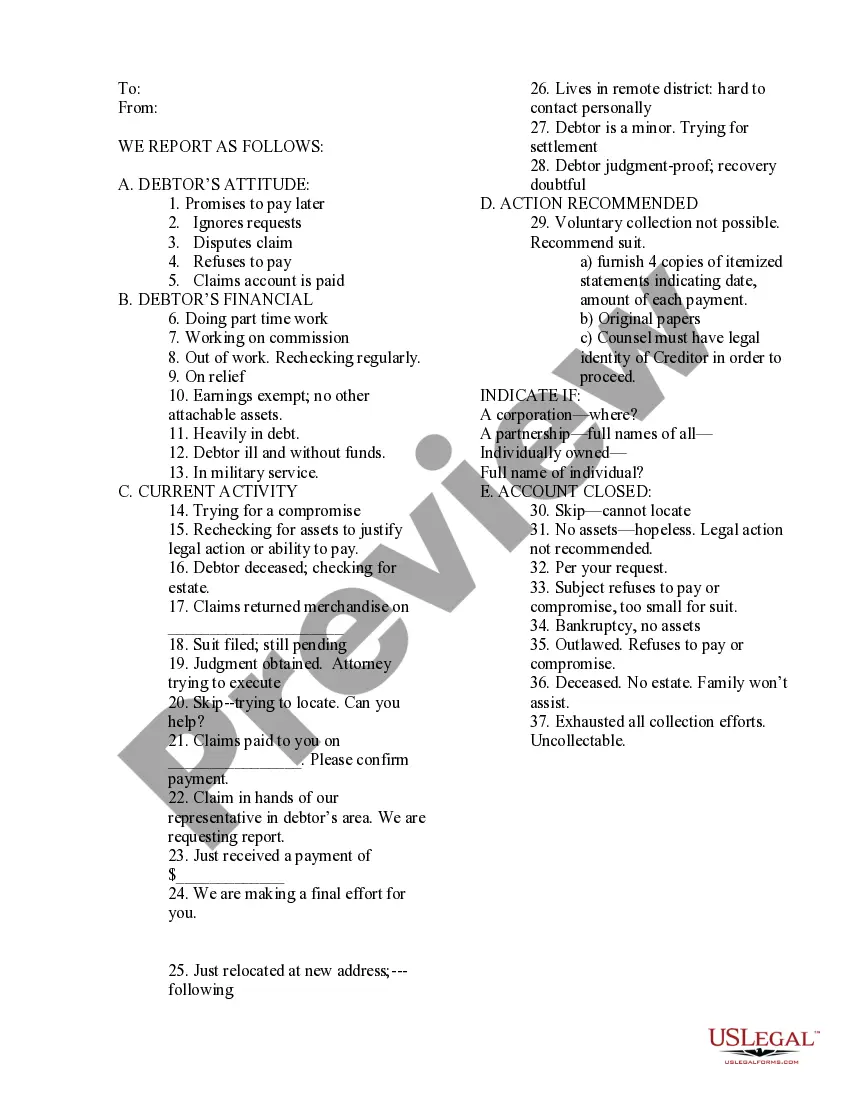
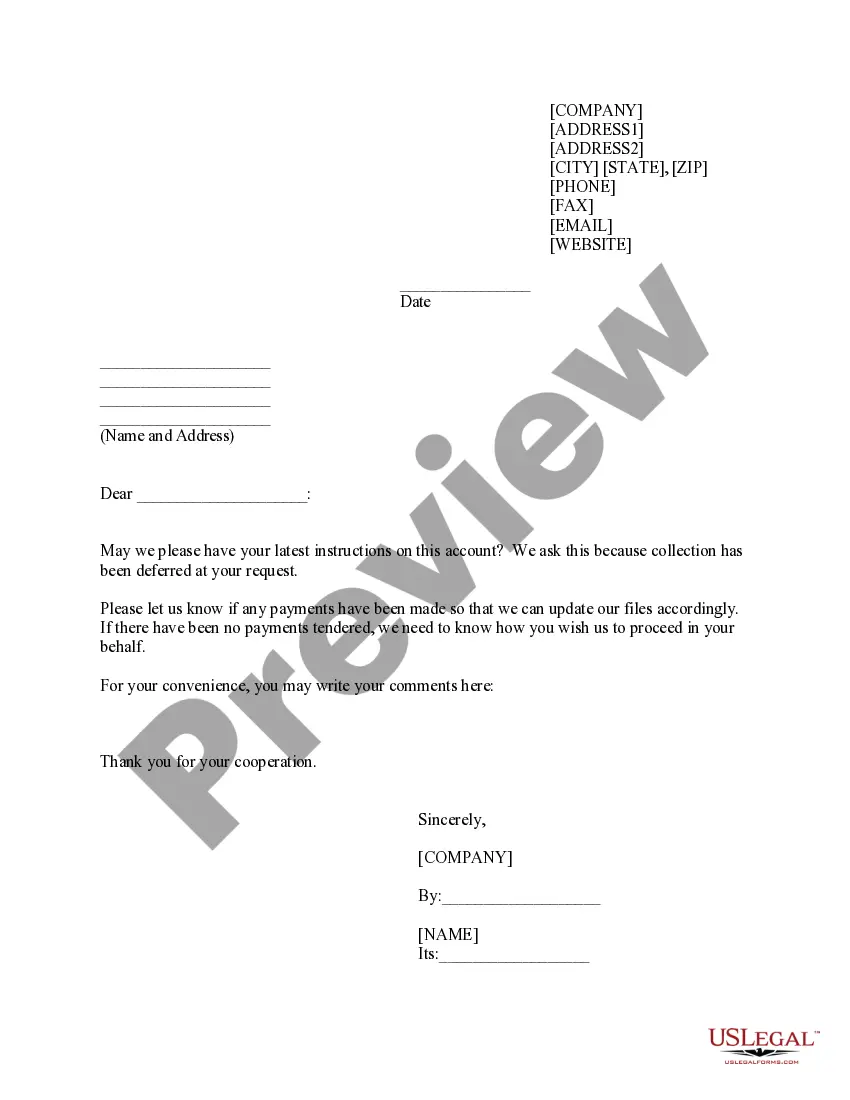
The Collection Reports on Current Status of Debt form is a legal document used by creditors to report on the status of a debtor's financial situation and progress in debt collection. This form provides crucial details about the debtorâs attitudes, financial status, current activities regarding debt repayment, and recommended actions. It is essential for creditors seeking to document and communicate updates in the collection process effectively, distinguishing it from other general debt collection forms.
Main sections of this form
- Debtor's attitude toward payment, including promises and disputes.
- Financial status of the debtor, detailing employment and income situation.
- Current activities related to the debt, including potential legal actions.
- Recommendations for action based on the latest findings.
- Options for account closure or further collection efforts.
When to use this document
This form is essential when a creditor needs to provide a comprehensive report on the status of their debt collection efforts. It is typically used after initial attempts to collect payment have been unsuccessful and further details about the debtor's situation are needed to assess the next steps. Situations may include when the debtor is unresponsive, has disputed the debt, or when legal action is being considered.
Who should use this form
- Creditors seeking to track the status of debtors.
- Collection agencies managing multiple debt accounts.
- Business owners owed money and needing to assess collection efforts.
- Legal professionals representing creditors in debt collection matters.
Completing this form step by step
- Identify the debtor's current attitude towards the debt and any communications made.
- Provide a detailed overview of the debtor's financial situation.
- Document any current actions being taken regarding the collection of the debt.
- Specify recommendations based on the debtor's status and responsiveness.
- Indicate whether the account should be closed or further actions should be pursued.
Is notarization required?
Notarization is not commonly needed for this form. However, certain documents or local rules may make it necessary. Our notarization service, powered by Notarize, allows you to finalize it securely online anytime, day or night.
Get your form ready online
Our built-in tools help you complete, sign, share, and store your documents in one place.
Make edits, fill in missing information, and update formatting in US Legal Forms—just like you would in MS Word.
Download a copy, print it, send it by email, or mail it via USPS—whatever works best for your next step.
Sign and collect signatures with our SignNow integration. Send to multiple recipients, set reminders, and more. Go Premium to unlock E-Sign.
If this form requires notarization, complete it online through a secure video call—no need to meet a notary in person or wait for an appointment.
We protect your documents and personal data by following strict security and privacy standards.

Make edits, fill in missing information, and update formatting in US Legal Forms—just like you would in MS Word.

Download a copy, print it, send it by email, or mail it via USPS—whatever works best for your next step.

Sign and collect signatures with our SignNow integration. Send to multiple recipients, set reminders, and more. Go Premium to unlock E-Sign.

If this form requires notarization, complete it online through a secure video call—no need to meet a notary in person or wait for an appointment.

We protect your documents and personal data by following strict security and privacy standards.
Mistakes to watch out for
- Failing to accurately document all communications with the debtor.
- Omitting important financial details that could impact next steps.
- Not following up on recent developments regarding the debtor's payments or status.
- Using vague language instead of specific terms related to the debtor's situation.
Why complete this form online
- Convenient access to a legally vetted template ready for immediate use.
- Easy editing to customize the form to specific needs and situations.
- Reliable formatting ensures compliance with legal standards.
Legal use & context
- This form is useful in documenting efforts to collect a debt and may serve as evidence in potential legal proceedings.
- Proper completion can help ensure compliance with debt collection laws, helping to protect creditors' rights.
- Failing to use this form or not providing accurate information could hinder collection efforts legally.
Main things to remember
- The Collection Reports on Current Status of Debt form is essential for tracking and documenting debtors' responses and financial statuses.
- Key sections include debtor attitudes, financial conditions, and recommended actions to take regarding collections.
- Completion of this form helps creditors establish their position before pursuing further legal actions.
Looking for another form?
Form popularity
FAQ
Once an account is sold to a collection agency, the collection account can then be reported as a separate account on your credit report. Collection accounts have a significant negative impact on your credit scores. Collections can appear from unsecured accounts, such as credit cards and personal loans.
A collection account may be reported to one, two or all three of the nationwide credit bureaus (Equifax, Experian and TransUnion) and reflected on your credit reports. It can also have a negative impact on credit scores, depending on the credit scoring model (different ways credit scores are calculated).
A collection on a debt of less than $100 shouldn't affect your score at all, but anything over $100 could cause a big drop. In many cases, it doesn't even matter how much it is if it's over $100. Whether you owe $500 or $150,000, you may see a credit score drop of 100 points or more, depending on where you started.
If you are struggling with debt and debt collectors, Farmer & Morris Law, PLLC can help. As soon as you use the 11-word phrase ?please cease and desist all calls and contact with me immediately? to stop the harassment, call us for a free consultation about what you can do to resolve your debt problems for good.
The Debt Collector Hasn't Reported the Debt Yet Some accounts go to ?pre-collections? when they're only one or two months past due. During this period, you may get calls or letters about the debt even though it's not on your credit report yet.
The multistage debt collection process varies depending on the creditor, but it usually includes phone and mail notices, stoppage of services (if applicable), notifications to credit reporting bureaus, assignment to third-party collection agencies, and potential court proceedings.
Collection agencies begin reporting to the credit bureaus once they have taken the required steps to confirm the debt with the borrower, then continue to report monthly. Confirming the debt with the borrower can occur instantly or take up to several weeks.
Step 1: Get notice. By law, a collector must send you a ?Notice of Debt? letter within 30 days of their first contact with you.Step 2: Check your credit report. Once you receive the Notice of Debt you can compare it to your own records?namely, your credit report.Step 3: Ask for validation.Step 4: Cease and desist.